Tag Archives: President Trump

Is Michigan Rep. Justin Amash
Seeking a Political Exit Strategy Should He Run for President?

By Jim Ellis

Michigan Rep. Justin Amash (R-Cascade Township/Grand Rapids)

June 13, 2019 — The Michigan Information & Research Service (MIRS) released an independent poll just a couple days ago from the Practical Political Consultants organization (June 5-9; 335 likely MI-3 Republican primary voters) that finds western Michigan Rep. Justin Amash (R-Cascade Township/Grand Rapids) trailing his announced 3rd Congressional District Republican primary opponent, state Rep. James Lower (R-Greenville), by a lopsided 49-33 percent count.

After Rep. Amash became the only Republican to side with the Democrats’ informal impeachment caucus over whether to bring proceedings against President Trump, speculation became more rampant that the five-term Michigan congressman would seek the Libertarian nomination for president. The new poll and his action earlier in the week of resigning from the Freedom Caucus and its leadership fuels more speculation that he will jump into the presidential contest.

Many are arguing that Amash would have an effect upon the national election to the point of potentially costing President Trump victory, or at the very least, the state of Michigan, but such an outcome is far from determined.

The Libertarian presidential nomination has some value in that the party can qualify for the ballot in all 50 states and the District of Columbia. It is the only political entity aside from the Republican and Democratic parties that has such an ability. Jill Stein, the 2016 and 2012 Green Party presidential nominee, appeared on the ballot in 45 and 38 states, respectively.

However, just how much of a factor are the individuals who represent the minor parties on the presidential ballot? Former New Mexico governor Gary Johnson was the Libertarian nominee in both 2016 and 2012. He has already said he will not be a candidate in 2020. In 2012, his national vote total was 1.27 million. Four years later, his aggregate vote number soared to just under 4.5 million. But, was that due to Johnson himself, or is the Libertarian ballot position, regardless of the candidate’s name associated with it, simply the best place for disaffected voters to cast a ballot?

Continue reading

Democrat Debate Friction


By Jim Ellis

June 10, 2019 — The Politico publication ran a story late last week detailing building friction between the Democratic National Committee and Montana Gov. Steve Bullock, a late-entering Democratic presidential candidate, over the committee leaders apparently axing the western governor from the first debate forum coming later this month.

The source of controversy is the party leadership contending that Gov. Bullock, who looked to have qualified for the debate under the outlined criteria, now has not. Instead, New York City Mayor Bill de Blasio is in position to capture the 20th and final debate podium for the upcoming June 26-27 candidate forums from Miami.

As we have previously reported, the qualifications the party leaders have placed upon the candidates require them to either build a fundraising organization of 65,000 donors, with a minimum of 200 coming from 20 states, or score one percent support in at least three surveys from eight designated pollsters.

Gov. Bullock appeared to have met the polling requirement. He exceeded the one percent threshold in the ABC/Washington Post survey in January. But, the DNC is now disallowing this particular poll, and the action probably eliminates him from the debate.

Their reasoning is that the ABC/Post poll asked an open-ended presidential ballot test question — that is, where the names of the candidates are not read, but the respondents must voluntarily state a name. This type of question is usually employed to test hard name identification and candidate strength.

Continue reading

Polling vs. Delegates:
“The Game Within the Game”

By Jim Ellis

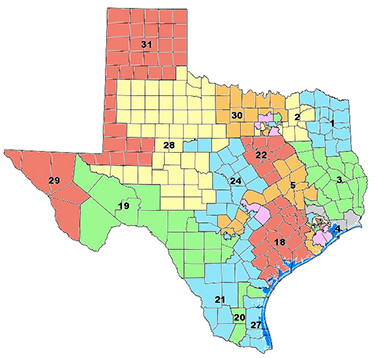
Texas state senate districts

June 7, 2018 — Quinnipiac University released their latest Texas poll (May 29-June 4; 1,159 registered Texas voters) and it finds former Vice President Joe Biden doing well in opponents’ Beto O’Rourke and Joaquin Castro’s home state.

According to the results, Biden heads the Lone Star State Democratic presidential field and is the only candidate to top President Trump when the president is isolated against each competitive Democrat (Biden over Trump: 48-44 percent).

Arguably, Texas, with its 38 Electoral Votes and the largest cache that a Republican candidate can generally claim, is Trump’s most important state. Losing here would likely mean forfeiting the presidency. There is no mathematical way to compensate for Trump failing to win Texas’ electoral votes and still allow him a path to reach the 270 Electoral Votes to claim a national victory.

In the Democratic primary, scheduled for Super Tuesday, March 3, Biden leads the pack of candidates with 30 percent of the vote, topping ex-Rep. O’Rourke (16 percent), Sen. Bernie Sanders (15 percent), Sen. Elizabeth Warren (11 percent), and the nine others who recorded between one and four percent statewide support.

Sens. Amy Klobuchar (D-MN), Kirsten Gillibrand (D-NY), Michael Bennet (D-CO), Govs. Jay Inslee (D-WA) and Steve Bullock (D-MT), Reps. Tulsi Gabbard (D-HI), Eric Swalwell (D-CA), Seth Moulton (D-MA), and Mayors Bill de Blasio (New York, NY), Wayne Messam (Miramar, FL), failed to reach the one percent plateau.

But, how would such a vote split translate into delegates for the participating candidates? Under Democratic Party rules, each state has both at-large and district delegates. Another group, called PLEO’s, are comprised of state and local Democratic Party leaders along with elected officials.

Continue reading

A Counter Poll in NC-9

By Jim Ellis

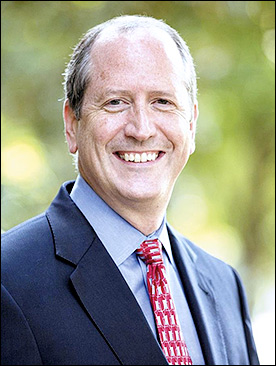
North Carolina Republican state Sen. Dan Bishop (left) | Democrat Dan McCready (right)

June 5, 2019 — The Atlantic Media & Research organization went into the field in North Carolina’s 9th Congressional District and found a different special election leader than last week’s JMC Analytics poll. Atlantic’s conclusion sees Democrat Dan McCready topping state Sen. Dan Bishop 41-39 percent, which is the inverse of JMC’s result.

JMC projected Sen. Bishop leading 46-42 percent in their survey of 350 likely special election voters conducted on May 21-24. Atlantic polled 358 “definite or very likely” special election voters from May 20-23 and continuing through May 28-30. Though the two polls produced separate leaders, their combined data conclusions are similar in that the participants are within the polling margin of error. While the spread yields an eight-point net difference between the two polls, the margin of error contained in each is less than four percent.

But the Atlantic methodology is a bit different. The research firm polled on consecutive weekdays in two separate weeks leaving the Memorial Day weekend period unsampled. The gap leads to a longer than average polling stage, which could mean a less accurate conclusion.

Atlantic Media also reviews its previous poll completed five months ago in December of last year, just after the general election, and compares those results with the most current data set. The numbers are similar in that the partisan ballot tests and the president’s job approval rating varies by only a percentage point or two. And, attempting to discount the final 2018 result that was infected with voter fraud, the Atlantic December post-election poll finds candidate McCready topping Republican Mark Harris by a tight 46-43 percent margin.

Continue reading

Electoral Vote Compact Takes a Hit

By Jim Ellis

June 3, 2019 — Recently, Sen. Elizabeth Warren (D-MA) spoke one of her strongest applause lines on the presidential campaign trail, when she talked about eliminating the Electoral College. And the National Popular Vote Interstate Compact organization had been gaining significant energy when Colorado, Delaware, and New Mexico officially joined its ranks earlier this year. But, that momentum hit a major roadblock yesterday.

The National Popular Vote Interstate Compact, or NPVIC, began soon after the 2000 presidential election when Democratic nominee Al Gore won the popular vote count but fell to George W. Bush in the Electoral College. The result marked the first time since the 1888 election when the popular vote winner failed to win the presidency.

By 2007, Maryland became the first state to officially join the NPVIC. Today, 14 states are Compact members, representing 189 Electoral Votes. The organization’s stated goal is to recruit enough states to equal a majority of 270 EVs that will agree the respective members will deliver its Electors to the national popular vote winner regardless of how their own electorate votes.

However, the Maine House of Representatives, on a 76-66 vote, defeated legislation late last week to add their state to the growing NPVIC organization. And, Nevada Gov. Steve Sisolak (D), in a surprise move to some, vetoed the compact legislation that had reached his desk. Earlier in the Oregon legislative session, the state Senate passed its bill to join the compact and action is awaited in the House before the legislative session’s scheduled end on June 21.

Continue reading

NC-9: The First Poll is Surprising

By Jim Ellis

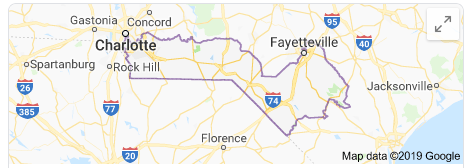
North Carolina’s 9th Congressional District

May 30, 2019 — The JMC Analytics survey research firm released the first special general election poll for North Carolina’s 9th District, and some may consider the results surprising.

According to JMC (May 21-24; 350 NC-9 registered voters), Republican state Sen. Dan Bishop (R-Charlotte) has taken a 46-42 percent lead over Democrat Dan McCready, the solar energy businessman who was the 2018 party nominee. Considering the seven-month-long vote fraud controversy that kept the North Carolina Board of Elections from certifying Republican Mark Harris as the general election victor over McCready (the unofficial total gave the GOP nominee a 905-vote edge) many expected the Democrat to open the special election campaign with a discernible advantage.

There is no doubt that McCready has a resource advantage, however, which should play a major role as this contest moves toward a Sept. 10 conclusion. In the pre-primary financial disclosure period report that ended April 24, McCready reported already raising over $2.01 million, with a $1.57 million cash-on-hand figure. In contrast, Sen. Bishop stated $505,000 raised within the same time frame, more than any individual Republican candidate at the time, but the total included a $250,000 personal loan.

Continue reading

Trump’s Ballot Politics

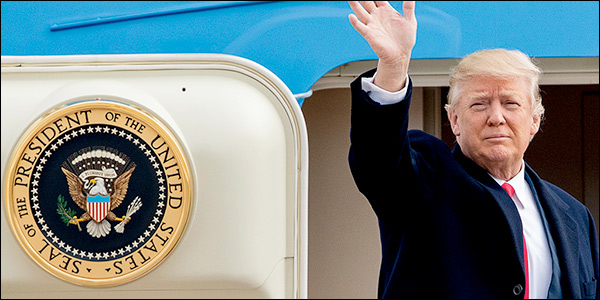
President Donald Trump | whitehouse.gov


By Jim Ellis

May 28, 2019 — Earlier this month, the California state Senate approved a bill that would require presidential candidates to release their tax returns in order to qualify for the Golden State ballot. A similar measure was vetoed by then-Gov. Jerry Brown (D) in 2017, but current Gov. Gavin Newsom (D) is expected to sign the measure.

A total of 17 other states also have similar pending legislation, with the strongest chances for enactment coming most probably in New York and Washington.

The move, of course, is targeted at President Trump who will not release his tax returns. But, would denying him ballot placement in states that he won’t carry actually hurt him?

A contrary argument exists to suggest that Trump and the down-ballot Republican candidates in those states might actually receive some tangential benefits from the president not being on the official ballot in places like California and New York, in particular.

First, if Trump didn’t appear on the California, New York, and Washington ballots, it would not change the Electoral College outcome because he won’t carry any of those states. He will likely concede them at the outset and spend no campaign money in any of those locations. Therefore, his ballot placement in these places could arguably be irrelevant.

Continue reading

Will Schilling Become a 2-State Rep?

By Jim Ellis

Republican Bobby Schilling

May 14, 2019 — In a dozen instances throughout American history a person has been elected to the House of Representatives from one state, departed Congress for whatever reason, moved to another domain, and then won an additional congressional election, or elections, from the adopted place.

Republican Bobby Schilling served one term in the House from western Illinois’ 17th District, losing his re-election bid in 2012. Relocating across the Mississippi River to Iowa in 2017, former Representative Schilling is reportedly looking to make a political comeback. It is expected that he will soon announce his candidacy for the Hawkeye State’s open 2nd Congressional District.

If the ex-Illinois representative were to win the Iowa seat, he would become the 13th person in American history to represent two different states in the House of Representatives. It last occurred when former Texas congressman, Ed Foreman (R), won a New Mexico US House seat in the 1968 election. Prior to that, the two-state switch had only happened one other time since the turn of the 20th Century.

Interestingly, the same number of individuals, 12, have represented two states by serving first in the House, moving, and then winning a Senate seat from the secondary place. The most famous of these is Sam Houston, who served in the House from Tennessee and as governor before helping found Texas as a country and state, and then subsequently serving as its president and US senator, respectively.

Schilling, a local restaurant owner, first won his Quad Cities anchored seat in the Republican landslide year of 2010, defeating then-two-term Rep. Phil Hare (D-Rock Island). But, in a redistricting year from a process the Democrats controlled, and with President Obama running for re-election at the top of his home state ballot in 2012, Schilling was unable to politically survive in the more Democratic district.

Continue reading

McCready, Bishop Advance in NC

By Jim Ellis

Charlotte, NC, state Sen. Dan Bishop

May 15, 2019 — Voters from Charlotte to Fayetteville went to the polls yesterday to choose nominees for North Carolina’s vacant 9th Congressional District. The seat has been unoccupied all year since the state Board of Elections refused to certify the November 2018 results due to voter fraud allegations in one county.

The Democratic side provided no drama because 2018 nominee Dan McCready was unopposed in last night’s special primary. Therefore, he automatically advances into the Sept. 10 special general election.

The 2018 Republican nominee, former pastor Mark Harris who denied Rep. Bob Pittenger (R-Charlotte) re-nomination in the May Republican primary, placed first in November’s final count, but the Bladen County voter fraud allegation claims were serious enough to deny him being officially declared the winner. With such negative publicity generated toward Harris during the post-election counting phase, in addition to some health concerns that recently surfaced, he decided not to run in the special election.

This opened the door for a new face, and Charlotte state Sen. Dan Bishop clinched the party nomination last night with 48 percent of the vote from a Republican field of 10 candidates, four of whom were competitive. Turnout was a low 31,103 Republican voters, 27.5 percent of whom voted before Election Day. Because he exceeded the minimum 30 percent threshold, Bishop now advances into the special general as the Republican nominee and will face McCready on Sept. 10.

In second place, with 20 percent, was Union County Commissioner Stony Rushing, followed by former Mecklenburg County Commissioner Matthew Ridenhour (17 percent), and realtor Leigh Brown (nine percent) who the national Realtors PAC supported with an independent expenditure of more than $1 million.

Continue reading

Biden’s Drastically Changed Picture

By Jim Ellis

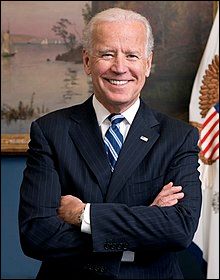
Former vice president and ex-Delaware senator Joe Biden

May 9, 2019 — Recent polling has seen former Vice President Joe Biden take full advantage of his announcement tour. While the pre-race appeared to be settling into a battle between Biden and Sen. Bernie Sanders (I-VT), once the ex-VP became an active candidate the picture drastically changed.

Several polls were taken during the last days of April and into early May. The HarrisX research organization and the Morning Consult firm conducted national surveys while Firehouse Strategies/Optimus commissioned Democratic primary polls in three of the first four nomination venues: Iowa, New Hampshire, and South Carolina. All of these polls produced big leads for Biden in contrast to what we were seeing just two weeks ago.

But, Change Research, in a slightly later New Hampshire poll with a larger sample (May 3-5; 864 likely New Hampshire Democratic primary voters), finds Sen. Sanders still on top, 30-26-12 percent over Biden and South Bend (IN) Mayor Pete Buttigieg.

The HarrisX national poll (May 3-4; 440 registered voters in the US) gives Biden a whopping 44-14 percent lead over Sen. Sanders with all others following in single-digits. The third-place finisher, Mayor Buttigieg has only eight percent support. Sens. Elizabeth Warren (D-MA) and Kamala Harris (D-CA) have seven percent and six percent, respectively, while former Rep. Beto O’Rourke (D-TX) has dropped to just three percent, tied with New Jersey Sen. Cory Booker.

Continue reading