Category Archives: LOUISIANA

Redistricting Review, Post Virginia

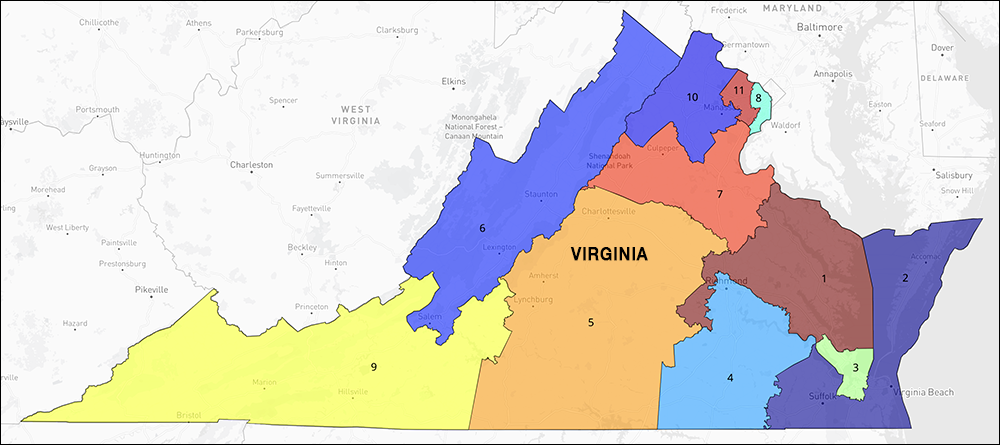
Virginia Congressional Districts / Dave’s Redistricting App (6D-5R map)

By Jim Ellis — Monday, May 11, 2026

The Virginia state Supreme Court decision to uphold the lower court ruling, finding that the legislature violated its own rules by rushing a referendum onto the ballot and, in the process, violated the Old Dominion Constitution, has significantly altered the outlook for the House midterm elections.

Instead of the cumulative effect of the new congressional maps being largely a wash, with neither party gaining a significant number of seats, Republicans are now positioned to net between 8 and 12 seats. Added to their current 220 seats, the new maps could expand their current prospective majority to more than 230 seats.

The following is an update on where the affected states stand in terms of 2026 electoral outlook under the new congressional maps, Starting with Virginia first:

Virginia

On Friday last week, the state Supreme Court invalidated the statewide redistricting referendum vote, upholding the lower court ruling that said the legislature violated its own rules and the state constitution in rushing the referendum to the ballot. While congressional redistricting is now effectively closed for this year here, meaning the 6D-5R map will remain in place for the 2026 elections, the process could be revisited in time to produce a new Virginia map for the 2028 cycle.

Certainly, the state Supreme Court ruling is a big win for Republicans, but the victory is likely to be short lived. For 2026, however, expect all Virginia incumbents to be favored for re-election.

California; Texas

The nation’s two most populous states became the focal points of the early redistricting battles, with party leaders in both parties predicting that their new maps would yield a net gain of five seats for their respective parties.

A closer examination of the partisan data and voting histories in the affected areas, however, suggests that gaining five seats under these new maps may be ambitious. What does appear likely, however, whether the eventual gain is three, four, or five seats, is that the two states will largely cancel each other out in terms of national seat gains.

Alabama

After the US Supreme Court’s ruling in the Callais v. Louisiana established clearer criteria for the construction of minority districts, the Alabama legislature reinstated a congressional map it had originally passed in 2023, only to have it later struck down by a court as a partisan gerrymander. Under the Supreme Court’s new directive, however, the plan could no longer be characterized as a racial gerrymander.

There is one remaining legal hurdle for the map to overcome, so it is possible that Gov. Kay Ivey (R) could suspend the congressional primaries until the map issue is resolved. Campaigns competing in the regularly scheduled May 19 primary for other offices would likely still be allowed to proceed.

The 2023 map would eliminate the majority minority 2nd District that a previous court had ordered drawn. Assuming no further legal complications arise, Alabama’s congressional delegation would likely revert to a 6R-1D partisan split. Rep. Shomari Figures’ (D-Montgomery) 2nd District would be dismantled and shifted back into southeastern Alabama, like its configuration during the previous decade.

Florida

The new Florida map has cleared the legislative process and now must face a legal challenge before the state Supreme Court. The plaintiffs are expected to file suit pertaining to the state ballot initiative voters approved to establish criteria for drawing legislative and congressional districts.

It is probable the court will rule that the map, which is predicted to net the Republicans three to four seats, is a partisan gerrymander with a projected 24R-4D partisan split; but other provisions of the voter-passed initiative may violate the SCOTUS’ Louisiana ruling. But the new map will likely stand for now, and net the GOP three to four seats.

Louisiana

The Bayou State is at the center of the determinative racial gerrymandering ruling, and Louisiana is now moving toward adopting a new congressional map that would produce a 5R-1D partisan split; thus, returning to the configuration that existed before the series of court rulings that ultimately reached the US Supreme Court.

The new map is reportedly being designed to preserve a Baton Rouge-anchored seat for Rep. Cleo Fields (D) while eliminating the New Orleans-based district that Rep. Troy Carter (D) currently holds.

Mississippi

Gov. Tate Reeves (R) has called a special redistricting legislative session, but only for the purpose of redrawing the state’s Supreme Court districts.

With the primary election already held on March 10, ordering a new round of congressional redistricting would effectively invalidate the 2026 primary, requiring all candidates to re-file and compete under a revised map. As a result, it appears unlikely that Mississippi congressional redistricting will take place in 2026.

Missouri

The Missouri map was enacted months ago, but opponents gathered enough signatures to qualify a repeal initiative for the ballot. The Missouri Supreme Court is now considering whether to stay the new map pending the vote or allow it to remain in effect for the 2026 election cycle. In the meantime, candidates have already filed under the current district lines.

If the map is allowed to stand, Republicans are expected to gain one seat in the delegation at the expense of veteran Rep. Emanuel Cleaver (D-Kansas City), though the Congressman has already filed for re-election. According to the Dave’s Redistricting App statisticians, the new 5th District has a partisan lean of 56.6R – 41.1D.

North Carolina

The Tar Heel State was among the first to complete the redistricting process, and the new congressional map will stand. The revised plan effectively shifts one district from Democratic to Republican control. Rep. Don Davis (D-Snow Hill) now sees his eastern North Carolina district move from a lean Democratic seat to one that is likely to favor a Republican in the general election.

In 2024, Rep. Davis won re-election by a margin of less than 1.5 percentage points. Retired Army officer Laurie Buckhout (R) is returning for a rematch, and this time the political landscape is more favorable to her chances of unseating the Congressman. With North Carolina’s primary having been held on March 3, the general election field is now set, and campaigning is underway.

South Carolina

While Gov. Henry McMaster (R) has said he would not call the legislature into a special redistricting session, lawmakers — still meeting in regular session — are moving forward with efforts to redraw the state’s congressional map.

Because the session is nearing adjournment, new legislation, including any proposal to adopt a revised congressional redistricting plan, would require a two-thirds vote of members to be added to the legislative calendar.

Republicans believe they have the votes to advance a 7R-0D plan from the House of Representatives, though they may be slightly short of the necessary support in the state Senate. If the new redistricting map is to pass, it will need to do so this week.

Tennessee

The Tennessee legislature and Governor passed a new 9R-0D congressional map soon after the Supreme Court ruled on the Louisiana racial gerrymandering case. With the Tennessee primary not scheduled until Aug. 6, the new map will stand. As a result, Rep. Steve Cohen (D-Memphis), the state’s only remaining Democratic member of the House, faces long odds of returning to the next Congress.

Utah

Months ago, the Utah court system invalidated the state’s 4R–0D congressional map, ruling that the legislature had disregarded voter-approved criteria for drawing district boundaries. As a result, the courts imposed a new map that creates a Salt Lake City–based district that Democrats are expected to win. Overall, Utah’s redistricting is projected to result in a net gain of one Democratic seat.

Redistricting Disarray: Alabama Yes, Georgia No, Louisiana Back to Jungle

By Jim Ellis — Monday, May 4, 2026

Redistricting

The Supreme Court ruling on the Callais v. Louisiana racial gerrymandering case has thrown the House election cycle into disarray. As a result of the high court’s decision, redistricting options are again being contemplated in several states.

Alabama Gov. Kay Ivey (R), despite previously stating she opposed redistricting ahead of the 2026 elections, issued a proclamation on Friday calling the legislature into special session later today to redraw the state’s congressional and state Senate maps.

Alabama is in exactly the same situation now as Louisiana. Under court orders, both states were required to redraw their 2021 congressional maps to add a majority minority district. Following last week’s Supreme Court Callais ruling, those revised maps are now invalid.

It is probable that the Alabama legislature will revert to a map like the one enacted in 2021. Such a plan would collapse Rep. Shomari Figures’ (D‑Montgomery) current District 2 and shift the seat back to southeast Alabama. That change would likely return the state’s congressional delegation to a 6R–1D alignment, rather than the current 5R–2D split.

The principal beneficiary of such a map would be former Congressman Jerry Carl (R), who lost his seat in a 2024 paired‑incumbent primary. He is currently running in the reconfigured 1st District now that incumbent Rep. Barry Moore (R) is seeking a Senate seat. Carl, however, trails state Rep. Rhett Marques (R‑Enterprise) in a recently released poll.

A new map would likely restore Mobile County as the population anchor of District 1 and shift District 2 back to southeast Alabama. Such a draw would allow both Carl and Marques to run in separate districts. While each would still face primary competition under a new configuration, they would no longer be forced to run against one another.

The Alabama primary is scheduled for May 19, which means the legislature will have to act quickly. The most likely scenario is that the regular primary proceeds as planned for all offices except the US House of Representatives and state Senate. Once new maps are enacted, a separate filing period and new primary dates for those offices would be set for later in the year.

Georgia is another state that could potentially redraw its congressional map, but with candidate filing already closed and the May 19 primary fast approaching, Gov. Brian Kemp (R) is taking the opposite position of Gov. Ivey. Kemp said he does not support redistricting for 2026, though indicated he would be open to considering a new map for the 2028 election cycle.

In Louisiana, state Senate President Cameron Henry (R‑Metairie) said Friday that the 2026 election scheduling decision will likely return the state’s US House races to the jungle primary format that has been in place since the late 1970s.

Gov. Jeff Landry (R) has already suspended the May 16 primary for US House campaigns in response to the Supreme Court ruling. The other affected contests, most notably the US Senate race, will continue to proceed under the May 16 partisan primary schedule.

With other offices still operating under the jungle primary system, which runs concurrently with the November general election and employs December runoffs when no candidate wins a majority, it is likely the Governor will simply return the US House races to this previous format and election calendar. Such would be the least expensive way for the state to conduct elections under a revised schedule.

Once the Virginia state Supreme Court renders a decision upholding the April 21 redistricting referendum, and the new Florida plan wins approval from its state Supreme Court after a lawsuit is formally filed, along with Alabama and Louisiana overcoming the legal objections to moving their primaries, the national redistricting landscape will finally come into clear focus.

Assuming all of these courts rule as suggested, we can reasonably predict that the new California and Texas maps would offset one another in terms of partisan gains, as would the changes in Virginia and Florida. Republicans would probably gain one seat each in Alabama, Louisiana, Missouri, and North Carolina, with the potential for one or two additional seats in Ohio. Democrats would gain one seat in Utah under that state’s new court‑ordered map.

Therefore, if the national redistricting picture ultimately unfolds as outlined above, the 2026 changes would likely result in Republicans achieving a net gain of four to five seats nationwide.

Louisiana Suspends House Primaries

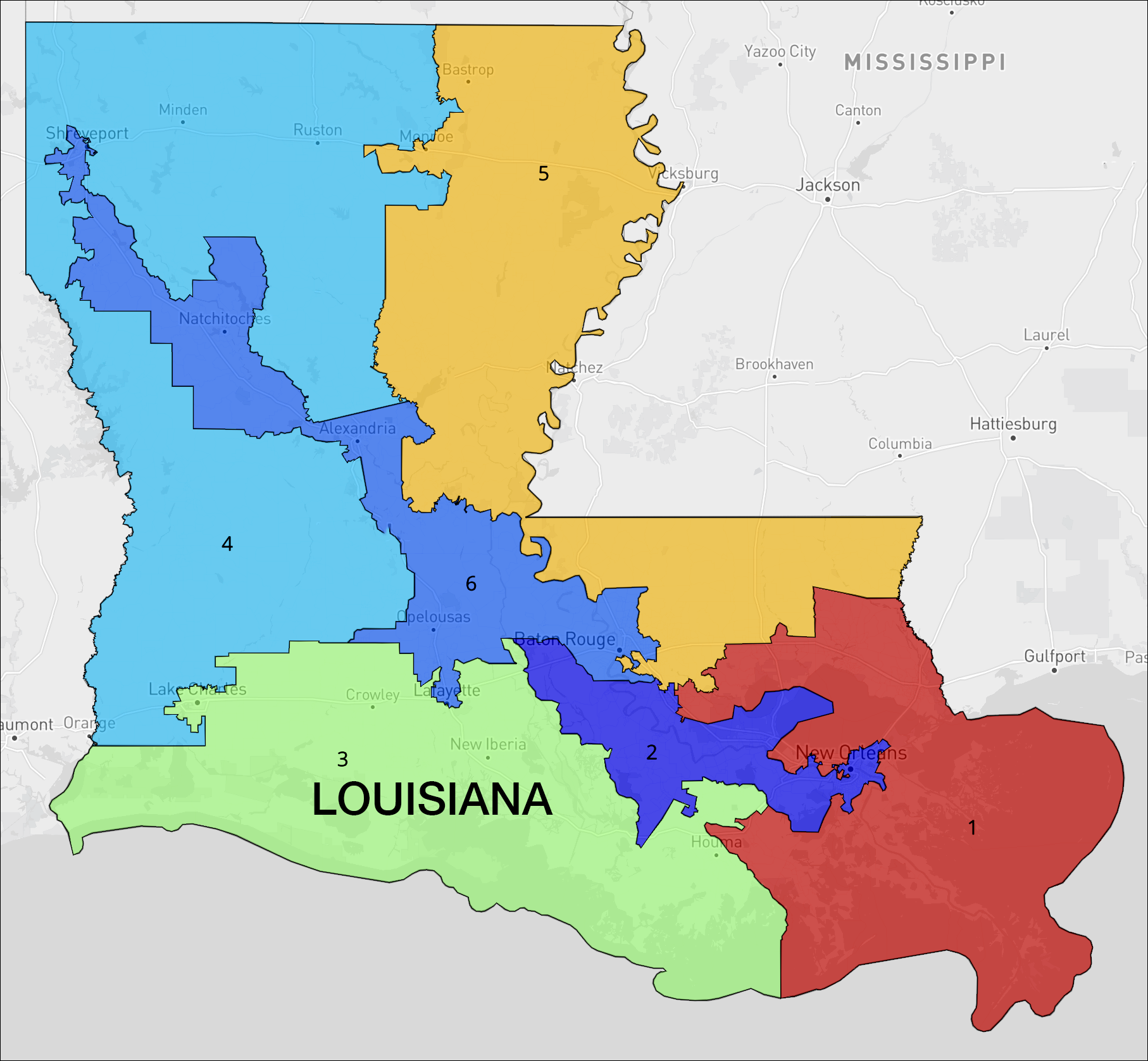
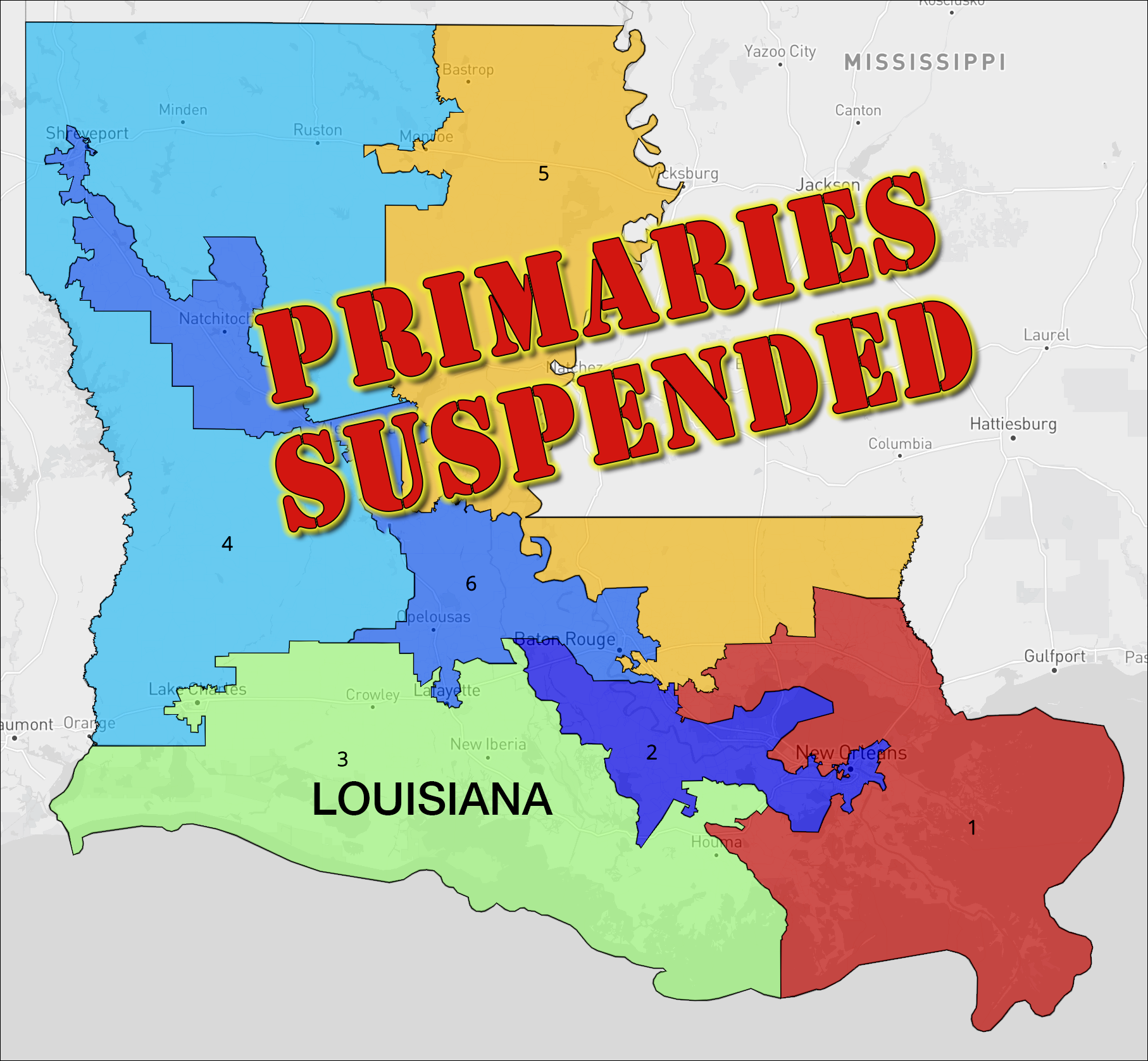
Louisiana Governor suspends US House elections (view interactive 2024 Louisiana Congressional Districts map on Dave’s Redistricting App).

By Jim Ellis — Friday, May 1, 2026

House

A day after the US Supreme Court ruled Louisiana’s congressional map an unconstitutional gerrymander, Gov. Jeff Landry (R) issued an executive order affecting the state’s May 16 primary election.

With early voting set to begin tomorrow and the state’s congressional map declared illegal by the nation’s highest court on Wednesday, Gov. Landry moved quickly to suspend the House primaries. He said the nomination election will remain in abeyance to give legislators time to redraw and approve a new congressional map and identified July 15 as the target date for rescheduling the House contests.

All other races, including the US Senate primaries in both parties, will proceed as planned on May 16.

Democrats, and even some Republicans, criticized the decision, arguing that early voting ballots have already been distributed and that postponing only the US House primaries would create confusion and likely depress turnout.

One of the Republican critics, Sen. Bill Cassidy, who faces a difficult renomination fight under the new partisan primary system, warned that running two different nomination schedules will mislead voters. For that reason, he opposes allowing the Senate primary to proceed on May 16.

What is likely a more salient reason for Sen. Cassidy’s push to postpone the primary is a new Emerson College poll released yesterday. The survey (April 24–26; 500 likely Republican primary voters; multiple sampling techniques) shows Sen. Cassidy trailing both former state Treasurer John Fleming and Rep. Julia Letlow (R‑Start), whom President Trump has already endorsed.

The ballot test produced a 28-27-21 percent split, with Fleming narrowly leading Rep. Letlow, and Sen. Cassidy following. Clearly, the race is headed toward a runoff, and it is not even certain that Sen. Cassidy will qualify for the second round.

At the end of 2024, the Louisiana legislature and the Governor overhauled the state’s preliminary election system. The new law created a partisan primary in May of the election year, followed by a June runoff in any race where no candidate secures a majority. Once nominees are chosen, they advance to a November general election, as in all other states.

Previously, Louisiana used a jungle primary system in which all candidates, regardless of party, appeared on the same ballot. Any candidate who received more than 50 percent of the vote in the first round was elected outright. If no one reaches a majority, the top two finishers, again, regardless of party affiliation, advance to the general election.

In past years, Louisiana held its initial election concurrently with the national general election. If a runoff was required, the top candidates would meet again in an early December second round. For the state legislature and many statewide offices, including the governorship, that system remains in place. The new partisan primary structure applies only to federal offices and certain designated state positions.

The act of drawing a new congressional map will almost certainly guarantee Republicans at least one additional seat in the current 4R–2D Louisiana delegation. Some observers, most notably reporters at the liberal political blog The Down Ballot, have speculated that Republican legislators might even attempt to convert both Democratic seats. Whether such an effort will materialize remains uncertain.

In addition to Louisiana, other states may also undertake redistricting ahead of the 2026 election. Reports indicate that President Trump has urged Tennessee Gov. Bill Lee (R) to eliminate the state’s lone Democratic‑held district; Georgia is also viewed as a potential candidate for a 2026 redraw.

Other states could be in the mix, as well. If such efforts move forward, they will almost certainly unfold on a very compressed timeline.

SCOTUS Decides Louisiana Case;
Florida Rep. Webster to Retire

2024 Louisiana Congressional Districts map (view interactive version on Dave’s Redistricting App)

By Jim Ellis — Thursday, April 30, 2026

Louisiana

The US Supreme Court, months after initially hearing the Louisiana racial gerrymandering case, released its ruling yesterday.

In authoring the Court’s opinion, Associate Justice Samuel Alito outlined the reasons the justices upheld the three‑judge panel’s ruling in Callais v. Louisiana, which found that the congressional map used before the 2024 election constituted a racial gerrymander.

The ruling is viewed as favorable to Republicans and will almost certainly require Louisiana’s congressional map to be redrawn before the 2026 statewide primary on May 16. It is possible that the legislature could simply revert to the 2021 map that was in place for the 2022 election.

Activists in several states are already urging their legislators to redraw congressional maps. Such is the case in Georgia, Mississippi (for their state Supreme Court districts), and potentially South Carolina. The Florida legislature is now likely to pass the map that Gov. Ron DeSantis (R) produced, which was drawn in anticipation of a favorable Republican Louisiana ruling.

In the Callais decision, Justice Alito outlined the parameters of the Voting Rights Act. He wrote, “Because the Voting Rights Act did not require Louisiana to create an additional majority-minority district, no compelling interest justified the State’s use of race in creating SB8, and that map is an unconstitutional racial gerrymander.”

He further explained when race can be used as a factor in drawing legislative district boundaries. From later in the ruling, Justice Alito stated, “The Court’s precedents have identified “only two compelling interests” that can satisfy strict scrutiny: avoiding imminent and serious risks to human safety in prisons,” and “remediating specific, identified instances of past discrimination that violated the Constitution or a statute.”

Further explaining, the Justice wrote, “Properly understood, §2 thus does not intrude on States’ prerogative to draw districts based on nonracial factors, including to achieve partisan advantage. In short, §2 imposes liability only when the evidence supports a strong inference that the State intentionally drew its districts to afford minority voters less opportunity because of their race. Not only does this interpretation follow from the plain text of §2, but it is consistent with the limited authority that the Fifteenth Amendment confers.”

It remains to be seen which states besides Louisiana will redraw their maps before the 2026 election. Alabama, where officials were also required to add another minority district ahead of the 2024 election, is one possibility. With primary elections already underway in many states, most significant redistricting activity is likely to shift to the 2028 election cycle.

FL-11

Although he would have continued to represent a safely Republican district under Gov. Ron DeSantis’ proposed congressional map, eight-term US Rep. Dan Webster (R-Clermont) announced just after celebrating his 77th birthday that he will not seek re-election later this year.

Rep. Webster had been viewed as a potential retirement candidate throughout this election cycle. Under the DeSantis map, his central Florida 11th District is rated as safely Republican. In the proposed FL‑11, President Trump would have recorded a 57.2 to 41.5 percent victory margin over Kamala Harris.

Dan Webster was first elected to the Florida House of Representatives in 1980 and later became the chamber’s first Republican Speaker since Reconstruction. He was elected to the state Senate in 1998, where he went on to serve as Majority Leader.

The number of open House seats has now grown to 64. Thirty-eight of these seats are currently Republican held with 21 from the Democratic column. Five additional open districts have been created as a result of redistricting maps in California, Texas, and Utah.

Of the 64 seats in the open category, only 28 involve members retiring from elective office. This group includes two lawmakers who were paired in a new redistricting map with another incumbent of his own party, Reps. Lloyd Doggett (D-TX) and Burgess Owens (R-UT).

Twenty-seven Representatives are running for a different office, three have resigned their seats, two districts are open due to the incumbent’s death, and one has already been defeated in his primary election.

Once the Florida redistricting process is resolved, a crowded Republican field is expected to emerge for the now‑open 11th District. The Sunshine State candidate‑filing deadline for US House races is June 12, and the state’s primary is scheduled for Aug. 18.

Updates on Louisiana, Maryland,
& Ohio Redistricting Plans

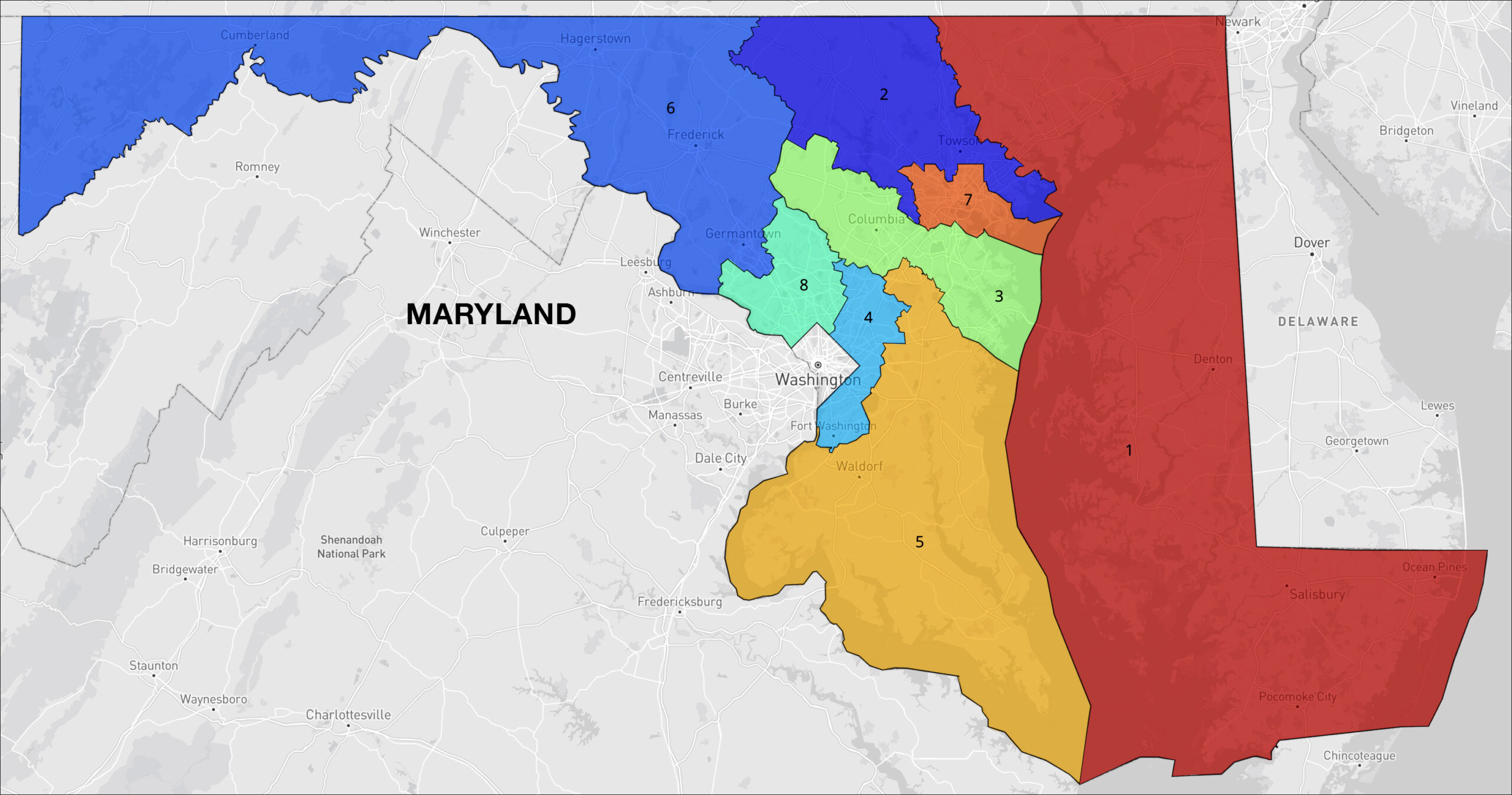
Maryland Congressional Districts

Maryland Congressional Districts (Click on map to see interactive version on DavesRedistricting.org.)

By Jim Ellis — Monday, Nov. 3, 2025

Redistricting

We saw redistricting moves occur in several states last week. Below is a recap of the action:

Louisiana

As the redistricting world awaits the US Supreme Court’s ruling on the Louisiana racial gerrymandering case, the Bayou State’s Governor and legislature passed legislation to move the state’s primary in anticipation of a ruling coming well after the first of next year.

Previously, the legislature and Gov. Jeff Landry (R) changed the Louisiana primary system to do away with their jungle primary held concurrently with the general election and an accompanying December runoff for those races where no candidate received majority support on the initial vote.

The new primary system returned to a partisan format scheduled for April 18, 2026, with a two-candidate runoff on May 30 for the races where no candidate received majority support.

The legislation passed earlier last week, now on its way to Gov. Landry for his signature, would move the initial primary date to May 16 with the associated runoff election on June 27.

Changing the primary will give the state more time to adjust their congressional map to adhere to whatever the Supreme Court eventually decides. The change also gives the candidates more time to campaign in the Senate primary where several contenders are mounting GOP nomination challenges against Sen. Bill Cassidy.

Maryland

It appears the Maryland legislature will not engage in another redistricting. According to a report from The Down Ballot political blog, state Senate President Bill Ferguson (D-Baltimore) sent a letter to his colleagues saying that the Senate leadership “is choosing not to move forward with mid-cycle congressional redistricting.”

Sen. Ferguson’s argument is that redrawing the current map “… could reopen the ability for someone to challenge” the present plan upon which the Democrats were able to routinely claim seven of the state’s eight congressional seats. Basically, the Senate President was explaining he was not going to risk a 7D-1R map for an uncertain attempt to add one more to the Democratic column.

Without the Senate’s participation, redistricting in Maryland will not occur. Thus, we see a break for the state’s lone Republican Congressman, Andy Harris (R-Cambridge), and the national Republican goal of maximizing their number of seats through mid-decade redistricting.

Ohio

The Buckeye State has both a complicated redistricting system and law. The process first starts with a commission of elected officials who authorize the drawing of maps, then votes upon and presents the approved plan to each house of the legislature. A map must receive three-fifths support in both houses to remain in place for the entire decade. Passing with a lesser amount means the plan can stand for only two elections. The Governor retains veto power over the completed legislative process.

Since the 2021 congressional plan failed to receive three-fifths support in both the state House of Representatives and Senate, it could only remain in place for the 2022 and 2024 elections. Therefore, Ohio must enact a new congressional plan before the 2026 election.

The bipartisan commission came to an agreement on a map last week, which will now be reported to the legislature. Understanding that the Republicans have strong majorities in both houses, but not three-fifths strength, the plan appears to give the GOP a chance to increase their delegation share by two seats.

The partisan percentage increase in both principal targets, however, appears to still make Democratic victories possible. The purpose of the compromise is to obtain enough bipartisan support to keep a new map intact for the decade’s remaining elections.

Statistics for the districts are not yet publicly available, but the new plan appears to make Districts 7, 9, and 13 slightly more Republican.

District 7 is already a Republican seat that two-term Congressman Max Miller (R-Rocky River) represents. The 9th is veteran Democratic Congresswoman Marcy Kaptur’s Toledo-anchored seat where her victory margin under the current boundaries fell to less than a percentage point in 2024. Finally, the politically marginal Akron anchored 13th CD is also made a bit redder. Rep. Emilia Sykes (D-Akron) has averaged just under 52 percent in two consecutive elections.

Both Reps. Kaptur and Sykes were going to be major 2026 Republican targets and this map will make them only slightly more vulnerable.

Republicans were also looking to target 1st District Congressman Greg Landsman (D-Cincinnati), but this map keeps the district in the marginal category and likely makes the Congressman at least a slight favorite for re-election.

Much more will be known when the map statistics and voting history under the new boundaries become publicly available. Until then, the swing margins remain points of conjecture.

US Supreme Court Hears
Louisiana Redistricting Case

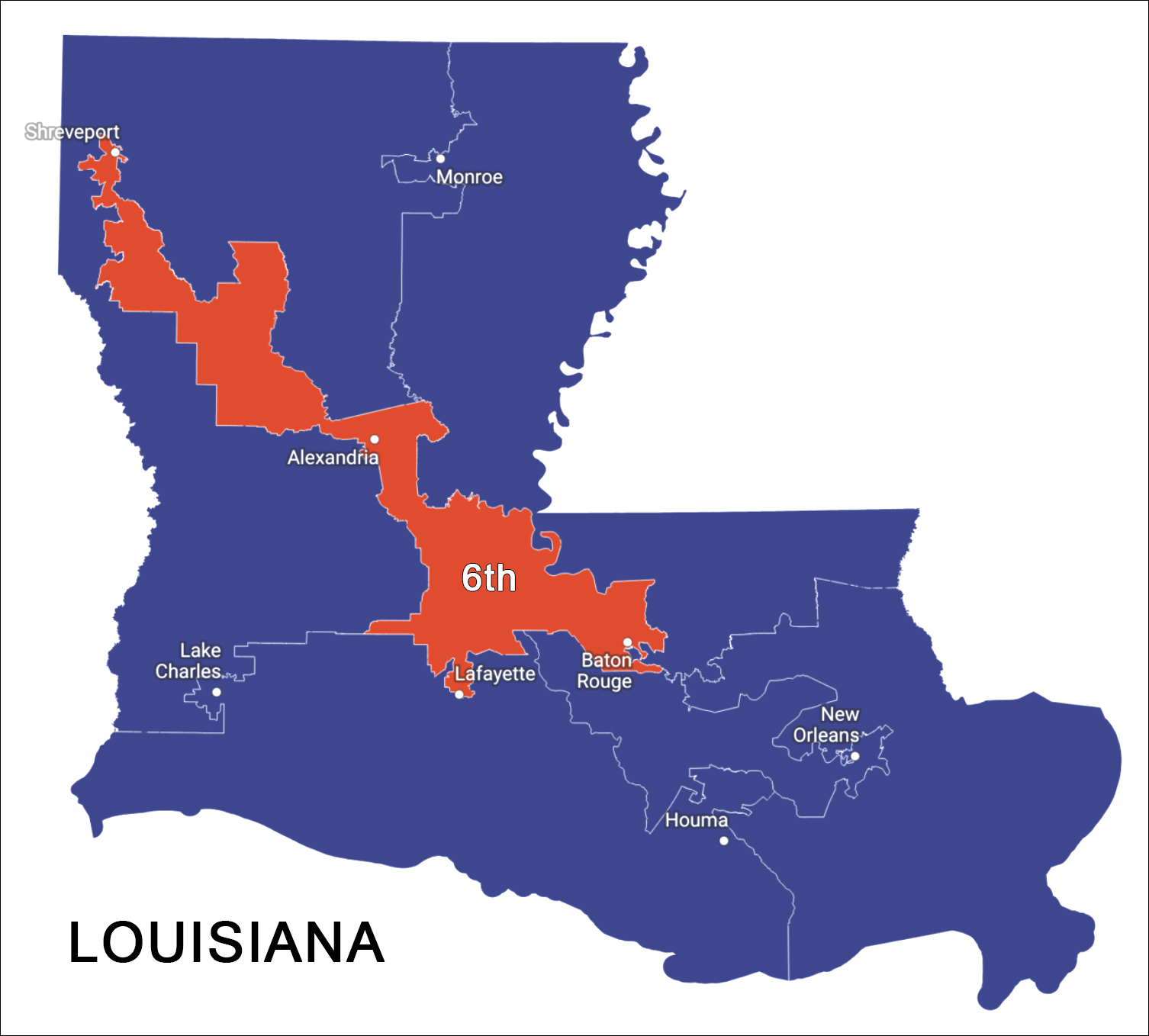
Louisiana’s 6th Congressional District / Graphic by VeriteNews.org

By Jim Ellis — Thursday, Oct. 16, 2025

Redistricting

Yesterday, the nine United States Supreme Court justices heard oral arguments for the second time on the Louisiana racial gerrymandering case. How this case is decided could have a major impact on the 2026 US House election cycle and in district elections throughout the remainder of the current decade.

At issue is Louisiana’s 6th Congressional District (in red on above map), which stretches from Baton Rouge to Shreveport. This CD was put in place before the 2024 election in response to a court order to create a second majority minority district that would elect an African-American Representative. Ironically, this very draw was rejected in a 1994 ruling, but the 2024 map drawers reinstated the same district 30 years later.

A lawsuit was filed over the redraw and the plaintiffs earned a favorable decision from the initial three-judge federal panel constructed to hear the case, but the US Supreme Court stayed the ruling. After briefs and oral arguments were conducted, the high court chose not to rule in June opting for a second round of oral arguments, which were held yesterday.

According to news stories and observations, impressions suggest that several justices appear favorable toward changing the particulars that heretofore have governed the parameters relating to minority district construction. Whether a majority exists to do so and to what extent change may be forthcoming remains unanswered.

The eventual decision could have wide-ranging ramifications to maps in several other states, and not just those where legislators are currently either drawing new districts or contemplating such action.

A SCOTUS decision to uphold the three-judge panel ruling would allow the Louisiana legislature to return to the previous map, or a similar one. That particular map produced a 5R-1D partisan division. The current Louisiana congressional delegation consists of a 4R-2D split.

If the three-judge panel ruling is upheld or expanded upon, the Alabama map would be affected because that state is in virtually the same situation as Louisiana with regard to minority district composition. Such a decision would also virtually eliminate any serious challenge to the new Texas map.

Therefore, with the updated Lone Star State map projected to net Republicans five seats — and should the previously described scenario in Louisiana and Alabama come to fruition and before the 2026 election — the Republicans could net seven seats from the three states. Even if the California redistricting referendum passes and the Democrats net five seats to neutralize the GOP’s Texas gains, the net Republican increase from the four domains would be two. Adding the new completed Missouri map, and the Republicans would see a net three-seat national gain.

Other states in some way, shape, or form considering redistricting either with a special legislative session or when their next regular session begins, or through a court directive are Florida, Georgia, Indiana, Kansas, Nebraska, North Carolina, and Ohio. These could favor Republicans. While Illinois, Maryland, and Utah would likely produce Democratic gains.

Not all of these states will move forward, but should the Supreme Court ruling on the Louisiana case be of a landmark proportion, some of these states and others may then be compelled to follow suit.

Another factor is when SCOTUS rules. Louisiana now has an April partisan primary schedule, so one would think the ruling will be revealed in time for the nomination elections to be conducted as scheduled. A later ruling would suggest that a great deal of the redistricting action will greatly affect the 2028 House election schedule instead of 2026.

We can expect many future political twists and turns in the pending redistricting war, but the catalyst to developing clear district construction criteria lies with the US Supreme Court.

US Supreme Court Hears
Louisiana Redistricting Challenge

By Jim Ellis — Wednesday, March 26, 2025

House

The US Supreme Court (SCOTUS) heard oral arguments Monday over the Louisiana redistricting process that led to the state hosting two Black districts, but the decade’s final map is yet to be decided.

So far, the process has led to the revival of a congressional district that was declared unconstitutional in 1994, which is a seat stretching all the way from Baton Rouge to Shreveport, which effectively cuts through the middle of House Speaker Mike Johnson’s 4th District.

Ironically, the member negatively affected when the seat was declared unconstitutional 30-plus years ago was then-Rep. Cleo Fields (D), who is also the beneficiary of the current draw. Fields, after serving two terms in the House, would later be elected to the state Senate, a body in which he served prior to his election to Congress. Once the same previously rejected congressional district configuration returned to the Louisiana map in 2023, it was again Fields who would run for the re-created 6th District and once more enter the US House of Representatives.

When the original 2021 congressional map was adopted, the partisan division again favored the GOP by a 5-1 count. Democratic plaintiffs went to a favorable federal district court in Baton Rouge to file their case, and Middle District Chief Judge Shelly Dick, an appointee of President Barack Obama, as predicted, ruled in their favor. The map was returned to the legislature for a redraw with the instruction to craft a second Black district. The new map forced then-Rep. Garret Graves (R) to retire, which virtually assured Fields of returning to Congress.

Republicans then filed a constitutional challenge to the new 6th District, citing the court’s rejection of such a draw in 1994, and a three-judge federal panel constituted to hear the case ruled in favor of the GOP plaintiffs and declared the map a gerrymander, just as was determined 30 years earlier.

The ruling was then sent to the Supreme Court where a summary affirmation of the lower court ruling was expected. In a surprise pre-election ruling, however, the high court stayed the case with the six Republican justices voting in favor of the stay and the three Democrats opposing. The stay cost the Republicans a seat, and almost the party’s small majority.

Monday’s hearing featured a long, very active, and at times intense session with even Justice Elena Kagan jumping in to answer a question from Justice Sam Alito before the presenting attorney could answer, and Justice Brett Kavanaugh asking whether the time had come to “sunset the Voting Rights Act.”

Unless the court now decides to summarily affirm the three-judge panel ruling, which they can still do, we can expect a final decision on this case at the end of the session in June. Regardless of how the court rules, it will affect the 2026 congressional elections and also the House majority because of the slim 220-215 eventual edge the Republicans will likely hold once the vacancies are filled barring any special election upsets.

If the court rules in favor of the current state map, Democrats will hold their second seat in the Louisiana delegation. If the high court ultimately upholds the three-judge panel ruling, then the state’s plan will become void and the map would return to the panel for a redraw, assuming the legislature does not step in and issue an alternative congressional plan.

Should the legislature not take action, and it’s unlikely they will be in session when SCOTUS decides the case, the three-judge panel will draw a new map, which will probably lead to a GOP gain of one seat. Such a move would likely return the delegation to a 5R-1D split along with returning Speaker Johnson to a more compact and undivided district.

Once again, Louisiana is in the forefront of a redistricting drama battle. It remains to be seen how this chapter ultimately ends.

Garcia Trails in Early Poll; Fong Ballot Status Dropped; Washington Senate Finalist Announces for House; Louisiana Redistricting; Good Well Behind in New Primary Poll

By Jim Ellis — Thursday, May 9, 2024

House

California Republican Mike Garcia

CA-27: Rep. Garcia Trails in Early Poll — Impact Research, polling for the George Whitesides campaign, released the results of their mid-April poll (April 12-18; 650 CA-27 registered voters; 100 over-sample of Hispanic voters), which shows their client leading three-term California US Rep. Mike Garcia (R-Santa Clarita) by a 47-44 percent count. In the jungle primary, however, Rep. Garcia topped Whitesides, a former NASA chief of staff and ex-CEO for Virgin Atlantic Airlines, 55-33 percent, from a turnout of 135,161 primary voters.

This will clearly be one of the top national congressional campaigns. Rep. Garcia represents one of four California Republican held districts that the FiveThirtyEight data organization rates as a Democratic seat. In this instance, the California Citizens Redistricting Commission made the northern Los Angeles County district even more Democratic, stretching the seat to a D+8 rating. President Biden carried this district configuration with a 55-43 percent victory margin, so Rep. Garcia has his work cut out for him to win here again in November.

CA-20: Appeal to Fong Ballot Status Dropped — California Secretary of State Shirley Weber (D) announced that she is dropping her office’s appeal of the ruling that allows Assemblyman Vince Fong (R-Bakersfield) to run for the open 20th District congressional seat while still on the ballot for state Assembly. Weber contended that a candidate cannot seek two offices simultaneously. Two court rulings, however, allowed Fong to continue his regular election campaign for the seat from which former House Speaker Kevin McCarthy (R) resigned even after qualifying for the state Assembly ballot. Weber’s action means that Fong’s congressional candidacy is finally unimpeded.

Assemblyman Fong did appear on the ballot for both offices on the March 5 jungle primary. He placed first in the congressional race and was unopposed for re-election to his current office. He is also on the ballot for the May 21 special congressional election to fill McCarthy’s unexpired term. In both the special election and in November, Fong will face Tulare County Sheriff Mike Boudreaux in a double-Republican format.

Should Fong win the special election, and he is favored to do so, he will resign from the Assembly before taking the congressional oath. At that point, Gov. Gavin Newsom (D) will call a special election to fill the balance of the unexpired Assembly term and another for the regular election.

WA-4: Senate Finalist Announces for House — There has been growing speculation that Washington Rep. Dan Newhouse (R-Sunnyside), one of two remaining Republican House members to vote for the Trump impeachment, would announce his retirement before the state’s May 24 candidate filing deadline and the latest development here will increase such talk.
Tiffany Smiley (R), who was a credible opponent to Sen. Patty Murray (D) in the 2022 statewide election, yesterday announced that she will enter the 4th District House race. The move is unusual since it seems unlikely that she would challenge the incumbent especially when former President Donald Trump has already endorsed former race car driver Jerrod Sessler (R). Her candidacy does make sense, however, if Rep. Newhouse has decided not to seek re-election and has quietly told her such. This is a developing situation worth watching.

Louisiana: Judges Order New Cong Map by June 3 — The three judge federal panel that invalidated the new Louisiana congressional map is now sending the plan back to the state legislature with a deadline of June 3 to redraw the map. This time, there is no judicial requirement to specifically add a new majority minority district.

In response, Secretary of State Nancy Landry (R) is filing an appeal of the original ruling with the US Supreme Court and criticized the panel for not adhering to her May 15 deadline for producing a 2024 map. She said the state needs such a time frame to adequately administer the election.

While the Louisiana redistricting situation will soon come to a head, it is difficult to see exactly how the map’s final version will develop.

VA-5: Rep. Good Well Behind in New Primary Poll — A just-released Battleground Connect poll (April 30-May 2; 504 likely VA-5 voters; live interview) finds two-term Virginia US Rep. Bob Good (R-Lynchburg) falling well behind his Republican primary challenger, state Sen. John McGuire (R-Manakin-Sabot). According to the survey data, Sen. McGuire would lead Congressman Good by a double digit margin, 45-31 percent, as the two battle for position in anticipation of the June 18 Old Dominion primary.

The McGuire effort, which has been principally hitting Rep. Good over his lack of support for former President Donald Trump, is being supplemented by heavy outside spending much of which is coming from organizations affiliated with former House Speaker Kevin McCarthy, who Rep. Good was instrumental in deposing. Additionally, this is the first time Rep. Good has faced a primary election. Previously, he was nominated through a district convention, which is the way he denied former Rep. Denver Riggleman renomination in 2020.

Examining Polling Margin of Error; McCarthy Ally to Challenge Florida Rep. Gaetz; Court Strikes Down New Louisiana Congressional Map; Kennedy Wins NY-26 Special Election; Gov. to Run for Mayor in Delaware

By Jim Ellis — Wednesday, May 1, 2024

Senate

Polling Margin of Error: Different Ballot Tests — All polls contain a margin of error, and two sets of surveys in the Pennsylvania and Wisconsin Senate races demonstrates the importance of the spread.

Both CBS News and Emerson College were in the field in both states at relatively the same point in time, but they arrived at significantly different results for the same races. CBS News (conducted by the YouGov polling firm; April 19-25; 1,306 registered Pennsylvania voters; online) found Sen. Bob Casey Jr. (D) leading businessman David McCormick (R), 46-42 percent. Beginning on April 25, Emerson College also studied the Keystone State Senate race. Their data (April 25-29; 1,000 likely Pennsylvania general election voters; multiple sampling techniques) posted Sen. Casey to a much larger 46-39 percent advantage.

Using a margin of error figure of three percentage points, we see that these two polls do fall within the pre-stated specter. Yet, the difference between a four- and seven-point edge on the ballot test is substantial.

We see a similar situation in the latest Wisconsin polling. During the same polling periods, again for both pollsters, we see similar divergent results yet within the polling margin of error. CBS/YouGov (April 19-25; 1,245 likely Wisconsin general election voters; online) finds Sen. Tammy Baldwin (D) leading businessman Eric Hovde (R) 48-41 percent, while Emerson (April 25-29; 1,000 registered Wisconsin voters; multiple sampling techniques) again finds a closer race. Their result detects a Baldwin edge of only 46-43 percent. Again, a significant difference, yet within the polling margin of error spread.

House

FL-1: McCarthy Ally to Challenge Rep. Gaetz — At last Friday’s candidate filing deadline, controversial Rep. Matt Gaetz (R-Niceville/Pensacola) drew a Republican primary challenger who could enjoy outside support. Retired Navy officer Aaron Dimmock (R) filed his candidacy just before time expired. Reports suggest that former House Speaker Kevin McCarthy (R-CA) will back Dimmock and raise substantial support money from loyal organizations who want to even the score for McCarthy’s political demise. Rep. Gaetz was the leader of the McCarthy ouster movement.

It remains to be seen how well Dimmock could perform in the Aug. 20 Republican primary. In 2022, Rep. Gaetz easily turned back a well-funded Republican primary challenge from businessman Mark Lombardo who spent just under $800,000 for his campaign. The congressman won renomination over Lombardo with a landslide 70-24 percent victory margin.

Louisiana: Court Strikes Down New Congressional Map — Louisiana plaintiffs challenging the state’s new congressional map that created a second majority minority district that stretched from Baton Rouge to Shreveport received a favorable ruling yesterday from the three-judge federal panel hearing the lawsuit. The decision means the new congressional map is nullified. The judicial panel will now consider replacement maps. The plaintiffs argued the district was drawn only on racial criteria in violation of the US Constitution.

The ruling is likely to help Republicans, and particularly Rep. Garret Graves (R-Baton Rouge) whose GOP favorable 6th District was reconfigured as a majority minority seat designed to elect an African-American Democrat. The secretary of state informed the court that the 2024 districts must be in place by May 15 to allow the election office to properly administer the election. Therefore, a quick remedy decision will soon follow.

NY-26: Tim Kennedy (D) Wins Special Election — As expected, state Sen. Tim Kennedy (D-Buffalo) easily scored a special election victory last night to succeed resigned Rep. Brian Higgins (D) in New York’s 26th Congressional District. Kennedy received 75 percent of the vote in the heavily Democratic seat that Republicans basically conceded. The latter party’s candidate, West Seneca Town Supervisor Gary Dickson, reported raising only $35,000 in the pre-election Federal Election Commission disclosure report.

The Kennedy victory means the House party division will move to 217R – 213D with five vacancies (4R – 1D). The 26th District encompasses the Buffalo metropolitan area including parts of Erie and Niagara Counties.

Governor

Delaware: Gov. Carney to Run for Mayor — Two-term Delaware Gov. John Carney (D), who is ineligible under the state’s election law from seeking a third term, instead announced that he will run for mayor of Wilmington. Should Gov. Carney win the open municipal post — he’ll be favored to top City Treasurer Velda Jones-Potter (D) — he would become at least the third governor to later become a mayor.

Gov. Carney would join former Maryland Gov. Ted McKeldin (R) who was elected the state’s chief executive in the 1950s and then return as mayor of Baltimore in the 1960s. Gov. Jerry Brown was elected mayor of Oakland after his first stint as governor of California. He would then return to the governorship and eventually serve 16 non-consecutive years as the state’s chief executive.

Nevada Primary Underway, Caucus Begins Thursday; Spartz “Un-Retires”; Louisiana Redistricting Fight;
Strong Challenger in MI-3

By Jim Ellis — Tuesday, Feb. 6, 2024

President

Nevada: Primary Today; GOP Caucus Thursday — Nevada voters will cast their votes for a Democratic presidential nominee with 49 delegates at stake in their primary, while Republicans will be participating in what is termed as only a “beauty contest” primary because delegate apportionment will not correspond to the cast ballots. The delegates will be awarded in a caucus system with meetings scheduled for Thursday.

President Joe Biden will easily sweep the small Democratic field, maybe not to the point of getting 97 percent support as he did in South Carolina, but he will win in a substantial landslide. On the Republican side, where the candidates chose to enter either the primary or caucus, sees ex-UN Ambassador Nikki Haley on the outside; she will win a virtually meaningless primary, against virtually meaningless minor candidates, while former President Donald Trump opted to enter the caucus and is likely to sweep Nevada’s 26 convention delegates.

House

IN-5: Rep. Spartz “Un-Retires” — In early 2023, Indiana sophomore US Rep. Victoria Spartz (R-Noblesville) became the session’s first lame duck House member when announcing that she would not seek a third term in order to spend more time with her two daughters who are entering their teenage years. Yesterday, Spartz reversed course and now becomes the first of the burgeoning departing group of members to “unretire.”

Rep. Spartz said the urging from many of her constituents to run again and what she termed as the “failed leadership in Washington,” were her reasons for deciding to stand for another term just as the Indiana candidate filing deadline approaches on Friday.

The focus now turns to the 10 Republicans who are vying to succeed Spartz and see just how many, if any, will terminate their campaigns. State Rep. Chuck Goodrich (R-Noblesville) is viewed as the leading contender and has already spent over $1 million on his congressional effort. He also has more than twice the amount of money in the bank than does Rep. Spartz ($679,000 to $313,000) according to the year-end (2023) Federal Election Commission disclosure report. No other candidate has significant resources.

Louisiana: New Map Challenged — While the Louisiana legislature and governor complied with a court order to draw a new majority minority seat in the congressional delegation, a group of “non African-American voters” have filed suit against the new plan as a racial gerrymander.

A different three-judge panel will hear the lawsuit suggesting the possibility that this map could be rendered illegal, too. The plaintiffs site a 1994 case where a similarly drawn district, one that stretches from Baton Rouge to Shreveport to create a black majority district, was in fact declared a racial gerrymander, which forced a redraw then. This lawsuit suggests that Louisiana congressional redistricting may not be quite over.

Now, House Speaker Mike Johnson (R-LA) weighed in on “X” saying, “there are multiple other map options that are legally compliant and do not require the unnecessary surrender of a Republican seat in Congress.” The new 6th District virtually cuts Johnson’s 4th District into two parts, driving through the middle of the Speaker’s current territory in order to annex the black dominated precincts in Shreveport.

MI-13: A Second Strong Democrat to Challenge Rep. Thanedar — In 2022, then-Detroit state Rep. Shri Thanedar won an eight-person Democratic congressional primary with 28 percent of the vote to claim his seat in the US House. In doing so, Thanedar self-financed his effort to the tune of $9.1 million.

In October, Rep. Thanedar’s top 2022 challenger, former state Sen. Adam Hollier, announced that he would return for a Democratic primary rematch. Yesterday, another major Detroit political figure joined the primary race. Detroit City council member and former state House Minority Leader Mary Waters filed a congressional campaign committee with the FEC. She did not run in 2022. Another potential entry is two-time former candidate John Conyers III, the son of the late Congressman John Conyers (D-Detroit), who held the seat from his initial election in 1964 to his resignation from the House in 2017.

From the freshman incumbent’s perspective, he benefits from having more opponents that will split the vote just the way the 2022 race unfolded.

Regardless of his number of opponents, the congressman looks again to be the biggest spender. According to the year-end (2023) Federal Election Commission campaign finance disclosure report, Rep. Thanedar shows $2.6 million in his political committee bank account. The Michigan candidate filing deadline is April 23 in conjunction with the Aug. 6 primary election.