
By Jim Ellis — Thursday, May 14, 2026
Alabama
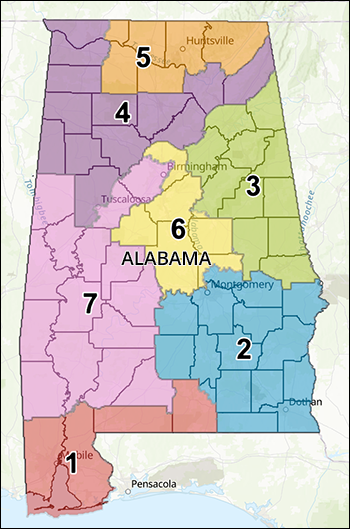
Click the map above or here to see an interactive version: Alabama Congressional Districts map.
The high court vacated all lower-court federal injunctions related to Alabama’s 2023 congressional map, which had previously been ruled a racial gerrymander. The Court’s opinion in Callais v. Louisiana effectively invalidated the prior rulings, clearing the way for Alabama to proceed with enacting a new congressional redistricting plan.
Gov. Kay Ivey (R) summoned the legislature into a special redistricting session following the Callais decision, and lawmakers moved to reinstate the congressional map they passed in 2023. The plan is expected to give Republicans an additional seat and return the state to a 6R–1D delegation. The map shifts the 2nd District back into southeastern Alabama after a court order had previously required the creation of a second majority minority district anchored in the city of Montgomery.
Returning to the 2023 map resolves a major Republican redistricting challenge in southern Alabama. With Rep. Barry Moore (R-Enterprise) running for the Senate, former Rep. Jerry Carl (R) had been set for a Republican primary battle with state Rep. Rhett Marques (R-Enterprise) in the open 1st District, which stretched from Mobile to the Georgia border.
Under the newly enacted plan, however, Carl and Marques will run in separate Republican-leaning districts, each of which would make them nominal favorites in their respective congressional campaigns.
Now seeing a legal resolution, Gov. Ivey announced that the primaries for the affected districts, meaning CDs 1, 2, 6, and 7, are now scheduled for Aug. 11. The remaining districts, 3, 4, and 5, will continue their nomination process on May 19, the state’s original primary election date. Because the boundaries of those latter three districts remain unchanged, there is no need to postpone their primaries.
Although Alabama is a runoff election state, the districts holding delayed primaries will not be subject to a secondary runoff. Instead, the candidates receiving the highest number of votes in their respective primaries will secure their party nominations and advance to the general election.
There had been speculation that the legislature might attempt to draw a 7R – 0D congressional map, but the lawmakers ultimately bypassed the opportunity in order to quickly enact a new plan.
South Carolina
While Alabama moved forward with redistricting, the South Carolina legislature did not. Falling two votes short of the two-thirds majority needed to suspend the regular order rules to move a new bill, lawmakers will conclude the 2026 legislative session today without making any changes to the state’s congressional map.
The opportunity for change, however, may not be over. Gov. Henry McMaster (R) still has the power to call a special legislative session for the purpose of drawing a new congressional map. If convened quickly, a revised plan could still be implemented for the 2026 election cycle.
In a special session, only a simple majority vote would be required to bring the measure forward and secure final passage. Since the state House approved the proposed map with two-thirds support and the Senate fell only two votes short of that threshold, Republicans would likely have sufficient backing to enact a new 7R–0D congressional map.
Gov. Henry McMaster has previously said he would not call a special session, but he could still change course. It is clear that President Trump and congressional Republican leaders are likely to lobby him to move forward with a new federal redistricting map.
Now that Alabama, Florida, Louisiana, and Tennessee have all enacted new congressional maps in recent days, it remains to be seen if South Carolina will ultimately follow suit.