Tag Archives: Virginia

First 2028 Decision Looms

By Jim Ellis — Thursday, April 9, 2026

Super Tuesday

While the 2028 presidential campaign is still almost two full years away, the beginning of an important decision-making process occurs this week.

The Democratic National Committee Rules and Bylaws Sub-committee will meet to hear the first oral presentation from the 12 states applying as candidates for the pre-Super Tuesday window; that is, the states allowed to hold delegate-binding primaries or caucuses prior to the March date that will be selected for Super Tuesday voting events. Though the calendar is not yet officially set, Super Tuesday 2028 will likely be March 7.

Under rules in both parties, as many as five states can be designated for the pre-Super Tuesday voting window. Traditionally, four have held window slots: Iowa, New Hampshire, Nevada, and South Carolina. Republicans kept the traditional calendar in 2024, but Democrats did not.

The DNC dropped Iowa and New Hampshire, though both state Democratic parties held non-binding events (meaning delegates were not apportioned based upon the voting results): Iowa, a caucus, and New Hampshire, a primary. Both states are back again in 2026 applying for an official pre-Super Tuesday window position.

Instead, the 2024 Democratic calendar began in South Carolina, and then went to Nevada. The newcomer in the window became Michigan, which was the first state in the ’24 nominating cycle where both parties held their vote on the same day.

The DNC argument for ejecting Iowa and New Hampshire from their traditional prominent positions was that the two states did not adequately represent the Democratic Party’s vote base because the pair have such low minority populations.

While it is unlikely the two will be restored, both the Iowa and New Hampshire state chairmen say their states will continue to hold early votes regardless of the DNC’s ultimate scheduling decision.

The ultimate early window voting schedule is important not only to the states, but to certain likely presidential candidates, namely Illinois Gov. J.B. Pritzker, currently running for a third term, and Michigan Gov. Gretchen Whitmer, who is in her last year of service. The delegate vote bump from their home states, if in the early window, could give their campaigns a significant early momentum boost directly before Super Tuesday.

The 12 applying states, down from 20 that competed for an early slot in 2024, are, in the East: Delaware and New Hampshire; from the South: Georgia, North Carolina, South Carolina, Tennessee, and Virginia; the Midwest: Illinois, Iowa, and Michigan; and, in the West: Nevada and New Mexico.

The Rules and Bylaws Sub-committee will recommend to the full DNC one state from each geographic region and can choose an at-large entry from the remaining eight applicants.

It would be hard to deny South Carolina, since the state has been historically significant in giving candidates from both parties the critical thrust toward winning the national nomination. The Palmetto State became the deciding factor for Joe Biden’s 2020 campaign, giving him the necessary momentum to succeed on Super Tuesday, which made him unstoppable for the party nomination. He would then, of course, go onto win the Presidency that year.

Since it would be difficult to see this panel reversing the 2024 Iowa-New Hampshire decision, it would appear that Delaware will become the Eastern sector pre-Super Tuesday voting state. Likewise, in the West, Nevada would appear to have the inside track to securing a slot since they were one of the traditional early voting states. New Mexico, a newcomer to the application process, is the only other to come forth from the West.

The Midwest decision will likely come down to a choice between Illinois and Michigan. The committee, however, could install both if they again award Michigan the regional slot and give Illinois the at-large position.

In addition to New Mexico applying for the first time, the other three newcomers are North Carolina, Tennessee, and Virginia.

Virginia’s Twisted Campaign

By Jim Ellis — Tuesday, April 7, 2026

Redistricting

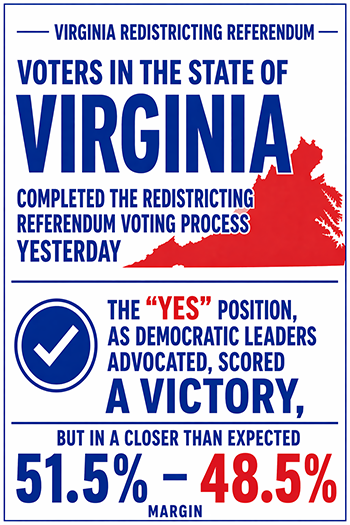
One of the most bizarre campaigns in recent memory is currently unfolding in the Old Dominion. On April 21, Virginians will cast final votes on a congressional redistricting referendum that will change the state’s 6D-5R map into a 10D-1R plan under the guise of “fairness.”

At this point, the Virginia referendum campaign is one of the most disingenuous ever because all sides, including the official Department of Elections, are part of the chaos.

The old saying, “you can’t tell the players without a scorecard,” seems to be applicable here, but even with a political scorecard a voter would be confused.

Let’s begin with the official state approved ballot language, as follows:

“Should the Constitution of Virginia be amended to allow the General Assembly to temporarily adopt new congressional districts to restore fairness in the upcoming elections, while ensuring Virginia’s standard redistricting process resumes for all future redistricting after the 2030 census?”

Restore fairness? The current map is 6D-5R in a state that voted 51.8 – 46.0% for Kamala Harris and, while electing a Democratic Governor in 2025, supported a Republican Governor in the previous election. Yet, the new map would give the Democrats 91 percent of the congressional seats.

The Virginia Supreme Court justices have also been less than forthcoming. They are saying they are still in the process of hearing whether the redistricting process can proceed because a lower court ruling said it cannot; that’s because the legislature itself violated its own rules in passing the referendum legislation, and the justices are allowing the statewide vote to take place. So, if the people vote for the referendum to redraw the districts, is the court going to reject their preference? Simply, no.

The Democratic campaign has been overwhelming so far, dominating the airwaves largely with ads from former President Barack Obama and Gov. Abigail Spanberger talking heroically about how they are “restoring a level playing field” with their 10D-1R map. This, after being on record time after time opposing gerrymandering when it cuts against their own party.

Perhaps the biggest stretch, however, is the Democratic campaign directly tying the abortion issue to passing the redistricting map, saying that “President Trump and the MAGA extremists” are planning to pass a national law to ban abortion. There is no evidence of such and passing this type of bill at least through the Senate is a realistic impossibility under the current filibuster rules. The ad verbiage also presumes the GOP has a majority to pass such a measure, which is also improbable.

The Republican response, which has so far been shockingly minimal despite understanding that the new Virginia map would put the Democrats in a much stronger position to capture the House majority, is also getting into the sleight of hand act.

The Virginians for Fair Maps organization are mailing post cards telling voters to join President Obama and Gov. Spanberger in opposing gerrymandering. They use previous public comments from the two when redistricting in Virginia and other places did not favor Democrats. Then the mailers tell voters to join Obama and Spanberger in opposing gerrymandering by voting “No” in the special referendum election.

One Republican advantage, even with their lackluster campaign, is that the “No” position is typically an easier argument to make in ballot proposition campaign strategy, and the Virginians for Fair Maps organization is using that edge to confuse voters with their Obama/Spanberger gerrymandering boomerang.

The Republicans’ early minimal response to what could be a devastating result for them is even more surprising when looking at the preference data. The Washington Post and the Schar School of Policy and Government at George Mason University just released a new statewide poll (March 26-31; 1,101 registered Virginia voters) finding the referendum passing, but with only a 52-47 percent margin within their response segment of likely voters.

Early voting is already underway. So far, according to the Virginia Public Access Project statistics, 646,493 ballots have been cast for an average turnout in the localities (in Virginia, residents are either in a city or a county but not both) of 11.9 percent. In the 2024 presidential election, as a point of comparison, 4.5 million individuals voted.

Though the campaign has been universally disingenuous to a very high degree, the referendum will likely pass, particularly if the Republican leadership continues to run their minimal response effort. Still, political prime time for this April 21 election is just beginning, so seeing the GOP launch a major ending media blitz remains a possibility.

Redistricting:
New York, Utah, and Virginia

By Jim Ellis — Thursday, February 19, 2026

Redistricting

Redistricting news is coming to the forefront in three states, New York, Utah, and Virginia. Today, we will review the latest information.

New York

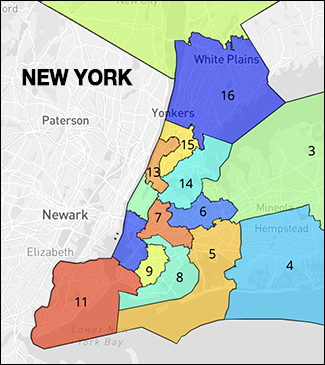
Empire State Congresswoman Nicole Malliotakis (R-Staten Island) previously filed a lawsuit appealing a lower court ruling that declared her 11th Congressional District as a racial gerrymander. Her appeal is before the New York Appellate Division. The initial ruling was made in relation to the New York Voting Rights Act.

This is the first time that a federal political district has been adjudicated under a state voting rights law. While the ruling declared NY-11 as a racial gerrymander, it also included a redraw order that negated the use of the current NY-11 CD in the 2026 election.

Under the New York judicial procedure, a motion to appeal automatically stays the previous ruling until heard by the upper courts. This week, the New York Court of Appeals, the state’s highest court and equivalent to a Supreme Court in most states, released a statement saying they would not hear the case on an expedited basis and further emphasizing that the Appellate Division is the proper authority to rule on the motion.

Therefore, a great deal of confusion remains. If the appellate division fails to act before the New York candidate filing deadline of April 6, would this lead to a postponement of the filing procedure and possibly the June 23 primary? And, if the court delays the filing deadline and potentially the primary, would this apply statewide or just to the 11th Congressional District and the neighboring CDs that a redraw would affect?

Once again, we see another redistricting issue causing widespread confusion. It remains to be seen how the courts rule; until they do at least a portion of the New York congressional map hangs in abeyance.

Utah

Utah Congressional Districts / Dave’s Redistricting App

In 2025, a Utah court ruled that the Beehive State’s congressional map was illegal because the legislature failed to adhere to voter passed criteria relating to the drawing of congressional districts.

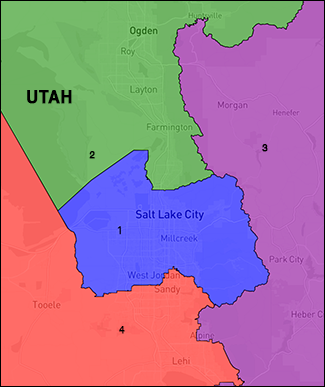
As a result, the court imposed a new map, one that will create a Salt Lake City-anchored seat, labeled District 1, that a Democrat will win. In fact, at this point, about a month before the congressional filing deadline of March 13, no Republican has even announced their candidacy. Therefore, a gain of one Democratic seat under this new Utah map appears certain.

According to a report from The Down Ballot political blog, Republican activists took to the streets and submitted ballot petition signatures to repeal the new map and thereby restore the previous plan. The activists have submitted well over the number of signatures required to qualify a ballot initiative, but whether the signatures adhere to all provisions of the petition law remains unclear.

Not only does a petition need 140,748 signatures, but a specific number must come from various geographic regions. Therefore, whether the petitions submitted meet the regional requirements remains unknown. The election authorities have until March 7 to issue a decision.

It is most likely that the new map will remain in place at least for the 2026 elections. If so, we will see a new Democrat coming from Salt Lake City, along with Congressman Mike Kennedy (R-Alpine) and Rep. Celeste Malloy (R-Cedar City) paired in new District 3. This draw takes UT-3 south and east of Salt Lake City before stretching down the Colorado border all the way to Arizona.

Virginia

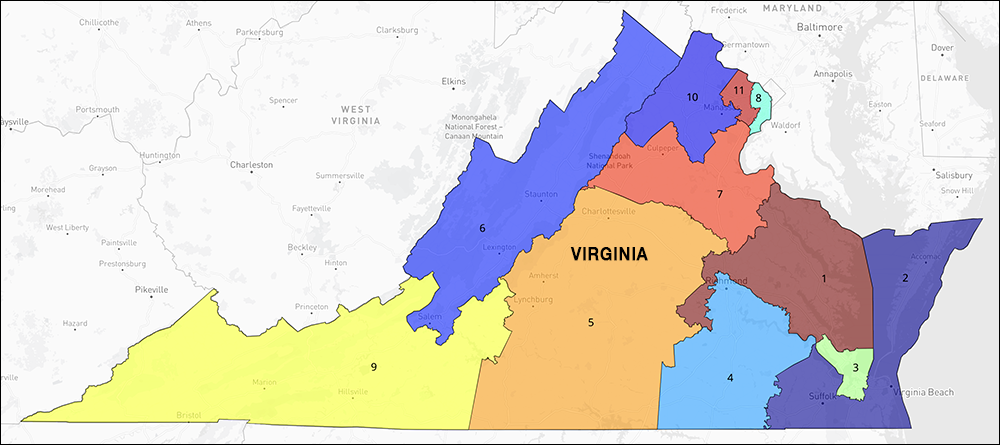
Despite a lower court ruling that negated the Virginia attempt to redistrict because the judge ruled that the legislature violated their own rules in order to schedule a redistricting referendum vote, the state Supreme Court is allowing the proposed April 21 referendum to proceed.

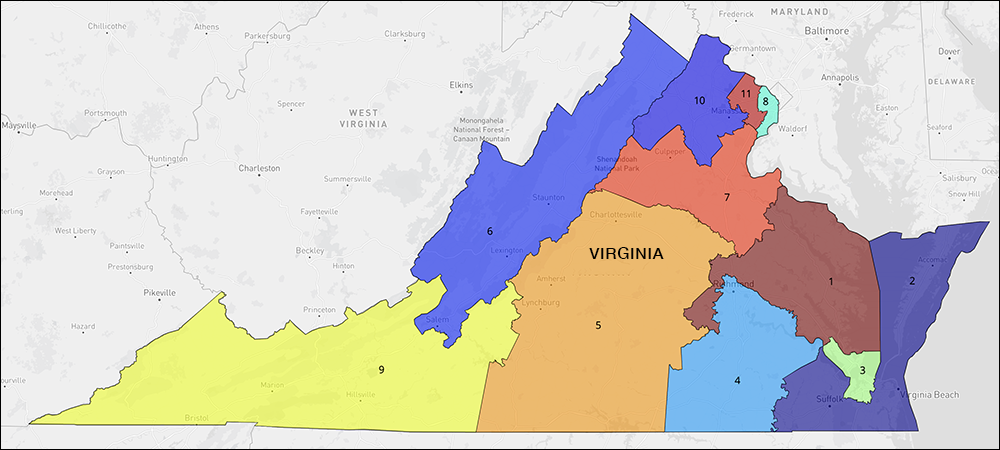
Virginia Congressional Districts / Dave’s Redistricting App

The decision would allow the public to vote on a proposed map, likely without the voters actually seeing the draw, and although the justices indicated they will continue to hear the case and review the previous ruling, the issue of whether the new map will be used for the 2026 election remains unclear.

It is probable, after the referendum vote likely passes that the new map will be in place for the current 2026 election cycle.

This new plan will radically change the state. Currently, the Democrats have six congressional seats in the Virginia delegation and the Republicans’ five. The new plan projects that Democrats could gain four seats, thus making a 10D – 1R delegation.

Some analysts suggest that a 9D – 2R split is more likely, however. Congresswoman Jen Higgins (R-Virginia Beach) would be placed in a 50-50 District 2, and her likely opponent is the woman she unseated in 2022, former Congresswoman Elaine Luria (D). Therefore, the Virginia Beach race might be the tightest in the state. The rest of the GOP members will be likely drawn out of their seats or paired with another Republican.

From a national redirecting standpoint, the Virginia situation is extremely critical because if the Democrats gain four seats here, they very possibly could finish slightly ahead of Republicans in national redistricting if they meet their stated goals in California, Utah, and Virginia.

The national redistricting picture is still cloudy. It is unclear exactly how many new maps will be in place for the 2026 election, and if either party could meet their stated maximum goals regarding the flipping of congressional districts to their side.

Therefore, many unanswered questions remain regarding which maps will be in place for election year 2026 and is largely due to judicial inaction.

The new maps locked into place lie in California, North Carolina, Ohio, and Texas. The states where legal and political challenges remain are Louisiana, still before the US Supreme Court; Missouri, regarding a qualification of a balance initiative that can negate their new map; and Florida, balanced on whether will or not a new map will pass in a special legislative session. Those are in addition to the three states we covered in this column, New York, Utah, and Virginia.

Court Tosses Virginia Redistricting; Florida Rep. Vern Buchanan to Retire

Virginia Congressional Districts map / Dave’s Redistricting App

By Jim Ellis — Thursday, January 29, 2025

Virginia

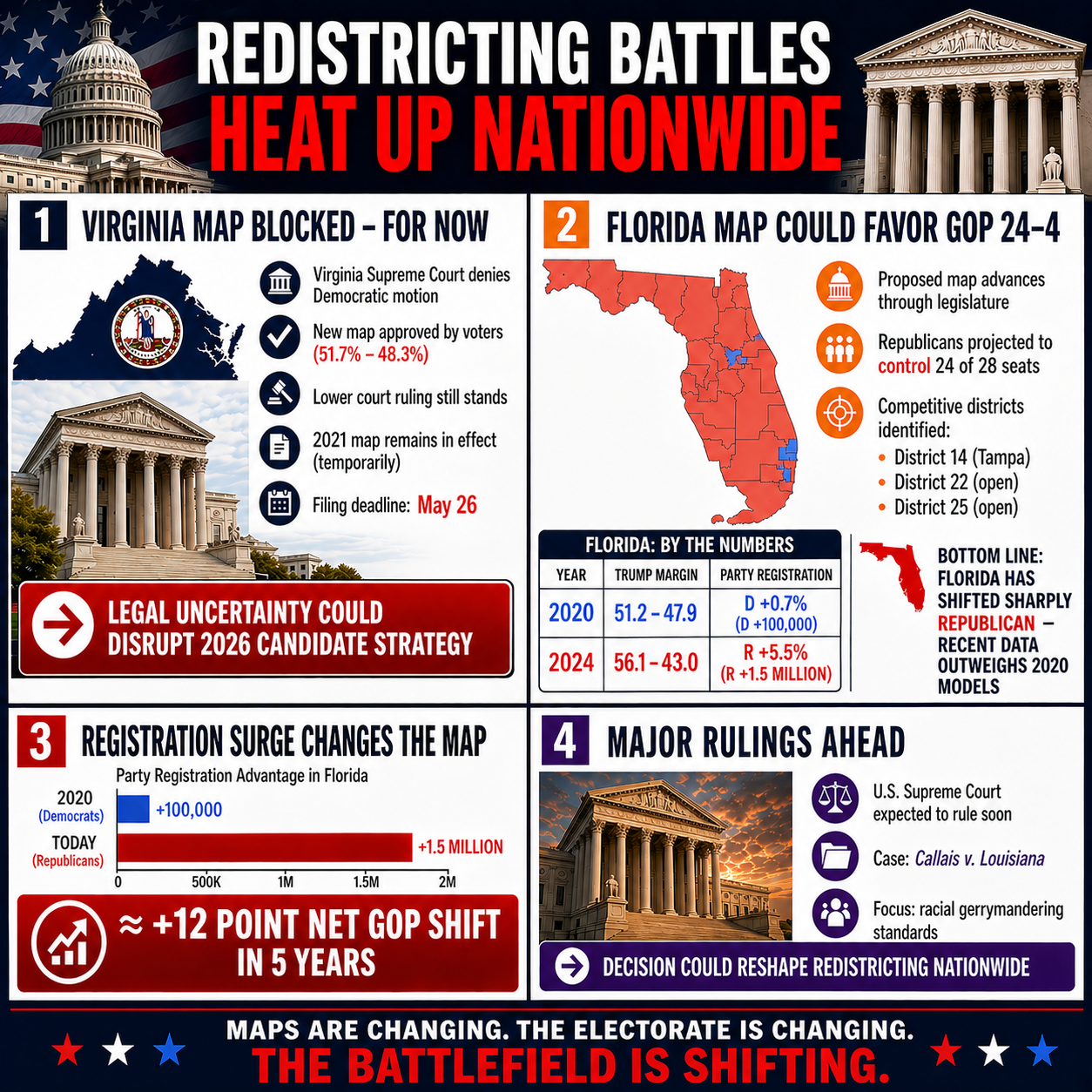
A Virginia Circuit Court Judge ruled that the legislature violated its own rules in hastily voting to place a partisan redistricting referendum on a statewide special election ballot. Therefore, with this ruling, the Virginia congressional redistricting referendum is likely nullified for the 2026 election cycle.

Judge Jack Hurley Jr. agreed with three of the four plaintiffs’ arguments, which is enough to halt the redistricting process. The arguments largely pertained to legislative procedure for special sessions: determining that the legislators violated certain rules they almost unanimously put in place, and not providing timely notice to voters and counties about the upcoming referendum in accordance with Virginia election law.

The Old Dominion redistricting outcome may have been devastating to Republicans if the proposed map outline, which has not been unveiled publicly, ultimately delivered a 10D-1R partisan split as reported. The current Virginia delegation is 6D-5R. Unless something changes on the legal front in relation to appealing this decision, the 2026 election will be conducted on the present 2021 map.

The Virginia candidate filing deadline is April 2 for the June 16 primary election. Therefore, the 2026 political clock at least regarding redistricting is now on the Republicans’ side.

Yet, even under the current map, several seats will be hotly contested in the midterm election cycle. Eleven Democrats have announced their challenge to veteran 1st District Rep. Rob Wittman (R-Montrose). Former Congresswoman Elaine Luria (D) is mounting a comeback attempt against the woman who unseated her in 2022, Rep. Jen Kiggans (R-Virginia Beach), in District 2.

Moving to the central part of the state, freshman Rep. John McGuire (R-Manakin-Sabot) faces a primary challenge from former Congressman Bob Good in a rematch from the 2024 primary, and general election competition from ex-Congressman Tom Perriello (D), assuming he tops seven other Democrats also vying for the party nomination.

Moving into Northern Virginia, state Sen. Tara Durant (R-Fredericksburg) is poised to run a competitive campaign against freshman Rep. Eugene Vindman (D-Dale City) in the politically marginal 7th District.

Regardless of the electoral map, Old Dominion voters can expect a very active 2026 congressional political cycle.

FL-16

Ten-term Florida Rep. Vern Buchanan (R-Sarasota) announced that he will not seek re-election later this year. The Buchanan retirement means that 55 US House seats are open for the next election. The number includes the four seats that are vacant due to death of an incumbent or resignation from the House and will be filled in special elections.

Of the 55, Rep. Buchanan joins 18 other members who are retiring from elective politics. The others, excluding the two deceased members, are running for another office, either Governor or US Senate. Of the 55 open seats, a total of 30 come from the Republican aisle compared to 20 who are Democrats. The remaining five are new open seats created through 2025 redistricting maps in California and Texas.

Buchanan’s 16th Congressional District, anchored in Bradenton and Manatee County, is safely Republican. The district also houses 25 percent of Hillsborough County. The other population centers are the cities of Bloomingdale, Sun City Center, and Palmetto.

According to the Dave’s Redistricting App statisticians, the Republicans hold the partisan lean advantage at 55.2R – 42.7D. President Trump carried the 16th with a 57.3 – 41.8 percent vote spread in 2024.

It is likely, however, that all of these numbers will change if the legislature follows through and passes redistricting legislation later in the year. Gov. Ron DeSantis (R) says he will call the legislature into special session in April for the purpose of redrawing the congressional boundaries.

Rep. Buchanan is the third member of the Florida delegation to not seek re-election. The other two are Reps. Neal Dunn (R-Panama City) who is retiring, and Byron Donalds (R-Naples) a gubernatorial candidate.

Expect the new 16th District to be slightly less Republican, as will the surrounding seats on Florida’s Gulf Coast. Doing so will allow more Republican voters to be drawn into Democratic seats, and particularly the district of Rep. Jared Moskowitz (D-Parkland) who is clearly in the most vulnerable political position of any central/southern Florida Democratic member.

Redistricting Becoming Clearer

By Jim Ellis — Tuesday, Dec. 16, 2025

Redistricting

Putting together the redistricting puzzle

The redistricting wars may be coming to a head. Recent action has occurred in several states providing a better national redistricting picture in preparation for the 2026 election.

Below is a synopsis of the latest developments:

California: After a majority of California voters approved the special election redistricting referendum, a racial gerrymandering lawsuit was filed against the state’s new map.

Meanwhile, the US Supreme Court issued a stay on the Texas racial gerrymandering lawsuit, with a rebuke from Justice Samuel Alito to the three-judge panel in El Paso for rendering a decision before the high court ruled on a related Louisiana racial gerrymandering case. Thus, it became clear that all other cases would be held until the high court issues what could be a landmark ruling.

The judicial action likely means the new California map will be in place for the 2026 election. The original map proponents believe the plan will return five more seats for the Democrats, reducing the Republicans to just four of 52 Golden State districts.

Florida: Late last week, Gov. Ron DeSantis (R) said that the state will redistrict the congressional map and do so during the Spring. The Florida primary is not scheduled until Aug. 18, so time remains to complete the redistricting process. It is possible that Republicans could gain two seats from a new map.

Georgia: A new Georgia map has been completed. The legislature made minor changes to the existing plan that will not likely affect the current partisan division (9R-5D).

Indiana: Late last week, the Indiana state Senate defeated a redistricting map that the state House passed. The plan would have converted two Democratic seats to Republican, thus sweeping the nine-member delegation. Unless the Senate reconsiders the action, the current 7R-2D map will remain intact for the 2026 election.

Louisiana: The US Supreme Court is considering the Callais racial gerrymandering case that could become the vehicle for the justices to render a landmark racial gerrymandering decision. A ruling was expected in June, but the justices postponed their opinion and ordered a second round of oral arguments. The subsequent hearing was held Oct. 15, and all await a final determination.

If the court upholds the lower court decision, the current Louisiana map will be invalidated, meaning the Republicans will likely gain one seat. Should this be the Supreme Court’s ultimate decision, then the possibility exists that the Alabama map will also be redrawn because its plan is virtually identical to Louisiana’s.

Maryland: In a situation similar to what is found in Indiana, most of the Maryland Democratic political establishment favors attempting to collapse their one Republican congressional district, but the state Senate leadership refuses to take action. Therefore, unless the Senate President completely reverses himself, a new redistricting map will not be enacted.

Missouri: The Missouri legislature and Governor have enacted a new map that will likely convert the Kansas City anchored 5th CD from Democratic to Republican. Opponents of the map, officially organized under a group name entitled People Not Politicians, have collected double the number of signatures needed to force a special election initiative vote with the goal of repealing the new map. If a ruling is made qualifying the initiative for the ballot, voters will then decide if the new map will stand.

Under Missouri procedure, simply qualifying the initiative will suspend the new map. This means the state would be forced to revert to the 2021 map for the 2026 election. An initiative vote would occur in the regular election cycle. If the voters adopt the new plan, it would take effect in the 2028 election cycle.

North Carolina: The legislature’s new congressional map will almost assuredly stand for the 2026 election. The initial complaint protesting the plan was rejected at the lower court level. The US Supreme Court’s action involving the Texas case suggests that no further judicial movement will occur on the new North Carolina plan before the candidate filing deadline on Dec. 19. Therefore, it is likely that Republicans will gain one seat in the Tar Heel delegation.

Ohio: The bipartisan elected official redistricting commission unanimously agreed upon a new congressional map, one that state law mandated be drawn. Under the Ohio procedure, a unanimous decision from the redistricting panel, which included Gov. Mike DeWine (R), means the map is officially enacted without action from the state legislature. The new plan will likely produce a one seat gain for Republicans in western Ohio, with the outside possibility of a second conversion in Cincinnati.

Texas: As discussed above, the Supreme Court stayed the three-judge panel decision that ruled the new map a racial gerrymander. Candidate filing has concluded, so the new 2025 map will be in place for the 2026 elections. The original map proponents believe the plan will return five more seats for the Republicans.

Utah: A state court ruled that the legislature ignored certain criteria that voters adopted in a previous redistricting initiative. Therefore, the 2021 map was declared invalid, a ruling that the state Supreme Court sustained. The court then adopted a new map that created a Salt Lake City Democratic seat. The new plan will produce a 3R-1D map for the 2026 election, which is a gain of one Democratic seat.

Virginia: The Old Dominion redistricting effort may determine which party wins the national redistricting wars. With the Democrats gaining full control of the state government, the new legislature must pass a referendum for the ballot when they convene in January. The measure will have to fulfill other legal requirements, and a special statewide referendum election is required. Voters would have to approve a new map before the April 2 candidate filing deadline for the June 16 primary election.

Democrats claim they can draw a map that will relegate Republicans to just one seat in the 11-member delegation. Currently, the Virginia congressional districts split 6D-5R. A four-seat swing in this state could tip the balance of power toward the Democrats in their quest for the US House majority.

A Democratic Sweep: Sherrill, Spanberger, Mamdani and More All Win

By Jim Ellis — Wednesday, Nov. 5, 2025

Elections

New York City voters elected Democratic Socialist Zohran Mamdani as their next Mayor.

Last night’s election results yielded victories for Democrats across the board and it appears that high prices and the state of the economy are among the top reasons.

Of course, Democrats will argue that their attacks against President Trump compared to the election results is a rejection of the current administration, and the votes provide evidence for such a claim, but New Jersey and New York City are heavily Democratic enclaves, and the Washington, DC metropolitan area, including the Northern Virginia and Maryland suburbs have repeatedly proven itself as the most anti-Trump region in the country.

Therefore, within the partisan context, the election results should not be considered overly surprising.

New York City

As expected, state Assemblyman Zohran Mamdani (Democratic/Working Families) was elected Mayor of New York City last night, capturing what looks to be a bare majority of the vote.

In the end, it appears the self-described Democratic Socialist outpaced former Gov. Andrew Cuomo (Fight and Deliver Party), and Curtis Sliwa (Republican/Protect Animals Party) by a 50.4 – 41.6 – 7.1 percent margin. Polling did not fully capture Mamdani’s strength, nor Republican Sliwa’s weakness. In particular, the latter man polled approximately ten points better on average than his ultimate performance.

Certainly, barely going over the 50 percent mark gives Mamdani the mandate he needs to implement his more radical agenda, and certainly will have support to do so from the New York City Council. Much more to come in the ensuing weeks about this result and the new Mamdani Administration.

New Jersey

This gubernatorial election outcome was one of the most surprising decisions of last night as Rep. Mikie Sherrill (D-Montclair) scored what will likely be a 56-43 percent win over 2021 Republican gubernatorial nominee Jack Ciattarelli despite polling that suggested the race was falling into the toss-up range.

The Sherrill victory represents the first time a political party has won three consecutive New Jersey gubernatorial elections since World War II.

With the Congresswoman’s victory, we will see another special congressional election, this time in her 11th District seat. Sherrill will resign from the House shortly before she assumes the Governorship in mid-January. One of her first duties will be to schedule the special election for voters to elect her successor. Already vying for positioning are former NJ-7 Congressman Tom Malinowski (D) and several local Democratic officials.

Virginia

Polling in this race was spot on, as survey research firms were not only consistently projecting an Abigail Spanberger victory, but they also saw the surge for the Democratic candidates in the final week of early voting and on Election Day. The combination carried not only Spanberger, but also Lt. Gov.-Elect Ghazala Hashmi and Attorney General-Elect Jay Jones to victory as part of the Democratic sweep.

The most surprising result was Jones defeating AG Miyares after the controversy broke several weeks ago about him fantasizing about killing his Republican opponents. Much analysis about the Attorney General’s result will be forthcoming over the next period of days when the actual results can be digested.

California Proposition 50

As expected, last night Golden State special election voters easily adopted the referendum to replace the California Citizens Redistricting Commission congressional map with a plan that Gov. Gavin Newsom had drawn. The redraw gerrymander could net the Democrats five seats and reduce the Republicans to four of the state’s 52 congressional districts.

Whether the map actually produces such results remain to be seen in the 2026 election. We can expect to see legal challenges to the entire process to soon be forthcoming but with a strong public vote, overturning the new map becomes very difficult.

TX-18

The jungle primary for the third of four special congressional elections to fill vacancies was held in Houston last night. The results will go to a runoff election that Texas Gov. Greg Abbott (R) will schedule as soon as the Secretary of State verifies that no candidate received a majority of the vote.

The verification will come quickly, since Harris County Attorney Christian Menefee (D) and former Houston City Councilwoman Amanda Edwards (D) placed first and second with 32 and 25 percent of the vote, respectively. Therefore, no one came close to obtaining majority support.

The problem for whoever wins the runoff election, which will likely be in January, is that he or she will have to turn around and participate in a March 3, 2026, primary in another version of the 18th District and against incumbent Rep. Al Green (D-Houston) under the new Texas congressional map.

The Democrats are assured of keeping the 18th District seat to replace the late Rep. Sylvester Turner (D-Houston), but the prize may be short-lived because the regular primary in the new district will be just weeks after securing victory.

Election Day Preview

By Jim Ellis — Tuesday, Nov. 4, 2025

Elections

The major odd-numbered elections are upon us with early voting completed and election day occurring today in New Jersey, New York City, and Virginia. Polling projects a good night forthcoming for Democrats, but the available early voting statistics suggest Republicans might be stronger than the polls indicate.

New Jersey

The open Governor’s race is the main focus on the Garden State ballot, and it may well become the most interesting contest to follow tonight.

The polling momentum has closed in Republican Jack Ciattarelli’s favor with the latest five publicly released surveys from the Oct. 25-30 period finding Rep. Mikie Sherrill (D-Montclair) holding an average 3.4 percentage point advantage. This number is down from a much higher range, usually in the upper single digits, for most of the race.

Furthermore, if the SoCal Strategies poll (Oct. 28-29; 800 likely New Jersey voters) is removed from the group because its seven-point spread (52-45 percent) is an outlier when compared with the other four (Atlas Intel, Emerson College, Quantus Insights, and Suffolk University), the Sherrill average point lead drops to 2.5.

Additionally, Ciattarelli has under-polled in his previous races, particularly in the primary earlier this year and by a large amount. Going into the five-way 2025 Republican primary, Ciattarelli’s highest preference number was 54 percent yet he ended with a 68 percent actual vote total. Should this Ciattarelli under-poll pattern continue in this year’s general election, we could see an upset.

New Jersey early voting statistics are not as available as in some other places, but Ciattarelli’s assessment that more Republicans are voting early that ever before appears correct. According to CBS News, approximately 514,500 Democrats have voted early as compared to an approximate 279,000 Republicans, and 177,000 non-affiliated and minor party voters.

These raw number figures translate into 56.5 percent of the early voters being Democrats, 30.6 percent Republicans, and 12.9 percent non-affiliated and others. While the Democrats lead the early vote count, their percentage is down from 2024 when the Dems accounted for 68.0 percent of the early voting participation numbers and 2022 when their percentage was 59.9 according to the Target Early Target Smart organization calculations.

Though the 2025 Republican number is much smaller than the Democratic percentage, it is up from 27.4 percent in 2024, but down from a 32.2 percent participation factor in 2022. The Non-affiliated/ Other category accounted for 4.7 percent of the early voters in 2024 and 7.9 percent in 2022. Therefore, the NA/O segment’s 12.9 percent early turnout is considerably ahead of the previous elections.

New York City

While Assemblyman and New York City mayoral nominee Zohran Mamdani’s (D) polling percentages are falling somewhat as Election Day dawns, the three-way candidate structure virtually assures that he will win tomorrow’s election, but likely with only a plurality of the votes.

While the majority of NYC voters are likely to choose a mayoral candidate other than the Democratic nominee, the split between former Gov. Andrew Cuomo (I) and Republican Curtis Sliwa will benefit Mamdani.

Since the race has not changed greatly since Cuomo entered under a minor party label after losing the Democratic primary, today’s outcome is unlikely to be surprising.

Virginia

In the Old Dominion’s gubernatorial race, former Rep. Abigail Spanberger is clearly favored to defeat Republican Lt. Gov. Winsome Earle-Sears and convert the commonwealth’s Governorship to the Democrats. Incumbent Gov. Glenn Youngkin (R) is ineligible to seek re-election under the only one-term limit law in the country.

The final five Virginia gubernatorial polls conducted during the Oct. 25-31 period (from Atlas Intel, Echelon Insights, Insider Advantage/Trafalgar Group, SoCal Strategies, and State Navigate) give Spanberger leads of between four and 12 points, margins she has maintained for most of the election cycle.

Yet, the early vote numbers tend to suggest an improved GOP standing. All five of the state’s congressional districts where the electorate sends a Republican to the US House have substantially improved their early vote participation rates when compared to 2021.

According to the latest available reports from the Virginia Public Access Project (VPAP), the statewide increase in early voting is just under 10 percent. All five Republican House districts, however, are up between 20 and 41.9 percent in early voting participation through Friday.

From the six Democratic districts, only two report increased turnout compared to 2021, and even this pair’s increase is below the statewide average. The other four Democratic congressional districts, at least through Friday’s count, have failed to equal their previous 2021 early voting numbers.

Since Virginia’s early voting numbers are not measured by political party preference, largely because the Old Dominion does not register voters by party, it is difficult to tell if the congressional district breakdowns accurately reflect the partisan composition of 2025 early voting.

The clue, however, that the Republican represented districts are all substantially up in early voting and most of the Democratic seats are down should suggest that Republicans are likely to outperform their polling standing.

Furthermore, it is important to remember that the Republicans won the 2021 election, so Democrats falling behind their losing benchmark numbers from the previous election is another clue that 2025 Virginia voter enthusiasm is higher on the GOP side.

The most likely outcome of tomorrow’s election, however, is a Spanberger victory, a closer Lieutenant Governor’s race, but one that still suggests a slight victory for Democratic nominee Ghazala Hashmi, and a Republican victory for Attorney General Jason Miyares, largely due to the controversy surrounding Democratic nominee Jay Jones.