
By Jim Ellis — Thursday, May 21, 2026
Senate
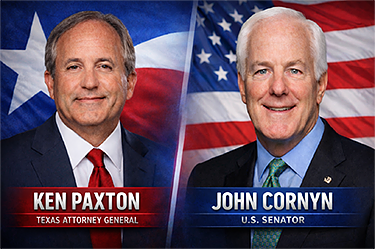 The Texas Senate Republican runoff is Tuesday, and President Trump’s endorsement this week of Attorney General Ken Paxton over Sen. John Cornyn has certainly drawn even more attention to this race. But is it the clinching blow? Several points suggest otherwise.
To recap, Sen. Cornyn placed first in the March 3 primary with a 41-40 percent edge over AG Paxton. The incumbent performed well in the state’s major population centers while Paxton handily carried most of the Texas rural regions with the notable exceptions of the Panhandle and South Texas.
As we have seen recently with the defeats of Louisiana Sen. Bill Cassidy and Kentucky Rep. Thomas Massie, the President has been on a strong political run in helping his endorsed candidates secure victories.
There are several reasons why the Texas situation differs from the previously mentioned campaigns. In both the Cassidy and Massie races, President Trump’s involvement centered on Republican officeholders who had openly opposed him. Trump sought to defeat Sen. Cassidy because of his vote to convict during the 2021 impeachment proceedings.
Rep. Massie, meanwhile, had long been a member who frequently broke with the President’s proposals and was widely viewed as the least loyal House Republican in terms of supporting Trump’s policy agenda.
The Texas situation is different. First, the President is not attacking Cornyn as an enemy; in fact, for a time he appeared inclined to endorse the Senator. This, even though Paxton has been a loyal Trump supporter since the very beginning of the President’s political rise in 2016.
Secondly, both four‑term Sen. Cornyn, previously elected as state Attorney General and to the Texas Supreme Court, and AG Paxton, who has won three statewide general elections and two competitive primaries, are already very well known to Texas Republican primary voters. As a result, the extent to which a last‑minute presidential endorsement can sway or energize voters on Paxton’s behalf is open to question.
Third, it’s possible the President is influenced with the latest polls because the most recent May research studies have produced results suggesting the closing trends were moving away from the incumbent.
Peak Insights (May 2-5; 800 likely Texas Republican runoff voters) found Cornyn and Paxton virtually tied with a 47-46 percent split in the Senator’s favor. The Remington Research Group and the Global Strategy Group, the latter a Democratic pollster, detected a much different result slightly later in the month. The RRG data (May 3-5; 1,810 likely Texas Republican runoff voters) reported Paxton leading 47-36 percent, while GSG (May 6-11; 600 likely Texas Republican runoff voters) saw an even wider 52-40 percent Paxton advantage.
If polls factored into the President’s endorsement, the decision may have been hasty. In the primary, the six surveys conducted closest to Election Day showed Paxton leading by an average of seven percentage points. Yet Cornyn ultimately prevailed by a single point, indicating an eight‑point average polling miss.
Additionally, polling for a runoff is even more challenging than polling for a primary. Turnout in a Texas secondary election is typically one‑third to one‑half lower than in the primary, making accurate measurement even more difficult and the results less certain.
Furthermore, turnout tends to be higher in metro areas than in rural communities, a dynamic that could help Cornyn since he did well in the cities on March 3.
While the state does not have a mass vote‑by‑mail program, it does allow in‑person early voting for roughly a month before Election Day in regular elections and over a five‑day period for runoffs. According to the Target Early Target Smart organization, which tracks early voting, three‑quarters of the 2024 Texas general‑election vote was cast before Election Day.
With early voting ending on Friday, the Trump endorsement may have less impact because a substantial share of ballots are already cast.
The Texas Senate race remains one of the more compelling contests of the 2026 election cycle and will continue to draw significant attention through the general election, regardless of Tuesday’s Republican runoff result.
While the Trump endorsement has proven golden for many Republicans seeking a party nomination, the factors outlined above suggest the outcome on May 26 could be different. Once again, significant political attention will soon be focused on the Lone Star State.