Tag Archives: Super Delegates

Biden Still in Driver’s Seat, But Down in New York; Maloy Still Struggles in Utah; Filing Closes in Delaware

By Jim Ellis — Friday, July 12, 2024

President

President Joe Biden / Photo by Gage Skidmore

President Biden: Still in the Driver’s Seat — While pressure continues to mount on President Joe Biden to withdraw from his re-election candidacy, some still believe there is a way to change the rules at the Democratic National Convention to allow a free vote of the delegates. Doing so will be highly unlikely, however, because Biden’s total delegate vote includes 1,581 individuals not bound by party rules but rather state law. Therefore, those delegates will not be free.

To win the party nomination, a candidate must have 1,968 votes. This means from the remaining delegates, the president would need only keep 387 of the “freed” 2,368 delegates who are already pledged to vote for him. This factors into just 16.3 percent of the non-state law bound delegates.

The party would also have the option of changing the convention rules to allow the Super Delegates to vote on the first ballot, something they cannot currently do. The Super Delegates are officially called PLEO (Party Leader Elected Official) votes. There are 747 of these individuals. To add them, however, the non-PLEO delegates would have to vote to dilute their own power. It is unlikely a majority of the non-PLEO delegates will vote in such a manner even if this unlikely choice is presented.

House

New York: Biden’s Poll Deficit — The political situation continues to deteriorate for President Biden. As reported on X from journalist Jacqueline Sweet, Democratic polls that won’t be published apparently report that the president is trailing in two potential Democratic conversion districts by double-digit margins, seats that he carried in 2020.

The two are NY-17 and NY-19 that freshmen Reps. Mike Lawler (R-Pearl River) and Marc Molinaro (R-Red Hook) currently represent and won with close margins. As a point of reference, Biden carried the 17th with a 54-44 percent margin in 2020, and a 51-47 percent split in NY-19.

UT-2: Canvass Period Begins; Recount to Follow — Utah US Rep. Celeste Maloy (R-Cedar City) is not out of the woods yet from her close Republican primary race against businessman Colby Jenkins, conducted on June 25. The Utah election officials finally finished the end count, and what was a 309-vote margin for Maloy has dropped to 214 votes.

The process is not yet finished. The election staff must conduct a canvass to certify a final vote. Since the current margin is now within the range where a recount can be requested, Jenkins says he will do so after the canvass. This means the counting and recounting process could drag on until the end of July.

States

Delaware: Candidate Filing Closes — Candidate filing has now closed for the late Delaware primary scheduled for Sept. 10. Though the state features an open Senate and at-large House seat, little in the way of competition will be seen either in the Democratic primary or general election.

US Rep. Lisa Blunt Rochester (D-Wilmington) is a lock for the party nomination and the November election and will replace retiring Sen. Tom Carper (D) in the next Congress. State Sen. Sarah McBride (D-Wilmington) is the prohibitive favorite to win the party primary and the November election to replace Rep. Blunt Rochester. Upon election, she will become the first transgender individual elected to Congress.

The only competition appears to occur in the open governor’s race as incumbent John Carney (D) is ineligible to seek a third term. Lt. Gov. Bethany Hall-Long, New Castle County Executive Matt Mayer, and National Wildlife Federation CEO Collin O’Mara are all competing for the Democratic nomination. The eventual primary winner will then punch his or her ticket to the governor’s mansion.
Biden Showing Up Strong in North Carolina – But Is It Enough?

Former vice president and 2020 Democratic presidential candidate, Joe Biden

By Jim Ellis

Oct. 11, 2019 — Raleigh-based Public Policy Polling just released their latest North Carolina survey (Oct. 4-6; 963 likely North Carolina voters, 410 likely North Carolina Democratic primary voters) Wednesday, which projects a two-person race developing in the Tar Heel State as former Vice President Joe Biden leads Sen. Elizabeth Warren (D-MA), 39-22 percent. South Bend Mayor Pete Buttigieg receives nine percent support, while Sen. Bernie Sanders (I-VT) earns only a disappointing six percent. All other candidates fail to break the three percent level.

North Carolina is one of the Super Tuesday states, a state whose electorates will cast ballots on March 3, the largest voting day of the nominating season. On March 3, a total of 14 states and one territory will host primaries or caucuses, seven of which come from the south. It is here where former Biden would have to make his stand, since his southern numbers are the best of any candidate by a wide margin.

The question being posed is whether a sluggish Biden start in the first three voting states, Iowa, New Hampshire, and Nevada, where he could conceivably fail to place first in any, would derail his momentum to the point of lessening his southern advantage.

Making rudimentary delegate calculations from the 19 entities that would vote on or before Super Tuesday, we find that current polling would place the former vice president in the lead on the evening of March 3, but that his delegate edge would certainly not be dominating.

To re-cap, based upon the latest polling from Iowa, New Hampshire, and Nevada, the delegate estimate prior to South Carolina would find the former VP and Sen. Warren tied with 37 delegates apiece, while Sen. Sanders would have 27, meaning a virtual three-way tie despite Biden not winning any of the states outright. If he can stay in the hunt — with neither of his key opponents establishing themselves as a clear leader — the tide turns Biden’s way.

Continue reading

Delegate Projections

Super Delegates at the Democratic National Convention: Just how big an impact could they have?

By Jim Ellis

Sept. 23, 2019 — Recent polling data has been released in 11 Democratic presidential primary states that allows us to make rudimentary delegate vote calculation projections as to where the top candidates stand in the nomination process.

The data-producing 11 states include all of the early voting entities: Iowa, New Hampshire, Nevada, and South Carolina, along with big states such as California, Texas, and Florida. Also included is Massachusetts, another Super Tuesday state that is of course Sen. Elizabeth Warren’s home, along with Arizona and the later voting states of Wisconsin and New Jersey.

The polling data allows us to look at the particular state and then assign the candidates specific delegate votes based upon their standing. Obviously, the projections are mere estimates because they are based upon polls and not actual votes, and we extrapolate the statewide totals for each congressional district, which is also not reality. Actual delegate votes are awarded on an at-large and district basis.

But, as basic as they are, these calculations still yield an idea as to where the candidates would land if the actual voting is truly within range of the available polling results.

To qualify for delegates either through state at-large or district delegates, a candidate must exceed a 15 percent popular vote threshold. In the 11 polls, only three candidates would qualify for delegate votes in any of the tested states: former Vice President Joe Biden, Sen. Warren, and Vermont Sen. Bernie Sanders.

Based upon their polling standing in each state and calculating the delegate formula thereupon reveals that each of the three obtains a substantial share. The 11 states’ aggregate delegate total of 1,360 represents 36.1 percent of the entire first ballot total. To be nominated, a candidate is required to earn 1,885 first ballot delegate votes.

Continue reading

Probing the Second Choice

By Jim Ellis

Former vice president and ex-Delaware senator Joe Biden

Sept. 18, 2019 — The Morning Consult organization released their post-debate survey and it shows former Vice President Joe Biden stabilizing his lead over the Democratic presidential field. Arguably the contender who needed to register the best performance in the September debate, Sen. Kamala Harris (D-CA), because she had lost considerable support since her August performance before a national televised audience, fell well short of her intended goal.

According to the MC data (Sept. 13-15; 7,487 Democratic likely primary voters with an over-sample from the first four voting states, Iowa, New Hampshire, Nevada and South Carolina), Biden remains well ahead of his two closest competitors. The results find the former vice president securing 32 percent support, holding constant from the August post-debate poll. Sen. Bernie Sanders (I-VT) also remains in a stagnant position posting 20 percent both in the new September survey and from August. Sen. Elizabeth Warren (D-MA), however, increased from 15 to 18 percent after the two Democratic presidential forums.

Sen. Harris has been on a downward spiral since July, a period that could prove to be her candidacy’s apex. After the first debate, Sen. Harris reached 14 percent support in the Morning Consult survey, and appeared to be on an upward trend. After the August forum, however, she slipped to nine percent, and post the September forum she slid even further to six percent preference.

South Bend Mayor Pete Buttigieg has also fallen over the course of time. It appears he hit is high mark in April when he scored nine percent nationally but fell back to the five percent range in July and, except for a short-lived blip in August, has remained stagnant in the mid-single digit range.

Though the numbers are consistent for the leaders in the Morning Consult survey series, other polling firms see a much tighter contest among the top three. The second choice question that MC routinely asks, on the other hand, may provide better perspective as to where the race is headed, or where it might should one of the top three fade in the early voting states, leave the campaign, or remain tightly bunched to force additional roll call votes at the convention.

Continue reading

Polling vs. Delegates:
“The Game Within the Game”

By Jim Ellis

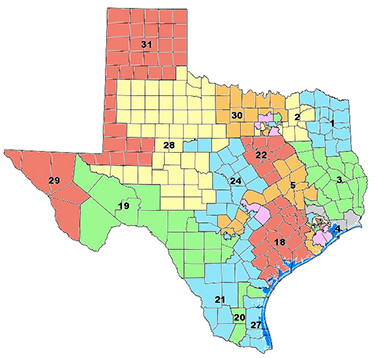
Texas state senate districts

June 7, 2018 — Quinnipiac University released their latest Texas poll (May 29-June 4; 1,159 registered Texas voters) and it finds former Vice President Joe Biden doing well in opponents’ Beto O’Rourke and Joaquin Castro’s home state.

According to the results, Biden heads the Lone Star State Democratic presidential field and is the only candidate to top President Trump when the president is isolated against each competitive Democrat (Biden over Trump: 48-44 percent).

Arguably, Texas, with its 38 Electoral Votes and the largest cache that a Republican candidate can generally claim, is Trump’s most important state. Losing here would likely mean forfeiting the presidency. There is no mathematical way to compensate for Trump failing to win Texas’ electoral votes and still allow him a path to reach the 270 Electoral Votes to claim a national victory.

In the Democratic primary, scheduled for Super Tuesday, March 3, Biden leads the pack of candidates with 30 percent of the vote, topping ex-Rep. O’Rourke (16 percent), Sen. Bernie Sanders (15 percent), Sen. Elizabeth Warren (11 percent), and the nine others who recorded between one and four percent statewide support.

Sens. Amy Klobuchar (D-MN), Kirsten Gillibrand (D-NY), Michael Bennet (D-CO), Govs. Jay Inslee (D-WA) and Steve Bullock (D-MT), Reps. Tulsi Gabbard (D-HI), Eric Swalwell (D-CA), Seth Moulton (D-MA), and Mayors Bill de Blasio (New York, NY), Wayne Messam (Miramar, FL), failed to reach the one percent plateau.

But, how would such a vote split translate into delegates for the participating candidates? Under Democratic Party rules, each state has both at-large and district delegates. Another group, called PLEO’s, are comprised of state and local Democratic Party leaders along with elected officials.

Continue reading

Poll: Sanders Up in California

By Jim Ellis

April 12, 2019 — The Change Research polling organization released a new Democratic primary poll of the California electorate (April 6-9; 2,003 likely California Democratic primary voters) and projects Sen. Bernie Sanders (I-VT) to be nipping former Vice President Joe Biden and home state Sen. Kamala Harris. In a secondary ballot test that excludes Biden, Sanders prevails over Harris even under this scenario.

Earlier in the week, Emerson College released a Massachusetts Democratic primary poll (April 4-7; 371 likely Massachusetts Democratic primary voters) that found Sen. Sanders leading Biden and Massachusetts home state Sen. Elizabeth Warren (26-23-14 percent). Therefore, we are clearly seeing a Sanders rise in the early part of April.

In the Change California poll, Sanders has a slight 22-21-19 percent lead over Biden and Harris – obviously a statistically insignificant margin – but it does show that Sen. Harris is not dominating her own electorate. Taking fourth, fifth, and sixth in this poll are ex-US Rep. Beto O’Rourke (D-TX) with 10 percent, South Bend (IN) Mayor Pete Buttigieg at nine percent, and Sen. Warren pulling only eight percent of the vote.

If Biden chooses not to run, since he is still not an announced presidential candidate, Change finds that Sen. Sanders would edge Sen. Harris 28-27 percent, with O’Rourke (16 percent), Buttigieg (11 percent), and Warren (nine percent) following.

This tells us, at least in the early going, that California, with its large 416 first ballot delegate contingent, is clearly up for grabs even with its home state senator in the field of candidates.

Continue reading

Could The Democrats Be Headed
Towards a Convention Free-For-All?

By Jim Ellis

April 11, 2019 — One of the most interesting facets of the Democratic presidential nomination process sounds mundane, but it may be more telling than any single campaign factor.

The primary/caucus schedule will in many ways determine if the party can coalesce behind one candidate before the Democratic delegates convene in Milwaukee during mid-July, or if they’ll be headed to a contested convention featuring several roll calls.

To win the nomination a candidate must either garner majority support on the first ballot (1,885 votes from a field of 3,768 elected delegates) or from among the full complement of 4,532 Democratic delegates on subsequent roll calls when the 764 Super Delegates are eligible to vote.

Joining the early mix, meaning the states that will vote on or before March 17, 2020, is Washington state, which has moved their nomination event. Additionally, over just this past weekend, the Washington Democrats passed a new party rule that transforms the previous delegate-apportioning caucus into a statewide primary. Previously, the state featured both apparatuses, with the caucus attenders selecting the delegates while the primary was no more than a political beauty contest.

Continue reading

Biden’s Strong Rebound, and a
Michigan Senate Surprise

By Jim Ellis

March 21, 2019 — Earlier this week, Emerson College Polling released a survey of Wisconsin Democrats that found Sen. Bernie Sanders (I-VT) leading former Vice President Joe Biden, 39-24 percent, but an even newer Emerson offering detects that the tables have already turned.

According to the latest Emerson Michigan poll (March 7-10; 743 registered Michigan voters; 317 likely Michigan Democratic presidential primary voters), it is Biden who is claiming 40 percent support within the Democratic sample, while Sen. Sanders pulls 23 percent. As is the case with the Wisconsin poll, California Sen. Kamala Harris is third, well back with 12 percent, and Sen. Elizabeth Warren (D-MA) follows with 11 percent. All others fall into low single digits. New entry Beto O’Rourke was not included on the survey questionnaire.

The results are not surprising. Biden has long been a favorite of the private sector unions, which are a strong force in Michigan politics. Additionally, President Obama, with Biden on the ticket, ran strongly here. In 2012, he defeated Mitt Romney, 54-45 percent. The former Republican nominee’s father, George Romney, is a past governor of Michigan. Four years earlier, Obama’s margin over John McCain was an even greater 57-41 percent.

Michigan is an important state on the Democratic nomination circuit, eighth largest of the 57 voting entities. Currently scheduled for a March 10 primary, the Wolverine State is awarded 125 elected delegates, ballooning to an aggregate 147 when Super Delegates are added to the total. The Super Delegates, or party leaders, may not vote on the first ballot, but are eligible if more than one roll call becomes necessary.

Continue reading

Numbers Continue to Grow in 2020
Democratic Presidential Field

By Jim Ellis

Former vice president and ex-Delaware senator Joe Biden: Will he jump into, or stay out of, the 2020 presidential race?

Feb. 13, 2019 — Major action is beginning to occur within the Democratic presidential field. Sen. Amy Klobuchar’s (D-MN) announcement entering the race on Sunday means that now 11 individuals are official candidates or have working exploratory committees. Expect more to be on the way.

Three more Democrats, men who we have yet to hear much from, confirmed that they in fact are taking serious steps to potentially enter the presidential field just a couple days ago. US Reps. Tim Ryan (D-OH) and Seth Moulton (D-MA) told media sources that they both may become candidates. Ryan is going so far as to travel to Iowa and New Hampshire later this week. New York City Mayor Bill de Blasio is also making a trip to the Granite State, site of the first-in-the-nation primary, but he has, at least until now, been categorized in the “less than likely to enter” group.

Former Vice President Joe Biden continues to hover above the active candidates with a great deal of speculation surrounding his potential candidacy. Many believe he will soon enter the race, but just as many are also predicting that he will ultimately decline to run.

The McClatchy news organization, owner of 31 local newspapers that stretches from California to North and South Carolina, published an analysis article early this week from DC Bureau reporter Kevin Roarty summarizing his interviews of 31 Democratic strategists who largely believe that Biden might actually prove to be a weaker candidate than Hillary Clinton.

Continue reading

Super Delegates’ Status Changes

By Jim Ellis

super-delegates-375Aug. 30, 2018 — Just last weekend in Chicago, the Democratic National Committee, on a voice vote, changed the status of the so-called “Super Delegates” for the 2020 presidential nomination process. DNC chairman Tom Perez successfully convinced the executive committee to accept the changes earlier in the year. The full committee then ratified the chairman’s proposal on Saturday.

Simply put, those in the Super Delegate category, which is comprised of elected officials and party leaders, will no longer be able to vote on the first ballot at the presidential nominating convention. Should the voting proceed to multiple ballots, the Super Delegates would again be able to participate.

Controversy came to the national forefront in 2016 when the Super Delegates were perceived as being largely responsible for delivering Hillary Clinton the nomination even though Sen. Bernie Sanders (I/D-VT) had major support among the grassroots.

Ironically, the Democrats could still find themselves in a situation where the Super Delegates make the difference. With as many as 20 or more candidates likely competing for the 2020 nomination, and no winner-take-all states, the total proportional system could well produce a first place finisher who falls short of majority support. If so, at least one more floor vote would be required, and the Super Delegates would return as a major force.