Tag Archives: New Mexico

First 2028 Decision Looms

By Jim Ellis — Thursday, April 9, 2026

Super Tuesday

While the 2028 presidential campaign is still almost two full years away, the beginning of an important decision-making process occurs this week.

The Democratic National Committee Rules and Bylaws Sub-committee will meet to hear the first oral presentation from the 12 states applying as candidates for the pre-Super Tuesday window; that is, the states allowed to hold delegate-binding primaries or caucuses prior to the March date that will be selected for Super Tuesday voting events. Though the calendar is not yet officially set, Super Tuesday 2028 will likely be March 7.

Under rules in both parties, as many as five states can be designated for the pre-Super Tuesday voting window. Traditionally, four have held window slots: Iowa, New Hampshire, Nevada, and South Carolina. Republicans kept the traditional calendar in 2024, but Democrats did not.

The DNC dropped Iowa and New Hampshire, though both state Democratic parties held non-binding events (meaning delegates were not apportioned based upon the voting results): Iowa, a caucus, and New Hampshire, a primary. Both states are back again in 2026 applying for an official pre-Super Tuesday window position.

Instead, the 2024 Democratic calendar began in South Carolina, and then went to Nevada. The newcomer in the window became Michigan, which was the first state in the ’24 nominating cycle where both parties held their vote on the same day.

The DNC argument for ejecting Iowa and New Hampshire from their traditional prominent positions was that the two states did not adequately represent the Democratic Party’s vote base because the pair have such low minority populations.

While it is unlikely the two will be restored, both the Iowa and New Hampshire state chairmen say their states will continue to hold early votes regardless of the DNC’s ultimate scheduling decision.

The ultimate early window voting schedule is important not only to the states, but to certain likely presidential candidates, namely Illinois Gov. J.B. Pritzker, currently running for a third term, and Michigan Gov. Gretchen Whitmer, who is in her last year of service. The delegate vote bump from their home states, if in the early window, could give their campaigns a significant early momentum boost directly before Super Tuesday.

The 12 applying states, down from 20 that competed for an early slot in 2024, are, in the East: Delaware and New Hampshire; from the South: Georgia, North Carolina, South Carolina, Tennessee, and Virginia; the Midwest: Illinois, Iowa, and Michigan; and, in the West: Nevada and New Mexico.

The Rules and Bylaws Sub-committee will recommend to the full DNC one state from each geographic region and can choose an at-large entry from the remaining eight applicants.

It would be hard to deny South Carolina, since the state has been historically significant in giving candidates from both parties the critical thrust toward winning the national nomination. The Palmetto State became the deciding factor for Joe Biden’s 2020 campaign, giving him the necessary momentum to succeed on Super Tuesday, which made him unstoppable for the party nomination. He would then, of course, go onto win the Presidency that year.

Since it would be difficult to see this panel reversing the 2024 Iowa-New Hampshire decision, it would appear that Delaware will become the Eastern sector pre-Super Tuesday voting state. Likewise, in the West, Nevada would appear to have the inside track to securing a slot since they were one of the traditional early voting states. New Mexico, a newcomer to the application process, is the only other to come forth from the West.

The Midwest decision will likely come down to a choice between Illinois and Michigan. The committee, however, could install both if they again award Michigan the regional slot and give Illinois the at-large position.

In addition to New Mexico applying for the first time, the other three newcomers are North Carolina, Tennessee, and Virginia.

Mississippi’s Sen. Hyde-Smith Favored for Re-Election; DSSC & Primaries; Fine Likely to Replace Waltz in Fla.; A GA-9 Challenge; Conn., NM Governor News

By Jim Ellis — Monday, Feb. 3, 2025

Senate

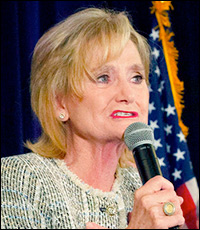
Mississippi Sen. Cindy Hyde-Smith (R)

Mississippi — Ty Pinkins, the 2024 Senate nominee against Sen. Roger Wicker (R) who received 37.2 percent of the vote, says he will challenge Sen. Cindy Hyde-Smith (R) in 2026. Sen. Hyde-Smith was appointed to the chamber when Sen. Thad Cochran (R) resigned due to health issues. She then defeated former US Agriculture Secretary and ex-Congressman Mike Espy (D) in the 2018 special election, and won a full term, again against Espy, in 2020 with a 54-44 percent vote spread. The Senator has announced for a second full term next year and will be the favorite to win re-election.

DSCC — At a fundraising event late this week, new Democratic Senatorial Campaign Committee chair Kirsten Gillibrand (D-NY) broadly hinted that the organization would not back away from getting involved in primaries. She made specific references to targeted contests in Maine, Michigan, and North Carolina. Democrats expect to mount strong challenges against Sens. Susan Collins (R-ME) and Thom Tillis (R-NC), in addition to campaigning to hold their newly open Michigan seat.

House

Florida State Sen. Randy Fine (R-Melbourne)

FL-6 — Though not residing in Florida’s vacant 6th District, state Sen. Randy Fine (R-Melbourne) topped two GOP opponents with 83 percent support to win the special Republican primary to replace resigned Rep. Mike Waltz (R-St. Augustine Beach). Waltz left the House to become President Trump’s National Security Advisor.

Sen. Fine, like Jimmy Patronis in the open 1st District, had the support of President Trump and Sen. Rick Scott. The FiveThirtyEight data organization rates the 6th District as R+28, so Sen. Fine becomes a definitive favorite to claim the seat in the April 1 special general election.

CO-8 — Freshman Rep. Gabe Evans (R-Ft. Lupton/Westminster) has already drawn a Democratic opponent in what will be another very competitive congressional race in northern Colorado’s 8th District. The Colorado Independent Redistricting Commission members drew this CD to be contested in every election, and so far it has performed as designed. Democrat Yadira Caraveo represented the seat in its initial term, only to fall to Evans in the 2024 election.

State Rep. Manny Rutinel (D-Commerce City) announced this week that he will enter the 2026 congressional race thus attempting to limit Rep. Evans to a one-term career. This contest will be a top target 2026 campaign.

GA-9 — Three-term US Rep. Andrew Clyde (R-Athens) has drawn a significant primary challenger. Gainesville Mayor Sam Couvillion announced that he will challenge Rep. Clyde in the 2026 Republican primary.

Clyde, a Freedom Caucus member and one of the more conservative Representatives, has fared well in nomination contests. In his first run back in 2020, Clyde won a GOP runoff with 56 percent of the vote. He defeated four Republicans in 2022 with just over 74 percent and was unopposed for renomination in 2024. The Congressman will remain a heavy favorite for renomination in 2026.

Governor

Connecticut — New Britain Mayor Erin Stewart (R) has filed a 2026 gubernatorial campaign committee. She promises to make a formal announcement by the end of this month, but it is a virtual certainty that she will run. Gov. Ned Lamont (D), who is eligible to run for a third term, says he will make a decision about 2026 after the legislative session ends in June.

New Mexico — Sen. Martin Heinrich (D), just re-elected in November, says he will not run for Governor in 2026. The Heinrich decision makes former Interior Secretary and ex-Rep. Deb Haaland the undisputed front-runner for the Democratic gubernatorial nomination. Haaland is making moves toward entering the race but has not yet officially announced her candidacy.

Virginia: The co/efficient data group released their latest Virginia poll (Jan. 18-20; 867 likely 2025 Virginia general election voters; live interview & text) and again finds a toss-up open 2025 gubernatorial race between Democratic former Congresswoman Abigail Spanberger and Republican Lt. Gov. Winsome Earle-Sears. Both appear to be presumptive nominees of their party at this early point in the election cycle. According to the co/efficient data, Spanberger and Earle-Sears would each command 40 percent support.

An Activity-Laden Gubernatorial Week Across the Country

By Jim Ellis — Monday, Jan. 27, 2025

Governor

With South Dakota Gov. Kristi Noem officially being confirmed for her federal position as Secretary of the Department of Homeland Security, Lt. Gov. Larry Rhoden (R) ascends to the Governorship. / Photo by Gage Skidmore

While political activity is largely quiet in the early 2026 Senate and House races, the same is not true for budding Governors’ campaigns.

First, in South Dakota, with Gov. Kristi Noem officially being confirmed for her federal position as Secretary of the Department of Homeland Security, Lt. Gov. Larry Rhoden (R) ascends to the Governorship and is expected to seek a full term in 2026. Noem was term-limited for the coming election, so a GOP nomination fight has been expected for months.

With Rhoden now the sitting Governor, a major multi-candidate Republican primary may be avoided. At this time, however, it is too early to tell exactly how the state’s politics may unfold. For his part, Rhoden served as Lieutenant Governor for the entirety of Noem’s tenure as Governor, beginning in 2019. Prior to assuming his statewide office, Rhoden served for 16 years in the state legislature.

Late last week in Michigan, Secretary of State Jocelyn Benson (D) announced that she will seek the Democratic gubernatorial nomination to succeed term-limited Gov. Gretchen Whitmer (D). This race will be complicated with the presence of Detroit Mayor Mike Duggan running as an Independent. He was elected to his present position three times as a Democrat.

The possibility of splitting the Democratic vote between Duggan and the eventual party nominee could give the eventual Republican nominee the opportunity of winning the statewide vote with just plurality support. Crowded primaries in both major parties are expected to form.

Turning to New Mexico, Sen. Martin Heinrich (D), who had been considering making a bid for Governor on the heels of his re-election to a third term, announced last week that he will not enter the race. This likely makes former US Interior Secretary and ex-Congresswoman Deb Haaland the Democrats’ leading candidate to succeed term-limited Gov. Michelle Lujan Grisham (D).

In Ohio, Attorney General David Yost (R) formalized his gubernatorial campaign with a specific announcement late last week, though for months it has been no secret that he would run. With Lt. Gov. Jon Husted, who was thought to be Yost’s main opponent, now an appointed US Senator, the Attorney General’s top GOP competitor may well be former presidential candidate Vivek Ramaswamy who is expected to make a formal announcement this week. State Treasurer Robert Sprague (R) also announced his candidacy earlier this month.

The state’s health care director during COVID, Dr. Amy Acton, has already announced for the Democratic gubernatorial nomination, but we can expect additional individuals to ultimately declare their candidacies. Gov. Mike DeWine (R) is ineligible to seek a third term.

In South Carolina, Rep. Nancy Mace (R-Charleston) confirmed last week that she is seriously considering a run for Governor since incumbent Henry McMaster (R) is ineligible to succeed himself. Lt. Gov. Pamela Evette and Attorney General Alan Wilson, son of Rep. Joe Wilson (R-Springdale), are also potential Republican gubernatorial candidates. Rep. Ralph Norman (R-Rock Hill) is also mentioned as a possible contender, but if he is to launch a statewide Republican primary bid it would more likely be against Sen. Lindsey Graham.

As mentioned in our column late last week, Tennessee Sen. Marsha Blackburn (R) is now running “thank you” ads for her Senate victory, which is an apparent move to solidify support for the open 2026 Governor’s race. It was clear that several GOP members of the Tennessee congressional delegation were preparing to run, specifically Rep. John Rose (R-Clarksville) who was scheduled to announce soon after the November election, but such may not materialize.

Sen. Blackburn’s presence in the race, with polls showing she would easily win a gubernatorial primary is suggesting that the twice-elected Senator won’t even draw major opposition. Should she choose to run to succeed term-limited Gov. Bill Lee (R), it appears she would be a lock to win both the Republican primary and general elections.

Senate Recap – Part II

By Jim Ellis — Thursday, Oct. 3, 2024

Senate

In our second of a three-part series, we examine another set of seven US Senate races that are either competitive, at least to a degree, or where a new senator will succeed an incumbent not seeking re-election. Today, we provide a quick analysis of the campaigns from Minnesota through New Mexico. Tomorrow, we end with the competitive races from Ohio to Wisconsin.

Minnesota Sen. Amy Klobuchar (D) / Photo by Gage Skidmore

Minnesota — Though the Minnesota Senate race is not particularly competitive, recent polling has suggested that Sen. Amy Klobuchar’s (D) re-election campaign is a bit closer than one would expect in a state that reliably supports its Democratic incumbents. Four polls of the Minnesota Senate contest were released in September, and Sen. Klobuchar’s average advantage is nine percentage points over former professional basketball player Royce White (R). The margin is moderately strong, but not where one would have expected a virtually uncontested senator in the most loyal Democratic state in presidential election years.

The polls also track Vice President Kamala Harris as under-performing in her VP nominee Tim Walz’s (D) home state. The five September polls and two tracking surveys yield Harris an average six-point lead, well below what one would expect in what is perceived as a non-competitive state. Sen. Klobuchar will win re-election, but possibly not in the landslide proportion that most believed would occur.

Missouri — The Show Me State of Missouri has been voting solidly Republican during the Trump years, and Sen. Josh Hawley (R) should easily win another term. There have, however, been two Democrat polls that project the senator’s lead over attorney and military veteran Lucas Kunce (D) to be just four and five points. The Hawley September average through four public polls is nine percentage points, thus reflecting two other surveys yielding the senator 12- and 15-point advantages.

This polling pattern is not much different than what we saw for Sen. Eric Schmitt (R) when he was running in the open seat two years ago. The average of the closing polls posted Schmitt with a lead right around 11 percentage points. In the actual election, he won with a 13-point margin. Expect a similar result this year for Sen. Hawley.

Montana — If the Republicans are to capture the Senate majority, unseating Sen. Jon Tester (D) in Montana becomes a must win. At this point, it appears GOP candidate Tim Sheehy (R), a retired Navy SEAL and aerospace business CEO, is well positioned to convert Big Sky Country to the Republican Senate column. If he does, Montana will become the 51st state in the GOP Conference after West Virginia Gov. Jim Justice’s (R) virtually assured win to even the partisan division at 50-50.

Surprisingly, there have been relatively few polls conducted of the Montana Senate race. One reason could be the pollsters have already seen enough to concede the race to Sheehy. From Aug. 20 to the present, we find just four poll results. Sheehy leads in all, and his polling average is seven-plus points over the three-term incumbent. Though Sen. Tester has a major resource advantage, in a small state campaign spending is typically less important than in major population states. Such appears to be the case in Montana.

Continue reading

RFK Jr.’s Ballot Status;
Dahlstrom Withdraws in Alaska;
NJ-9 Replacement Nominee Selection;
New Hampshire Pre-Primary Poll

By Jim Ellis — Tuesday, August 27, 2024

President

Robert F. Kennedy Jr. (I) / Photo by Gage Skidmore

RFK Jr: Current Ballot Status — Robert F. Kennedy Jr. (I) on Friday announced that he will suspend his campaign in battleground states but remain in places where the race is not as competitive. Which, however, are those states? It’s clear he will not compete in Georgia, Michigan, North Carolina, and Pennsylvania, domains that all agree are battlegrounds, but what about some others that may be on the competitiveness cusp? Kennedy has qualified for the ballot in Alaska, Maine, Nebraska, and New Mexico, all of which under certain circumstances could become close.

Alaska and Maine employ the Ranked Choice Voting system, which could change the outcome of the initial ballot count if no one secures majority support. Nebraska’s 2nd Congressional District is a battleground area and, depending upon the outcome of other key battleground domains, could cause a tie in the Electoral College. New Mexico has shown some close polling before President Joe Biden exited the race, but could it tighten again in the remaining weeks? Therefore, while Kennedy is out of the key battlegrounds and has endorsed former President Donald Trump, where he will or will not remain on the ballot is still open to some question.

House

AK-AL: Dahlstrom Withdraws — Republicans scored a major break in the Alaska at-large congressional race. Lt. Gov. Nancy Dahlstrom (R), who finished third in the Aug. 20 jungle primary, and thus advances into the general election under the Alaska top four voting system, announced on Friday that she is ending her congressional campaign. This will allow second-place finisher Nick Begich III (R) to challenge Rep. Mary Peltola (D-Bethel) in a one-on-one general election battle.

The Dahlstrom move increases the Republican chances of victory, though Rep. Peltola still should be considered at least a slight early general election favorite. Though all of the primary ballots are still not recorded, it does appear that she exceeded the 50 pecent mark. This would be significant heading into the general election, though under a larger turnout and a united Republican Party, Begich’s chances significantly increase.

There will be a fourth-place finisher advancing, too, however the individual’s vote count – fourth position is still undecided – is less than 1,000, so chances are strong that said individual will either drop out or only be a minimal factor in November.

NJ-9: Replacement Nominee to be Selected — Individuals contemplating whether to run now to replace New Jersey’s late Rep. Bill Pascrell (D-Paterson) don’t have much time to decide. Under state law, the ballots become locked on Aug. 29, so the 9th District Democratic party has only three days this week to choose a replacement nominee.

Indicating they want to be considered for the nomination are state Assembly members Shavonda Sumter (D-Paterson) and Speaker Pro Tempore Benjie Wimberly (D-Paterson). Paterson Mayor Andre Sayegh is also a potential candidate. The committee members’ choice will immediately become a heavy favorite to succeed Pascrell. The Republican nominee is sales consultant Billy Prempeh, who held Rep. Pascrell to a 55-45 percent victory margin in 2022.

States

New Hampshire: Pre-Primary Statewide Poll — The University of New Hampshire conducted their regular Granite State poll, this in anticipation of the state’s late Sept. 10 primary election.

As other data has shown, ex-Sen. Kelly Ayotte maintains a strong Republican primary advantage over former state Senate president and 2022 Senate candidate Chuck Morse. In this poll, which is her best showing, Ayotte leads Morse by a whopping 65-21 percent. On the Democratic side, we see a closer race, but one with a consistent leader, former Manchester Mayor Joyce Craig. In this survey, Craig notches a 39-30 percent edge over Executive Councilor Cinde Warmington.

In the US House races, Rep. Chris Pappas (D-Manchester) has only minor opposition in the Democratic primary. In the crowded Republican primary, former executive councilor and ex-state Sen. Russell Prescott holds a 19-10 percent advantage over Manchester City Alderman Joseph Kelly Lavasseur with no other candidate reaching double digits.

In open District 2, from which Rep. Annie Kuster (D-Hopkinton) is retiring, former Biden Administration official Maggie Goodlander leads the Democratic primary over former executive council member and 2016 Democratic gubernatorial nominee Colin Van Ostern. The split is 34-28 percent, which is closer than other polls have indicated. This could suggest that Van Ostern has developed momentum heading into the primary election. On the Republican side, business consultant Vikram Mansharamani has a small 21-17 percent edge over businesswoman Lily Tang Williams and 10 others.

Harris Momentum is Up, However So is the Voter Registration Gap in Battleground States: What It Means

By Jim Ellis — Friday, August 16, 2024

Voter Registration

Vice President Kamala Harris / Photo by Gage Skidmore

While Vice President Kamala Harris is riding a momentum wave in polling that puts her slightly ahead of former President Donald Trump in most places, one element trending against her is the battleground states partisan registration gap.

Voters in only 30 states register by political party designation, and several of them are in the most competitive category. Arizona, Maine, Nebraska, Nevada, New Hampshire, New Mexico, North Carolina, and Pennsylvania, all of which are either hotly contested or showing signs of potential swing voting, require partisan registration designations on the voter registration forms. (Maine and Nebraska are included here because they split their electoral votes, meaning allowing each congressional district to carry its own vote. Both states have districts that tend to swing opposite of the statewide tally.)

In some cases, both parties have fewer members in these swing domains than they did in 2020, largely due to the election authorities conducting list purges to eliminate people who no longer live at the stated address, have passed away, or have not voted in a specific number of consecutive elections (state laws differ on the criteria listed last).

All of the aforementioned states have fewer registered Democrats than they did at the beginning of 2021. Arizona, North Carolina, and Pennsylvania show a greater number of registered Republicans on their most recent registration report as opposed to where they stood at the beginning of 2021. Arizona, Nevada, North Carolina, and Pennsylvania also have more unaffiliated voters than they did at the beginning of 2021.

The statistic of particular interest comes in the states where the raw number registration gap between Democrats and Republicans has significantly changed. It is here where the Republicans benefit substantially, and this is a statistical category that will not necessarily be reflected in polling.

In Arizona, New Hampshire (which is a new entry in this category), and the 2nd District of Nebraska, Republican registrants outnumber Democrats. With New Hampshire flipping to plurality Republican since 2021, that could signal a different vote pattern in 2024, and that could make a major difference in several races including the presidential campaign.

If Trump were to convert Arizona, Georgia, Nevada, and New Hampshire — while assuming he kept all 25 states and the 2nd District of Maine in his column, all of which have voted for him twice — he would win a 272-268 electoral vote victory, and can do so without carrying any of the key Great Lakes states that are typically highlighted as the deciding factor in the national race.

In all of the remaining swing or potentially swing domains: Maine, Nevada, New Mexico, North Carolina, and Pennsylvania, Democrats still outnumber Republicans, but the registration gap between the two parties is much smaller denoting Republican gains in each place.

Most significantly, in three states, Arizona, Nevada, and New Hampshire, the net Republican registration gain is larger than the number of votes that separated Joe Biden and Donald Trump in the 2020 election. Therefore, these states become obvious Trump conversion targets.

The Republican registration gap in North Carolina has also improved for the party. Though still behind the Democrats by more than 132,000 registrants, the new numbers represent a net GOP gain of 111,066 individuals than at the beginning of 2021. Therefore, while Trump twice carried the Tar Heel State, his margins were small and the boost in registration should make this critical state a bit safer for his Republican team in 2024.

The state of Florida is the most extreme registration change example and is generally what takes the state out of play not only for Democrats at the presidential level, but also in the US Senate race between incumbent Sen. Rick Scott (R) and his most likely opponent, former US Rep. Debbie Mucarsel-Powell (D).

Since 2021, the registration gap has grown in the Republicans favor by a net 940,005 individuals, which gives the Republicans a registration advantage over the Democrats of just over one million partisan voters.

While polling detects the Harris surge in the presidential race, the Republicans closing the registration gap in all of the battleground states where registered partisanship can be measured should be considered at least one significant neutralizing factor of the polling numbers as we head toward early voting month in October.

The New Mexico Factor

By Jim Ellis — Monday, August 5, 2024

President

Former President Donald Trump / Photo by Gage Skidmore

The Land of Enchantment, as the state of New Mexico is known, does not attract a great deal of attention in a national presidential campaign, but 2024 may prove different.

Looking at the presidential map, it previously was a foregone conclusion that to win the national election, former President Donald Trump would have to covert one of the key Great Lakes States, either Michigan, Pennsylvania, or Wisconsin. Now that the Trump campaign has apparently expanded the map, such may not be the case.

To win, Trump needs to convert states that Joe Biden carried in 2020 with a minimum cumulative total of 35 electoral votes. For presumed Democratic nominee Kamala Harris to win, she would only need to keep 90 percent of Joe Biden’s electoral vote total.

Looking at the polling since the beginning of 2024, Trump has been consistently ahead in the swing states of Arizona, Georgia, and Nevada. Each voted for President Biden with small margins and now all three appear headed toward Trump.

New Arizona polling confirms that, at least in the early going, Trump would perform as well against Harris as he did against President Biden. The latest Public Policy Polling survey (for the Clean and Prosperous America PAC; July 19-20; 736 registered Arizona voters; live interview & text) sees Trump holding a 46-40 percent lead over Vice President Harris with Harris carrying a poor favorability index of 38:55 percent positive to negative. For his part, Trump posts an improved 47:49 percent ratio.

In Nevada, Trump recorded a 10-point spread over VP Harris according to the latest Insider Advantage survey (July 15-16; 800 registered Nevada voters; Trump 50; Harris 40 percent). The Georgia numbers are also trending toward Trump. The University of Georgia (for the Atlanta Journal-Constitution; July 9-18; 1,000 registered Georgia voters; live interview) found the former president holding a five-point lead over Harris, 51-46 percent.

Should these patterns continue, and Trump converts the three states, he would gain 33 electoral votes, or just two short of the minimum 270 needed to secure election. Doing so would then mean he would need only one other state to clinch victory.

Capturing New Mexico, with its five electoral votes, would allow Trump to win the national election even if Vice President Harris is successful in keeping Michigan, Pennsylvania, and Wisconsin in the Democratic column. Therefore, the ability to expand the map could fundamentally change the outcome.

Several points suggest New Mexico will become a major Trump target. First, the polling is now showing a much closer race than expected. In 2020, President Biden defeated Trump here, 54-43 percent, and the state was never seriously in play for the then-incumbent president.

This year, however, the numbers appear different. The most recent study was conducted in June from the 1892 Polling firm (June 19-24; 600 likely New Mexico voters). The results found Trump trailing President Biden by a scant one percentage point in the multi-candidate field. In the Senate contest, Republican Nella Domenici, the daughter of the late Sen. Pete Domenici (R-NM), trailed Sen. Martin Heinrich (D) by only a 46-42 percent margin.

Secondly, New Mexico is a plurality Hispanic state (Voting Age Population figures: 44.3 percent Hispanic; 40.5 percent White; 11.5 percent Native American; 2.8 percent Black; 2.5 percent Asian), and Republicans are faring better within the community than in past elections. A significant Trump improvement among New Mexico Hispanics could provide enough of a margin to boost him over the top.

Third, the state having only three congressional districts and a total population of just over 2.1 million individuals means campaigning here is inexpensive. This is especially true considering almost the entire domain is virtually self-contained within the Albuquerque and El Paso media markets. Therefore, targeting the state would not require large expenditures but the return on such an investment could be major.

Furthermore, developing voter coalitions would be relatively easy because 63 percent of the population lives in just five counties, and basically one-third of New Mexicans live in the Albuquerque metropolitan area.

With an expanding map, the campaign will spread to many more places. Expect a major Trump effort targeted for the Land of Enchantment with potentially a big payoff.

DNC Schedules Virtual Vote; Harris Bump Predicted; Candidate Pattern Continues in Pennsylvania; A Cliff-Hanger in New Mexico

By Jim Ellis — Thursday, June 25, 2024

President

Vice President Kamala Harris / Photo by Gage Skidmore

Democratic National Committee: Virtual Vote Scheduled — Following through on predictions that the Democrats would nominate Vice President Kamala Harris as quickly as possible, DNC chairman Jaime Harrison announced that in fact the committee will schedule a virtual roll call vote in advance of the Democratic National Convention.

The voting period will occur over multiple days culminating with an Aug. 7 deadline — or 12 days before the Democratic National Convention officially convenes in Chicago. At this point, it appears that Harris will easily secure the first ballot nomination and end speculation of another potential candidate arriving to claim support from a delegate majority.

The early vote allows the Democratic leadership to avoid an open convention that could bring chaos, gives the Harris campaign an additional two weeks of general election campaigning, and allows them to make the convention a unifying event.

Trump Pollster: Predicting a Harris Bump — Trump for President pollster Tony Fabrizio yesterday issued a public letter predicting that Vice President Harris will see a bump in national polling because of her “honeymoon” with the institutional media and Democratic rank and file. He also predicted the polling would eventually return to the earlier pattern that posted former President Donald Trump to consistent small leads.

In the past two days, we have seen three national polls released, which include the Independent and minor party candidates:

  1. RMG Research (July 22-23; 2,000 registered US voters; online) sees Trump holding a two point, 48-46 percent, edge over Harris.
  2. Ipsos/Reuters, polling over the same period (July 22-23; 1,018 registered US voters; online) finds a different result, posting Harris over Trump with a four-point, 42-38 percent spread.
  3. YouGov polling for The Economist publication (July 21-23; 1,435 registered US voters; online) sees a tally closer to RMG: Trump leading Harris, 44-41 percent.

We can expect to see close but inconsistent polling from now until the latter stages of the election. It is likely Fabrizio is correct about a forthcoming Harris bump, but things will start to stabilize once early voting begins in earnest come mid-October.

Senate

Pennsylvania: Pattern Continues — A new Pennsylvania poll again finds a pattern that is troubling for Republicans. While Donald Trump leads in the presidential contest, the Republican Senate candidate lags far behind the Democratic incumbent.

North Star Opinion Research, polling for the American Greatness Super PAC (July 20-23; 600 likely Pennsylvania voters; live interview) tested the Pennsylvania electorate. While some of the respondents were interviewed before President Joe Biden announced his decision to withdraw from his re-election bid, we still see the sample members favoring former President Trump over Vice President Harris by a 47-45 percent margin. Conversely, in the Senate election, Sen. Bob Casey Jr. (D) enjoys a 49-41 percent spread over Republican David McCormick.

The combined totals suggest a net 10-point swing between Trump’s standing in the national campaign and that of McCormick in the Senate race. Unless Republicans can find a better way of tying their Senate candidates’ support to that of Trump, the party’s goal of reaching 53 or 54 Senate seats in the next Congress will not come to fruition.

House

NM-2: Another Cliff-Hanger — After New Mexico’s southern 2nd Congressional District was converted into a Democratic seat in the 2021 redistricting map from one that favored Republicans, then-Rep. Yvette Herrell (R) lost her seat in 2022 to then-Las Cruces City Councilman Gabe Vasquez (D) by a scant 50.3 – 49.7 percent margin.

A new poll suggests we will likely see a similarly close result in 2024. The Tarrance Group, polling for the Herrell campaign (July 11-14; 400 likely NM-2 voters; live interview) finds the former congresswoman clutching to a 48-46 percent edge over Rep. Vasquez. At this point, it is unclear which candidate will win the seat, but every available data point is again suggesting that this race will be extremely tight.

Harris: A Tough Road Ahead

Vice President Kamala Harris: a tough path to winning in November. (Photo by Gage Skidmore)

By Jim Ellis — Tuesday, July 23, 2024

President

While Vice President Kamala Harris is well positioned to replace President Joe Biden as the 2024 Democratic presidential nominee, her task of winning the general election is anything but easy. New polls in the key swing states start her in an underdog position in virtually every key place that will determine the final outcome.

As we know, there are six states considered prime swing states: Arizona, Georgia, Michigan, Nevada, Pennsylvania, and Wisconsin. Before Biden announced his exit, another half-dozen surprising domains were showing competitive signs: Maine, Minnesota, New Hampshire, New Jersey, New Mexico, and Virginia. This means that former President Donald Trump was either leading in the most recent state survey or within a point or two of moving ahead. It remains to be seen if any of these second-tier swing states truly become competitive in a Trump-Harris race.

July polling in eight of these states illustrates the Harris difficulty factor in overcoming Trump’s current advantage. None of the states are out of play, since the Trump leads are all in single digits, but the fact that she would have to simultaneously hold nine of 12 domains increases the difficulty factor.

Vice President Harris’ biggest problem is that three of the states, Arizona, Georgia, and Nevada, appear locked for Trump. We have seen 26 publicly released polls from Arizona since January 1, and Trump leads in all. The Public Policy Polling organization conducted a Grand Canyon State survey during the July 19-20 period (736 registered Arizona voters), and Trump holds a six-point, 46-40 percent, advantage against Harris.

In Georgia, 24 Trump-Biden polls were conducted in 2024, and as in Arizona, Trump leads all. Two Trump-Harris polls have been conducted in July. The University of Georgia for the Atlanta Journal-Constitution newspaper (July 9-18; 1,000 likely Georgia voters) finds Trump holding a five-point edge over VP Harris. Insider Advantage (July 15-16; 800 likely Georgia voters) projects an even larger 10-point lead.

Nevada is turning in similar numbers. In 2024, a total of 22 Trump-Biden polls have been released, and Trump led in 21 with one tie. Insider Advantage conducted the most recent Trump-Harris poll (July 15-16; 800 likely Nevada voters) and Trump holds a 10-point, 50-40 percent, margin over the vice president.

These three states are significant because the data suggests that they are solid for Trump. Should he carry through and win them all, the former president would add 33 electoral votes to his 2020 national total, meaning he would be literally just one state away from winning the national election.

This is what makes Harris’s path difficult. Her margin of error if conceding Arizona, Georgia, and Nevada is just one state.

Therefore, looking at the remaining top-tier swings of Michigan, Pennsylvania, and Wisconsin, Harris would have to sweep them.

Today, she trails Trump in Michigan by five percentage points according to Democratic pollster Public Policy Polling (July 17-18; 650 registered Michigan voters)

The latest Pennsylvania numbers tell a similar tale. SoCal Research (July 20-21; 500 likely Pennsylvania voters) yields Trump a 50-46 percent edge over Harris.

In Wisconsin, Harris fares a bit better, but still could easily lose. The Civiqs research organization, polling for Daily Kos Elections (July 13-16; 514 registered Wisconsin voters), sees Trump and Harris deadlocked at 48 percent apiece.

There is some current data appearing from the second tier, though no July polling has been released for Maine, Minnesota, New Jersey, and New Mexico.

In New Hampshire, a state the former president twice lost to Hillary Clinton and President Biden, a group called Praecones Analytica just tested the electorate (July 19-21; 601 registered New Hampshire voters) and shows Trump holding a one-point, 40-39 percent, edge over VP Harris.

Finally, Florida Atlantic University tested the Virginia electorate with a released small sample survey (July 14-15; 301 registered Virginia voters) and projects Trump with a 41-40 percent lead over Harris.

As you can see, the point deficit in any of the nine first- and second-tier swing and potentially competitive states is not insurmountable in any instance. The vice president’s problem is that she must win all of these swing states, assuming Arizona, Georgia, and Nevada continue their year-long trend of favoring former President Trump. Therefore, of the remaining targets, Vice President Harris must run the table if she is to claim the White House since her margin of error is virtually depleted.

New Hampshire & New Mexico

Could New Hampshire & New Mexico be in play for Republicans?

By Jim Ellis — Friday, July 19, 2024

President

Even before the Trump assassination attempt and the Republican National Convention commenced, polling was beginning to suggest that some unusual states were venturing into the competitive realm.

At this point in the election cycle, it appears that the top conversion targets for the Trump campaign are Arizona, Georgia, and Nevada. Together, these states would deliver 33 of the 35 conversion electoral votes (from those states that voted for President Biden in 2020 but are strong potential Trump states in 2024) the former president would need to win the national election.

In the trio of these states since the beginning of this year, Trump has not trailed in any of the cumulative 62 polls from 15 different pollsters conducted in the three entities. If these states vote Trump in 2024, then the electoral map significantly changes.

Obviously, beyond Arizona, Georgia, and Nevada, the three commonly discussed Great Lakes states are clear battleground regions: Michigan, Pennsylvania, and Wisconsin.

Now, however, cumulative polling suggests other places could be potential Trump conversion opportunities. It is important, however, to determine which might legitimate prospects to flip as compared to those where the newly crowned Republican nominee could do well but might only come close to President Biden’s vote percentage.

The states in question are Maine, Minnesota, New Hampshire, New Jersey, New Mexico, and Virginia. One victory in any of the aforementioned, or converting the 2nd Congressional District of Nebraska (via an Electoral College tie), would award the election to former President Trump, assuming all 25 states that he twice carried return to his column.

While a Trump plurality victory is certainly within the realm of possibility in Maine since polling suggests his lead in the northern ME-2 district is at or near 20 percentage points, his chances of losing the 1st District by less than such a spread are good. Therefore, Trump could reasonably place first in Maine. His problem is the state’s Ranked Choice Voting system. Because it is doubtful he could secure majority support in the state — more than 50 percent — Trump would likely lose to President Biden in the RCV rounds.

Minnesota is the most loyal Democratic state in modern presidential campaign history. The last time the Land of 10,000 Lakes voted for a Republican in the national election came in 1972 when the state chose then-President Richard Nixon over then-Sen. George McGovern (D). Every other state has voted for a Republican at least one time since that election. In 2016, Mr. Trump came within 1.5 points of Hillary Clinton in Minnesota, which is probably the best he could do in 2024.

New Jersey is a state where Republicans poll better than they run, unlike some of the southern states where the opposite is true. The latest publicly released survey (co/efficient; June 26-27; 810 likely New Jersey general election voters; live interview & text) found Trump actually posting a slight 41-40 percent lead over President Biden in the Garden State. Such a margin is unlikely to occur when actual votes are cast, making New Jersey a “fool’s gold” state for Republicans.

Virginia also is unlikely to flip. The Washington, DC metro area in its entirety, meaning the city itself as well as the Northern Virginia and Maryland suburbs, is historically Trump’s worst-performing area in the country. Therefore, looking at the increased population in northern Virginia and Trump’s unpopularity in the region suggests that his three-point deficit spread found in the July 12-15 Florida Atlantic University survey of 918 likely Virginia voters is the closest that Trump will come to victory in the state.

The New Hampshire and New Mexico situations, however, look different. Both states are small, campaigning is relatively cheap, and though they have Democratic voting histories certainly since 2016, both could be seriously in play come November.

New Hampshire has elected a Republican governor in four straight elections and though outgoing Gov. Chris Sununu (R) is no fan of Trump’s, he pledged to vote for him and if the state is in a position to make a national difference, the governor will put the campaign levers in place to help push Trump over the top.

New Hampshire, however, has not been kind to the Republican presidential candidates. Since the 2012 presidential election, national Republican nominees have averaged only 46.1 percent of the vote as compared to the Democratic contenders 50.5 percent. Yet, the Granite State still has swing characteristics.

The New Mexico numbers are slightly worse than those in New Hampshire. The cumulative average in presidential races since 2012, inclusive, finds the Democratic nominee attracting a mean average of 51.8 percent compared to the Republicans’ 42.1 percent. Yet, with a plurality Hispanic Voting Age Population figure (44.3 percent Hispanic; 40.5 percent Anglo), and more Hispanic voters professing openness toward Republicans, the state may well be closer in 2024 than what previous statistics show.

If the Trump campaign is to overcome their electoral vote deficit, they must first expand the playing field, which they appear to be doing, continue to concentrate on Michigan, Pennsylvania, and Wisconsin, and then invest in some longer-shot states in the hope that one comes through. Two such candidates for long-shot victory are clearly New Hampshire and New Mexico.