
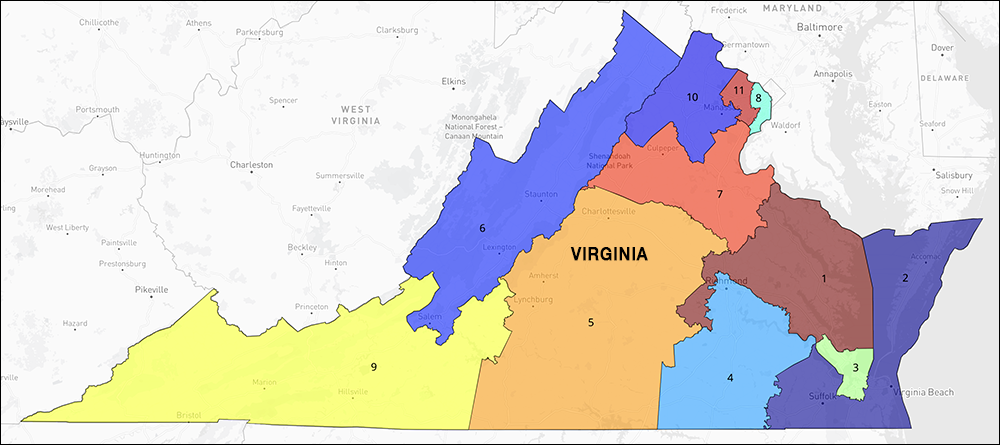
Virginia Congressional Districts / Dave’s Redistricting App (6D-5R map)
By Jim Ellis — Monday, May 11, 2026
The Virginia state Supreme Court decision to uphold the lower court ruling, finding that the legislature violated its own rules by rushing a referendum onto the ballot and, in the process, violated the Old Dominion Constitution, has significantly altered the outlook for the House midterm elections.
Instead of the cumulative effect of the new congressional maps being largely a wash, with neither party gaining a significant number of seats, Republicans are now positioned to net between 8 and 12 seats. Added to their current 220 seats, the new maps could expand their current prospective majority to more than 230 seats.
The following is an update on where the affected states stand in terms of 2026 electoral outlook under the new congressional maps, Starting with Virginia first:
Virginia
On Friday last week, the state Supreme Court invalidated the statewide redistricting referendum vote, upholding the lower court ruling that said the legislature violated its own rules and the state constitution in rushing the referendum to the ballot. While congressional redistricting is now effectively closed for this year here, meaning the 6D-5R map will remain in place for the 2026 elections, the process could be revisited in time to produce a new Virginia map for the 2028 cycle.
Certainly, the state Supreme Court ruling is a big win for Republicans, but the victory is likely to be short lived. For 2026, however, expect all Virginia incumbents to be favored for re-election.
California; Texas
The nation’s two most populous states became the focal points of the early redistricting battles, with party leaders in both parties predicting that their new maps would yield a net gain of five seats for their respective parties.
A closer examination of the partisan data and voting histories in the affected areas, however, suggests that gaining five seats under these new maps may be ambitious. What does appear likely, however, whether the eventual gain is three, four, or five seats, is that the two states will largely cancel each other out in terms of national seat gains.
Alabama
After the US Supreme Court’s ruling in the Callais v. Louisiana established clearer criteria for the construction of minority districts, the Alabama legislature reinstated a congressional map it had originally passed in 2023, only to have it later struck down by a court as a partisan gerrymander. Under the Supreme Court’s new directive, however, the plan could no longer be characterized as a racial gerrymander.
There is one remaining legal hurdle for the map to overcome, so it is possible that Gov. Kay Ivey (R) could suspend the congressional primaries until the map issue is resolved. Campaigns competing in the regularly scheduled May 19 primary for other offices would likely still be allowed to proceed.
The 2023 map would eliminate the majority minority 2nd District that a previous court had ordered drawn. Assuming no further legal complications arise, Alabama’s congressional delegation would likely revert to a 6R-1D partisan split. Rep. Shomari Figures’ (D-Montgomery) 2nd District would be dismantled and shifted back into southeastern Alabama, like its configuration during the previous decade.
Florida
The new Florida map has cleared the legislative process and now must face a legal challenge before the state Supreme Court. The plaintiffs are expected to file suit pertaining to the state ballot initiative voters approved to establish criteria for drawing legislative and congressional districts.
It is probable the court will rule that the map, which is predicted to net the Republicans three to four seats, is a partisan gerrymander with a projected 24R-4D partisan split; but other provisions of the voter-passed initiative may violate the SCOTUS’ Louisiana ruling. But the new map will likely stand for now, and net the GOP three to four seats.
Louisiana
The Bayou State is at the center of the determinative racial gerrymandering ruling, and Louisiana is now moving toward adopting a new congressional map that would produce a 5R-1D partisan split; thus, returning to the configuration that existed before the series of court rulings that ultimately reached the US Supreme Court.
The new map is reportedly being designed to preserve a Baton Rouge-anchored seat for Rep. Cleo Fields (D) while eliminating the New Orleans-based district that Rep. Troy Carter (D) currently holds.
Mississippi
Gov. Tate Reeves (R) has called a special redistricting legislative session, but only for the purpose of redrawing the state’s Supreme Court districts.
With the primary election already held on March 10, ordering a new round of congressional redistricting would effectively invalidate the 2026 primary, requiring all candidates to re-file and compete under a revised map. As a result, it appears unlikely that Mississippi congressional redistricting will take place in 2026.
Missouri
The Missouri map was enacted months ago, but opponents gathered enough signatures to qualify a repeal initiative for the ballot. The Missouri Supreme Court is now considering whether to stay the new map pending the vote or allow it to remain in effect for the 2026 election cycle. In the meantime, candidates have already filed under the current district lines.
If the map is allowed to stand, Republicans are expected to gain one seat in the delegation at the expense of veteran Rep. Emanuel Cleaver (D-Kansas City), though the Congressman has already filed for re-election. According to the Dave’s Redistricting App statisticians, the new 5th District has a partisan lean of 56.6R – 41.1D.
North Carolina
The Tar Heel State was among the first to complete the redistricting process, and the new congressional map will stand. The revised plan effectively shifts one district from Democratic to Republican control. Rep. Don Davis (D-Snow Hill) now sees his eastern North Carolina district move from a lean Democratic seat to one that is likely to favor a Republican in the general election.
In 2024, Rep. Davis won re-election by a margin of less than 1.5 percentage points. Retired Army officer Laurie Buckhout (R) is returning for a rematch, and this time the political landscape is more favorable to her chances of unseating the Congressman. With North Carolina’s primary having been held on March 3, the general election field is now set, and campaigning is underway.
South Carolina
While Gov. Henry McMaster (R) has said he would not call the legislature into a special redistricting session, lawmakers — still meeting in regular session — are moving forward with efforts to redraw the state’s congressional map.
Because the session is nearing adjournment, new legislation, including any proposal to adopt a revised congressional redistricting plan, would require a two-thirds vote of members to be added to the legislative calendar.
Republicans believe they have the votes to advance a 7R-0D plan from the House of Representatives, though they may be slightly short of the necessary support in the state Senate. If the new redistricting map is to pass, it will need to do so this week.
Tennessee
The Tennessee legislature and Governor passed a new 9R-0D congressional map soon after the Supreme Court ruled on the Louisiana racial gerrymandering case. With the Tennessee primary not scheduled until Aug. 6, the new map will stand. As a result, Rep. Steve Cohen (D-Memphis), the state’s only remaining Democratic member of the House, faces long odds of returning to the next Congress.
Utah
Months ago, the Utah court system invalidated the state’s 4R–0D congressional map, ruling that the legislature had disregarded voter-approved criteria for drawing district boundaries. As a result, the courts imposed a new map that creates a Salt Lake City–based district that Democrats are expected to win. Overall, Utah’s redistricting is projected to result in a net gain of one Democratic seat.