Tag Archives: California

Steyer Declares War

By Jim Ellis — Thursday, April 16, 2026

Governor

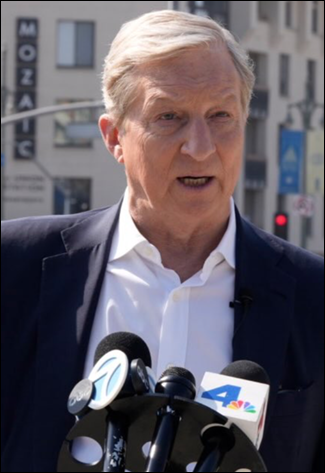
California businessman and investor Tom Steyer / Facebook photo

Just two days after Rep. Eric Swalwell (D) dropped out of the California Governor’s race and then announced his resignation from the US House over sexual assault accusations, Democratic gubernatorial and billionaire businessman and investor Tom Steyer, who could become the race’s leading candidate, made an unorthodox and controversial campaign move.

Steyer, who has already spent over $90 million of his personal wealth to promote his gubernatorial campaign has a chance to become the top Democratic candidate and qualify for the general election in the state’s top two primary system.

Party leaders are concerned that the primary vote would be split among so many Democratic candidates (23) that two Republicans, namely former Fox News host Steve Hilton and Riverside County Sheriff Chad Bianco, could capture first and second place. Such a result would freeze any Democratic candidates from advancing to the general election.

The shutout fear also explains why party leaders were beginning to coalesce around Swalwell, believing he had the best chance of securing a general election qualifying position. Now, without him in the race, the party leaders need to focus on another candidate to avoid the shutout.

Tom Steyer is a former presidential candidate who began as an Independent but later became a Democrat. He is a controversial figure, and one not likely to commit his complete allegiance to party leaders as readily as would many of the other Democratic contenders.

The Steyer new policy objective declares war on ICE and advocates the following principles in his released plan:

  • Abolish ICE – Put ICE agents in jail & “treat them like the mob.”
  • Bring those “kidnapped & detained by ICE back home.”
  • Give the California Attorney General the power to imprison ICE agents & their leadership.
  • Have taxpayer funded legal representation & support for illegal aliens.
  • Ignore a SCOTUS ruling that allows ICE to utilize to use race, language, job, and location to contribute to “reasonable suspicion” for immigration arrests, and instead, California should take matters into our own hands and extend legal protections to its residents, despite the federal government’s failure.

Launching such a controversial policy statement, and one that is extreme even by California standards, may prove the exact wrong strategy to employ just when he could now move to the top of the massive 62-person candidate field.

It is important to remember that all voters are eligible to participate in the June 2 qualifying election, not just Democratic Party members as would be the case in a closed primary; going to extremes on the immigration issue, then, even to the point of basically declaring civil war on the federal government, may not be a successful proposition.

While California is one of the most reliably Democratic states in the country, and a party candidate’s victory in the 2026 general election is already viewed as a foregone conclusion by most political observers, a Democrat finalist’s margin in some statewide campaigns is not insurmountable.

Most Republican candidates attract about 40 percent of the general election vote, and most Democratic winners secure their statewide positions in the high 50s.

Therefore, while the Democratic base is certainly anti-ICE, it may be a stretch for Steyer to assume that the majority of even California Democratic voters want to jail law enforcement officers, bring back deported aliens, ignore the US Supreme Court, and virtually break the state away from the United States.

The Steyer immigration policy document now brings yet another point of controversy into the California Governor’s campaign and may open the door for another Democrat to emerge as the party’s top candidate. Such a Democratic candidate might better attract traditional party support and gain the necessary momentum to overtake Steyer and secure a general election position.

Or, these latest turn of events in the California Governor’s campaign could lend more credence to the idea that a pair of Republicans, Hilton the Fox News host, or Bianco the law enforcement officer, could actually secure both general election slots and shut out the entire Democratic field for the general election.

California’s 1st District:
A Tale of Two Races

By Jim Ellis — Monday, March 23, 2026

House

Northern California’s 1st Congressional District. See interactive map at Dave’s Redistricting App.

A confusing political situation is present in northern California as several more candidates than expected have filed for both the special election to replace the late Rep. Doug LaMalfa (R) and the regular election.

Redistricting has caused most of the confusion. The special election will occur in the 1st District to which Rep. LaMalfa was last elected while the regular term 1st District election will be held in the post-redistricting version. Though the field of candidates is largely the same for both campaigns, the two 1st Districts are political opposites.

Several surprising moves have been made. First, term-limited state Assemblyman James Gallagher (R-Yuba City) announced early that he would run in the special election from the district that favors Republicans (Dave’s Redistricting App partisan lean: 60.2R – 37.7D), but he remained uncommitted about running for the full term in the Democratic 1st (DRA partisan lean: 55.2D – 44.1R).

It was thought that when Gallagher announced, he would have little competition and win the seat outright on June 2 and serve half a year in the House. The leading Democrat, it was believed, would not want to risk losing in the Republican 1st, which might potentially weaken his chances for the regular term.

The redistricted 1st CD was drawn for state Sen. Mike McGuire (D-Sonoma County), who at the time the redistricting referendum was moving through the legislature was state Senate President. Like Gallagher in the Assembly, Sen. McGuire was also ineligible to seek re-election to his current position. His price for getting the redistricting referendum through the Senate – the Democrats have a super majority but with no votes to spare – was a 1st District draw where he would run and be favored to win.

Since the map drawers shifted Democratic voters from Reps. Jared Huffman (D-San Rafael) and Mike Thompson’s (D-St. Helena/Napa) 2nd and 4th Districts while adding Sen. McGuire’s home county of Sonoma, the 1st was transformed into a Democratic CD. Therefore, it was initially expected that Gallagher would not enter the regular election and McGuire would not enter the special.

The next two surprising political moves occurred just before the candidate filing deadline expired on March 11. Gallagher actually entered the regular term race and McGuire decided to become a candidate in the special election. Both moves are curious, especially for McGuire.

While a Republican winning the new 1st District that now stretches from the Napa wine country east to the Nevada state line may not be impossible in a favorable election year, it will still be very difficult and especially so when national trends favor the Democrats. But, with few options, Gallagher, who is favored to win the special election, had little to lose by trying since the special election victory would only give him a maximum of six months in Congress.

The more surprising move — and a new poll suggests that Mr. McGuire may not be as strong as initially believed — was the former Senate President entering the special election in the Republican district. Though he should be the regular election favorite in a district he basically drew himself, losing the special election would likely pierce his aura of invincibility.

To complicate matters further, another Democrat — non-profit organization agriculture consultant and frequent candidate Audrey Denney — also filed for both elections. Her presence in the special election could have a significant effect.

In the special, all candidates are placed on one ballot, and should a contender receive majority support, the individual would be elected outright. If no one reaches the 50 percent plateau, the top two finishers regardless of political affiliation will advance to an Aug. 4 runoff election.

Therefore, having another credible Democrat in the special election changes the campaign. Now it will be more difficult for Gallagher to reach 50 percent because Denney could attract some Republican agriculture votes, but she also decreases McGuire’s percentage because she will capture more than a few Democratic votes.

For the regular term, all candidates are again on the same ballot, and on the same day (June 2 regular election primary day) for both elections. In the regular, the top two finishers, presumably Sen. McGuire and Assemblyman Gallagher, will advance to the general election irrespective of percentage attained.

A new poll from David Binder & Associates for the McGuire campaign tested the new 1st District and the result is underwhelming for their client. The survey (Feb. 24-28; 700 likely CA-1 regular term voters; live interview, online, & text) finds McGuire topping Assemblyman Gallagher by a slight 33-30 percent margin with Denney attracting a credible 18 percent.

With so many moving parts and all candidates having some disadvantages in at least one of the two 1st Districts, northern California’s tale of two races promises to feature some very interesting campaigns and results.

Rep. Issa to Retire From CA-48;
Non-Partisan Rep. Kiley to Run in CA-6

By Jim Ellis — Thursday, March 10, 2026

CA-48

California Rep. Darrell Issa (R-San Diego)

In another House retirement decision, veteran California US Rep. Darrell Issa (R-San Diego) reversed course and announced on Friday that he will not seek re-election this fall.

The new California redistricting plan was not kind to Rep. Issa, but he initially made statements predicting victory in the new version of District 48. Under the current map, the Dave’s Redistricting App partisan lean calculation revealed a 58.3R – 39.8D split for CD-48. The new Dave’s Redistricting App version, in use for the 2026 election, yields a 50.6D – 48.7R partisan lean.

Though the Democratic map drawers attempted to make this a seat for their new party standard bearer, the numbers suggest a competitive contest will develop potentially resulting in a toss-up rating.

With the news of Issa’s intended retirement, San Diego County Supervisor Jim Desmond (R), who was running in Congressional District 49 against Rep. Mike Levin (D-San Juan Capistrano), will change his focus and move into what will now be an open 48th CD.

Desmond, who represents much of CA-48 on the county Board, will be a strong candidate for the GOP and can now compete in a district more favorable for a Republican. New District 49 carries a 53.8D – 45.3R partisan lean according to the DRA calculations.

There are 12 announced CA-48 Democratic candidates. California candidate filing closed on Friday but because the incumbent did not file in this district, the deadline extends until March 11. Therefore, it becomes unclear exactly how many individuals will ultimately qualify.

Among the notable Democratic individuals who had previously announced are frequent candidate Ammar Campa-Najjar, San Diego City Councilwoman Marni von Wilpert, and Vista City Councilwoman Corinna Contreras.

A recent Public Policy Polling company survey (Feb. 16-17; 727 registered CA-48 voters; live interview and text) produced a 40-18 percent Issa lead over Campa-Najjar with no other potential candidate even reaching the 10 percent level.

Under California’s top-two jungle primary system, all contenders will compete in a June 2 qualifying election. The top two finishers, regardless of partisan affiliation and percentage attained, will advance to the general election. Under the new lineup, Supervisor Desmond appears as a lock to advance, because he will likely coalesce the Republican vote, while the large Democratic grouping will split their party’s votes and battle for the second qualifying position.

While the partisan lean slightly favors the Democrats, the CA-48 election could conceivably develop into a toss-up general election campaign as previously mentioned. Without Rep. Issa in the race, however, the eventual Democratic finalist will begin the general election with a slight advantage.

CA-6

As candidate filing was coming to a close in northern California’s 6th District, we see 3rd District Congressman Kevin Kiley (R-Rocklin) filing in this domain while 6th District incumbent Rep. Ami Bera (D-Sacramento) is seeking re-election in the adjacent District 3.

Rep. Kiley appeared indecisive about where he would run. Most observers believed he would file against Republican Rep. Tom McClintock (R-Elk Grove) in District 5, which stretches all the way to the Fresno area. The 5th is one of four Republican favorable districts in the state after the new redistricting plan was enacted.

Kiley clearly did not want to challenge Rep. Bera in CD-3, so as the filing deadline drew near the Congressman announced that he would enter the District 6 race indicating that he did not want to run in a place, meaning CD-5, that didn’t include his hometown.

District 6, located to the north and east of downtown Sacramento and stretching to the city of Roseville, is now as Democratic as District 3 (each new draw for Districts 3 and 6 show a partisan lean of approximately 53D – 46R). While running in CD-6 does not provide Kiley with a partisan edge, he isn’t facing a fellow incumbent.

His surprise move, likely in an attempt to negate some of his partisan disadvantage, is to file as a No Party Preference candidate, meaning an Independent.

While he isn’t opposing Rep. Bera, Kiley does have a group of formidable Democrats to overcome. In the field are Sacramento County District Attorney Thien Ho, West Sacramento Mayor Martha Guerrero, and ex-state Sen. Richard Pan. In all, six Democrats, four Republicans, and Rep. Kiley on the NPP ballot line appears to be the 6th District field.

How Rep. Kiley not filing as a Republican helps him remains a subject of debate. While he is trying to ditch the GOP party label in an area where it is unpopular, he loses the institutional party support and likely many donors. He begins the campaign with just over $2 million in his campaign account, which should be enough to run a credible campaign if the money is spent late in the campaign cycle.

Both CA-48 and CA-6 will be districts to watch in the June 2nd qualifying election and the November campaign.

Redistricting Becoming Clearer

By Jim Ellis — Tuesday, Dec. 16, 2025

Redistricting

Putting together the redistricting puzzle

The redistricting wars may be coming to a head. Recent action has occurred in several states providing a better national redistricting picture in preparation for the 2026 election.

Below is a synopsis of the latest developments:

California: After a majority of California voters approved the special election redistricting referendum, a racial gerrymandering lawsuit was filed against the state’s new map.

Meanwhile, the US Supreme Court issued a stay on the Texas racial gerrymandering lawsuit, with a rebuke from Justice Samuel Alito to the three-judge panel in El Paso for rendering a decision before the high court ruled on a related Louisiana racial gerrymandering case. Thus, it became clear that all other cases would be held until the high court issues what could be a landmark ruling.

The judicial action likely means the new California map will be in place for the 2026 election. The original map proponents believe the plan will return five more seats for the Democrats, reducing the Republicans to just four of 52 Golden State districts.

Florida: Late last week, Gov. Ron DeSantis (R) said that the state will redistrict the congressional map and do so during the Spring. The Florida primary is not scheduled until Aug. 18, so time remains to complete the redistricting process. It is possible that Republicans could gain two seats from a new map.

Georgia: A new Georgia map has been completed. The legislature made minor changes to the existing plan that will not likely affect the current partisan division (9R-5D).

Indiana: Late last week, the Indiana state Senate defeated a redistricting map that the state House passed. The plan would have converted two Democratic seats to Republican, thus sweeping the nine-member delegation. Unless the Senate reconsiders the action, the current 7R-2D map will remain intact for the 2026 election.

Louisiana: The US Supreme Court is considering the Callais racial gerrymandering case that could become the vehicle for the justices to render a landmark racial gerrymandering decision. A ruling was expected in June, but the justices postponed their opinion and ordered a second round of oral arguments. The subsequent hearing was held Oct. 15, and all await a final determination.

If the court upholds the lower court decision, the current Louisiana map will be invalidated, meaning the Republicans will likely gain one seat. Should this be the Supreme Court’s ultimate decision, then the possibility exists that the Alabama map will also be redrawn because its plan is virtually identical to Louisiana’s.

Maryland: In a situation similar to what is found in Indiana, most of the Maryland Democratic political establishment favors attempting to collapse their one Republican congressional district, but the state Senate leadership refuses to take action. Therefore, unless the Senate President completely reverses himself, a new redistricting map will not be enacted.

Missouri: The Missouri legislature and Governor have enacted a new map that will likely convert the Kansas City anchored 5th CD from Democratic to Republican. Opponents of the map, officially organized under a group name entitled People Not Politicians, have collected double the number of signatures needed to force a special election initiative vote with the goal of repealing the new map. If a ruling is made qualifying the initiative for the ballot, voters will then decide if the new map will stand.

Under Missouri procedure, simply qualifying the initiative will suspend the new map. This means the state would be forced to revert to the 2021 map for the 2026 election. An initiative vote would occur in the regular election cycle. If the voters adopt the new plan, it would take effect in the 2028 election cycle.

North Carolina: The legislature’s new congressional map will almost assuredly stand for the 2026 election. The initial complaint protesting the plan was rejected at the lower court level. The US Supreme Court’s action involving the Texas case suggests that no further judicial movement will occur on the new North Carolina plan before the candidate filing deadline on Dec. 19. Therefore, it is likely that Republicans will gain one seat in the Tar Heel delegation.

Ohio: The bipartisan elected official redistricting commission unanimously agreed upon a new congressional map, one that state law mandated be drawn. Under the Ohio procedure, a unanimous decision from the redistricting panel, which included Gov. Mike DeWine (R), means the map is officially enacted without action from the state legislature. The new plan will likely produce a one seat gain for Republicans in western Ohio, with the outside possibility of a second conversion in Cincinnati.

Texas: As discussed above, the Supreme Court stayed the three-judge panel decision that ruled the new map a racial gerrymander. Candidate filing has concluded, so the new 2025 map will be in place for the 2026 elections. The original map proponents believe the plan will return five more seats for the Republicans.

Utah: A state court ruled that the legislature ignored certain criteria that voters adopted in a previous redistricting initiative. Therefore, the 2021 map was declared invalid, a ruling that the state Supreme Court sustained. The court then adopted a new map that created a Salt Lake City Democratic seat. The new plan will produce a 3R-1D map for the 2026 election, which is a gain of one Democratic seat.

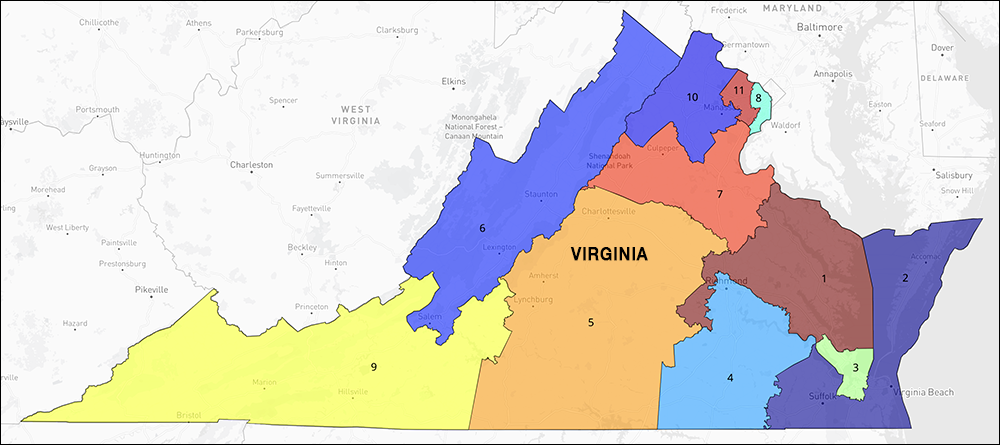
Virginia: The Old Dominion redistricting effort may determine which party wins the national redistricting wars. With the Democrats gaining full control of the state government, the new legislature must pass a referendum for the ballot when they convene in January. The measure will have to fulfill other legal requirements, and a special statewide referendum election is required. Voters would have to approve a new map before the April 2 candidate filing deadline for the June 16 primary election.

Democrats claim they can draw a map that will relegate Republicans to just one seat in the 11-member delegation. Currently, the Virginia congressional districts split 6D-5R. A four-seat swing in this state could tip the balance of power toward the Democrats in their quest for the US House majority.

Rep. Issa to Remain in California

By Jim Ellis — Monday, Dec. 8, 2025

US House

California Rep. Darrell Issa (R-San Diego)

There had been some speculation that veteran Rep. Darrell Issa (R-San Diego) was going to travel to Texas to seek re-election in the new TX-32 district since the California redistricting plan has turned his safely Republican CD into one that is highly competitive.

At the end of last week, Rep. Issa announced that he will seek re-election and will do so in CA-48 despite the district now having a Democratic tilt.

The US Supreme Court approved the new Texas map late last week and declared that the 2025 plan will be in place for the 2026 election. The decision also affects the new California map since the pending lawsuits in both cases involved racial gerrymandering claims, meaning the voter-approved new Golden State map will almost assuredly be in place for the 2026 elections.

The justices timed their ruling to allow candidate filing in Texas to conclude today. Several key political determinations dominoes will fall, the most significant of which revolves around Rep. Jasmine Crockett’s (D-Dallas) decision to file for the Senate or House.

In a related choice, Rep. Marc Veasey (D-Ft. Worth), who sees his 33rd District now located wholly within Dallas County thus eliminating his Tarrant County political base, says he will file in Crockett’s District 30 if she announces for the Senate. If Crockett decides to remain in the House, Veasey will either file for District 33 or enter the race for Tarrant County Judge (labeled County Executive in other places).

Freshman Rep. Julie Johnson’s (D-Farmers Branch) 32nd District is transformed into a Republican seat that stretches into East Texas. Her plan is to reportedly file in District 33.

While California’s candidate filing will remain open until March 6 (March 11 if the incumbent in a particular race does not file), individuals are making decisions about where to seek election; hence, Rep. Issa’s plan to run in new District 48.

Under the 2021 California Citizens Redistricting Commission map that the legislature and voters replaced this year, Rep. Issa’s San Diego County-anchored 48th District held a partisan lean (according to the Dave’s Redistricting App organization) of 58.3R – 39.8D. Under the new plan, that ratio moves to 50.6D – 48.7R, a net swing of 20.5 data points in the Democrats’ favor.

Though this makes re-election much more difficult for Rep. Issa, he still has a fighting chance of defeating a Democrat in the general election. Several California districts with more lopsided Democratic partisan leans have elected Republican Representatives. Therefore, this seat likely moves from a Safe Republican rating to Toss-Up.

In comments posted in an X tweet, Rep. Issa also made some suggestions about other members in his delegation, most specifically the proposed pairing between Reps. Ken Calvert (R-Corona) and Young Kim (R-La Habra). At this point, both have announced for new District 40 (DRA partisan lean: 57.0R – 42.3D), but Rep. Issa was suggesting that Rep. Kim instead run in new District 45 where she would challenge freshman Rep. Derek Tran (D-Orange County).

From a Republican Party standpoint, such a move would make sense. Ironically, the state’s two most vulnerable Democratic members, the pair who won the closest US House elections in 2024 — Reps. Adam Gray (D-Merced; winning by 187 votes) and Tran (winning by 653 votes) — actually see their Democratic partisan ratios surprisingly reduced under the new map.

In District 13, Rep. Gray views a partisan swing that moves a net 4.3 data points in the Republicans’ favor, making the partisan lean, according to the Dave’s Redistricting App statisticians, of 52.4D – 46.9R. In 2022, Republican John Duarte won the 13th District that featured a partisan lean of 54.0D – 44.2R.

In southern California’s 45th CD, former Rep. Michelle Steel (R), who earlier announced that she will not return to run again in 2026, carried the seat in 2022 with a DRA partisan lean of 52.2D – 45.9R. The new 45th posts a 51.7D – 47.5R partisan lean, again suggesting that a Republican general election finalist will be competitive.

With the Supreme Court making the political situations clearer in at least the two most populous states, final 2026 electoral decisions in California and Texas can now be made with all candidates confident of which map will be in place. We will carry further analysis of the Texas situation after candidate filing closes later today.

Greene to Resign; Swalwell for Gov; Velazquez will Retire

Read Rep. Marjorie Taylor Greene’s full resignation letter on X.

By Jim Ellis — Tuesday, Nov. 25, 2025

US House

Three more US House seats became open late last week, from Georgia, California and New York.

GA-14

The recent feud between former staunch allies President Donald Trump and Georgia Rep. Marjorie Taylor Greene (R-Rome) has culminated with the latter resigning from office.

In her resignation announcement, Rep. Greene said, “I have too much self-respect and dignity, love my family way too much, and do not want my sweet district to have to endure a hurtful and hateful primary against me by the President we all fought for, only to fight and win my election while Republicans will likely lose the midterms.”

Rep. Greene indicates she will resign from the House effective Jan. 5. Once the abrupt resignation becomes official, Gov. Brian Kemp (R) will schedule a special election to fill the northwest Georgia vacancy.

The Dave’s Redistricting App partisan lean for GA-14 is 69.2R – 28.9D, which makes the 14th the safest Republican district in Georgia. The seat contains nine full counties and part of Cobb. The CD stretches from near the city of Marietta on the district’s southern border all the way to Tennessee, encompassing the area just south of Chattanooga.

CA-14

On the heels of billionaire Tom Steyer (D) entering the open jungle California gubernatorial primary, seven-term US Representative and former presidential candidate (2020) Eric Swalwell (D-Livermore) announced on the “Jimmy Kimmel Live” program that he will also run for Governor next year.

At this point, a total of 63 individuals, 24 Democrats, 20 Republicans, and 19 independents or minor party candidates, have announced their gubernatorial intentions. It remains to be seen how many actually petition to run by the state’s candidate filing deadline scheduled for March 11 (five days later than the official March 6 deadline because the incumbent Governor is not running). The official candidates will then go on to compete in the June 2 statewide jungle qualifying election.

Under California voting procedure, all candidates are placed on the same initial election ballot regardless of party preference. The top two finishers, irrespective of party preference or percentage attained will advance to the general election.

Therefore, in such a situation with several candidates who appear capable of qualifying for the general election, i.e., Democrats Steyer, former Rep. Katie Porter, ex-Los Angeles Mayor Antonio Villaraigosa, Health and Humans Services Secretary, ex-CA Attorney General, and former Congressman Xavier Becerra, and Republicans Steve Hilton, a former Fox News host, and Riverside County Sheriff Chad Bianco, it may be difficult to conceptualize Rep. Swalwell at least capturing second place in an expensive statewide campaign.

At the end of September, the Congressman reported only $520,000 in his campaign account, so he would certainly be considered well behind in the money chase for a California statewide campaign.

In any event, his 14th Congressional District now becomes an open seat, which is the fourth in California and the second from the San Francisco Bay Area.

The new CA-14 district, which covers the East Bay area south of Oakland and is fully contained within Alameda County, houses the cities of Fremont, Hayward, Livermore, and Pleasanton. The new partisan lean, according to the Dave’s Redistricting App statisticians, is 68.4D – 30.6R. Therefore, it is reasonable to believe that two Democrats could advance into the general election from the open June 2 jungle qualifying election.

NY-7

Saying, “I love this work and I love my district, but I believe now is the right moment to step aside and allow a new generation of leaders to step forward,” Veteran Rep. Nydia Velazquez (D-NY) declared late last week that she will not seek re-election to an 18th term next year.

The Velazquez announcement means there will be over 40 open seats in the House for the 2026 election. Including Reps. Eric Swalwell (R-CA) and Velazquez, the total number of exiting Democratic members now rises to 15.

The exact open seat figure will be determined when the Texas redistricting saga finally ends, and a 2026 map is locked in place. The state of Texas immediately appealed to the US Supreme Court, asking for a stay of last week’s three-judge panel ruling that returned the state, at least temporarily, to the 2021 map.

Justice Samuel Alito, the administrator for the 5th Circuit Court of Appeals in which Texas lies, granted the state’s request. Therefore, last week’s three-judge panel decision is stayed, and unless the high court takes further action the 2025 map returns as the plan in place.

Velazquez is the ranking Democrat on the Small Business Committee, a panel that she chaired for four years during the period when her party last controlled the House majority. She will leave a Brooklyn-Queens congressional district that will remain safely under Democratic control.

New York’s 7th District finds 60 Perent of its population in Brooklyn and 40 percent in the Queens borough. According to the Dave’s Redistricting App statisticians, the NY-7 partisan lean is a whopping 85.7D – 11.5R, so the fight to succeed Rep. Velazquez will occur in the June 23 Democratic primary.

California Numbers:
Some Democrats Actually Fare Worse

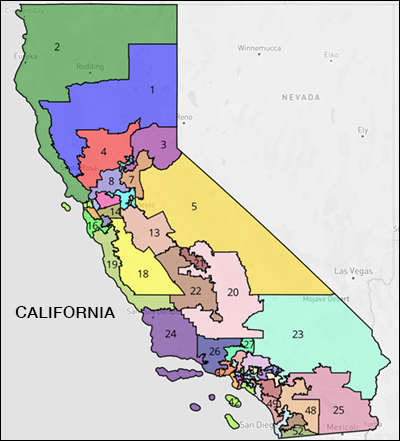
California Congressional redistricting map. Click on image or here to see interactive version: Dave’s Redistricing App.

By Jim Ellis — Monday, Nov. 17, 2025

Redistricting

The Dave’s Redistricting App (DRA) statistical organization released their data figures for the new 52 California redistricted congressional districts, and their non-partisan analysis may not be quite as rosy for the Democrats as Gov. Gavin Newsom and the party leaders have boasted. The DRA is the only data organization that has already calculated a clear partisan division for all of the new Golden State districts.

Several Democratic incumbents, and surprisingly the two considered most vulnerable heading into the 2026 election, actually fare worse when compared to the previous draw. Several Republican districts have no doubt been destroyed, but the situation may not be as dire for the GOP as Gov. Newsom’s media spin leads one to believe.

Starting in Northern California, Rep. Doug LaMalfa’s (R-Oroville) 1st District has been transformed into a Democratic district. According to the DRA partisan lean calculations, the 1st moves from 60.2R – 37.7D to 55.2D – 44.1R. With state Senate President Mike McGuire (D-Sonoma County) positioning himself to challenge Rep. LaMalfa, the Republican Congressman will have a very difficult time winning an eighth term.

Rep. Ami Bera (D-Sacramento) is leaving his Sacramento County 6th District to run in District 3, which is now a point more Democratic than his home district. There, he will ostensibly challenge two-term Rep. Kevin Kiley (R-Rocklin/Sacramento). The move puts Rep. Kiley in a bad position since his 3rd CD has flipped from holding a partisan lean of 52.5R – 45.6D to one having a 53.4D – 45.7R split, a net swing of just under 15 percentage points toward the Democratic segment.

There is some speculation that Rep. Kiley will vacate District 3 and attempt to unseat fellow Republican Tom McClintock (R-Elk Grove) in District 5, one of just four safe Republican seats in the state. The new CA-5 partisan lean: 60.7R – 38.7D.

Rep. Adam Gray (D-Merced) was the closest winner of all 435 districts in the 2024 election, a 187-vote win over then-Rep. John Duarte (R). Surprisingly, the new map makes the latest version of CA-13 slightly less Democratic. The previous partisan lean was 54.0D – 44.2R, yet Duarte won the seat in 2022 and barely lost in 2024. The new partisan lean is a net 4.6 percentage points more Republican (52.4D – 46.9R).

Though the new 13th District remains more Democratic, the congressional voting history shows weakness in the Dem fortress. A strong candidate such as former Stockton Mayor Kevin Lincoln (R), who has already announced that he will run, projects another difficult race for Gray.

Fresno Rep. Jim Costa (D) has averaged only 53.4 percent of the vote in his two elections but his district, just like Rep. Gray’s, actually moves more Republican according to the Dave’s Redistricting App calculations. Instead of seeing a 58.5D – 39.9R partisan lean, the new district records a 54.4D – 45.0R swing, a net gain of 9.2 percentage points in the Republicans’ favor. Though Rep. Costa will still be favored to carry the new 21st CD, seeing a potential Republican upset develop here is not outside the realm of possibility.

Rep. David Valadao (R-Hanford) has always been a major national Democratic target since he represents one of the most Democratic districts to send a Republican to the US House. Despite facing an adverse partisan lean in the previous District 22 version of 55.5D – 42.6R, Rep. Valadao secured two consecutive victories. This is another Central Valley district where the non-partisan calculations find the Republican factor getting better on this new map.

Moving forward, the DRA partisan lean for CD-22 is 52.1D – 47.3R, representing a net Republican gain of 8.1 percentage points. Therefore, with Rep. Valadao securing a 53-47 percent victory under the previous partisan lean, his chances should improve under this new 2026 map.

Seven-term Rep. Raul Ruiz (D-Indio) also sees his sprawling desert district become a bit more Republican. According to the past and present DRA partisan lean calculations, Rep. Ruiz’s 25th District is 5.5 percentage points more Republican. The new partisan lean is 54.2D – 45.3R, which clearly still favors Democrats, but the new draw makes the seat potentially more competitive.

The new 40th District is the final domain conceded to the Republicans. At this point, it appears both Reps. Ken Calvert (R-Corona) and Young Kim (R-La Habra) may be fighting each other to capture this seat. Rep. Calvert has already declared he will run here as his 41st District was transferred to Los Angeles County from Riverside County, and Rep. Linda Sanchez (D-Whittier) has declared her intent to run in that district.

Neither Reps. Calvert nor Kim represent a great deal of the new 40th, so we will see how this paired contest eventually unfolds. It is possible that both could advance to the general election under the state’s jungle primary format so we might see a year-long campaign between the two Republicans.

Another surprising aspect on this new map is the draw for freshman Rep. Derek Tran (D-Orange) in the new 45th District. In 2024, Tran unseated two-term GOP Rep. Michelle Steel (R) by 653 votes, which made it the second-closest congressional race in California and the nation. Yet, under the new map, the partisan lean actually moves slightly more toward the Republicans. When Rep. Tran won, the DRA partisan lean was 52.2D – 45.9R. The new ratio is 51.7D – 47.5R, a net swing of 2.1 percentage points toward the GOP.

While Rep. Tran will still see more Democratic voters in his district than Republican, we can count on the GOP making a major effort here. Under the new draw, this seat could be another option for Rep. Kim.

The final district that was greatly changed is Rep. Darrell Issa’s (R-San Diego) 48th District. The seat flips from having a partisan lean of 58.3R – 39.8D to a new district, largely because of including most of the city of Encinitas, that yields a 50.6D – 48.7R partisan split. Obviously, the district is somewhat more Democratic, but the numbers are close enough that Rep. Issa will have a fighting chance to win again.

While Democrats will very likely gain seats under this new draw and reduce California’s Republican contingent to fewer than the nine seats they currently control, stretching to a Democratic gain of five might not be achieved.