Tag Archives: Iowa

First 2028 Decision Looms

By Jim Ellis — Thursday, April 9, 2026

Super Tuesday

While the 2028 presidential campaign is still almost two full years away, the beginning of an important decision-making process occurs this week.

The Democratic National Committee Rules and Bylaws Sub-committee will meet to hear the first oral presentation from the 12 states applying as candidates for the pre-Super Tuesday window; that is, the states allowed to hold delegate-binding primaries or caucuses prior to the March date that will be selected for Super Tuesday voting events. Though the calendar is not yet officially set, Super Tuesday 2028 will likely be March 7.

Under rules in both parties, as many as five states can be designated for the pre-Super Tuesday voting window. Traditionally, four have held window slots: Iowa, New Hampshire, Nevada, and South Carolina. Republicans kept the traditional calendar in 2024, but Democrats did not.

The DNC dropped Iowa and New Hampshire, though both state Democratic parties held non-binding events (meaning delegates were not apportioned based upon the voting results): Iowa, a caucus, and New Hampshire, a primary. Both states are back again in 2026 applying for an official pre-Super Tuesday window position.

Instead, the 2024 Democratic calendar began in South Carolina, and then went to Nevada. The newcomer in the window became Michigan, which was the first state in the ’24 nominating cycle where both parties held their vote on the same day.

The DNC argument for ejecting Iowa and New Hampshire from their traditional prominent positions was that the two states did not adequately represent the Democratic Party’s vote base because the pair have such low minority populations.

While it is unlikely the two will be restored, both the Iowa and New Hampshire state chairmen say their states will continue to hold early votes regardless of the DNC’s ultimate scheduling decision.

The ultimate early window voting schedule is important not only to the states, but to certain likely presidential candidates, namely Illinois Gov. J.B. Pritzker, currently running for a third term, and Michigan Gov. Gretchen Whitmer, who is in her last year of service. The delegate vote bump from their home states, if in the early window, could give their campaigns a significant early momentum boost directly before Super Tuesday.

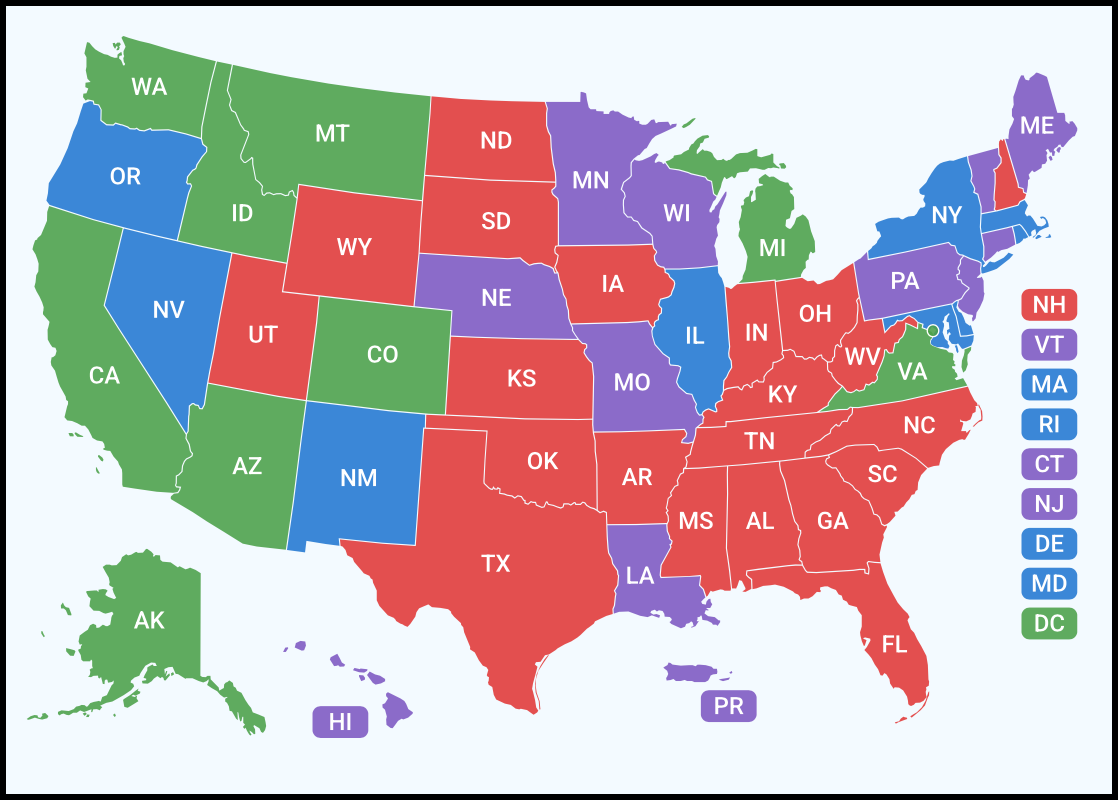
The 12 applying states, down from 20 that competed for an early slot in 2024, are, in the East: Delaware and New Hampshire; from the South: Georgia, North Carolina, South Carolina, Tennessee, and Virginia; the Midwest: Illinois, Iowa, and Michigan; and, in the West: Nevada and New Mexico.

The Rules and Bylaws Sub-committee will recommend to the full DNC one state from each geographic region and can choose an at-large entry from the remaining eight applicants.

It would be hard to deny South Carolina, since the state has been historically significant in giving candidates from both parties the critical thrust toward winning the national nomination. The Palmetto State became the deciding factor for Joe Biden’s 2020 campaign, giving him the necessary momentum to succeed on Super Tuesday, which made him unstoppable for the party nomination. He would then, of course, go onto win the Presidency that year.

Since it would be difficult to see this panel reversing the 2024 Iowa-New Hampshire decision, it would appear that Delaware will become the Eastern sector pre-Super Tuesday voting state. Likewise, in the West, Nevada would appear to have the inside track to securing a slot since they were one of the traditional early voting states. New Mexico, a newcomer to the application process, is the only other to come forth from the West.

The Midwest decision will likely come down to a choice between Illinois and Michigan. The committee, however, could install both if they again award Michigan the regional slot and give Illinois the at-large position.

In addition to New Mexico applying for the first time, the other three newcomers are North Carolina, Tennessee, and Virginia.

Senate: Open Race Recap

By Jim Ellis — Friday, March 27

Senate

Below is a status update of the 11 open US Senate races that will go a long way toward determining which party controls the chamber in the next Congress:

Alabama: Rep. Barry Moore (R-Enterprise), after receiving the Trump endorsement and now Majority Leader John Thune’s backing, has pulled ahead of state Attorney General Steve Marshall (R) in polling and fundraising. Marshall is Rep. Moore’s principal Republican opponent. Still, Moore winning the party nomination outright in a field of six candidates is a tall order.

The Alabama primary is May 19. If no candidate receives majority support, the top two finishers advance to a June 16 runoff election. The eventual Republican nominee wins the seat in November.

Illinois: With her victory in the March 17 open Democratic primary, Lt. Gov. Juliana Stratton has punched her ticket to the Senate. She will succeed retiring Sen. Dick Durbin (D) in the next Congress with an easy general election victory.

Iowa: Rep. Ashley Hinson (R-Marion/Cedar Rapids) is the consensus Republican nominee and will open the general election as the favorite to carry the state in November. The Democrats feature a tightly contested primary between state Sen. Zach Wahls (D-Des Moines) and state Rep. Josh Turek (D-Council Bluffs). The VoteVets group just announced they will spend $825,000 in an independent expenditure for Turek. The Iowa primary is June 2.

Kentucky: Rep. Andy Barr (R-Lexington) and former Attorney General and 2023 Republican gubernatorial nominee Daniel Cameron are locked in a very tight race with businessman Nate Morris a distant third. Rep. Barr, however, had a 10:1 cash-on-hand advantage over Cameron at the end of 2025. Democrats have a crowded primary with former state Representative and ex-US Senate candidate Charles Booker taking an early lead.

The Kentucky plurality primary is May 19. The eventual Republican nominee will be heavily favored in the general election.

Michigan: An intense Democratic primary is underway among Rep. Haley Stevens (D-Birmingham), state Sen. Mallory McMorrow (D-Royal Oak), and former Wayne County Health Director Abdul El-Sayed. Polling and fundraising are relatively even, though Rep. Stevens has the resource edge.

This primary won’t be decided until Aug. 4, which is a boon to GOP candidate Mike Rogers, the former Congressman who came within three-tenths of a percentage point of winning the 2024 Senate race. This contest will be in toss-up mode all the way to election day.

Minnesota: While Democrats feature a primary battle between Lt. Gov. Peggy Flanagan and Rep. Angie Craig (D-Prior Lake), Republicans have a consensus candidate in former national sports broadcaster Michele Tafoya. This race has the underpinnings of evolving into a surprisingly competitive general election even though Minnesota is a reliable Democratic state.

A tough and late Democratic primary (Aug. 11), unrest within the state, and Republicans united behind a strong candidate makes this contest more interesting than one would have expected after Sen. Tina Smith (D) announced her retirement.

Montana: The surprise withdrawal of Sen. Steve Daines (R) just before the candidate filing deadline expired and basically handing the party nomination to his chosen successor, former US Attorney Kurt Alme, will likely work even though the move does not sit well with most Montanans. At this point, Alme must be rated as the favorite to win the seat. Democrats have a five-way primary and former state Rep. Reilly Neill is considered the favorite to win the party nomination.

The most formidable non-Republican contender is likely former University of Montana President Seth Bodnar who is running as an Independent. The Montana primary is June 2, so it remains to be seen how a three-way general election race will evolve once both major parties have nominees in place.

New Hampshire: Democrats have a consensus candidate to replace retiring Sen. Jeanne Shaheen (D) in the person of Rep. Chris Pappas (D-Manchester). A new St. Anselm’s College Poll finds the Congressman leading former Sen. John E. Sununu (R) by only a 46-43 percent margin in the Senate general election ballot test.

Sununu, who served in the Senate from 2003-2009, is the clear favorite in the Republican primary opposite former Massachusetts Sen. Scott Brown, who challenged Sen. Shaheen in 2014.

North Carolina: Nominees are already set in the Tar Heel Senate race, as both former Gov. Roy Cooper (D) and ex-Republican National Committee chairman Michael Whatley each won their respective primaries outright in the March 3 primary election.

Cooper, who has won six statewide North Carolina races (two as Governor and four for Attorney General), may be in the best position of any Democratic Senate candidate to flip a Republican seat. Expect this race to end in a close finish as do most North Carolina political campaigns.

Oklahoma: With no serious opposition mounting in the Republican primary against Rep. Kevin Hern (R-Tulsa), who is quickly becoming a consensus GOP candidate in one of the strongest Republican states, the party does not have to worry about keeping Oklahoma in the red column.

Former Sen. Markwayne Mullin (R) was just confirmed as US Homeland Security Secretary. Gov. Kevin Stitt (R) appointed energy executive Alan Armstrong (R) to replace Sen. Mullin until the regular election cycle is complete. Because the Mullin seat is in-cycle, a special and regular election for the full six-year term will be held concurrently.

Wyoming: Sen. Cynthia Lummis (R) deciding not to seek a second six-year term has opened the door for at-large Rep. Harriet Hageman (R-Cheyenne) to become her successor. Expect Rep. Hageman to easily win both the Republican primary and the general election with the state’s other major political figures either running for the open Governor’s position or Hageman’s open congressional seat.

Key Senate Races Taking Shape

By Jim Ellis — Friday, January 16, 2026

Senate

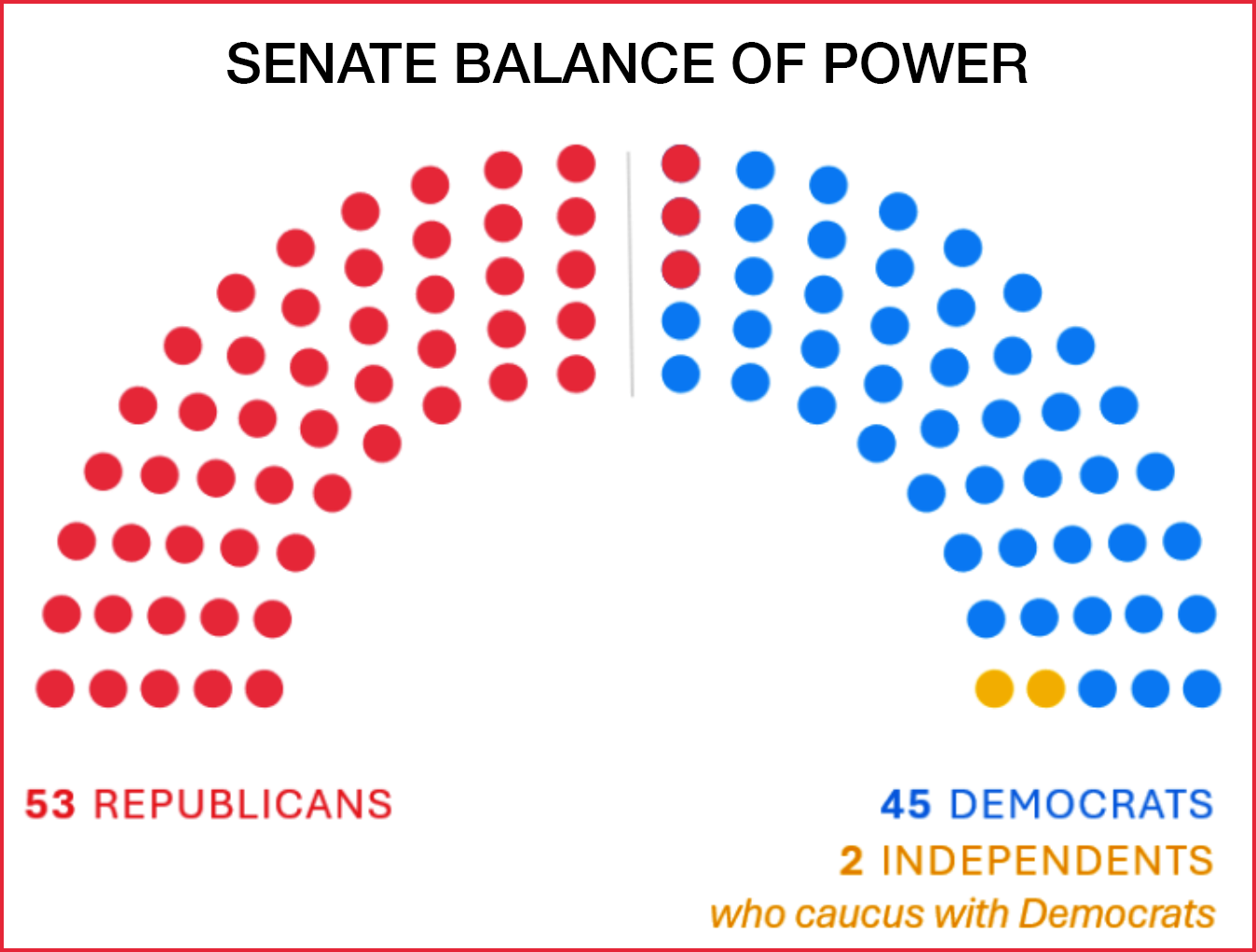
As we know, Republicans currently have a 53-47 Senate majority and the unfolding competitive statewide races suggest that the GOP will retain chamber control, but their margin could lessen.

A total of nine Senate seats are open but only two of those, Michigan and North Carolina, appear hotly competitive for the general election. The remaining seven are projected to retain the party that currently holds the respective seat. Eight of the nine in this group, however, will host highly contested primary elections for at least one party. North Carolina features the only open Senate race where the party nominees already appear set.

Another group of nine seats are contested for the general election, and it is here where Democrats will make a run at taking the Senate majority away from Republicans. To do so, they must reach 51, since Vice President Vance would break a 50-50 tie; Democrats would have to win seven of the nine contested races.

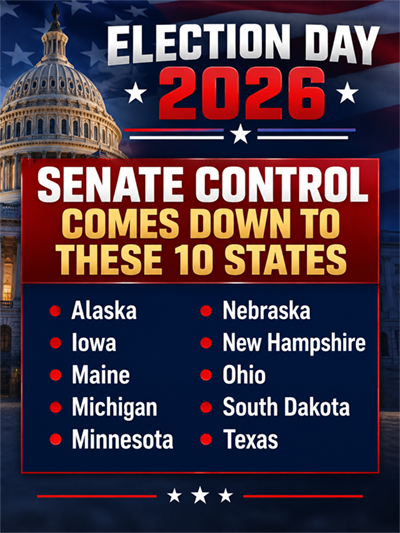
The Republicans are defending seats in Alaska, Iowa, Maine, North Carolina, Ohio, and Texas, while the Democrats must protect Georgia, Michigan, and New Hampshire.

Earlier this week former Alaska at-large Rep. Mary Peltola (D), who lost her seat to current Rep. Nick Begich III (R-Chugiak) in 2024, surprisingly launched a Senate campaign. Most believed she would enter the open Governor’s race where her prospects appear brighter. In the Senate race, she faces an uphill challenge against two-term incumbent Dan Sullivan (R), who has posted an average winning margin of 14.9 percentage points in his two elections including defeating Democratic Sen. Mark Begich in 2014.

Alaska’s unique top four/Ranked Choice Voting system does give Peltola some chance of winning the Senate race in the same manner as how she cobbled together two US House victories. If she can hold Sullivan under 50 percent in the general election, Ranked Choice Voting will begin and then all bets are off. At the outset, however, Sen. Sullivan is favored to win re-election.

Iowa Sen. Joni Ernst (R) is retiring after two terms, and Rep. Ashley Hinson (R-Marion/Cedar Rapids) appears as a consensus 2026 GOP Senatorial candidate. She will be favored to hold the seat probably against the Democratic leadership’s top choice, state Rep. Josh Turek (D-Council Bluffs), though several credible party members are competing for the nomination.

Maine Sen. Susan Collins (R) will defend her seat against either Gov. Janet Mills (D) or oysterman Graham Platner. Platner is the chosen Democratic Socialist candidate and has attracted major far left political figures to his campaign such as Sens. Bernie Sanders (I-VT) and Elizabeth Warren (D-MA). The general election will be close no matter who the Maine Democrats nominate.

North Carolina Republican Sen. Thom Tillis is retiring after two terms, and we will see a tight contest develop between former two-term Gov. Roy Cooper (D) and ex-Republican National Committee chairman Michael Whatley. North Carolina always features tight statewide elections, but for the first time in history Republicans have overtaken Democrats in party registration. This race, however, will likely end in a photo finish.

Appointed Ohio Sen. Jon Husted (R) faces the voters in his new role for the first time (he previously won two statewide races as Secretary of State and was twice on the gubernatorial ticket with Gov. Mike DeWine), and his opposition will be former Sen. Sherrod Brown (D). The fact that ex-Sen. Brown lost his seat in 2024 even though he garnered almost 293,000 more votes than when he last won in 2018 shows strongly the Ohio electorate is moving to the right.

The Texas Republican primary is likely going to a runoff between two of three candidates: Sen. John Cornyn, Attorney General Ken Paxton, and Rep. Wesley Hunt (R-Houston). The Democrats feature a battle between Rep. Jasmine Crockett (D-Dallas) and state Rep. James Talarico (D-Austin). A better general election picture will be drawn once the party nominees are chosen, but Texas Democrats have not won a statewide race since 1994.

Georgia Sen. Jon Ossoff (D) will be seeking a second term, and he already leads the nation in campaign fundraising. Republicans likely won’t have a nominee until a May runoff election concludes. A secondary election campaign potentially between Reps. Mike Collins (R-Jackson) and Buddy Carter (R-Pooler/Savannah) could well determine who challenges Sen. Ossoff in November.

The most vulnerable Democratic Senate seat may lie in Michigan. Here, an open contest between favored Republican Mike Rogers, a former seven-term Congressman and 2024 US Senate nominee, and one of the following: Rep. Haley Stevens (D-Birmingham), state Sen. Mallory McMorrow (D-Royal Oak), or former Wayne County Health Director Abdul El-Sayed, will take place.

The Michigan Democrats not only face a difficult primary campaign, but the nomination election isn’t until Aug. 4. The lengthy Democratic primary means Rogers will enjoy a long period of political open field running where he can build volunteer support and funding reserves.

Should former Sen. John E. Sununu win the New Hampshire Republican Senatorial nomination — and he is favored to do so over former ex-Massachusetts Sen. Scott Brown — the GOP will have a strong candidate to battle presumptive Democratic nominee Chris Pappas, the 1st District Congressman.

Though Pappas will be considered at least a slight favorite to win the general election, the Sununu name in New Hampshire has generally been political magic over the years. The Sununu family, including former Gov. John Sununu, ex-Gov. Chris Sununu, and ex-Senator and former Rep. John E. Sununu, have combined to win 11 major New Hampshire elections.

It remains to be seen if any other Senate contests enter the competitive realm, but electoral history suggests that an unexpected campaign is also likely to reach the political forefront.

Republicans are likely to hold their majority, but all of the aforementioned campaigns should be regularly monitored throughout this election year.

Iowa Rep. Hinson Declares
Her Candidacy for Senate

By Jim Ellis — Thursday, Sept. 4, 2025

Senate

Rep. Ashley Hinson (R-Marion/Cedar Rapids) / Facebook photo

On the heels of Sen. Joni Ernst (R-IA) announcing her retirement earlier this week, three-term US Rep. Ashley Hinson (R-Marion/Cedar Rapids) quickly declared her candidacy for the now open Iowa Senate seat.

Rep. Hinson will be a strong statewide candidate. In the House since 2021, a state Representative for two terms, and a Cedar Rapids ABC affiliate news anchor before running for office, Congresswoman Hinson has both the political and media experience necessary to be a strong candidate. Though the Republicans are losing an incumbent on the 2026 statewide ballot, Rep. Hinson will give the party everything they need to hold the open Senate seat.

The Democratic field is expected to remain constant. It features state Sen. Zach Wahls (D-Des Moines), state Rep. Josh Turek (D-Council Bluffs), Des Moines School Board chair Jackie Norris, and local Chamber of Commerce executive Nathan Sage. The open Governor’s race has attracted the state’s lone statewide Democratic officeholder, State Auditor Rob Sand.

Although Rep. Hinson’s 2nd Congressional District being in an open situation leaves competitive potential. Dave’s Redistricting App calculates a 51.4R – 45.3D partisan lean. President Trump carried the IA-2 district with a 54-44 percent victory margin over Kamala Harris. In 2020, Hinson defeated one-term Rep. Abby Finkenauer (D) who had unseated then-Rep. Rod Blum (R) in 2018.

Iowa is one of 31 states that register voters with partisan affiliation. In the 2nd District, 450,332 individuals are actively registered to vote. A total of 36.1 percent affiliate as Republican, 33.4 percent as No Party, 29.8 percent Democratic, and 0.7 percent as “Other.”

Therefore, the statistics suggest that this northeastern Iowa district leans Republican but, as in 2018 when Finkenauer won, the seat has flip potential in a strong Democratic year.

Expect to see political musical chairs begin among state legislators who represent districts that fall within the 2nd CD boundaries. It is likely we will see several current or former lawmakers come forward. One person already reportedly making fundraising calls and informing potential supporters that he is going to run is Trump Administration HUD official Joe Mitchell, a former state Senator.

Turning to the Democratic side, four individuals are already active candidates including state Rep. Lindsay James (D-Dubuque). The other candidates are ex-nursing college dean and retired Army Lt. Col. Kathy Dolter, 2020 local office nominee Don Primus, and pastor and non-profit organization founder Clint Twedt-Ball. It is probable we will soon see other Democrats also come to the forefront.

The 2nd District lies in Iowa’s northeast sector under the state’s quadrant congressional redistricting plan. It borders the Mississippi River and Illinois on the east and Minnesota to the north.

Under the rather unique plan, incumbents’ residences are not considered when drawing maps, and all counties are kept whole within each individual CD. Thus, the 2nd District houses 13 complete counties with four significant population centers. In order of size from large to small, the inhabitant clusters are the cities of Cedar Rapids, Waterloo, Dubuque, and Mason City.

Counting IA-2, a total of 31 seats are now in the open category (15R, 12D, with three new as a result of Texas redistricting), and Rep. Hinson becomes the tenth House member to run for the Senate in the current election cycle. Once the four special elections to fill vacant seats conclude beginning next week and running through early next year, the open seat will at least temporarily drop to 27.

Once Again, Ernst Polling Is Close

By Jim Ellis — Thursday, Aug. 28, 2025

Senate

Sen. Joni Ernst (R-IA)

In her two previous victorious Iowa US Senate races, Republican Joni Ernst defied the aggregate polling universe, and a new Public Policy Polling survey of the 2026 campaign suggests we may see this familiar pattern repeat.

As a whole in both 2014 and 2020, the pollster universe underestimated Ernst’s political strength and miscast her campaigns as being too close to call when they weren’t.

In Sen. Ernst’s first statewide election, running from her position as a state Senator, she defeated then-US Rep. Bruce Braley (D) by more than eight percentage points, or a full six points above her average polling lead according to the Real Clear Politics Polling Archives.

In her re-election bid from five years ago against Des Moines businesswoman Theresa Greenfield, Sen. Ernst headed into Election Day with just over a one point average edge, again according to the RCP Polling Archives, yet won with close to a seven-point cushion.

The new PPP Iowa poll (Aug. 18-19; 572 registered Iowa voters; live interview and text) finds Sen. Ernst with only toss-up leads over a series of largely unknown, from a statewide perspective, Democratic candidates.

According to the Public Policy Polling results, Sen. Ernst would lead state Sen. Zach Wahls (D-Des Moines), only 43-42 percent; she tops Des Moines School Board chair Jackie Norris, 45-42 percent; and posts a pair of 45-41 percent advantages over local Chamber of Commerce executive Nathan Sage and state Rep. Josh Turek (D-Council Bluffs).

In reviewing the Polling Archives from her two previous statewide races, we saw Sen. Ernst beginning well behind.

In 2014, against Braley, Sen. Ernst trailed in the first published poll – in July of 2013 and again according to PPP – by a 13 percentage point margin, 45-33. Over the course of the 2014 campaign, 45 statewide surveys were publicly released from 14 different pollsters.

Within the 45 poll universe, Sen. Ernst led in 19, but none among the first nine released surveys (down an average of 7.1 points). In the campaign’s closing stage, her average percentage lead was 2.3 from the six polls released during the Oct. 27 to Nov. 3 period, yet her actual victory margin over Braley was 8.5 percent.

In 2020, this time as the incumbent seeking her first re-election, we saw a similar pattern unfold. In the ’20 race, the Real Clear Polling Archives reports a total of 19 Iowa Senate race polls being released from nine different polling organizations beginning in early April of the election year.

The first released poll again came from PPP with a survey ending on May 1, 2020. It projected Sen. Ernst as having a 43-42 percent edge over Greenfield, the same percentage this new 2025 poll finds her leading opposite state Sen. Wahls.

Within the 19-poll universe that the RCP Polling Archives tracked in the 2020 campaign, Sen. Ernst led in only seven of the polls and trailed by an average of just under three percentage points through the period ending Oct. 24 (a total of 14 released polls). In the final five polls, during the Oct. 27 through Nov. 2 period, Sen. Ernst built an average polling point lead of only 1.4 according to the Archives’ calculations but won the race on Nov. 3 by 6.6 percent.

We saw similar polling underestimates in President Trump’s three Iowa campaigns. In 2016, again with data from the Polling Archives, 26 presidential polls were conducted in the Hawkeye State from Aug. 9, 2015 through Nov. 4, 2016. Within the 26-poll universe, Hillary Clinton led in 10 with four ties. Looking at the final three polls from Nov. 1 through Nov. 4, Trump led in two with an average three-poll lead of three percentage points. On Nov. 8, 2016, he carried Iowa with a 9.5 percent margin spread.

In 2020, though Trump would lose the national election, he again carried Iowa with a greater than predicted margin. In this election, 27 polls were conducted from the period of Feb. 2, 2020 through Nov. 2. The polling universe was better in this election, as they forecast Trump to be leading Joe Biden in 15 of the polls with three ties. In the final five polls from Oct. 27 through Nov. 2, he led in four of the surveys with an average edge of two percentage points. Again, his final margin on Nov. 3 was much larger: 8.5 points.

In 2024, Iowa polling became a point of national contention as the state’s pollster deemed most accurate, Selzer & Company, projected a Kamala Harris lead of three percentage points in a poll concluded on Oct. 31.

President Trump would carry the state on Nov. 5 by a 13.2 percent margin, meaning the Selzer miss was a whopping 16-plus points.

Only three presidential polls were released during the closing days of the Iowa 2024 cycle. The other two pollsters, Emerson College and Insider Advantage, were much closer to the final result (Trump plus-10 and plus-6, respectively), but even they underestimated the Republican strength.

While the early 2025 Public Policy Polling survey again depicts Sen. Ernst in a potentially close race, this is nothing new for her Iowa Senate campaigns. If polling history is any indication, the end result will likely tell a much different story.

The Iowa Political Hotbed

By Jim Ellis — Monday, Aug. 25, 2025

Iowa

The Hawkeye State of Iowa will be among the nation’s hottest political domains in the next year, featuring competitive races from the top of the ballot to the bottom. In the past week, we have seen new action occurring in several of the races.

Iowa Sen. Joni Ernst (R)

Sen. Joni Ernst (R) has not yet formally announced for re-election, and rumors that she would retire and yield to Rep. Ashley Hinson (R-Marion/Cedar Rapids) as the consensus Republican candidate, have dissipated. Sen. Ernst says she will declare her intentions in the fall.

The fact that she has raised $6.7 million during her current term and maintains $3.4 million cash-on-hand is a good indication that she is running.

One person who won’t be in the Senatorial field is state Rep. J.D. Scholten (D-Sioux City). Previously declaring for the Senate, Scholten this week announced that he is dropping his statewide bid and endorsed state Rep. Josh Turek’s (D-Council Bluffs) US Senate effort. Also in the Democratic primary race are state Sen. Zach Wahls (D-Des Moines), Des Moines School Board chair Jackie Norris, and local Chamber of Commerce executive Nathan Sage.

Sen. Ernst will be a strong favorite for re-election, but it is obvious the Democrats are going to make this race a national target.

With Gov. Kim Reynolds (R) retiring, the 2026 Iowa Governor’s race will be an open contest. Five Republicans have announced their intention to run including three-term Rep. Randy Feenstra (R-Hull/Sioux City). In addition, two sitting state legislators, one former state Representative, and ex-State Administrative Services Director Adam Steen have all formally entered the Republican primary.

The Democrats are fielding four candidates, but all political eyes are on Iowa’s lone Democratic statewide elected official, State Auditor Rob Sand. A likely Feenstra-Sand general election will lead the ballot and promises to become a competitive race. Rep. Feenstra, however, begins the campaign as the favorite.

We will also see competitive action in all four of Iowa’s congressional districts.

Rep. Mariannette Miller-Meeks (R-Le Claire) will face challenges in the Republican primary and general election. Her 56 percent showing in the 2024 GOP primary against an opponent who literally spent no money and winning the general election with just a 799-vote cushion leaves her in vulnerable position. Her 2024 primary opponent, advertising executive David Pautsch, is returning for a re-match and promises to raise and spend money in the coming race.

The 2022 and ’24 Democratic nominee, former state Rep. Christina Bohannan, returns for a third run. She faces credible Democratic opposition, however, in the person of former state Rep. Bob Krause and attorney Taylor Wettach.

Rep. Hinson just drew a formidable Democratic opponent this week. State Rep. Lindsay James (D-Dubuque) formally announced her candidacy and will launch a spirited general election campaign. She faces three announced Democrats in the party primary, none of whom have ever been elected to any office.

After flirting with running for Governor and even moving to the open 4th District, which is a much safer Republican CD than his own, Rep. Zach Nunn (R-Bondurant) will seek re-election in his Des Moines anchored 3rd District. IA-3 is politically marginal (Dave’s Redistricting App partisan lean: 49.8R – 47.0D), which guarantees a close finish.

Two strong Democrats, state Sen. Sarah Trone Garriott (D-Des Moines) and former state House Minority Leader Jennifer Konfrst, are the major contenders. This district’s electorate has unseated two incumbents, one from each party, since 2018.

With Rep. Feenstra leaving the House to run for Governor, the open western 4th District will largely be decided in the Republican primary (Dave’s Redistricting App partisan lean: 61.9R – 34.9D). State House Majority Leader Matt Windchitl (R-Harrison County) and Siouxland Chamber of Commerce president Chris McGowan appear to be the leading GOP candidates.

The Iowa primary is scheduled for June 2. The state has a post-nomination election process for races that end with no candidate receiving 35% of the vote. A special party convention is then called for the affected district or state, with delegates choosing the eventual party nominee.

As we can see, all of the state’s most important races will offer a high degree of competition throughout next year. Expect Iowa to draw major national political attention in the coming months.

IA-1: A Close Re-match Predicted

Iowa Congressional Districts

By Jim Ellis — Tuesday, June 24, 2025

House

Iowa’s southeastern 1st Congressional District delivered the third-closest US House race in 2024, and the two principals are officially returning for a re-match. Late last week, former state Rep. Christina Bohannan (D) announced that she would return for a third attempt at unseating Rep. Mariannette Miller-Meeks (R-Le Claire).

The Congresswoman first won her seat in 2020 after several tries with a six-vote victory over former state Senator and Lieutenant Governor nominee Rita Hart (D) from the previous 2nd District.

Iowa runs a unique redistricting system, basically ceding map-drawing responsibility to a legislative committee staff who design the districts based upon a mathematical algorithm. The legislature then has the right to approve or reject the map without amendment.

In the 2021 redistricting cycle, the legislature turned down the original map, which led to the present draw. The final plan forced Reps. Miller-Meeks and Ashley Hinson (R-Marion/Cedar Rapids) to switch districts, but both Republican members have been able to hold their new CDs.

The 1st District covers 20 complete counties and is anchored in the Quad Cities area, which features the Davenport and Bettendorf municipalities in Scott County on the Iowa side of the Iowa-Illinois border. The remaining entities that comprise the four-city group lie in the Land of Lincoln.

The seat then stretches west as far as the city of Indianola, which lies due south of Iowa’s capital city of Des Moines. The other significant population centers are Iowa City, which houses the University of Iowa, and the Burlington, Clinton, and Newton communities.

IA-1 is politically marginal. The Dave’s Redistricting App statisticians calculate a 50.0R – 46.7D partisan lean. President Trump carried the district with a 53.5 – 45.0 percent victory margin over Kamala Harris. In 2020, Trump defeated President Biden here, 50.5 – 47.6 percent.

Therefore, Rep. Miller-Meeks’ 799-vote victory margin, translating into a percentage spread of 48.4 – 48.2, was an underperfor-mance in relation to President Trump’s total, but also when compared to the partisan lean. In 2022, however, and again opposite Bohannan, Rep. Miller-Meeks scored a 52.6 – 42.9 percent victory, which is more consistent with other Republican margins.

The 2024 election cycle displayed obvious weakness for Rep. Miller-Meeks not only in the general election, but also in the Republican primary. In the June vote, Rep. Miller-Meeks managed only a 56 percent victory against a GOP primary opponent who literally spent no money.

The 2026 IA-1 race will again be close, and Miller-Meeks must work to strengthen her Republican base, since the Trump coalition, or MAGA faction, as a group apparently does not believe her to be solidly conservative.

Rep. Miller-Meeks’ 2024 Republican opponent, advertising executive David Pautsch, returns for a re-match and pledges to run a serious campaign in the 2026 primary although his $8,170 raised in the first quarter of 2025 doesn’t provide evidence of a budding competitive effort.

Seeing the 2nd Quarter totals for both candidates — the period closes June 30 with a filing deadline of July 15 — will be interesting. Obviously, Pautsch must significantly improve his fundraising for his candidacy to become credible, and it will be worth seeing if Rep. Miller-Meeks continues to do well on the fundraising trail. In the 1st Quarter, she reported a strong $1.02 million in receipts with a cash-on-hand figure of $1.09 million.

Clearly, the IA-1 contest is a congressional race with national majority implications since the House partisan divide after the 2026 election is again projected to be very close. Expect a very expensive general election congressional campaign in southeast Iowa and another close finish.