Tag Archives: New Jersey

Yesterday’s Primary Results Roundup

By Jim Ellis — Wednesday, June 3, 2026

Voters in six states, California, Iowa, Montana, New Jersey, New Mexico, and South Dakota, cast their nomination ballots yesterday and what follows are the key results and analysis.

The night was particularly bad for two US House members attempting to run statewide. In Iowa, Rep. Randy Feenstra (R-Hull/Sioux City) fell to investment company executive Zach Lahn in the open Republican gubernatorial primary, and South Dakota at-large Congressman Dusty Johnson (R-Mitchell), after leading in early polling, failed to even qualify for the gubernatorial runoff election in his state.

California

The Governor and Los Angeles Mayor’s contests dominated the pre-election coverage. With only about half the vote counted, Republican Steve Hilton, a former Fox News host, is leading the huge 60-person field. Closely behind is former Health and Human Services Secretary, ex-California Attorney General, and 22-year congressional veteran Xavier Becerra.

When all the votes are counted, which could be weeks from now, it appears that both men will advance into the general election.

Billionaire Tom Steyer (D) is in third place, but it appears his effort to reach the general election will fail. The same for Riverside County Sheriff Chad Bianco (R), who for a time, was in competition for one of the runoff slots. Former Rep. Katie Porter (D) will also be eliminated.

In Los Angeles, Mayor Karen Bass (D) will be forced to a runoff election. It appears she will secure less than 40 percent of the vote when all ballots are counted. Advancing to the November runoff appears to be upstart Republican Spencer Pratt. His vote percentage likely places him far enough ahead of LA City Councilwoman Nithya Raman to secure the second slot.

Though Mayor Bass performed poorly for an incumbent and is clearly unpopular since almost 64 percent of the people chose another candidate, Los Angeles’ strong Democratic voting history suggests that Pratt will have a very difficult time unseating her in the general election. Still, a Republican finishing a credible second in a LA Mayor’s race is notable.

There is a new US House member in the California delegation. Republican Assemblyman James Gallagher won the 1st District special election outright, and he will immediately be sworn into office to finish the late Rep. Doug LaMalfa’s (R) term.

Gallagher, though finishing first in the new 1st District regular primary, which is much different than the seat in which he clinched the special election, will be considered at least a slight underdog in the general against state Sen. Mike McGuire (D-Sonoma County) even though the latter man fell short of expectations in yesterday’s voting.

Because only half the votes are counted, it is difficult to draw conclusions about how the House races unfolded. It does appear, however, that veteran Rep. Doris Matsui (D-Sacramento) will advance to the November general election with another Democrat, Sacramento City Councilwoman Mai Vang. This is a race to watch in November.

Other Democratic members falling below the 50 percent mark in the jungle primary will still do well in the general election because they are drawing Republican opponents and not other Democrats.

For the Republicans, in the southern California pairing between Reps. Ken Calvert (R-Corona) and Young Kim (R-La Habra), both will advance to the general election. Calvert, however, has a large lead heading into the general election campaign.

The other general election contest to watch is in San Diego where County Supervisor Jim Desmond (R) clinched the first runoff position and will face San Diego City Councilwoman Marni Van Wilpert (D), who was a distant second. This open seat race, though designed to elect a Democrat, will be very close in November.

Finally, in the race to replace retiring former House Speaker Nancy Pelosi in her San Francisco congressional district, as expected, state Sen. Scott Wiener (D-San Franciso) and San Francisco County Supervisor Connie Chan (D) will both advance to the general election.

Iowa

As mentioned above, the Republican gubernatorial winner was technology company executive Zach Lahn. He will face State Auditor Rob Sand (D), who was unopposed in the Democratic primary. This will be a very competitive general election pairing.

As expected, US Rep. Ashley Hinson (R-Marion/Cedar Rapids) and state Rep. Josh Turek (D-Council Bluffs) will square off in the US Senate general election. Democrats need to make this a competitive race to have a chance at taking the Senate majority. Rep. Hinson begins the general election campaign as the favorite.

Three of the state’s four congressional races will be competitive. The open 2nd District also went as predicted. Former state Rep. Joe Mitchell easily won the Republican primary as did state Rep. Lindsay James (D-Dubuque) in the Democratic primary.

The 1st District will see the third version of Rep. Mariannette Miller-Meeks (R-Le Claire) and former state Rep. Cynthia Bohannan (D) opposing each other. The Congresswoman performed much better in yesterday’s Republican primary (over 70 percent of the vote) as compared to her 2024 standing.

Montana

As expected, former US Attorney Scott Alme easily won the Republican US Senate primary. He will be favored to succeed retiring Sen. Steve Daines (R).

Rep. Ryan Zinke (R-Whitefish) is retiring and his chosen replacement, radio talk show host Aaron Flint, won the 1st District Republican primary. It will likely be some time before the Democratic nominee is officially elected. The initial vote totals show a tight finish between smokejumper firefighter Sam Forstag and former gubernatorial nominee Ryan Busse.

New Jersey

The key race on the New Jersey ballot is the 7th Congressional District, and the Democratic primary went as expected. The easy winner against a crowded field is businesswoman and Navy veteran Rebecca Bennett. She will now challenge two-term Rep. Tom Kean Jr. (R-Westfield), who has been absent from the House for over two months related to an undisclosed heath situation. This race is a key national Democratic conversion opportunity.

In the open 12th District, where the Democratic primary winner was a lock to replace retiring Rep. Bonnie Watson Coleman (D-Ewing Township/Trenton), physician Adam Hamawy claimed the party nomination. He is now the prohibitive favorite to win the general election.

New Mexico

Former US Interior Secretary and ex-Congresswoman Deb Haaland is the landslide Democratic gubernatorial primary winner here, defeating Bernalillo County District Attorney Sam Bregman to secure the party nomination. She becomes a heavy favorite to win the open November race against new Republican nominee Gregg Hull, the Rio Rancho Mayor.

In the competitive 2nd District, retired police officer Greg Cunningham (R) will challenge two-term Rep. Gabe Vasquez (D-Las Cruces).

South Dakota

The South Dakota Governor’s race was the second to see a businessman defeat established political figures. Businessman Toby Doeden advances to a July 28 Republican runoff likely against Gov. Larry Rhoden, who is on the ballot seeking a full term in his own right after succeeding Kristi Noem when she resigned to accept a position in the Trump Administration. Congressman Dusty Johnson (D-Mitchell) is close behind in third position but will not likely receive enough late votes to overtake the Governor for second position.

In the state’s lone House race, multi-term Attorney General Marty Jackley, as expected, was a landslide Republican primary winner. He will go onto capture the general election in November and enter the new Congress at the beginning of January.

Primary Preview: NJ, NM, SD

By Jim Ellis — Monday, June 1 2026

Our third preview piece ahead of tomorrow’s primaries examines the contests in New Jersey, New Mexico, and South Dakota. Earlier, we reviewed the full slate of races in California, Iowa, and Montana. A total of 15 primaries will occur this June.

New Jersey

The Garden State features just one top‑tier competitive general‑election contest: the 7th Congressional District, where two‑term Rep. Tom Kean Jr. (R‑Westfield), who has been absent from Congress for two months due to an unexplained health issue, is poised to face a strong Democratic challenger. The district only slightly favors Republicans; analysts at the Dave’s Redistricting App estimate a 50.9R–46.7D partisan lean.

The primary elections include a Republican Senate contest and 10 contested congressional primaries. As noted earlier, however, only one of these nomination battles is expected to become a truly competitive general election race.

Four Republicans are vying for the opportunity of challenging Sen. Cory Booker (D), but the GOP primary is merely a secondary storyline. Sen. Booker enters the general election as a strongly positioned incumbent in a state that has consistently favored Democratic candidates.

The first notable primary is in District 2, where four Democrats are competing for the chance to challenge four‑term Rep. Jeff Van Drew (R‑Dennis Township/Atlantic City). The Congressman is now seeking his third election as a Republican after initially winning the seat as a Democrat. Tomorrow’s Democratic victor will likely attract some initial national consideration to determine if Rep. Van Drew has general election vulnerability.

In the 7th District, four Democrats are competing for the opportunity to challenge Rep. Kean. Businesswoman and Air National Guard officer Rebecca Bennett has led in recent polling and is well‑positioned to secure the nomination. Because New Jersey uses a plurality‑vote primary system, finishing first tomorrow is all that matters.

In the northern New Jersey 8th District, two‑term Rep. Rob Menendez (D‑Jersey City) again faces a Democratic primary challenger, though the opposition is not as formidable as the field he confronted in 2024. Rep. Menendez is widely viewed as the clear favorite over former Jersey City Board of Education president Mussab Ali.

In District 11, special‑election winner Analilia Mejia (D‑Glen Ridge/Morristown) faces only minimal opposition in the regular Democratic primary and is not expected to encounter a competitive general election challenge. The seat became open earlier this year after then‑incumbent Rep. Mikie Sherrill (D) was elected Governor in the November 2025 election.

Rep. Bonnie Watson Coleman (D‑Ewing Township/Trenton) is not seeking a seventh term, creating an open seat and prompting a crowded 13‑candidate Democratic primary. The eventual nominee will win the strongly Democratic district in November.

Only two of the 12th District contenders hold elected office: state Assemblywoman Verlina Reynolds‑Jackson (D‑Trenton) and Somerset County Commissioner Shanel Robinson. With such a large field, the winning candidate will likely secure only a modest share of the vote, but New Jersey’s plurality primary system means that finishing first is all that matters, regardless of the overall percentage.

New Mexico

With Sen. Ben Ray Luján (D) facing only minimal Democratic primary opposition and no Republican challenger, statewide political attention is centered almost entirely on the open Governor’s race.

Because Gov. Michelle Lujan Grisham (D) is ineligible to seek a third term, the open Democratic primary is central to determining her successor. The race has narrowed to a two‑candidate contest between former US Interior Secretary and ex‑ Albuquerque Congresswoman Deb Haaland and Bernalillo County District Attorney Sam Bregman. While Haaland enters the primary with notable advantages, political observers still expect a relatively competitive finish.

Three Republicans are competing for the party’s gubernatorial nomination, with Rio Rancho Mayor Gregg Hull and former New Mexico Human Services Secretary Duke Rodriguez viewed as the leading contenders. Whoever emerges from the primary is expected to face a difficult campaign path in the general election, given the state’s Democratic voting history.

Only one of New Mexico’s congressional races is expected to be competitive in the general election: the southern 2nd District. Here, Rep. Gabe Vasquez (D‑Las Cruces) is seeking a third term in what is shaping up to be a closely watched contest.

Retired police officer Greg Cunningham is unopposed for the Republican nomination, setting up a potentially high‑profile national race. While Vasquez enters the cycle with some clear advantages, the district has a recent history of competitive outcomes, making it a race to watch this fall.

South Dakota

The open Republican gubernatorial campaign is shaping up to be a tight contest. Gov. Larry Rhoden assumed the state’s top office from his post as Lieutenant Governor when then‑Gov. Kristi Noem (R) resigned to accept a federal appointment. At‑large Rep. Dusty Johnson (R-Mitchell) immediately announced a primary challenge to Gov. Rhoden. Businessman Toby Doeden and state House Speaker Jon Hansen (R-Dell Rapids) are also running, and each has a credible base of support.

South Dakota is a runoff state, and there is a real possibility that none of the four candidates will reach the 35 percent threshold needed to clinch the Republican nomination outright. If a runoff is required, it will be held on June 28.

Separate recent polls have individually placed three of the four candidates in first place, leaving tomorrow’s outcome uncertain. The eventual Republican nominee, however, is strongly positioned to win the Governorship in November, given the state’s partisan landscape.

In the open at‑large House race, multi‑term Attorney General Marty Jackley is strongly positioned to win the Republican primary and advance to November as the party’s nominee. Given the state’s voting history, he enters the general election cycle as the prohibitive favorite in the contest for South Dakota’s lone US House seat.

Malinowski Concedes in NJ-11;
Murkowski Says No in Alaska

By Jim Ellis — Wednesday, February 11, 2026

NJ-11

Democratic Socialist Analila Mejia / NJPBS

With former Rep. Tom Malinowski (D) conceding defeat in the close NJ-11 special election to replace Gov. Mikie Sherrill (D) in Congress, Democratic Socialist Analila Mejia, a former staff member to Sen. Bernie Sanders (I-VT), has won the party primary and will advance into the special general election on April 16.

Turnout for the special was low, with 63,804 Democrats participating as we analyze near-final unofficial tabulations. Mejia defeated Malinowski, 29.1 – 27.7 percent, a margin of 889 votes (18,584 to 17,695).

Mejia will also file for the full term before March 23, and it remains to be seen how many of the 12 defeated special election Democrats will decide to challenge her in that race for the regular term.

In the special general, Mejia will face Randolph Township Mayor Joe Hathaway, who was unopposed in the special Republican primary. Because Mejia is to the left of the district’s historical voting pattern, the Republican leadership will now make the calculated decision about whether to run a significant campaign in an attempt to score an upset victory.

Chances are that Mejia will likely win the general against a minimal effort, since Republicans have been performing poorly in special elections around the country since the 2024 election and will likely choose to save the money to use in other regular election contests.

The next special election will occur in Georgia on March 10 in the Peach State’s vacant 14th District (Rep. Marjorie Taylor Greene resignation). There, 16 members of the GOP, three Democrats, a Libertarian, and an Independent will compete in a jungle primary for Georgia’s strongest Republican seat.

Should no one receive majority support, almost a certainty from such a crowded field, the top two finishers will advance to an April 7 special general election.

The final special election will occur in California’s 1st District on June 2. State Assemblyman James Gallagher (R-Yuba City) is favored to win the seat outright in the first election. Should others join the candidate field and force a runoff, the secondary election will be held on Aug. 4.

The CD-1 position is vacant due to the death of the late Rep. Doug LaMalfa (R-Oroville).

Alaska

Sen. Lisa Murkowski (R-AK), who had not ruled out entering her state’s open Governor’s race, said to reporters earlier in the week that she will not run later this year, and restated her commitment to serve Alaska in the US Senate.

It is likely that Sen. Murkowski would have been favored to win the Governor’s position, as her father did in 2002. Gov. Frank Murkowski was then defeated in the 2006 Republican primary, losing to future Governor and 2008 Vice Presidential nominee Sarah Palin and even dropping to a third-place finish.

In 2026, it is probable that Lisa Murkowski would have advanced into the general election via the top four jungle primary system that Alaska employs. Ten Republicans have announced for the position, but the crowded field would have helped her since the conservative vote would have been split among so many candidates.

Without former Rep. Mary Peltola (D) in the race – she chose instead to run for the US Senate – the Republicans will again be favored to win the general election.

The Senator’s decision looks to lay the groundwork for an interesting 2028 campaign, however. Term-limited Gov. Mike Dunleavy (R) has already said he plans to challenge Sen. Murkowski in the next election.

NJ-11: Special Primary Today

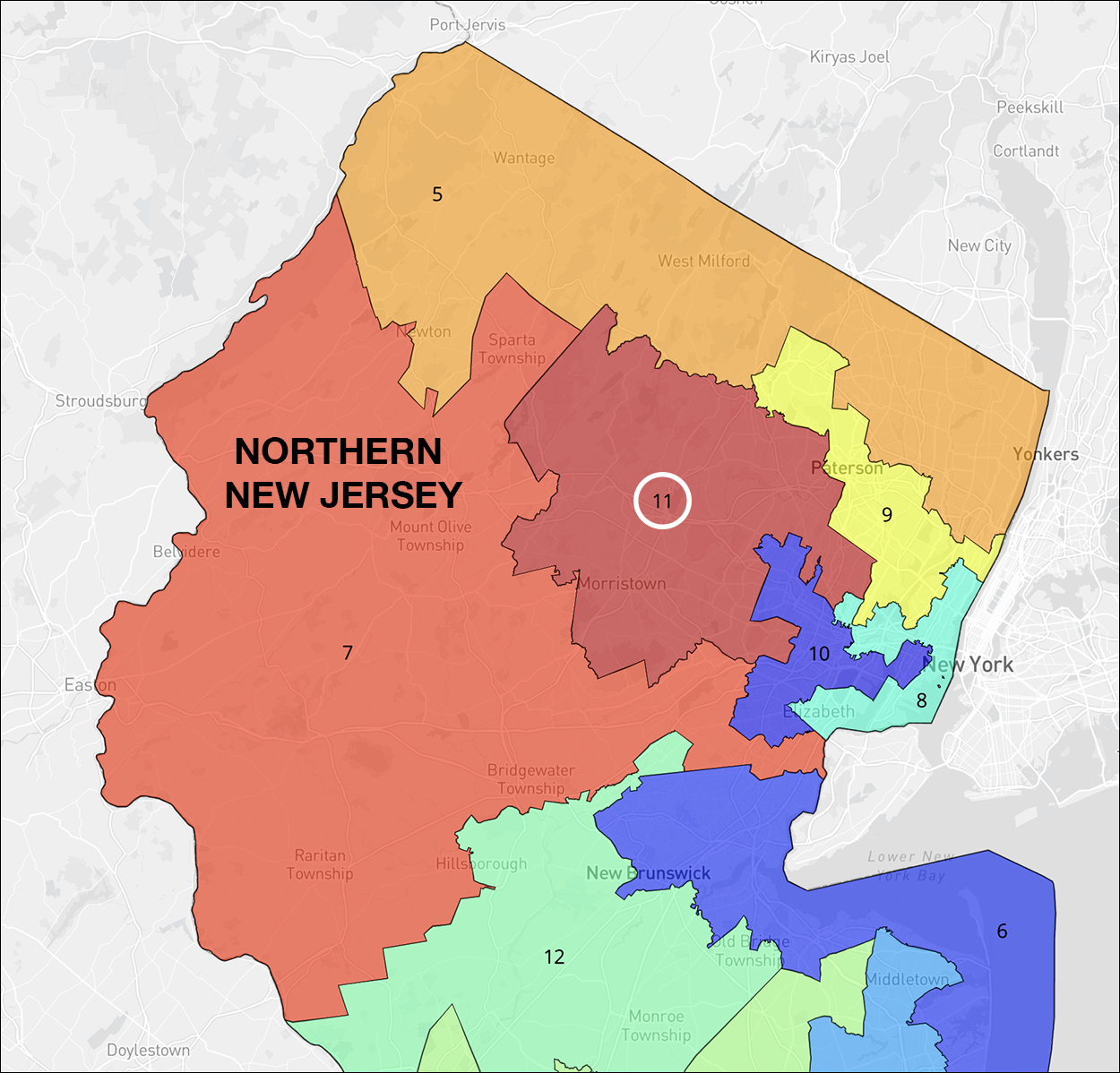
CD-11, Northern New Jersey / Dave’s Redistricting App

By Jim Ellis — Thursday, February 5, 2026

House

Voters in northern New Jersey go to the polls today to choose party nominees for the purpose of replacing Gov. Mikie Sherrill (D), who vacated this congressional district after winning her statewide election in November.

The real battle today is in the Democratic primary as 11 candidates are vying for the party nomination. The primary victor tonight will then likely claim the April 16 special general election.

Former 7th District Congressman Tom Malinowski is viewed as at least a slight favorite to win tonight’s Democratic election, though he has been under attack from his opponents particularly for his stock market success while a member of Congress.

Malinowski was elected to the House in 2018 and won a close re-election over the district’s current Congressman, Tom Kean Jr. (R-Westfield), in 2020. After redistricting, which made the 7th District a touch more Republican, Kean was able to unseat the two-term incumbent in 2022. Rep. Kean was then re-elected in 2024 and will face a tough fight again later this year.

In today’s 11th District special election, Malinowski’s chief opponents are Essex County Commissioner Brendan Gill, venture capitalist Zach Beecher, Passaic County Commissioner John Bartlett, and former Lt. Gov. Tahesha Way.

Malinowski is the top fundraiser within the group, bringing in just over $1.1 million according to the Federal Election Commission pre-primary filing covering the period through January 16th. Gill, however, is not far behind with over $800,000 raised. The remaining group has all attracted between $400-$500,000. Since little difference in ideology exists among the candidates, the Democratic primary will likely be an Election Day turnout battle because early voting has not previously been a major factor in New Jersey voting.

For the Republicans, Randolph Township Mayor Joe Hathaway is unopposed for the party nomination and will automatically advance into the mid-April special general election. For his part, Randolph has raised over $260,000, with just over $160,000 in his campaign treasury.

Depending upon tonight’s Democratic result, we will soon see whether the national Republican apparatus will spend significant money to boost Hathaway’s chances in the special general.

The 11th District lies in northern New Jersey and contains parts of Essex, Morris, and Passaic counties. The major population centers are the cities of Morristown, Broomfield, and Montclair.

According to the Dave’s Redistricting App statisticians, the district’s partisan lean favors the Democrats by a 55.6D – 42.5R count. Kamala Harris carried the district with a 53.3 – 44.6 percent margin over President Trump. Of New Jersey’s nine Democratic congressional districts, the 11th ranked as Harris’ sixth-best performance against Trump. Statewide, her victory margin was 52.0 – 46.1 percent, so the 11th District exceeded her statewide showing by 1.3 percentage points.

The NJ-11 special will be the seventh such contest in House races since the current Congress began. Each party has held the seats it was risking, and the NJ-11 contest in April will very likely follow suit.

The next special election will occur in Georgia where the fight will be on the Republican side. The state’s 14th District, from which former Rep. Marjorie Taylor Greene (R) resigned in early January, is the Republican’s safest Peach State CD. This election will occur on March 10.

Under Georgia election law, all candidates are placed on a jungle primary ballot. If a candidate scores majority support, the individual is elected outright. If no one reaches that threshold, the top two finishers regardless of political party affiliation will advance to an April 7 runoff election.

The 14th District’s partisan lean (Dave’s Redistricting App: 69.2R – 28.9D) is overwhelmingly Republican, so the GOP will hold the seat. With 21 filed candidates, however, going to a runoff election is a virtual certainty.

The contest to replace the late Rep. Doug LaMalfa (R-CA) will be held June 2 under an identical format to the Georgia structure. If a runoff election is necessary in that race, such is scheduled for Aug. 4.

NJ-11: Special Election Heating Up

By Jim Ellis — Wednesday, January 21, 2026

House

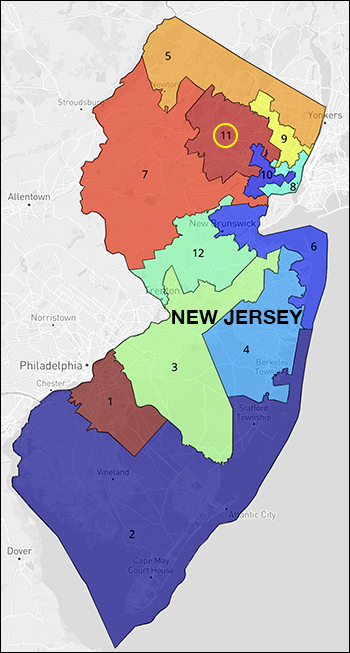
New Jersey Congressional Districts map (click on image to see larger interactive map on Dave’s Redistricting Map.)

The New Jersey special election campaign is well underway with the major candidates launching attack ads against each other and, of course, President Trump.

Northern New Jersey voters will choose their congressional nominees on Feb. 5 to begin the process of replacing former Rep. Mikie Sherrill (D) in the Garden State’s 11th Congressional District. Sherrill was sworn in as New Jersey’s Governor yesterday.

The real battle is in the Democratic primary, since the eventual party nominee will be a heavy favorite to win the seat in the special general election set for April 16. Eleven Democrats are actively campaigning, and the major contenders appear to be former Lt. Gov. Tahesha Way, ex-7th District Rep. Tom Malinowski, Essex County Commissioner Brendan Gill, and Passaic County Commissioner John Bartlett.

Gill is attracting attention for his ad that calls out former Rep. Malinowski for making millions of dollars in stock transactions when he was in the House during the Covid pandemic. Prior to his defeat in 2022, the House Ethics Commission was investigating the Malinowski transactions and ruled that he should have reported his gains on mandatory financial disclosure statements.

The Malinowski campaign responds with an ad saying he will fight Trump and, as he says, “… the billionaires screwing people and the insurance companies denying coverage, [and] the big tech companies hurting our kids.” The former Congressman says he “can do this because I refuse to take corporate PAC money.”

The Malinowski campaign appears vulnerable to the stock transaction attacks because the very companies he claims to be opposing are the type of industrial entities that he invested with to personally profit. Therefore, Gill and others attacking Malinowski because they perceive him as a front-runner may have the necessary political ammunition to deny him the party nomination.

Tahesha Way served as New Jersey’s Lieutenant Governor and Secretary of State. Now-former Gov. Phil Murphy (D) appointed her to both positions. She is spending her ad time attacking Trump and claims she is the only candidate to have “beaten Trump.” The reference is to winning an election law case against the Trump Administration.

All of the major candidates will be well funded, and the Democratic primary race will likely attract a great deal of attention as we approach Election Day. The Republicans have an unopposed candidate for their nomination. Randolph Township Mayor Joe Hathaway will face the eventual Democratic nominee.

It remains to be seen if the Republicans will mount a major challenge in this district. The seat has transformed over the years from one that typically elected Republicans to one that is now reliably Democratic.

According to the Dave’s Redistricting App statisticians, the NJ-11 partisan lean is 55.6D – 42.5R. In the 2024 presidential election, Kamala Harris defeated President Trump there, 53.1 – 44.6 percent. In her two elections under the present district configuration, then-Rep. Sherrill averaged 57.7 percent of the vote in a pair of largely non-competitive elections.

The 11th District’s partisan voting history suggests the seat could at some point again become competitive. Considering, however, the Republicans’ rather poor performances in special elections around the country this year where their candidates are typically underperforming either as compared to the Trump number, the partisan lean factor, or both, it is doubtful that Hathaway can mount a serious run to score an upset victory on April 16.

New Jersey’s 11th CD lies in the northern part of the state and encompasses parts of three counties, Essex, Morris, and Passaic. The district is anchored in Morris County where the 11th covers approximately three-quarters of the local population. Another approximately 300,000 individuals reside in Essex County, with the remaining 80,000-plus more in Passaic. The main population centers are the cities of Morristown, Montclair, and Broomfield, the latter two located just northwest of Newark.

The next special congressional election comes on Jan. 31 in Texas, where Houston voters will choose a successor between Harris County Attorney Christian Menefee and former Houston City Councilwoman Amanda Edwards, both Democrats.

California Gov. Gavin Newsom (D) previously announced that the special election to replace the late Rep. Doug LaMalfa (R-Oroville) for Aug. 4, the latest date possible under state law. Voters in the special election will choose who will serve out the remaining term of the late Congressman.

Special Elections Update

by Jim Ellis — Thursday, Dec. 4, 2025

Special Elections

With the TN-7 special election now complete, three more contests are pegged for the first quarter of next year. The upcoming special elections will be held in Georgia, New Jersey, and Texas.

TN-7

This week’s Tennessee result saw the 7th District electorate performing as the voting history projected, thus quelling the Democrats’ quest for the upset that certain polls suggested was possible. The 54-44 percent result from what will likely be a touch over 180,000 votes cast when all ballots are counted – a large number for a special congressional election – was equivalent to the Dave’s Redistricting App’s partisan lean calculation of 55.1R – 42.2D.

Most importantly, from the Republicans’ perspective, the party apparatus proved in this instance, that they could turn out the base vote and a sizable number of the casual Trump voters, meaning those who typically only vote when the President is on the ballot. Repeatedly doing so in future elections will be a critical factor in determining whether the party will have success in the regular midterm elections next year.

GA-14

Georgia Rep. Marjorie Taylor Greene (R-Rome) / Photo by Gage Skidmore

Rep. Marjorie Taylor Greene (R-Rome) will resign on Jan. 5. At that point, Georgia Gov. Brian Kemp (R) will schedule the special election to replace the outgoing Congresswoman in the northwestern district. GA-14 the safest Peach State Republican seat. The district stretches from just outside Marietta to the Tennessee border.

It is believed that Gov. Kemp will calendar the jungle primary for a date in March. Under Georgia special election law, all candidates are on the initial ballot with the top two finishers, irrespective of party affiliation, advancing to the runoff election in the likely event that no contender attracts majority support. To comply with state law, the secondary vote must occur within 28 days of the initial election. Therefore, it is probable that this seat will be filled before the end of April.

A total of 13 Republicans and two Democrats have already announced their candidacies, but the two most talked-about potential candidates, state Senate Majority Leader Jason Anavitarte (R-Doraville) and state Sen. Colton Moore (R-Trenton), have yet to formally declare.

It is probable that two Republicans will advance into the special runoff election. Republicans will hold this seat.

NJ-11

Gov.-Elect Mikie Sherrill (D) has resigned her congressional seat, thus leading to Gov. Phil Murphy (D) scheduling a Feb. 5 partisan primary and an April 16 special general election.

Candidate filing has closed, and 13 Democrats will be on the Feb. 5 ballot vying for the party nomination. Within the large group is former 7th District Congressman Tom Malinowski, ex-Lt. Gov. Tahesha Way, and five local officials, with the remainder coming from the private sector or political activist class. Only one Republican filed, Randolph Township Mayor Joe Hathaway, so he is guaranteed to win the party nomination, meaning a ballot slot for the special general election.

The partisan lean (Dave’s Redistricting App calculations) for this district, which redistricting has made much more Democratic in the previous two decades, is 55.6D – 42.5R. Therefore, it is clear the eventual Democratic nominee will have the inside track toward winning the special election and holding the seat for the party.

TX-18

The longest special election cycle to fill a congressional vacancy will culminate with a Jan. 31 runoff contest between Harris County Attorney Christian Menefee (D) and former Houston City Councilwoman Amanda Edwards (D). Since this is a double Democratic runoff, there is no doubt that the party will hold the seat for the duration of the current Congress.

Regardless of whether Menefee or Edwards wins the Jan. 31 vote, they will immediately find themselves embroiled in a new campaign against Rep. Al Green (D-Houston). Since it is likely that the new Texas congressional map will be in effect for the 2026 midterm elections, the Houston area sees a major reconfiguration of its congressional districts.

The new plan collapsed most of Rep. Green’s 9th CD into a new 18th District, with much of the current 18th going into Rep. Sylvia Garcia’s (D-Houston) new 29th CD. The regular cycle Texas primary is scheduled for March 3, so the eventual runoff winner and loser will find themselves immediately competing in a new campaign.

The regular term candidate filing deadline is Dec. 8. At this point, neither Menefee nor Edwards have filed for the new term, but both are expected to do so. This means that the loser of the Jan. 31 runoff could conceivably be an active candidate for the March 3 regular primary election, which could force Rep. Green into a runoff with either the new incumbent or the just-defeated runoff participant.

While the special election will end on Jan. 31, the campaign for a full term will already be entering political prime time.

Two New Special Elections

By Jim Ellis — Wednesday, Nov. 26, 2025

This is our last update for the week. We’ll take a pause for Thanksgiving and pick up again Monday, Dec. 1. Wishing all a very Happy Thanksgiving!


House

Governors in two states are making moves to calendar elections to fill new congressional vacancies in their states. With Rep. Mikie Sherrill (D-NJ) resigning her congressional seat to prepare for her swearing in as the Garden State Governor, and Rep. Marjorie Taylor Greene (R-GA) declaring that she will leave Congress on Jan. 5, two more districts will soon host special elections.

Since this Congress began, we have seen four seats filled in special elections; two more are scheduled, the first on Dec. 2 (TN-7) and the other Jan. 31 (TX-18), and now the Georgia-New Jersey pair open.

Three seats became vacant because the incumbent passed away — Reps. Raul Grijalva (AZ), Sylvester Turner (TX), Gerry Connally (VA); one accepted an appointment from President Trump, Rep. Mike Waltz (FL); three resigned for other opportunities, Reps. Matt Gaetz (FL), Greene (GA), Mark Green (TN); and one, Sherrill, won election to a different office.

NJ-11

Rep. Mikie Sherrill being elected New Jersey Governor on Nov. 4 creates a new vacancy in the Garden State congressional delegation. The 11th District lies in the northern part of the state and is reliably Democratic.

Under previous redistricting plans in the early part of the century, the 11th, which now includes parts of three counties, Essex, Morris, and Passaic, and the population centers of Morristown, Parsippany-Troy Hills, and Gov-Elect Sherrill’s hometown of Montclair, was a Republican district.

The Dave’s Redistricting App partisan lean for the current NJ-11 shows a 55.6D – 42.5R ratio. Kamala Harris carried the district 53.3 – 44.6 percent. Therefore, the stats show that Gov-Elect Sherrill’s successor will very likely be determined in the special Democratic primary.

Gov. Phil Murphy (D) just announced that the District 11 special partisan primaries will be held on Feb. 5, with the special general scheduled for April 16. Candidates must file right after Thanksgiving, on Dec. 1.

A total of 14 Democrats have announced their candidacies, including former 7th District Congressman Tom Malinowski. In 2022, Malinowski, who saw his district become a touch more Republican in 2021 redistricting largely to make the 11th and now-Sen. Andy Kim’s (D) former 3rd District more Democratic. Then-Rep. Malinowski would lose to current Rep. Tom Kean, Jr. (R-Westfield) as a result.

Beyond Malinowski, the Democratic field includes former Lt. Gov. Tahesha Way, five local officials from various townships, and former Obama White House aide Cammie Croft. Only one Republican is in the race, Randolph Town Commissioner and Mayor Joe Hathaway.

GA-14

Rep. Marjorie Taylor Greene’s (R-Rome) surprise resignation means an ensuing special election will be held in northwest Georgia. Reportedly, sources close to Gov. Brian Kemp (R) say he is leaning toward scheduling a March primary.

Under Georgia election law, when special elections are held all candidates are placed on the same ballot regardless of political party affiliation. If a contender receives majority support in the first election, the individual is elected. If no one reaches such a level, the top two finishers, again regardless of political party affiliation, advance to a runoff election within 28 days of the initial vote.

With an overwhelming Republican partisan lean (Dave’s Redistricting App: 69.2R – 28.9D), meaning the 14th District is the safest Georgia Republican congressional district, the possibility of two Republicans advancing to the runoff is relatively high.

A total of six state Senate seats and 17 districts in the state House contain part of the 14th CD. Encompassing all or part of 10 counties, a multitude of Republican state and local officials are likely to enter the congressional campaign.

State Senate Majority Leader Jason Anavitarte (R-Doraville) and state Sen. Colton Moore (R-Trenton), who for a time was in this year’s US Senate campaign, are viewed as potentially strong candidates.

The field will form once Rep. Greene resigns after the first of the year and Gov. Kemp officially calls the special election.

NJ Rep. Coleman to Retire; Rogers Up in Michigan; Allred Down in Texas

By Jim Ellis — Tuesday, Nov. 11, 2025

A congressional retirement announcement from New Jersey, ex-US Rep. Mike Rogers (R) taking the lead in a new Michigan Senate general election poll, and a Texas Senate survey that finds 2024 US Senate nominee and ex-Congressman Colin Allred again trailing in the Democratic primary, are outlined in this round up. These are the top political stories coming from the early part of the Veterans Day weekend. Also, overnight, Republican House Budget Committee Chairman Jodey Arrington (TX-19) announced that he will not seek re-election in 2026. Arrington has served for nearly a decade in the US House. More on his retirement in an upcoming post.

NJ-12

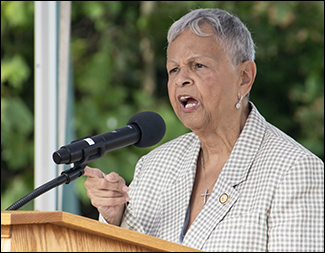
New Jersey Rep. Rep. Bonnie Watson Coleman (NJ-12)

Yesterday, saying “it’s time to pass the torch,” six-term Rep. Bonnie Watson Coleman (D-Ewing Township/Trenton), 80, announced that she will not seek re-election next year.

Prior to her election to the US House in 2014, she served 17 years in the New Jersey General Assembly, four years as Majority Leader. From 2002-06, Watson Coleman chaired the New Jersey Democratic Party.

The Garden State’s 12th District, which includes the capital city of Trenton, Princeton University; and North, East, and South Brunswick; is reliably Democratic. The Dave’s Redistricting App statisticians calculate a 56.5D – 43.5R partisan lean.

The central New Jersey district was at one time a Republican domain but redistricting and a change in voting patterns have yielded Democratic representation since the beginning of 1999. Therefore, Rep. Watson Coleman’s successor will almost assuredly come from winning what promises to be a hotly contested Democratic primary.

The Watson Coleman retirement means 39 seats will be open in 2026, not counting the CDs headed to special elections in Tennessee and Texas, along with New Jersey’s 11th District seat when Gov-Elect Mikie Sherrill (D) resigns from the House.

From the group of 2026 open seat members, Rep. Watson Coleman becomes the 15th Democrat not to seek re-election and the 11th to retire from politics. The other 28 are seeking a different office or moving to a congressional district other than the one they currently represent.

Michigan Senate

The Rosetta Stone polling organization released the results of an independent poll that finds Republican former Rep. Mike Rogers polling ahead of all three Democratic US Senate contenders.

Rogers, who served seven terms in the House before retiring, returned to enter elective politics with his run for the Senate in 2024. In an open-seat battle with then-Rep. Elissa Slotkin (D), Rogers came within 19,006 votes from just under 5.6 million votes cast of winning the race, a percentage margin of 48.6 – 48.3.

The Rosetta Stone poll, released over the weekend, (Oct. 23-25; 637 likely Michigan general election voters) finds Rogers, who is virtually unopposed for the Republican nomination, ahead beyond the polling margin of error individually against each of the Democrats: Rep. Haley Stevens (D-Birmingham), state Sen. Mallory McMorrow (D-Royal Oak), and former Wayne County Health Director Abdul El-Sayed.

Opposite Rep. Stevens, Rogers leads 47-40 percent. If Sen. McMorrow was his opponent, the Rogers edge would be a similar 46-39 percent. The Rogers’ advantage grows if El-Sayed becomes his general election opponent. Under this scenario, the former Congressman posts a 45-31 percent margin.

Other polls have shown this race much closer, but this is the first publicly released statewide poll since June.

Rosetta Stone tested the Democratic Senate primary, but the sample size of only 287 likely Democratic primary voters indicates the results should be considered statistically insignificant in a state the size of Michigan.

Texas Senate

New polling in the Texas Senate Democratic primary again shows trouble for 2024 Senate nominee Colin Allred.

The Impact Research survey conducted for the James Talarico Senate campaign (Oct. 23-29; 836 likely Texas Democratic primary voters; live interview & text) finds state Rep. Talarico taking a 48-42 percent lead over Allred.

In a late September survey from the University of Houston and Texas Southern University, the academic pollsters found Allred lagging in last place if the Democratic field consisted of he, Rep. Jasmine Crockett (D-Dallas), former El Paso Rep. and statewide candidate Beto O’Rourke, and state Rep. Talarico. For her part, Rep. Crockett says she is considering the Senate race. Crockett has led several Democratic statewide polls.

It has been known for some time that the Republican Senate primary would be a hard-fought contest between four-term incumbent Sen. John Cornyn, Attorney General Ken Paxton, and recently entered Rep. Wesley Hunt (R-Houston). Now, however, analyzing the available polling data leads to the conclusion that the Democratic primary appears just as competitive as the Republican contest.

A Democratic Sweep: Sherrill, Spanberger, Mamdani and More All Win

By Jim Ellis — Wednesday, Nov. 5, 2025

Elections

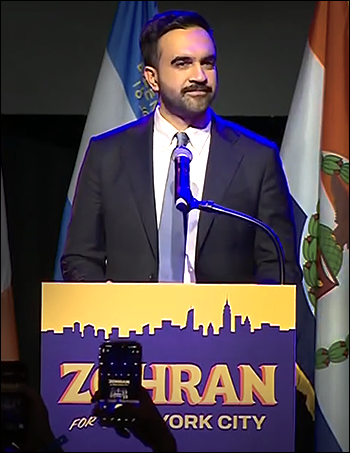
New York City voters elected Democratic Socialist Zohran Mamdani as their next Mayor.

Last night’s election results yielded victories for Democrats across the board and it appears that high prices and the state of the economy are among the top reasons.

Of course, Democrats will argue that their attacks against President Trump compared to the election results is a rejection of the current administration, and the votes provide evidence for such a claim, but New Jersey and New York City are heavily Democratic enclaves, and the Washington, DC metropolitan area, including the Northern Virginia and Maryland suburbs have repeatedly proven itself as the most anti-Trump region in the country.

Therefore, within the partisan context, the election results should not be considered overly surprising.

New York City

As expected, state Assemblyman Zohran Mamdani (Democratic/Working Families) was elected Mayor of New York City last night, capturing what looks to be a bare majority of the vote.

In the end, it appears the self-described Democratic Socialist outpaced former Gov. Andrew Cuomo (Fight and Deliver Party), and Curtis Sliwa (Republican/Protect Animals Party) by a 50.4 – 41.6 – 7.1 percent margin. Polling did not fully capture Mamdani’s strength, nor Republican Sliwa’s weakness. In particular, the latter man polled approximately ten points better on average than his ultimate performance.

Certainly, barely going over the 50 percent mark gives Mamdani the mandate he needs to implement his more radical agenda, and certainly will have support to do so from the New York City Council. Much more to come in the ensuing weeks about this result and the new Mamdani Administration.

New Jersey

This gubernatorial election outcome was one of the most surprising decisions of last night as Rep. Mikie Sherrill (D-Montclair) scored what will likely be a 56-43 percent win over 2021 Republican gubernatorial nominee Jack Ciattarelli despite polling that suggested the race was falling into the toss-up range.

The Sherrill victory represents the first time a political party has won three consecutive New Jersey gubernatorial elections since World War II.

With the Congresswoman’s victory, we will see another special congressional election, this time in her 11th District seat. Sherrill will resign from the House shortly before she assumes the Governorship in mid-January. One of her first duties will be to schedule the special election for voters to elect her successor. Already vying for positioning are former NJ-7 Congressman Tom Malinowski (D) and several local Democratic officials.

Virginia

Polling in this race was spot on, as survey research firms were not only consistently projecting an Abigail Spanberger victory, but they also saw the surge for the Democratic candidates in the final week of early voting and on Election Day. The combination carried not only Spanberger, but also Lt. Gov.-Elect Ghazala Hashmi and Attorney General-Elect Jay Jones to victory as part of the Democratic sweep.

The most surprising result was Jones defeating AG Miyares after the controversy broke several weeks ago about him fantasizing about killing his Republican opponents. Much analysis about the Attorney General’s result will be forthcoming over the next period of days when the actual results can be digested.

California Proposition 50

As expected, last night Golden State special election voters easily adopted the referendum to replace the California Citizens Redistricting Commission congressional map with a plan that Gov. Gavin Newsom had drawn. The redraw gerrymander could net the Democrats five seats and reduce the Republicans to four of the state’s 52 congressional districts.

Whether the map actually produces such results remain to be seen in the 2026 election. We can expect to see legal challenges to the entire process to soon be forthcoming but with a strong public vote, overturning the new map becomes very difficult.

TX-18

The jungle primary for the third of four special congressional elections to fill vacancies was held in Houston last night. The results will go to a runoff election that Texas Gov. Greg Abbott (R) will schedule as soon as the Secretary of State verifies that no candidate received a majority of the vote.

The verification will come quickly, since Harris County Attorney Christian Menefee (D) and former Houston City Councilwoman Amanda Edwards (D) placed first and second with 32 and 25 percent of the vote, respectively. Therefore, no one came close to obtaining majority support.

The problem for whoever wins the runoff election, which will likely be in January, is that he or she will have to turn around and participate in a March 3, 2026, primary in another version of the 18th District and against incumbent Rep. Al Green (D-Houston) under the new Texas congressional map.

The Democrats are assured of keeping the 18th District seat to replace the late Rep. Sylvester Turner (D-Houston), but the prize may be short-lived because the regular primary in the new district will be just weeks after securing victory.

Election Day Preview

By Jim Ellis — Tuesday, Nov. 4, 2025

Elections

The major odd-numbered elections are upon us with early voting completed and election day occurring today in New Jersey, New York City, and Virginia. Polling projects a good night forthcoming for Democrats, but the available early voting statistics suggest Republicans might be stronger than the polls indicate.

New Jersey

The open Governor’s race is the main focus on the Garden State ballot, and it may well become the most interesting contest to follow tonight.

The polling momentum has closed in Republican Jack Ciattarelli’s favor with the latest five publicly released surveys from the Oct. 25-30 period finding Rep. Mikie Sherrill (D-Montclair) holding an average 3.4 percentage point advantage. This number is down from a much higher range, usually in the upper single digits, for most of the race.

Furthermore, if the SoCal Strategies poll (Oct. 28-29; 800 likely New Jersey voters) is removed from the group because its seven-point spread (52-45 percent) is an outlier when compared with the other four (Atlas Intel, Emerson College, Quantus Insights, and Suffolk University), the Sherrill average point lead drops to 2.5.

Additionally, Ciattarelli has under-polled in his previous races, particularly in the primary earlier this year and by a large amount. Going into the five-way 2025 Republican primary, Ciattarelli’s highest preference number was 54 percent yet he ended with a 68 percent actual vote total. Should this Ciattarelli under-poll pattern continue in this year’s general election, we could see an upset.

New Jersey early voting statistics are not as available as in some other places, but Ciattarelli’s assessment that more Republicans are voting early that ever before appears correct. According to CBS News, approximately 514,500 Democrats have voted early as compared to an approximate 279,000 Republicans, and 177,000 non-affiliated and minor party voters.

These raw number figures translate into 56.5 percent of the early voters being Democrats, 30.6 percent Republicans, and 12.9 percent non-affiliated and others. While the Democrats lead the early vote count, their percentage is down from 2024 when the Dems accounted for 68.0 percent of the early voting participation numbers and 2022 when their percentage was 59.9 according to the Target Early Target Smart organization calculations.

Though the 2025 Republican number is much smaller than the Democratic percentage, it is up from 27.4 percent in 2024, but down from a 32.2 percent participation factor in 2022. The Non-affiliated/ Other category accounted for 4.7 percent of the early voters in 2024 and 7.9 percent in 2022. Therefore, the NA/O segment’s 12.9 percent early turnout is considerably ahead of the previous elections.

New York City

While Assemblyman and New York City mayoral nominee Zohran Mamdani’s (D) polling percentages are falling somewhat as Election Day dawns, the three-way candidate structure virtually assures that he will win tomorrow’s election, but likely with only a plurality of the votes.

While the majority of NYC voters are likely to choose a mayoral candidate other than the Democratic nominee, the split between former Gov. Andrew Cuomo (I) and Republican Curtis Sliwa will benefit Mamdani.

Since the race has not changed greatly since Cuomo entered under a minor party label after losing the Democratic primary, today’s outcome is unlikely to be surprising.

Virginia

In the Old Dominion’s gubernatorial race, former Rep. Abigail Spanberger is clearly favored to defeat Republican Lt. Gov. Winsome Earle-Sears and convert the commonwealth’s Governorship to the Democrats. Incumbent Gov. Glenn Youngkin (R) is ineligible to seek re-election under the only one-term limit law in the country.

The final five Virginia gubernatorial polls conducted during the Oct. 25-31 period (from Atlas Intel, Echelon Insights, Insider Advantage/Trafalgar Group, SoCal Strategies, and State Navigate) give Spanberger leads of between four and 12 points, margins she has maintained for most of the election cycle.

Yet, the early vote numbers tend to suggest an improved GOP standing. All five of the state’s congressional districts where the electorate sends a Republican to the US House have substantially improved their early vote participation rates when compared to 2021.

According to the latest available reports from the Virginia Public Access Project (VPAP), the statewide increase in early voting is just under 10 percent. All five Republican House districts, however, are up between 20 and 41.9 percent in early voting participation through Friday.

From the six Democratic districts, only two report increased turnout compared to 2021, and even this pair’s increase is below the statewide average. The other four Democratic congressional districts, at least through Friday’s count, have failed to equal their previous 2021 early voting numbers.

Since Virginia’s early voting numbers are not measured by political party preference, largely because the Old Dominion does not register voters by party, it is difficult to tell if the congressional district breakdowns accurately reflect the partisan composition of 2025 early voting.

The clue, however, that the Republican represented districts are all substantially up in early voting and most of the Democratic seats are down should suggest that Republicans are likely to outperform their polling standing.

Furthermore, it is important to remember that the Republicans won the 2021 election, so Democrats falling behind their losing benchmark numbers from the previous election is another clue that 2025 Virginia voter enthusiasm is higher on the GOP side.

The most likely outcome of tomorrow’s election, however, is a Spanberger victory, a closer Lieutenant Governor’s race, but one that still suggests a slight victory for Democratic nominee Ghazala Hashmi, and a Republican victory for Attorney General Jason Miyares, largely due to the controversy surrounding Democratic nominee Jay Jones.