Tag Archives: Ohio

Gov. DeWine’s Primary Trouble

By Jim Ellis

Ohio Gov. Mike DeWine (R)

Jan. 28, 2022 — The Ohio Republican gubernatorial race has been rather quiet to this point, but it appears the May 3 primary is beginning to get interesting.

A Fabrizio Lee research firm survey (Jan. 11-13; 800 Ohio Republican primary voters and Independents who choose to vote in the Republican primary, live interview) finds Ohio GOP Gov. Mike DeWine, one of the leading 2020 COVID shutdown governors, in trouble for re-nomination against his Republican primary opponent, former Congressman Jim Renacci.

According to the poll results, Renacci would top Gov. DeWine in his quest for re-nomination by a relatively substantial 46-38 percent margin. The governor falling under 40 percent among a voting sample within his own party is certainly a warning sign. It appears what was thought to be a relatively minor primary challenge is transforming into a highly competitive contest.

Earlier in the month, the Harris Poll (Jan. 4; 1,146 likely Ohio Republican primary voters, online) tested the Ohio primary and found the two contenders tied at 42 percent, possibly the first public tangible indication of the incumbent’s weakness within his own party.

Of Renacci’s 46 percent support in the Fabrizio Lee study, 22 of the 46 said they would “definitely” vote for the GOP intra-party challenger. Another 19 percent said they would “probably” back him, with the final five percent saying they are “leaning” toward the former congressman. Turning to DeWine’s supporters, 20 percent of his 38 percent said they would “definitely” vote for the governor, 16 percent retorted “probably” so, with the final two percent indicating they are “leaning” toward the incumbent.

Furthermore, Gov. DeWine’s score on the accompanying re-elect question is troublesome for any incumbent. A total of 33 percent from his own party said “I will definitely vote against Mike DeWine for governor regardless of who runs against him in the Republican primary” as compared to just 14 percent of Republicans and Republican voting Independents who said “I will definitely vote to re-elect Mike DeWine for governor, regardless of who runs against him in the Republican primary.”

Looking at the extremes on such a question is telling, and the fact that DeWine sees his opponent’s hard-core supporters more than doubling the number of his own strong backers is a major warning sign indicating that he could face losing the party nomination if this pattern is verified and continues.

Continue reading

Youngkin Wins in Virginia;
New Jersey’s Races are Teetering;
Ohio Congressional Races & More

By Jim Ellis

Nov. 3, 2021 — Republican Glenn Youngkin claimed the Virginia governor’s race with his victory over former Gov. Terry McAuliffe (D), becoming the first Republican to win a Virginia statewide office since the 2009 election.

In New Jersey, Republican Jack Ciattarelli is fighting Gov. Phil Murphy (D) to a virtual tie, but outstanding ballots suggest the Democratic governor may barely hang on to win a second term. It was a surprisingly strong showing for Ciattarelli in such a heavily Democratic state. Though both houses of the New Jersey legislature will remain under Democratic control, Republicans appear to have added seats in both chambers.

While mail votes are still being tallied and other ballots can be received in Virginia until Friday, it appears Youngkin did exceed the 50 percent plateau with McAuliffe about two percentage points behind. The Youngkin victory helped pull his lieutenant governor Republican partner, Winsome Sears, over the top to claim the state’s second position.

The Virginia attorney general’s race features another Republican, state Delegate Jason Miyares, leading incumbent Mark Herring (D), who is running for a third term. This is the closest of the three races, so uncounted mail ballots and votes to be received after election day could make a difference. Some entities have projected Miyares a winner, and he is certainly in the better position, but the final outcome may not yet be conclusive.

Several other races are still close, but Republicans may have converted the six seats they need to re-claim the state House majority. In any event, the party gained seats.

Turnout was higher than expected in Virginia. More that 3.2 million ballots have been tabulated, meaning that more than 73 percent of the number of people who voted in the record setting 2020 election returned to cast their votes in the 2021 governor’s race. When comparing the 2017 gubernatorial election to the 2016 presidential, the return rate was 66 percent.

OHIO

In the US House, two new Ohio members-elect completed their special election victories with ease. In the vacant Cleveland-Akron seat that Housing and Urban Development Secretary Marcia Fudge (D) represented, Democratic Cuyahoga County Councilwoman Shontel Brown, as expected, easily won the congressional special general election with 79 percent of of the vote.

Continue reading

Today’s Election Scorecard

By Jim Ellis

Nov. 2, 2021 — Today is a significant Election Day, and the menu of races stretches beyond a Virginia governor’s race that has attracted the lion’s share of political attention.

While the VA governor’s race will of course be top of mind as results come in tonight and analysts attempt to assign precursor status to the contest regardless of the final result, other campaigns will also be of significance.

In the Virginia race, if Republican Glenn Youngkin scores an upset win, and the late indications are clearly moving his way, it may be cast as an affront to the Biden Administration and the Democratic majorities in Congress relating to their legislative agenda. In actuality, it is a more locally based issue, education, that should correctly be cast as the linchpin to describe a Youngkin victory.

Former Gov. Terry McAuliffe’s (D) debate comment saying he did not believe “parents should be telling schools what they should teach,” will actually prove to be the key turning point to a Youngkin victory should it materialize. In McAuliffe wins, then the talk of a coming Republican wave election next year will certainly dissipate at least in the short term.

In addition to the Virginia governor’s race, the remainder of the statewide ticket, the lieutenant governor and attorney general races could be of significance. If Winsome Sears (R), running for lieutenant governor, and Jason Miyares (R), running for attorney general, both win their races to compliment a Youngkin victory, then talk of a clear precursor or budding Republican wave election will carry a more serious tone.

New Jersey voters will decide their governor’s contest as well. In Jersey, late polling, after seeing some closer numbers not even 10 days ago, seems to show Gov. Phil Murphy (D) pulling away from Republican Jack Ciattarelli in the closing week. The final result will likely be closer than most analysts would have projected at the beginning of the odd-numbered year election cycle, however.

In both Virginia and New Jersey, voters will also be electing members of the state legislature. In the Old Dominion, only the House of Delegates is on the ballot, as state senators, with their four year terms, won’t face the voters as a unit until the 2023 election cycle.

In the Garden State, both parties are projecting they will gain seats, but no one believes the strong Democratic majorities in the state Senate and Assembly are in any danger. In the Virginia House of Delegates, Republicans need to convert a net six seats to re-claim the majority they lost in the 2019 election.

Continue reading

Q3 FEC Senate Cash Updates

By Jim Ellis

Oct. 22, 2021 — The 3rd Quarter campaign finance summaries and reports are now publicly available at the Federal Election Commission website, and we have the recap for the key competitive Senate races in this Update. As typical for political campaigns since the latter part of the previous decade, the dollar figures are again astronomical.

The amounts are in hundreds of thousands, and COH refers to the candidates’ total cash-on-hand figures since the 2022 election cycle began. The Daily Kos Election website statisticians calculated the 3rd Quarter dollar amounts.

Alaska

CANDIDATE 3rd QTR RAISED (,000) TOTAL COH (,000)
Murkowski $1,062 $3,244
Tshibaka $460 $294

Sen. Lisa Murkowski and former State Administration Director Kelly Tshibaka are the only two candidates who filed disclosure reports. Despite an endorsement from former President Donald Trump, the Tshibaka financial figures are less than expected. With Alaska’s new top four primary system, the early money is rather irrelevant since four candidates, including Sen. Murkowski and Ms. Tshibaka, will advance into the general election.


Arizona

CANDIDATE 3rd QTR RAISED (,000) TOTAL COH (,000)
Kelly $7,217 $13,001
Masters $1,008 $864
Brnovich $559 $515
Lamon $133 $3,606

Sen. Mark Kelly continues to be one of the most prolific fundraisers of all Senate candidates. His huge $13.1 million cash-on-hand figure is topped only by Majority Leader Chuck Schumer’s $31.8 million, and Sens. Raphael Warnock’s (D-GA) $17.2 million and John Thune’s (R-SD) $14.8 million. Candidate Blake Masters is rumored to be benefiting from an outside $10 million Super PAC that billionaire Peter Thiel funds. Candidate Jim Lamon self-funded most of his $3 million-plus cash-on-hand total.


Florida

CANDIDATE 3rd QTR RAISED (,000) TOTAL COH (,000)
Demings $8,351 $5,967
Rubio $5,928 $9,612

Sen. Marco Rubio had a very strong fundraising quarter, but so did his opponent, Rep. Val Demings. Both have large war chests, but each has already spent millions to achieve these totals. Both candidates will advance into a competitive and expensive general election campaign in the Sunshine State.


Georgia

CANDIDATE 3rd QTR RAISED (,000) TOTAL COH (,000)
Warnock $9,432 $17,217
Walker $3,764 $2,477
Black $564 $928

Sen. Raphael Warnock raised more money in the quarter than any Senate candidate and already has a huge war chest. Herschel Walker’s first fundraising quarter as a candidate, and a partial one at that, has to be considered highly successful, but his resources pale in comparison to the incumbent’s dollar raising machine.


Iowa

CANDIDATE 3rd QTR RAISED (,000) TOTAL COH (,000)
Finkenauer $1,019 $598
Grassley $814 $3,064

Sen. Chuck Grassley announced his intention to seek re-election just a week before the third-period fundraising cycle ended. While he didn’t raise as much as his present chief opponent during the third quarter, former US Rep. Abby Finkenauer, his resource total is substantially better than hers and sets him in strong position to launch a massive fundraising effort.


Continue reading

The Trifecta States

By Jim Ellis

In the trifecta of political parties controlling the House, Senate and Executive branches in a state, how many will actually benefit from that power in the redistricting process?

Oct. 11, 2021 — As the redistricting cycle moves forward, predictions are being made as to which party will benefit most through the decennial district boundary drawing process. Most analyses favor the Republicans as the party best positioned to gain under 2021 redistricting largely because of the number of states they control outright, but this could be an over-statement.

When a state features one party in control of the governor’s mansion, state House, and state Senate, the horse racing term of “trifecta” is used to describe such a political situation. Since Republicans hold 23 trifectas and Democrats just 15, it appears on the surface that the GOP will be the big gainer in redistricting.

Let’s look a bit closer because the aggregate trifecta number doesn’t tell the whole story.

On the Republican side, though they control 23 states, their redistricting position is lessened when examining their ability to extract a net gain of congressional seats.

Of their 23, in one, West Virginia, they are a sure bet to lose a seat. In this case, Republicans hold all three of the state’s CDs, but reapportionment reduces the Mountain State to two districts. Therefore, Republicans will unavoidably absorb the loss.

In two of their states, Arizona and Montana, a non-politician commission will draw the maps. In another dozen (Alabama, Arkansas, Idaho, Indiana, Mississippi, Missouri, Nebraska, North Dakota, South Carolina, South Dakota, Utah, and Wyoming) the GOP is already at the max level of partisan members and can’t stretch the new plan further.

In Iowa and Texas, though Republicans have trifecta control, legislative rules lessen their complete power; hence, the redistricting outcome is affected.

Finally, the GOP only has effective redistricting control in six states, and in two of those, Oklahoma and Tennessee, it could arguably backfire if the party tries to expand their ratio further. Therefore, it is in really just four states, Florida, Georgia, New Hampshire, and Ohio where we could see Republican redistricting gains.

The Democrats find themselves in similar position. From their 15 trifectas, they only have redistricting control in five, possibly, and realistically, three states. In five of their 15 (California, Colorado, New Jersey, Virginia, and Washington) redistricting goes to a citizens’ commission.

Continue reading

Ohio Rep. Anthony Gonzalez
Won’t Seek Re-Election

By Jim Ellis

Ohio Rep. Anthony Gonzalez (R-Rocky River)

Sept. 21, 2021 — Saying he believes that former President Donald Trump “shouldn’t ever be president again,” sophomore Ohio Rep. Anthony Gonzalez (R-Rocky River) announced on Friday that he will not seek a third term in the House.

Rep. Gonzalez was one of 10 Republicans to support Trump’s second impeachment, and drew a strong Republican primary opponent as a result. Former President Trump responded to Gonzalez’s statement and decision with his own release saying, “1 down, 9 to go,” in reference to those Republican House members who supported removing him from office after the Jan. 6 Capitol invasion.

Gonzalez is the 19th member who will not be on the next election ballot for the US House seat he now holds, including the three vacancies to be filled in special elections. Of the 19, Republicans currently hold 10 seats as compared to nine for the Democrats. This is the first GOP opening with some competitive potential, however, though the Gonzalez decision will likely have a big impact upon the Ohio redistricting process currently under way within the state legislature in Columbus.

Former White House aide Max Miller had been Rep. Gonzalez’s top Republican competitor. Through the June 30 campaign financial disclosure period, Miller had raised just under $1 million ($951,520), but had only $533,153 remaining in cash-on-hand.

Despite Miller’s strong fundraising effort, Rep. Gonzalez still held the upper hand, reporting $1.22 million raised with over $1.5 million in the bank. Therefore, while the Miller challenge appeared formidable, it was not a foregone conclusion that he would have denied Rep. Gonzalez re-nomination had the congressman decided to continue running.

Rep. Gonzalez’s 16th Congressional District begins in the Westlake area to the west of Cleveland and stretches south toward the rural areas southwest of Canton. It then meanders to the northeast around Akron to end in the city of Edinburg.

Continue reading

Newsom Wins Recall; Other Elections

By Jim Ellis

California Gov. Gavin Newsom (D)

Sept. 16, 2021 — California Gov. Gavin Newsom (D) easily avoided being recalled in last night’s statewide election, but the margin will likely close once all of the ballots are received and finally counted. The reported results are largely from mail ballots received well before election day. The posted turnout totals exceed 9 million voters, and this number will continue to grow.

The NO option on the recall ballot, meaning the vote individuals cast in order to keep Gov. Newsom in office, is running just under 64 percent, but under the California system of ballot signature verification it will be several weeks before we see official final totals. California also allows a long post-election period for ballots postmarked on election day to be received. It is clear, however, that Newsom will survive in office by a wide margin, but with an end-result closer margin than we see in early returns.

Though the replacement election became moot with the recall being rejected, conservative commentator Larry Elder was the clear leader, recording a tick under 47 percent of the vote. The next closest candidate was Democrat Kevin Paffrath with 10 percent. Former San Diego Mayor Kevin Faulconer (R) finished third with just under 9 percent. John Cox (R), who was one of the leading recall effort funders and the finalist against Newsom in the 2018 election, fell back to less than 4.5% of the vote. Media star Caitlin Jenner (R), who proved not to be a serious candidate, scored just 1.1% in the replacement election.

All of the replacement candidates were at a disadvantage in terms of financial resources. Though Elder raised a reported $18 million, an impressive amount in a short time frame, Gov. Newsom spent possibly as much as $80 million.

The rules for Newsom, however, were different. Because he was the recall subject, and the people were deciding the question as to whether or not he alone should remain in office, the campaign financial structure for him was that of a referendum. Therefore, he could raise unlimited amounts of money from individuals and entities. The replacement candidates, because they were running in an election campaign, were bound by the state campaign finance laws that feature contribution amount limits.

Continue reading

Ohio Data: Below the Surface

By Jim Ellis

Sept. 10, 2021 — The London-based Redfield & Wilton Strategies international survey research firm tested electorates in several American states at the end of August, and today we look at their Ohio results. With a major open Senate campaign and a Republican governor seeking re-election in 2022, the Buckeye State is once again a national political focal point for the coming political year.

Ohio Rep. Tim Ryan announces his candidacy for the 2020 Presidential Election on the TV talk show, “The View.”

The Redfield & Wilton poll (Aug. 20-24; 1,200 likely Ohio voters) finds the Republican Senate candidates performing adequately opposite US Rep. Tim Ryan (D-Warren/Youngstown), who, at this early stage, has become the Democrats’ consensus statewide Senate contender.

Former state treasurer and 2012 US Senate candidate Josh Mandel (R) holds a 51-47 percent ballot test lead over Rep. Ryan within the sample segment who are self-identified as likely 2022 general election voters. Author J.D. Vance (R) largely falls into a dead heat with Ryan, trailing 37-36 percent, as does former Ohio Republican Party chair Jane Timken who places within two points of the congressman, 38-36 percent.

In the governor’s race, incumbent Republican Mike DeWine, who former Rep. Jim Renacci is challenging in the GOP primary from the ideological right, looks to be in strong shape against potential Democratic opponents. If Dayton Mayor Nan Whaley were the Democratic gubernatorial nominee, Gov. DeWine would post a 46-27 percent advantage. Should Cincinnati Mayor John Cranley become the Democratic nominee, he would trail the governor by a slightly larger 47-25 percent spread.

Generally, the Ohio polling pattern leans Democratic in the early going and then closes in the Republican candidates’ favor, while consistently understating GOP strength.

In the 2020 presidential election, Ohio polls in July of the election year were returning Joe Biden leads of 4-8 percentage points before former President Trump would rebound to score a mean average 1.0 percent polling lead close to election day, and then win the state going away with an eight-point margin, 53-45 percent. In 2016, the pattern was similar. In the July-September period, Hillary Clinton held leads of between 4 and 7 percentage points only to see the average favor Trump by a 2.2 percent spread. He would win the state 51-43 percent.

The same pattern occurred for Sen. Rob Portman (R) in 2016 and was present to a degree against Sen. Sherrod Brown (D) in 2018. In June through September of that year, certain polls found former Gov. Ted Strickland (D) leading incumbent Portman with a 3-6 point edge. As the race closed, Sen. Portman established an average 18-point lead and won 58-37 percent.

Even in a Democratic victory, the polling trend favoring Democrats early and then closing for the GOP toward election day was again present. During June-September of 2018, Sen. Brown held leads between 13-17 points. Going into the election, his polling average had slipped to 11 points, and he only won with a 6.4 percent margin.

Keeping this pattern in mind and then looking at the underlying Biden job approval numbers in the R&W poll suggests that even today, the GOP candidates are poised for a stronger finish than the current results yield. Overall, the Redfield & Wilton figures point to a 40:46 percent favorable to unfavorable presidential approval ratio for Biden, which isn’t particularly bad particularly in a state that the subject did not win. The underlying numbers, however, point to a much greater negative.

Continue reading

Ohio’s Lost Seat

Ohio’s Congressional Districts

By Jim Ellis

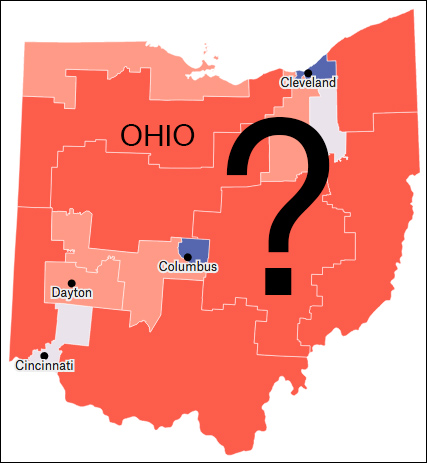
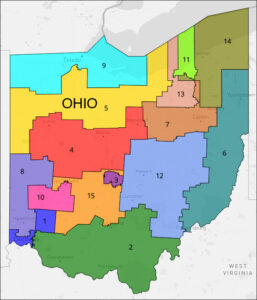
Sept. 8, 2021 — In some of our previous redistricting articles, we’ve alluded to Ohio’s interesting situation. With a 16-member congressional delegation reducing to 15, it seemed unlikely that Republican map drawers would stretch the new map to 12R-3D from its current 12R-4D split. Outside pressures and other factors, however, suggest the first Buckeye State map could have such a partisan division.

Recently, news coming from Illinois suggests that Democratic leaders are looking at ways to reduce the Republican federal contingent in the Land of Lincoln from five House members to just three. If so, states like Ohio, where Republicans are in complete control of the redistricting process, face national pressure to maximize the partisan gain.

Another factor pointing to the Democrats losing the Ohio seat is that only one member to-date, Rep. Tim Ryan (D-Warren/Youngstown), is not running for re-election. The eastern Ohio congressman is an announced US Senate candidate, meaning that his 13th District, which stretches from Akron to the Pennsylvania border, is largely unprotected.

As in Pennsylvania, where Rep. Conor Lamb (D-Pittsburgh) is the lone House member not seeking re-election in his state because he, too, is running for the Senate, it is reasonable that the collapsed seat would be the one with no incumbent. Therefore, in both cases, Republican map drawers would have a defensible opportunity to collapse a Democratic seat. Furthermore, a Democratic power grab in Illinois, should that happen, makes Republican retribution in Ohio and Pennsylvania more likely.

Another transitional Ohio factor is the two new members coming into the House right after the Nov. 2 special election. Since the partisan primaries have already nominated candidates in a pair of vacated congressional districts that have consistently performed for each party, it became clear on primary night that Democrat Rep. Shontel Brown and Republican Rep. Mike Carey would be joining the delegation.

Brown’s 11th District that stretches from Cleveland to Akron is likely to be a key redistricting focal point. The 11th must gain 94,091 people to reach the new 15-District Ohio population quota of 786,630 individuals, which is the second most of any Buckeye State CD. Since this is also a majority minority seat, adding the necessary people from the Akron area would be a reasonable move, and such a population segment would have to come from Rep. Ryan’s 13th District.

Continue reading

Gerrymandering Wars Ignited

By Jim Ellis
Aug. 27, 2021 — In the past few days, Democratic leaders and news sources in two states, New York and Illinois, are suggesting that the party redistricting strategists will attempt to maximize Democratic US House gains. Republicans will then counter in similar states that they control.

New York Gov. Kathy Hochul (D), on her first official day in office after replacing resigned Gov. Andrew Cuomo (D), bluntly answered a reporter’s question to the affirmative when asked if she would use her newfound power to maximize Democratic congressional gains through the redistricting process.

Earlier this week, news sources were reporting that Illinois Democratic map drawers, though no preliminary congressional map has yet been released, are attempting to draw a new 14D-3R map that would likely collapse Reps. Adam Kinzinger (R-Channahon) and Rodney Davis (R-Taylorville) into a strong Democratic seat for the former and pairing for the latter with another downstate Republican.

Doing this would put added national pressure on Republicans in states such as Texas, Florida, North Carolina, Ohio, and Georgia – places where the GOP has full control of the redistricting process. Here, the states are either adding seats or in position to carve a sitting Democrat into unfriendly political territory.

With New York losing one seat, the prime district for elimination would appear obvious since Rep. Tom Reed (R-Corning) has already announced his retirement and his 23rd District is the lowest in population among all New York seats. Adjacent Rep. Claudia Tenney’s (R-New Hartford) 22nd CD is second lowest, so combining those two Upstate Republican districts into one appears to be a foregone conclusion. It remains to be seen if the Democratic leaders try to do more. The current delegation breaks 19D-8R but will reduce to 26 seats in the next Congress.

Of Illinois’ current 18 congressional districts, only one, that of Rep. Danny Davis (D-Chicago), is over-populated and only by 10,986 people. While the Kinzinger seat is 61,125 individuals short of the state quota of 753,677 for the new 17-district map, his is not even close to being the most under-populated. He, however, sits between two Democratic seats that the party needs to protect, those of retiring Rep. Cheri Bustos (D-Moline), whose 17th CD is 79,907 residents under quota, and Rep. Lauren Underwood’s (D-Naperville) 14th, where she had a close call in 2020 but is only 482 people short of quota.

While the 14th does not need many more people, it does need significantly more Democrats and they can be found by dividing Kinzinger’s 16th CD into pieces.

Redistricting is always full of surprises, so this analysis is merely educated speculation. If, however, the Democrats come away with gaining a net three or four seats from New York and Illinois combined, then how do the Republicans retaliate?

Continue reading