Category Archives: Senate

The Michigan Barnburner


By Jim Ellis — Tuesday, February 3, 2026

Senate

A new Emerson College poll of the Michigan Senate race again suggests that we will see another photo finish in the 2026 campaign.

The latest EC poll (Jan. 24-25; 1,000 likely Michigan voters; 491 likely Democratic primary voters; multiple sampling techniques) sees a change in both the Democratic primary and the general election.

For the first time, Emerson projects state Sen. Mallory McMorrow (D-Royal Oak) taking the lead over Rep. Haley Stevens (D-Birmingham) and former Wayne County Health Director Abdul El-Sayed in the party primary. According to the Emerson ballot test result, Sen. McMorrow posts a 22-17-16 percent advantage over Rep. Stevens and Dr. El-Sayed.

This is the first poll that found someone other than Rep. Stevens holding the Democratic lead, though three of the other five polls released since early May have detected all three candidates polling under 30 percent support. Therefore, despite the projected change at the leader level, this race remains a tight, three-way toss-up.

The Michigan Senate seat is open because two-term incumbent Sen. Gary Peters (D) chose not to seek a third term. He likely would have been favored for re-election.

The general election polling is equally close. Likely Republican nominee Mike Rogers, the former Congressman who came within three-tenths of a percentage point of upsetting current Sen. Elissa Slotkin (D) in the 2024 general election, will be a formidable November contender. He has led all three of the Democratic candidates at one time or another in early polling. Rogers slightly trails Rep. Stevens in most polls but leads Sen. McMorrow and Dr. El-Sayed in almost all isolated pairings.

In the latest Emerson poll, Rep. Stevens tops Rogers, 47-42 percent, and Sen. McMorrow would lead him 46-43 percent, while El-Sayed and Rogers are tied at 43 percent support.

It is interesting to see the general election sample finding Stevens further ahead of Rogers than McMorrow in the same poll where the Democratic segment favored the latter contender. This means that Rep. Stevens is attracting a better share of the non-affiliated vote than is Sen. McMorrow when paired individually with the Republican former Congressman.

Looking at the 2024 polling, we again see a Republican underpoll when compared to the final result. Such a pattern has been present in a number of states and was certainly the case in President Trump’s three elections.

In the Michigan ’24 Senate contest, 82 public polls were released after the August primary. In those, Rogers led in only three. While he didn’t win the race, he clearly performed better than projected.

Of the four organizations that tracked polling in the 2024 election, Real Clear Politics, the Five-Thirty-Eight data organization, which is no longer in existence, 270 to Win, and Decision Desk Headquarters, all found Slotkin leading by a larger margin than her actual victory percentage. Such was true regardless of whether all the post-primary polls were included or just those from late October to Election Day.

The Slotkin average lead ranged from a high of 4.1 to a low of 2.3 percentage points, remembering that her victory spread was just 0.3. In terms of raw numbers, Sen. Slotkin won the race by only 19,006 votes from more than 5.58 million ballots cast.

Therefore, if we surmise that a similar pattern might occur in 2026, then this race is likely to be decided by just a few votes irrespective of which Democrat wins the party nomination. The political climate at the time of the election notwithstanding, Rogers remains in prime position to record what many would still consider an upset victory.

Looking at the national Senate picture, the Michigan race must be rated as the Republicans’ best opportunity to convert a current Democratic seat, with Georgia (opposite Sen. Jon Ossoff), and New Hampshire (open seat) also in play.

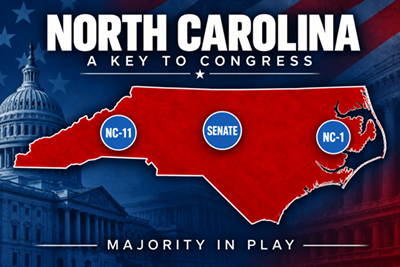
For the Democrats, the best opportunity is in North Carolina where the consensus party candidate, former Gov. Roy Cooper, has won six statewide elections. He leads former Republican National Committee chairman Michael Whatley in all polling, but North Carolina GOP candidates underpoll by a larger margin than in Michigan, and, for the first time in history Republicans exceed Democrats in registered party affiliation.

Democrats will also challenge Republican Senate seats in Maine (opposite Sen. Susan Collins), Alaska (against Sen. Dan Sullivan), and Ohio (challenging appointed Sen. Jon Husted). Their number one target, however, is North Carolina. In the others, right now the Republican incumbent should be considered at least a slight favorite.

Louisiana’s Cassidy Strikes Back

By Jim Ellis — Friday, January 30, 2026

Senate

Already, the Louisiana Senate Republican primary is taking shape, and we are witnessing a highly competitive and largely negative race beginning to unfold.

Louisiana Sen. Bill Cassidy (R)

Rep. Julia Letlow (R-Start) attracted a great deal of political attention last week as she announced her Republican primary challenge to Sen. Bill Cassidy along with an endorsement from President Trump. Now, the Senator is seizing the offensive.

The Cassidy campaign just released the results of a Public Opinion Strategies poll (Jan. 20-22; sample size not publicized) that largely outlines what promises to be the Cassidy campaign’s line of attack against Rep. Letlow.

According to the POS survey, Sen. Cassidy leads Rep. Letlow and state Treasurer and former Congressman John Fleming, 32-21-16 percent. State Sen. Blake Miguez (R-New Iberia) and Public Service Commissioner Eric Skrmetta trail the group with nine and one percent support levels.

Another recently released survey, this from JMC Analytics & Polling for the Fleming campaign (Jan. 12-14; 650 likely Louisiana Republican primary voters) finds an entirely different ballot test result. This data projects Fleming with a 23-22 percent edge over Sen. Cassidy. The remaining candidates split an aggregate 16 percent of the preference responses. The JMC poll was conducted before Rep. Letlow entered the race; hence, she was not included.

Under the Cassidy POS poll’s “informed ballot” result, meaning a series of messages about the poll sponsor’s opponent(s) that are usually negative, the Cassidy lead increases to 55-13-13 percent over Rep. Letlow and Treasurer Fleming. When the push questions isolate Rep. Letlow, the one-on-one “informed” ballot test moves to a whopping 69-22 percent in Cassidy’s favor.

While the query verbiage was not included in the poll analysis, the summary indicates that Rep. Letlow’s stock transactions will be at the forefront of the attack against her, and it is probable the information is at least somewhat sensationalized.

In the poll analysis, the text claims that Rep. Letlow has “over 200 violations of the Stock Act.” When reading the supporting story from the NOTUS (News of the United States) website, we see that the violations were for the late reporting of a group of 210 stock transactions on her financial disclosure report. The combined value of the transactions is reported in the range of $225,000 to $3.3 million. The disclosure report does not delineate further, but the campaign inference will be that she hid millions of dollars in stock transactions.

It appears that the Cassidy campaign is also targeting Letlow as a “RINO” (Republican In Name Only), claiming that her voting record is to the left of the Senator’s. Another attack, as also outlined in the poll analysis, is her taking a trip to Qatar “funded by a pro-Doha group.”

The most serious early campaign obstacle for Rep. Letlow and the other candidates is overcoming Sen. Cassidy’s large war chest. Again, according to the Cassidy polling analysis, the Senator’s campaign reports having $26 million in the bank, the year-end Federal Election Commission filing to be released early next month.

According to Rep. Letlow’s Sept. 30 campaign filing, she held just under $2.3 million in her account, but her total will likely be larger when the latest disclosure reports are made public. For his part, Fleming posted slightly over $2 million.

As previously reported, Louisiana has a new nominating system. Instead of a jungle primary held concurrently with the general election, Louisiana nominations for federal and certain state offices will revert to a traditional partisan primary and runoff procedure. If no candidate receives majority support in the first vote on May 16, the top two finishers advance to a June 27 runoff election.

In addition to Sen. Cassidy, Rep. Letlow, Treasurer Fleming, and Sen. Miguez, seven more Republicans have entered the race. The candidate filing deadline is Feb. 13, so it remains to be seen just how many of these individuals actually follow through and complete their final statement of candidacy. State Rep. Julie Emerson (R-Carencro) had also announced her candidacy but withdrew after Rep. Letlow entered the race.

The Louisiana and Texas Republican primaries feature the party’s two incumbent Senators, Cassidy and John Cornyn, who are in danger of losing their renomination efforts. Both the Texas primary on March 3 and Louisiana in May will be closely watched until the vote count is complete. Expect both the Texas and Louisiana campaigns to run at a frenetic pace throughout the remainder of the primary calendar.

Nebraska Senate: Here We Go Again

By Jim Ellis — Wednesday, January 28, 2026

Senate

In every US Senate election cycle, it seems that a surprising race unexpectedly comes to national prominence, and one 2026 such campaign is already emerging.

Nebraska US Senate candidate Dan Osborn

Nebraska US Senate candidate Dan Osborn

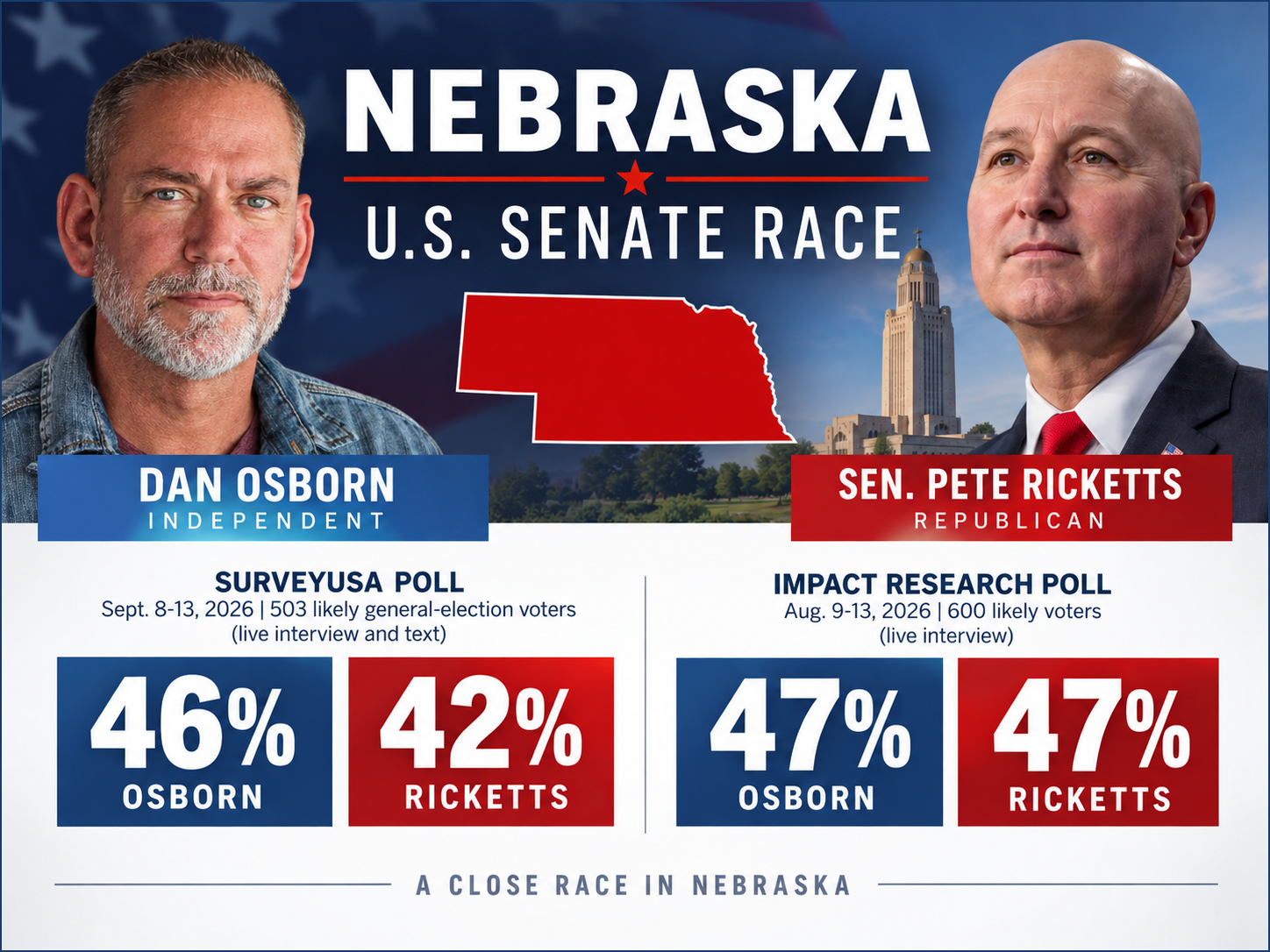
In 2024, Independent Dan Osborn came from nowhere to battle Nebraska Sen. Deb Fischer (R), and for a long while it appeared he was close to pulling the upset of the year. In the end, Sen. Fischer won by six percentage points, and the Osborn surge fell short.

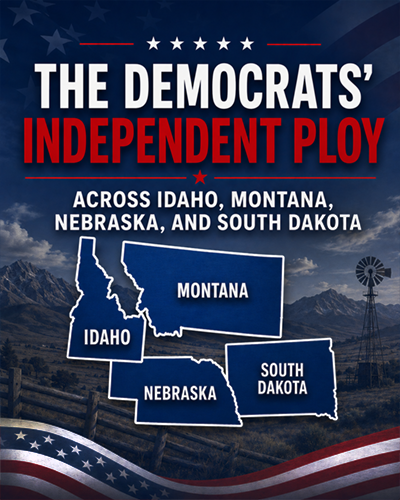
The chief reason that Osborn, as an Independent, became a competitive threat was because the Nebraska Democratic Party agreed not to field their own candidate and the Democratic state convention delegates then endorsed the Osborn campaign. Serious national fundraising then caught fire.

Osborn’s original reported choice for the 2026 election cycle was to run in the highly competitive 2nd Congressional District, now an open seat with Rep. Don Bacon’s (R-Papillion/Omaha) retirement; but, the Democratic leadership would not commit to supporting him. The reason is simple: The eventual Democratic nominee has a strong chance of winning the seat. The state party leaders said, however, they would again support an Osborn Senate bid, this time against the state’s other Republican incumbent, Pete Ricketts.

In a poll conducted a month ago but just released this week, we again see Osborn performing very well in a Senate battle. According to the Lake Research Partners ballot test data (Dec. 11-17; 600 likely Nebraska voters; live interview), Sen. Ricketts’ lead is only one percentage point, 48-47.

In the 2024 race, Osborn clearly over-performed in polling. In the 19 polls released publicly during the election year, Osborn led in eight ballot tests, was tied in two, and only trailed Sen. Fischer by an average of 4.3 percentage points in the nine surveys where she held the advantage. The momentum turned Sen. Fischer’s way in the campaign’s closing days.

The question for 2026 is whether the closeness of the 2024 race was an anomaly or is Osborn a true threat to upset Sen. Ricketts? In reality, Osborn winning the statewide tally is still a long shot.

In the 2024 race, though Osborn came relatively close in the final vote (53.2 – 46.5 percent), Sen. Fischer still carried 89 of the state’s 93 counties. Osborn’s strength was obviously in the Omaha metropolitan area and in Lancaster County, which hosts the capital city of Lincoln and is home to the University of Nebraska.

In the 89 counties that she carried, Sen. Fischer recorded 66.4 percent of the vote. In the four counties where she lost, which accounted for 56.3 percent of the total votes counted, she trailed Osborn substantially, 56.7 – 43.0 percent.

Sen. Fischer, however, displayed weakness in the metro areas to a greater extent than the other Republican candidates on the same ballot. Therefore, the Osborn task against Sen. Ricketts will be much more difficult.

In those same four counties, Douglas, Lancaster, Sarpy, and Thurston, Sen. Ricketts pulled 50.1 percent in his special election to fill the balance of resigned Sen. Ben Sasse’s (R) term and carried both Sarpy and Thurston counties. In the 89 Republican counties, Sen. Ricketts recorded 78.7 percent of the vote, a performance 16 percentage points higher than Sen. Fischer’s total.

For his part, President Trump also outpolled Sen. Fischer. In the four counties she lost, President Trump recorded 46.9 percent (also carrying Sarpy and Thurston counties) and topped 75 percent in the 89 Republican counties.

While Osborn will have strong union support, the Nebraska Democratic Party behind him, and the ability to raise funds nationally, Sen. Ricketts, considering his strong 2024 Senate win and his 58.1 percent average vote tally in his two successful gubernatorial campaigns, is a clear favorite for re-election.

It will not be surprising to see closer than expected polling published in the coming months, as we have already seen with this December Lake Research Partners poll, but as we approach election day Sen. Ricketts will very likely pull away to win with a substantial victory margin.

Tafoya’s Announcement for Senate

By Jim Ellis — Thursday, January 22, 2026

Senate

Michele Tafoya

Recently, both Democratic and Republican party leaders have scored positively in 2026 Senate candidate recruitment.

Last week, Democrats successfully recruited former at-large Rep. Mary Peltola into the Alaska Senate race, and this week the Republicans convinced their top Minnesota candidate prospect to enter the 2026 open campaign.

Former national sportscaster Michele Tafoya, who came to prominence from her years as part of the NFL Sunday Night Football telecasting team, this week formally declared for the Republican US Senate nomination and currently faces no major competition in the GOP primary.

In the general election, Tafoya will likely face either Lt. Gov. Peggy Flanagan or Rep. Angie Craig (D-Prior Lake).

The Democratic nomination battle will be interesting. Typically, Minnesota candidates in both parties don’t force a primary if they fail to receive the party endorsement at the state delegate convention. It is probable in this campaign, however, that the losing convention candidate will force a primary election to be decided on August 11th.

Considering the current state of the Minnesota Democratic Farm Labor Party, the most liberal candidate would likely earn the delegate vote. If so, Lt. Gov. Flanagan should be favored. Rep. Craig, risking her congressional seat to run for the Senate, probably won’t end her quest because of a partisan convention delegate vote. With her strong fundraising and campaign ability, Rep. Craig could be considered the favorite to win the primary election even without the official party blessing.

Democrats have enjoyed a strong run in Minnesota over at least the past couple decades and certainly so since 2006, the last election year when a Republican, former Gov. Tim Pawlenty, won a major statewide race. Despite the Democrat’s long string of statewide victories, their more recent average win percentage isn’t particularly high. Therefore, the act of fielding a potentially strong candidate like Tafoya suggests that the Republicans scoring an upset victory is within the realm of possibility.

Since the 2018 election, inclusive, Democrats have won every major statewide race, but their aggregate vote percentage average is only 53.5, low for a party that has not lost a major statewide campaign in what will be 20 years at the next election.

One could also argue that the recent average is artificially high because of Sen. Amy Klobuchar (D). Of the eight studied races, she won two and her average vote total is 58.2 percent against weak Republican competition. If she is removed from the calculation, the average Democratic win percentage in their most recent six victories is only 51.7.

Unfortunately for the Republicans, the highest GOP total in those same statewide elections is President Trump’s 46.7 percent total in 2024. Even when including Trump’s high number, the Republican aggregate average during the studied period is only 42.7 percent.

While the political situation is hot in Minneapolis right now when considering the ICE controversy and the public assistance fraud scandal, Republican strategists will still need to properly position Tafoya in order to positively drive home the policy differences between her and the eventual Democratic nominee. Because she is a prominent candidate, it is likely the Tafoya campaign will be adequately funded to properly deliver her message.

While the ICE tensions may well die down before the Nov. 3 election, the Tafoya campaign will work to keep the fraud scandal alive and pin the blame upon the Democrats. This task will be easier if Lt. Gov. Flanagan becomes the party nominee because, as a state official, she can be held at least partially responsible for the government’s poor oversight.

While Tafoya will be a credible Republican voice in the November contest, she still must be rated as a decided underdog at least until her campaign begins to significantly move polling numbers as the general election unfolds.

Former Republican Congressman Mike Rogers Leads All Dems in
Michigan Senate Race

By Jim Ellis — Tuesday, January 20, 2026

Senate

A new Detroit media poll finds former Congressman Mike Rogers (R) leading all of his potential Democratic opponents in the Michigan open Senate race.

In 2024, Rogers lost to now-Sen. Elissa Slotkin (D) by just three-tenths of one percent, or 19,006 votes of more than 5.5 million ballots cast. He represented the state’s Lansing area anchored congressional district from 2001-2015 and chaired the House Intelligence Committee for four years.

The Glengariff Group, polling for the Detroit News and WDIV-Channel 4 (Jan. 2-6; 600 likely Michigan general election voters; live interview), found Rogers at least slightly topping his three potential Democratic opponents: Rep. Haley Stevens (D-Birmingham), state Sen. Mallory McMorrow (D-Royal Oak), and former Wayne County Health Director Abdul El-Sayed.

The former seven-term Representative’s strongest showing, 48.0 – 41.6 percent, came opposite Dr. El-Sayed. The closest, a virtual tie, was against Rep. Stevens (44.1 – 43.7 percent). If Sen. McMorrow were his general election opponent, Rogers would post a 45.7 – 42.4 percent margin.

Though these results are good news for Rogers and the Republicans, the other poll questions suggest a bad political climate for the GOP; hence, as we have seen in other places, many of the respondents’ answers appear inconsistent.

For example, by a 55.0 – 34.0 percent margin the respondents feel the United States is on the wrong track. The generic question regarding the party in which the respondent would support for Congress found the Democrats enjoying a 41.7 – 35.6 percent advantage. The fact that Rogers is leading his race despite the political climate numbers currently favoring the Democrats is obviously a positive sign for his 2026 campaign.

The other advantage for Rogers is the three Democrats being locked in a difficult primary battle. The Real Clear Politics polling average for the most recent recorded period (Oct. 23 – Nov. 21, 2025) found Rep. Stevens holding only a 26-24-18 percent Democratic primary edge over Sen. McMorrow and Dr. El-Sayed, respectively.

The fact that this will be a resource-draining primary for the Democratic contenders and not decided until Aug. 4 is another advantage for Rogers who faces only former Michigan Republican Party co-chair Bernadette Smith and businessman Andrew Kamal for the GOP nomination.

His largely unencumbered path to the party nomination will allow Rogers more uncontested time for fundraising and building a campaign organization. In 2024, Slotkin outspent Rogers by a better than 4:1 margin. This time, he will have the time and the presence to substantially improve his own fundraising while his Democratic opponents are spending heavily against each other.

Despite his fundraising disadvantage in ’24, Rogers outperformed the polling with his close loss. According to the Real Clear Politics polling archives, 13 statewide polls were conducted from Oct. 24 through the election on Nov. 4. Slotkin averaged a 2.3 data-point lead in the aggregate 13-poll universe, and trailed in only one survey, while two ballot tests were tied.

Most of her advantage came at the beginning of the late October period, however. As the race closed, three surveys were conducted just before the election and each pollster, Atlas Intel, the Trafalgar Group, and Insider Advantage, correctly foresaw that the contest was evolving into a pure toss-up. Atlas Intel posted Slotkin to a one-point lead, and both Trafalgar and IA found the two candidates tied. Therefore, the later pollsters correctly predicted that the momentum had switched to Rogers as the campaign closed.

At this point, it appears the Michigan open race is the Republicans’ best opportunity to convert a Democratic Senate seat. With their 53-47 majority on the line, a GOP victory in the Wolverine State would virtually guarantee that the party would hold its majority.

The Michigan seat is open because two-term incumbent Gary Peters (D) chose not to seek a third term. He likely would have been favored for re-election.

Through the modern political era, Democrats have enjoyed strong success in the Wolverine State US Senate races. The last time a Republican won a Michigan Senate contest came in 1994 when Spencer Abraham scored an upset win. Sen. Homer Ferguson, with his re-election win in 1948, is the most recent Michigan Republican to win a second term.

It is clear that another hard-fought Michigan US Senate campaign will be a premier 2026 national contest. Already competitive, we can again count on seeing a close finish.

Key Senate Races Taking Shape

By Jim Ellis — Friday, January 16, 2026

Senate

As we know, Republicans currently have a 53-47 Senate majority and the unfolding competitive statewide races suggest that the GOP will retain chamber control, but their margin could lessen.

A total of nine Senate seats are open but only two of those, Michigan and North Carolina, appear hotly competitive for the general election. The remaining seven are projected to retain the party that currently holds the respective seat. Eight of the nine in this group, however, will host highly contested primary elections for at least one party. North Carolina features the only open Senate race where the party nominees already appear set.

Another group of nine seats are contested for the general election, and it is here where Democrats will make a run at taking the Senate majority away from Republicans. To do so, they must reach 51, since Vice President Vance would break a 50-50 tie; Democrats would have to win seven of the nine contested races.

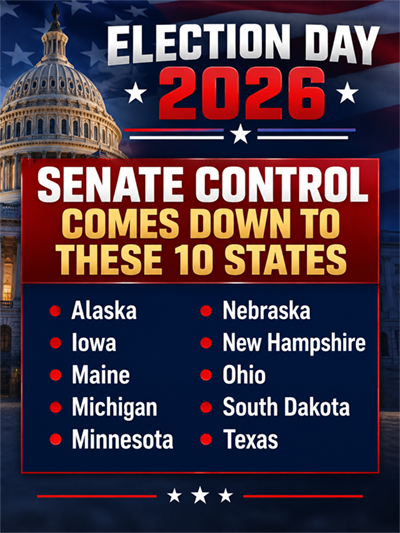
The Republicans are defending seats in Alaska, Iowa, Maine, North Carolina, Ohio, and Texas, while the Democrats must protect Georgia, Michigan, and New Hampshire.

Earlier this week former Alaska at-large Rep. Mary Peltola (D), who lost her seat to current Rep. Nick Begich III (R-Chugiak) in 2024, surprisingly launched a Senate campaign. Most believed she would enter the open Governor’s race where her prospects appear brighter. In the Senate race, she faces an uphill challenge against two-term incumbent Dan Sullivan (R), who has posted an average winning margin of 14.9 percentage points in his two elections including defeating Democratic Sen. Mark Begich in 2014.

Alaska’s unique top four/Ranked Choice Voting system does give Peltola some chance of winning the Senate race in the same manner as how she cobbled together two US House victories. If she can hold Sullivan under 50 percent in the general election, Ranked Choice Voting will begin and then all bets are off. At the outset, however, Sen. Sullivan is favored to win re-election.

Iowa Sen. Joni Ernst (R) is retiring after two terms, and Rep. Ashley Hinson (R-Marion/Cedar Rapids) appears as a consensus 2026 GOP Senatorial candidate. She will be favored to hold the seat probably against the Democratic leadership’s top choice, state Rep. Josh Turek (D-Council Bluffs), though several credible party members are competing for the nomination.

Maine Sen. Susan Collins (R) will defend her seat against either Gov. Janet Mills (D) or oysterman Graham Platner. Platner is the chosen Democratic Socialist candidate and has attracted major far left political figures to his campaign such as Sens. Bernie Sanders (I-VT) and Elizabeth Warren (D-MA). The general election will be close no matter who the Maine Democrats nominate.

North Carolina Republican Sen. Thom Tillis is retiring after two terms, and we will see a tight contest develop between former two-term Gov. Roy Cooper (D) and ex-Republican National Committee chairman Michael Whatley. North Carolina always features tight statewide elections, but for the first time in history Republicans have overtaken Democrats in party registration. This race, however, will likely end in a photo finish.

Appointed Ohio Sen. Jon Husted (R) faces the voters in his new role for the first time (he previously won two statewide races as Secretary of State and was twice on the gubernatorial ticket with Gov. Mike DeWine), and his opposition will be former Sen. Sherrod Brown (D). The fact that ex-Sen. Brown lost his seat in 2024 even though he garnered almost 293,000 more votes than when he last won in 2018 shows strongly the Ohio electorate is moving to the right.

The Texas Republican primary is likely going to a runoff between two of three candidates: Sen. John Cornyn, Attorney General Ken Paxton, and Rep. Wesley Hunt (R-Houston). The Democrats feature a battle between Rep. Jasmine Crockett (D-Dallas) and state Rep. James Talarico (D-Austin). A better general election picture will be drawn once the party nominees are chosen, but Texas Democrats have not won a statewide race since 1994.

Georgia Sen. Jon Ossoff (D) will be seeking a second term, and he already leads the nation in campaign fundraising. Republicans likely won’t have a nominee until a May runoff election concludes. A secondary election campaign potentially between Reps. Mike Collins (R-Jackson) and Buddy Carter (R-Pooler/Savannah) could well determine who challenges Sen. Ossoff in November.

The most vulnerable Democratic Senate seat may lie in Michigan. Here, an open contest between favored Republican Mike Rogers, a former seven-term Congressman and 2024 US Senate nominee, and one of the following: Rep. Haley Stevens (D-Birmingham), state Sen. Mallory McMorrow (D-Royal Oak), or former Wayne County Health Director Abdul El-Sayed, will take place.

The Michigan Democrats not only face a difficult primary campaign, but the nomination election isn’t until Aug. 4. The lengthy Democratic primary means Rogers will enjoy a long period of political open field running where he can build volunteer support and funding reserves.

Should former Sen. John E. Sununu win the New Hampshire Republican Senatorial nomination — and he is favored to do so over former ex-Massachusetts Sen. Scott Brown — the GOP will have a strong candidate to battle presumptive Democratic nominee Chris Pappas, the 1st District Congressman.

Though Pappas will be considered at least a slight favorite to win the general election, the Sununu name in New Hampshire has generally been political magic over the years. The Sununu family, including former Gov. John Sununu, ex-Gov. Chris Sununu, and ex-Senator and former Rep. John E. Sununu, have combined to win 11 major New Hampshire elections.

It remains to be seen if any other Senate contests enter the competitive realm, but electoral history suggests that an unexpected campaign is also likely to reach the political forefront.

Republicans are likely to hold their majority, but all of the aforementioned campaigns should be regularly monitored throughout this election year.

Peltola Announces for Senate

By Jim Ellis — Wednesday, January 14, 2026

Senate

Former Alaska at-large Rep. Mary Peltola (D) announces her Senate candidacy in this Facebook post.

Reports from last week suggesting that former Alaska at-large Rep. Mary Peltola (D) was seriously considering running for the Senate this year have proven correct. Peltola, defeated for re-election to the House in 2024, announced Tuesday that she will challenge two-term Republican Sen. Dan Sullivan later this year.

Though the Senate race was always on the table for Peltola, her decision to jump into this challenger contest is still a bit surprising. Considering the crowded Republican field running in the open Governor’s campaign, it appeared that Peltola would be assured of qualifying for the general election with a reasonable chance of winning the Governorship against possibly three Republicans advancing from the state’s unique top four primary system. Peltola’s chance improves even further when such a scenario advances to the Ranked Choice Voting round, through which she won her two congressional races.

The Alaska electoral system features an August jungle qualifying election where all candidates are placed on the same ballot regardless of political party affiliation. The top four finishers then advance into the general election. If no candidate receives majority support, the Ranked Choice Voting rounds begin.

The top four/Ranked Choice Voting system was challenged at the ballot box in 2024 through a voter initiative and survived by just 664 votes in the statewide tabulation. System opponents have again filed for another run at repealing the system and it appears enough signatures have been filed to qualify for the 2026 ballot. Even if the repeal proponents are successful in the ‘26 election, however, the top four process will still be in effect for the present cycle.

Though polling is already showing a Sullivan-Peltola Senate race to be a virtual toss-up, such is not surprising at this point in the election cycle. It is common to see the Alaska Democratic candidates consistently polling better early than they actually perform when votes are counted on election day.

For example, in the 2020 presidential race, President Trump appeared to be in a dead heat with future President Joe Biden in the Last Frontier, but the Republican ended with a secure 10-point win. In the 2024 congressional race, then-Rep. Peltola led Republican Nick Begich III by 9-14 percentage points in early polling before losing in a 51-49 percent Ranked Choice Voting final.

While Sen. Sullivan should still be regarded as the favorite for re-election, Peltola’s candidacy certainly makes the Senate race competitive. Looking at the rest of the country, we now see eight states where voters will decide a potentially tight Senate election.

In addition to Alaska, Republicans will be defending key Senate seats in Iowa, Maine, North Carolina, and Texas, while Democrats must protect Georgia, Michigan, and New Hampshire. For Democrats to reach a majority status of 51 Senate seats in this election, they would have to win seven of these eight hotly contested campaigns.

While the Peltola candidacy in Alaska puts another Republican Senate state in play for the Democrats, the party chances of capturing the majority in 2026 are still slim, but they may lessen the current 53-47 GOP margin.