Tag Archives: Donald Trump

Where DeSantis Stands

By Jim Ellis

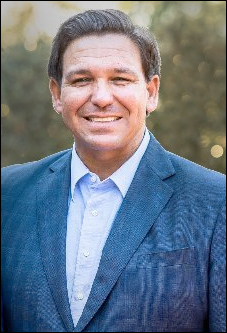
Florida Gov. Ron DeSantis (R)

June 29, 2021 — Florida Gov. Ron DeSantis (R) has been a hot political property of late, and no less than three political pollsters were in the field during late June to test his popularity in several scenarios.

Two of the firms, Echelon Insights and McLaughlin & Associates, tested Gov. DeSantis nationally in anticipation of a possible presidential run in 2024, while the Political Matrix/Listener Group surveyed the more timely Sunshine State 2022 governor’s race.

From the interactive voice response system poll released late last week, Political Matrix/Listener Group, on June 21, surveyed a total of 716 Florida likely voters who have a gubernatorial preference. They found DeSantis faring well against both announced Democratic gubernatorial candidates.

If US representative and former governor, Charlie Crist (D-St. Petersburg), were his 2022 general election Democratic opponent, Gov. DeSantis would hold a 55-45 percent advantage. Opposite state Agriculture Commissioner Nikki Fried (D), Florida’s only Democratic statewide elected office holder, the DeSantis margin would expand to a huge 61-39 percent spread; this, in a state where Republicans consistently perform a few points better than polling numbers typically predict.

The other two survey research firms tested Gov. DeSantis against a large number of commonly viewed ’24 GOP presidential prospects. Echelon Insights (June 18-22; 1,001 registered US voters, online from representative sample of registered voters) finds the governor topping the field of 19 named potential candidates within the 386 Republican primary voters segment with a 21 percent support figure, which is seven points higher than the former vice president, Mike Pence.

Donald Trump, Jr. posted seven percent, one point ahead of ex-UN Ambassador and former South Carolina governor, Nikki Haley, and Sen. Ted Cruz (R-TX) who both followed with six percent apiece. This group of five are the only potential contenders exceeding five percent preference. Former president, Donald Trump, was not included in the Echelon Republican nomination ballot test.

McLaughlin and Associates (June 16-20; 1,000 likely US voters, 444 GOP likely presidential primary voters) tested a two-tiered national GOP primary vote, one with former President Trump and one without.

If Trump does not run in 2024, McLaughlin, like Echelon, finds Gov. DeSantis to be the leading early candidate. In the field sans the ex-president, Gov. DeSantis places first with 24 percent followed by ex-VP Pence who attracts 19 percent, while Donald Trump, Jr. places third with 15 percent. Sen. Cruz (six percent) is the only other potential candidate who tops five percent of the vote.
Continue reading

The Controversy over Donald Trump’s Endorsement of NC Senate Candidate, Rep. Ted Budd


By Jim Ellis

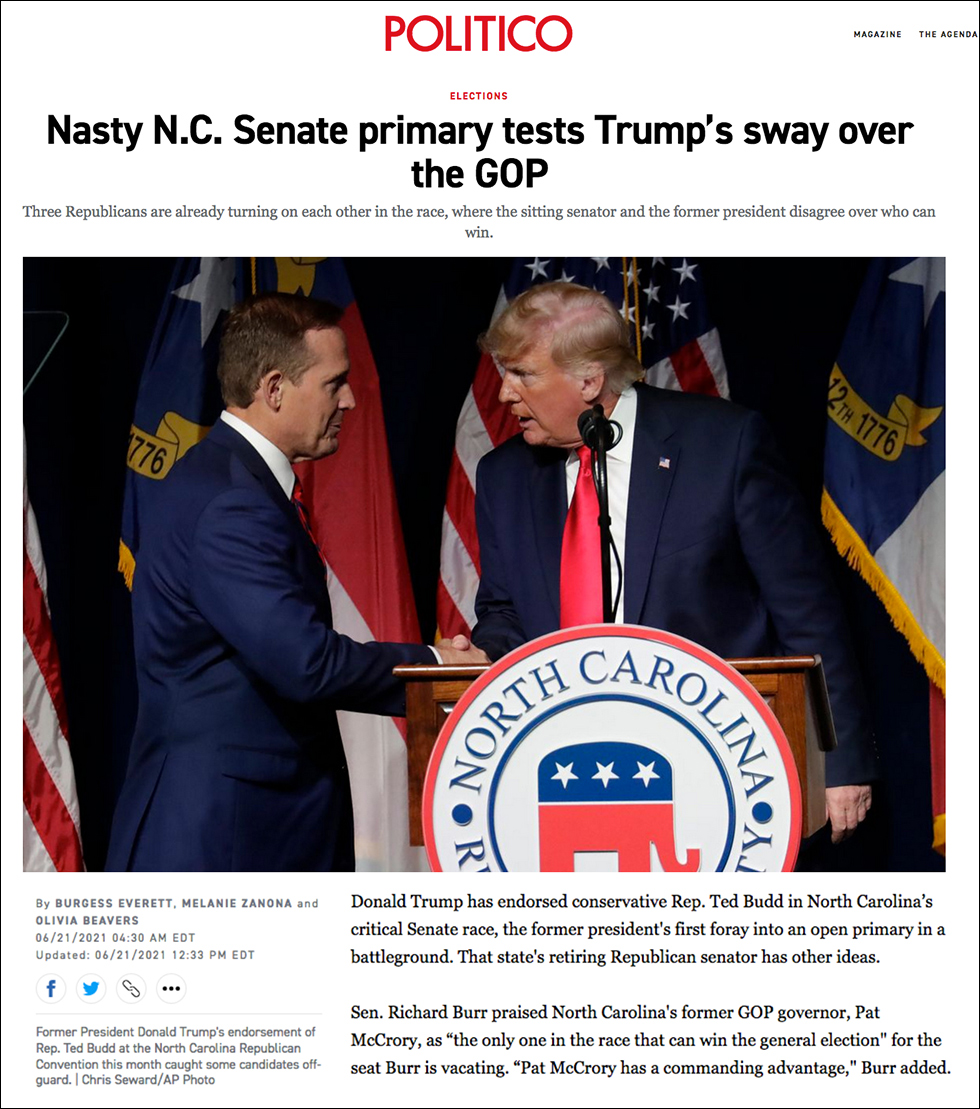
June 23, 2021 — Three Politico publication reporters, Burgess Everett, Melanie Zanona, and Olivia Beavers, combined on an article published yesterday (Nasty N.C. Senate primary tests Trump’s sway over the GOP) that merits refutation.

The piece details former President Trump’s public endorsement of US Senate candidate Ted Budd, the 13th District congressman, at the North Carolina Republican Party convention on June 5, and reactions to the development. Generally, and not surprisingly, it casts the endorsement and Rep. Budd’s statewide chances in a negative light.

Therefore, a number of points require balance.

1. To begin, the story quotes key Republicans, such as retiring North Carolina US Sen. Richard Burr (R) and South Carolina Sen. Lindsey Graham (R), who are downplaying the Trump endorsement’s effectiveness, with Sen. Burr going so far as claiming that ex-governor Pat McCrory is basically the only candidate who could win the upcoming general election. It is important to note here that McCrory failed to win re-election in 2016, the last time he was on a statewide ballot.

2. Secondly, a released Meeting Streets Insight poll conducted for the Budd campaign (June 9-10; 500 likely North Carolina Republican primary voters; live interview) highlights a different perspective.

The MSI survey found McCrory leading the GOP field 45-19-12 percent over Rep. Budd and former US representative, Mark Walker, respectively. When the polling sample is informed of the Trump endorsement – only 20 percent were aware before the pollsters provided the information – the ballot test completely flips to 46-27-8 percent with Rep. Budd leading, followed by ex-governor McCrory and former Rep. Walker. Obviously, this suggests the Trump endorsement still has power within the North Carolina Republican primary voter segment.

Continue reading

Trump Endorsement Matters in North Carolina Senate Primary

By Jim Ellis

Former President Donald Trump’s endorsement changes the face of the race for Senate in North Carolina.

June 16, 2021 — North Carolina US Rep. Ted Budd’s (R-Advance) Senate campaign released an internal Meeting Street Insights poll (June 9-10; 500 likely North Carolina Republican primary voters, live interview) Monday that finds former President Donald Trump’s endorsement completely changes the 2022 statewide Republican primary.

Rep. Budd is challenging former Gov. Pat McCrory and ex-US Rep. Mark Walker for the GOP nomination succeeding Sen. Richard Burr (R) who is not seeking re-election to a fourth term.

According to Meeting Streets, former Gov. McCrory would lead the field, as other polls have shown, by a wide margin. On the first ballot test, McCrory scores 45 percent preference as opposed to 19 perecent for Rep. Budd, while 12 percent choose ex-representative Walker.

The picture drastically changes, however, when the pollsters ask if the respondent is aware that former President Trump has endorsed Rep. Budd. Only 20 percent of the sampling universe expressed knowledge of this development. On what the pollster terms the “educated” ballot test, meaning the respondent is told that Trump has, in fact, endorsed Rep. Budd, we see the drastic transformation.

With the Trump endorsement becoming known, Rep. Budd soars to the lead with 46 percent support, while McCrory drops to 27 percent, and ex-Rep. Walker falls to eight percent.

McCrory’s campaign fielded a Public Opinion Strategies survey in early April (April 6-8; 500 likely North Carolina Republican primary voters, live interview) and found the former governor leading 48-13-9 percent over Walker and Budd, respectively.

This was followed later in the month by a Spry Strategies study (April 21-24; 700 likely Republican North Carolina primary voters; combination live interview and interactive voice response system) that found a 40-11-5 percent split, again with Rep. Budd trailing his two opponents.

Continue reading

Texas GOP Mayoral Victories

Along the US-Mexican border

By Jim Ellis

June 8, 2021 — On Saturday, Republican candidates picked up three victories in a trio of Texas mayoral runoffs, the most surprising of which came in the Mexican border city of McAllen where the Hispanic population is close to 85 percent.

McAllen City Commissioner (Council) Javier Villalobos, a former Hidalgo County Republican Party chairman, won the mayoral runoff election with a 51-49 percent victory. This on the heels of the Texas-Mexico border region voting much more Republican in 2020 than in previous electoral history. From the congressional district that houses McAllen, Rep. Vicente Gonzalez (D-McAllen) won his November re-election contest with only a 50.5 – 47.6 percent victory margin.

In Ft. Worth, an election that broke more definitively along partisan lines, though all of the mayoral elections in the state are nonpartisan in that the candidate’s political party affiliation does not appear on the ballot, Republican Mattie Parker defeated Tarrant County Democratic Party chair Deborah Peoples. The spread was 54-46 percent in a contest where turnout more than doubled the aggregate mayoral vote of four years ago. Voter participation was up in all three of the Texas city runoff elections, but none like the huge increase in Ft. Worth.

The least partisan of the races occurred in Arlington, where former police officer and local businessman Jim Ross defeated Arlington City Councilman Michael Glaspie, also with a 54-46 percent margin. In this election, law enforcement seemed to dominate the campaign as five different police and fire associations rallied to support Ross.

As mentioned above, South Texas voting ventured more toward the Republicans in November even though Democrats still proved victorious in the region. Biden’s margin over then-President Trump dropped as low as 50-48 percent in Rep. Gonzalez’s 15th District, and under 52 percent in three of the four CDs that touch the Texas-Mexico border.

Continue reading

NM-1: A Pattern?

By Jim Ellis

Albuquerque, New Mexico-anchored NM-1 Congressional District

June 4, 2021 — Several media reports — typified by an MSNBC website analysis article that Steve Benen authored after Tuesday’s New Mexico special election — are trying to make the point that Melanie Stansbury’s landslide victory is a potential benchmark for future Democratic victories. Such a conclusion is a stretch.

The two-pronged premise is that Stansbury was so strong that she even ran ahead of President Biden’s performance in the district, and that the Republican campaign’s emphasis on the crime problem and the national effort to defund the police proved a political failure.

While Stansbury, a two-term state representative, scored a 60-36 percent win in the Albuquerque anchored congressional district that former Rep. Deb Haaland (D) resigned to become US Interior Secretary, her performance is not unusual. In fact, her vote total was less than two points above the mean average Democratic congressional percentage since the party converted the seat from the Republicans back in 2008.

To the argument that Stansbury’s victory margin was larger than President Biden’s 60-37 percent spread against then-President Trump, and it was only one percentage point better, it is not unusual for a House campaign to outperform the top of the ticket. In most instances, the congressional winner is better known than his or her competitor, has greater funding and outside support, and is consistently in position to overwhelm the opposition. Such is rarely the case in a national presidential campaign or in a major statewide contest for senator or governor.

The crime issue was certainly a focal point of Republican nominee Mark Moores, an Albuquerque state senator. The national party, however, did very little to support Moores, virtually conceding the race from the outset based upon the voting history here for more than a decade.

For an underdog candidate in Moores position, emphasizing the crime issue, on paper, made sense as a point of attack. Albuquerque, according to FBI statistics has the ninth worst violent crime statistics in the country, meaning 1,352 crimes per 100,000 residents according to the latest available figures (2019). To put this number in perspective, Chicago, which has drawn much national media attention for its high murder rate, ranks 31st on the same scale, at 943 crimes per 100,000 city residents.

Perhaps one reason the crime issue did not propel the Moores candidacy is there was no serious effort to defund the Albuquerque Police Department, nor is there the sharp racial tension that is present in some of the cities where we saw serious problems along with a local movement to reorder policing.

Continue reading

NM-1 Special Election Tuesday

New Mexico state Rep. Melanie Stansbury (D)

By Jim Ellis

June 2, 2021 — The latest in the series of special elections to fill US House vacancies was held yesterday, and the race has an obvious favorite.

On the ballot: state Rep. Melanie Stansbury (D-Albuquerque); state Sen. Mark Moores (R-Albuquerque); ex-Land Commissioner Aubrey Dunn, a former Republican who is running as an Independent; and Libertarian Party nominee Chris Manning.

The major parties nominated their candidates in special convention soon after incumbent Rep. Deb Haaland (D-Albuquerque) resigned to accept her appointment as Interior Secretary in President Biden’s cabinet.

Rep. Stansbury prevailed in a close multi-candidate Democratic convention, ultimately defeating state Sen. Antoinette Sedillo Lopez (D-Albuquerque) in a final round of delegate voting. Many believed winning the Democratic convention was tantamount to claiming the special election. Sen. Moores was an easy winner on the Republican side.

All indications pointed to a Stansbury victory, which is what played out last evening. The only recent publicly released poll before yesterday’s election, one that RRH Elections conducted (May 18-21; 555 likely NM-1 voters, interactive voice response system), found the Democratic nominee holding a 49-33 percent lead over Moores.

Secondly, the district has moved sharply to the left over the past decade, as the 2016 and 2020 presidential elections suggest. In the ’16 campaign, Hillary Clinton defeated Donald Trump here, 52-35 percent. This past November, the Biden margin over ex-President Trump soared to 60-37 percent. The last Republican to represent the 1st District was former Rep. Heather Wilson (R-Albuquerque) who left the House in 2008 to run unsuccessfully for US Senate.

Continue reading

Another Close Michigan Race

By Jim Ellis

Detroit Police Chief James Craig

May 18, 2021 — As it is becoming clear that retiring Detroit Police Chief James Craig (R) is preparing to challenge Michigan Gov. Gretchen Whitmer (D) next year, Target Insyght, polling for the Michigan Information & Research Service (MIRS), tested the potential general election pairing in a recent study. The results portend another tight Wolverine State campaign.

The TI poll (May 9-11; 800 registered Michigan voters, live interview) finds Gov. Whitmer leading Chief Craig by a six-point, 48-42 percent, spread. More importantly, the survey identified key areas of weakness for the governor, ones that could potentially allow a GOP contender to construct a reasonable path to victory. Chief Craig has not yet announced his candidacy but is expected to do so once he officially retires from the police force on June 1.

Where Chief Craig may have a significant advantage in such a race is his potential ability to draw more votes from the African American community particularly in heavily Democratic Detroit.

While President Biden averaged 79.1 percent of the vote in Congressional Districts 13 and 14 that encompass the city, the Target Insyght poll finds Gov. Whitmer pulling only 64 percent among black voters, while the outgoing police chief attracts 36 percent. In Detroit, 78.3 percent of the population is African American according to the latest publicly available Census Bureau estimates (July 2019).

Gov. Whitmer’s bigger weakness, however, lies in the area of jobs and rebuilding the state’s economy. According to this issue segmentation, voters would favor Chief Craig over Gov. Whitmer by a whopping 63-30 percent margin.

John James, the African American Republican who has run highly competitive campaigns in the last two consecutive Michigan Senate races, was also tested but he doesn’t perform as well as Chief Craig in a general election pairing. While the governor tops Chief Craig by six points, as mentioned above, James trails by 10 percentage points, 49-39 percent.

In the Republican primary, however, it is James who would have a clear advantage. If he and Chief Craig oppose each other for the 2022 GOP gubernatorial nomination, the former man would begin the race with a 36-21 percent advantage in the primary according to this particular survey.

Continue reading

Add IL-17 to the List of Vacancies

By Jim Ellis

May 5, 2021 — Illinois Rep. Cheri Bustos (D-Moline), just emerging from her closest re-election victory in November – a 52-48 percent win over Republican Esther Joy King – surprisingly announced Friday that she will not seek re-election to a sixth term next year. Bustos was the Democratic Congressional Campaign Committee chair for the 2020 cycle and appeared positioned for further leadership or strong committee positions in the future.

Her absence in the next cycle from a state that is losing a congressional district means her politically marginal western Illinois CD (Trump ’20, 50-48 percent; Trump ’16, 47.4 – 46.7 percent) that stretches throughout the Iowa border region and is anchored in the area known as the Quad Cities, could drastically change in the next redistricting.

For her part, King immediately declared her candidacy for the open seat election. The Bustos retirement coupled with Rep. Charlie Crist’s (D-FL) expected gubernatorial announcement would create 16 open or vacant US House seats, eight from each party.

TX-6: Double R Runoff

By Jim Ellis

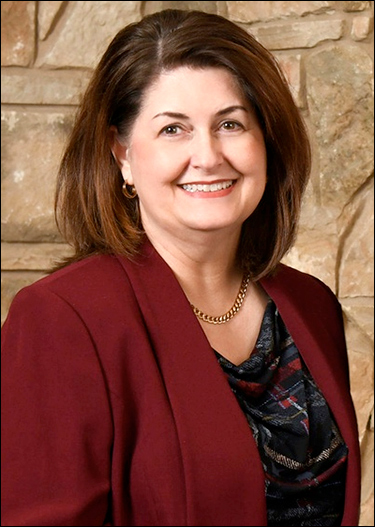
Susan Wright

May 4, 2021 — Republicans are guaranteed to hold Texas’ vacant 6th Congressional District in the succeeding runoff election as two GOP candidates advanced from the 23-person jungle primary election on Saturday night. Susan Wright, widow of late Congressman Ron Wright (R-Arlington), finished first, as expected, with just over 19 percent of the vote.

Accompanying Wright into the runoff contest is freshman state Rep. Jake Ellzey (R-Waxahachie). He scored a vote percentage of 13.9 in slipping past the top Democrat, 2018 congressional nominee Jana Lynne Sanchez, who finished just 354 votes behind in third place.

Ellzey was elected to the legislature in November, but immediately jumped into the congressional race when Rep. Wright passed away. In 2018, Ellzey ran for the 6th District open seat when veteran Rep. Joe Barton (R) retired, finishing second and forcing Rep. Wright, then the Tarrant County Tax Assessor, into a runoff election. Rep. Wright won the runoff 52-48 percent, which was a much closer finish than initially anticipated.

The Saturday night primary proved big for Republicans. Combined, their candidates received 61.9 percent of the 78,374 votes cast according to the initial final count. Democrats finished well below expectations with only a combined 37.3 percent split among their 10 candidates.

These totals are quite different than Rep. Wright’s victory margins in both 2020 and 2018, when he recorded almost identical splits of 53-44 percent and 53-45 percent, respectively. Former President Donald Trump carried the district with a 51-48 percent spread in November but a much stronger 54-42 percent in 2016.

Continue reading

Senate Action

Ohio Rep. Tim Ryan (D-Warren/Youngstown)

By Jim Ellis

April 29, 2021 — While most of the political world was focused on the census’s national apportionment announcement, several Senate moves of merit were also made this week.

In Ohio, US Rep. Tim Ryan (D-Warren/Youngstown) finally made his fledgling US Senate campaign official. Originally saying he would announce sometime in March only to postpone formal entry to an undetermined time, Ryan finally made his declaration on Monday. Once former Ohio Health Director Amy Acton — who was running slightly ahead of Rep. Ryan in early Democratic primary polling — said that she was not going to run, that paved the way for the 10-term congressman to open with an apparently clear path to the Democratic nomination.

Simultaneously, in Georgia, another announcement was made but one that contained a surprising message. Former Rep. Doug Collins (R), who placed third in the 2020 US Senate jungle primary, also declared his political intentions for 2022 on Monday. While observers were expecting the former four-term congressman to enter the current Senate race, he instead said he will not run for any office next year but didn’t close the door on returning to elective politics in another election cycle.

Yesterday, in another largely expected move, former North Carolina state Supreme Court Chief Justice Cheri Beasley (D), who lost her position in November by a scant 401 votes statewide, announced via video that she will enter the open Tar Heel State Senate race.

The three moves help further set the stage for a trio of critical Senate contests that will each contribute mightily toward determining which party breaks the 50-50 tie and assumes control of the body after the next election.

Despite Rep. Ryan looking as the candidate to beat for the Ohio Democratic nomination, the general election won’t be easy. Additionally, this political cycle could be different in terms of political options for Ryan. He has several times dipped his toe in the statewide or national waters only to return to the safety of his House district. With it now a certainty that Ohio will lose another congressional seat, and with at least one scenario suggesting that the eliminated seat could become Rep. Ryan’s 13th District, his usual fail-safe move might not again be available.

Continue reading