Tag Archives: Rep. Julia Letlow

Louisiana Sen. Cassidy Loses

By Jim Ellis — Monday, May 18, 2026

Senate

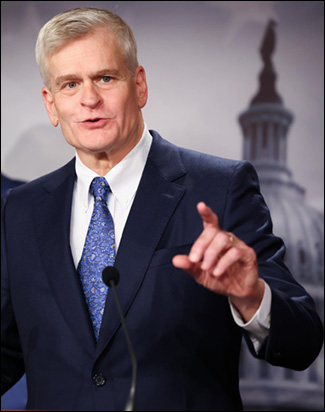
Sen. Bill Cassidy (R-LA) loses challenge to hold US Senate seat.

Louisiana Sen. Bill Cassidy suffered a decisive defeat in Saturday’s Republican primary, even failing to qualify for the runoff election.

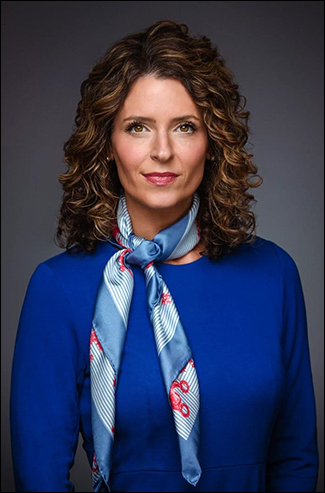
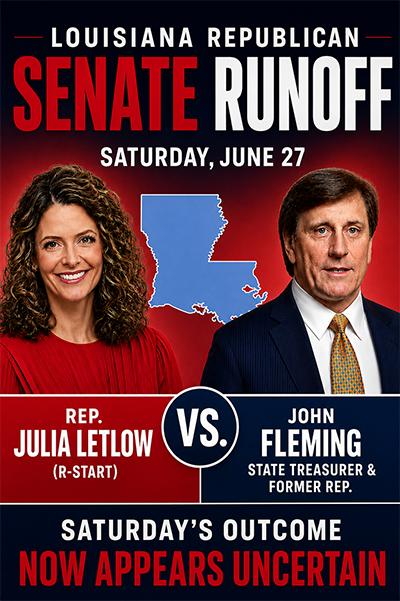
Rep. Julia Letlow (R-Start), with President Trump’s public support, finished first with a strong 44.8 percent of the vote against three opponents, falling just over five percentage points short of an outright victory. She will advance to the June 27 runoff against State Treasurer, physician, and former Congressman John Fleming, who outpaced Sen. Cassidy to secure second place. Dr. Fleming finished 3.5 percentage points ahead of the two‑term incumbent, a margin of nearly 14,000 votes.

Letlow carried 53 of Louisiana’s 64 parishes — and potentially 54 once all ballots are tallied. She trails Dr. Fleming by a single vote in Grant Parish. Including Grant, Dr. Fleming won eight parishes, all located within the 4th Congressional District that he represented for eight years. Sen. Cassidy managed to prevail in only three parishes, two in the New Orleans metro area and one in Baton Rouge.

The result marked another impressive primary victory for President Trump. He endorsed Rep. Letlow even before she became a Senate candidate. Sen. Cassidy had been Trump’s top Republican intra‑party target, as he is one of only two GOP Senators on the ballot this year — the other being Susan Collins from Maine — who voted for the 2021 impeachment just days before Trump left office after losing the 2020 election.

Clearly, Sen. Cassidy did not anticipate Trump’s return to the Presidency, which proved a grave political miscalculation. Of course, the Senator will remain in office to serve the final seven months of the current term.

Cassidy was first elected in 2014 and re‑elected in 2020, both under Louisiana’s jungle primary system, in which all candidates appear on the same ballot regardless of party affiliation. He defeated three‑term Sen. Mary Landrieu (D) in the 2014 runoff by a 56-44 percent margin. In 2020, he won re‑election outright in the jungle primary, earning 59.3 percent of the vote against 14 opponents, only one of whom was a Republican.

Many Louisiana political observers believe that unseating Sen. Cassidy was one factor motivating the legislature and Gov. Jeff Landry (R) to change the state’s nomination structure. Analysts have suggested that Cassidy would likely have performed better under the previous jungle primary system, where Democrats and Independents could also participate.

Instead of holding a November jungle primary concurrently with the general election followed by December runoffs for any race in which no candidate reached the 50 percent threshold, the legislature and Governor replaced the system with early closed partisan primaries for federal offices and select Louisiana state contests.

Ironically, because of the ongoing redistricting process, primaries for the US House races were not held on Saturday. Once a new 2026 congressional map is finalized, those campaigns will return to the traditional November/December schedule. As before, any candidate who secures a majority in the November vote will be elected outright.

For the Democrats, Saturday’s overwhelming first‑place finisher was farmer Jamie Davis, who captured 47.4 percent of the vote and topped his two opponents in all 64 parishes. It remains unclear whom he will face in the runoff, as the current second‑place candidate, businessman and Navy veteran Gary Crockett, leads non-profit organization executive Nicolas Albares by only 284 votes with several thousand ballots still uncounted.

In both parties, the first‑place finishers came close enough to the 50 percent mark that Rep. Letlow and Davis enter their respective June 27 runoff elections as virtual prohibitive favorites. Given Louisiana’s strong Republican lean, Rep. Letlow would then become the clear general‑election favorite once the runoffs conclude.

The Cassidy defeat brings the number of open US Senate races in the 2026 cycle to 11 – seven from the Republican side and four from the Democratic column. The next major Senate contest arrives on May 26 in Texas, where Sen. John Cornyn and Attorney General Ken Paxton are competing for the Republican nomination in what is expected to be a very close finish.

Louisiana Senate Primary Tomorrow

By Jim Ellis — Friday, May 15, 2026

Primary

Voting in the hard-fought Louisiana Republican primary among Sen. Bill Cassidy, Rep. Julia Letlow (R-Start), and State Treasurer John Fleming takes place tomorrow, and only two things appear certain. First, the race is headed to a runoff because none of the three candidates has majority support. Second, one contender will be eliminated, but polling has not definitively shown which one.

Ever since President Trump was re-elected, it became clear that he would seek to defeat Sen. Cassidy in Louisiana’s Republican nomination contest. Cassidy was one of two Republican Senators who voted to convict Trump in the 2021 impeachment trial, likely under the assumption that the outgoing president would never return to office.

True to form, Trump is now seeking political retribution. The only other Republican Senator on the 2026 ballot who voted to convict him in the impeachment trial is Maine’s Susan Collins. But because Republicans view her as their only chance of holding that seat, she has thus far avoided presidential opposition.

President Trump endorsed Rep. Letlow even before she officially entered the Senate race. The campaign’s true surprise, however, is State Treasurer and former Congressman Fleming’s strength. He has turned the Senate primary into a genuine three-way contest – a development few observers anticipated.

On the eve of the primary, it remains unclear which of the three candidates will be eliminated tomorrow, and it is entirely possible that Sen. Cassidy could even fail to qualify for the runoff election.

Four polls have been released since April 26 – from Emerson College, BDPC (a Louisiana polling firm), Fabrizio, Lee & Associates, and Quantus Insights. The two challengers have led in at least one of the recent surveys, while the incumbent has failed to place first.

The Emerson College poll (April 24-26; 455 likely Louisiana Republican primary voters; multiple sampling techniques) finds a virtual two-way tie, with Sen. Cassidy trailing outside the survey’s margin of error. The ballot test shows Fleming leading Letlow, 28-27 percent, while Sen. Cassidy attracts only 21 percent support.

The BDPC poll (April 28-30; 600 likely Louisiana Republican primary voters) projects Letlow leading beyond the survey’s margin of error, with Sen. Cassidy and Dr. Fleming tied for second place but well behind. The ballot test favors Letlow, 33-21-21 percent.

The Fabrizio, Lee & Associates study (April 4-5; 600 likely Louisiana Republican primary voters; live interview and text) also finds Rep. Letlow leading, with Sen. Cassidy in second place and Dr. Fleming falling short of runoff qualification. The Fabrizio ballot test posts a 32-26-21 percent split.

The most recent survey, from Quantus Insights (May 6-7; 1,015 likely Louisiana Republican primary voters; online), paints yet another distinctly different picture. Here, Rep. Letlow leads with 42 percent support, the strongest showing for any candidate in the recent polling, though still well below the 50 percent threshold needed to avoid a runoff. Thus, despite Letlow’s sizable advantage, the Quantus numbers still point toward a secondary election.

Dr. Fleming places second with 30 percent support in the Quantus result, while Sen. Cassidy trails badly at just 20 percent among Republican primary voters.

The cumulative results of these polls suggest that Rep. Letlow is likely to qualify for the second round, while it remains a toss-up whether Sen. Cassidy or Dr. Fleming will join her in the runoff. This is a rare situation in which, on the eve of a primary election, it is uncertain whether an incumbent will even advance to the runoff.

One area in which Sen. Cassidy leads is campaign resources. Through the April 26 pre-primary reporting period, he had raised $13.3 million and retained more than $5.5 million for the final stretch before the primary. By comparison, Dr. Fleming raised $11.2 million, including $9.6 million from individuals other than himself, while Rep. Letlow has raised just under $4.4 million.

Since the 2026 election has thus far proved to be turnout rather than persuasion driven, Sen. Cassidy using his financial advantage to deploy his vote base to the maximum degree will greatly improve his chances of securing a runoff position.

With inconsistent polling results over a prolonged period, virtually anything could happen tomorrow. The runoff election is scheduled for June 27.

Cassidy Crushed in New Poll

By Jim Ellis — Monday, April 6, 2026

Senate

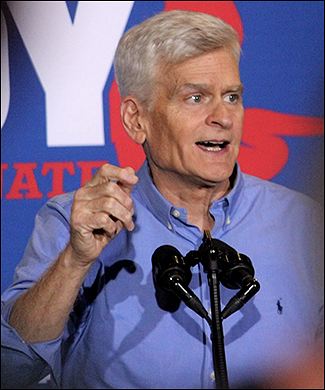
Louisiana Sen. Bill Cassidy (R)

A new American Pulse Research & Polling survey finds Louisiana GOP Sen. Bill Cassidy trending seriously downward in his fight for renomination.

According to the American Pulse data, Sen. Cassidy would be in danger of not even advancing to a runoff against Rep. Julia Letlow (R-Start) and State Treasurer and former Rep. John Fleming. In hypothetical runoff pairings, should Sen. Cassidy rebound, he would individually trail both Letlow and Fleming.

The American Pulse poll (March 20-24; 455 likely Louisiana Republican primary voters) sees Rep. Letlow topping Fleming and Sen. Cassidy, 31-25-21 percent, respectively. In a potential runoff, Rep. Letlow would lead Fleming, 37-34 percent. With 29 percent of the respondents unsure about this race, such a contest would be rated as too close to call.

Paired with incumbent Cassidy, Rep. Letlow would defeat him by a whopping 30 points according to this respondent sample, 54-24 percent. Fleming fares almost as well against the Senator. In a Fleming-Cassidy runoff, the challenger would lead the incumbent, 49-29 percent.

With a sample size of only 455 individuals for a statewide survey, the error factor would be high because of the small universe. These results, however, are so lopsided that even a wide error margin would still send Cassidy packing particularly because he fares so poorly in a runoff against either opponent.

Sen. Cassidy is facing serious obstacles. Obviously, these polling numbers reveal that the Senator is not popular within the Louisiana conservative vote base. Secondly, his vote to impeach President Trump associated with the January 6th conflict at the Capitol obviously put him at odds with the chief executive, though it is likely that the Senator believed doing so would not cause him future political problems because he obviously believed that Trump would never return to the White House.

As a result, President Trump has already endorsed Rep. Letlow, doing so even before she became an official Senate candidate.

Perhaps Sen. Cassidy’s most serious problem, however, is Louisiana’s new nomination structure for federal offices. Since the 1970s, Louisiana has featured a jungle qualification format for all offices. All candidates are placed on the same ballot in an election concurrent with the regular general election. If a candidate records majority support in the first vote, the individual is elected. If not, the top two finishers regardless of political party affiliation advanced to a post-general election runoff.

Under the new Louisiana primary system effective with the 2026 election, registered party members may only vote in their own party primary. If a person is registered as a “No Party” voter, the individual may choose a primary ballot at the polling place. Once selected, the “No Party” voter can then only participate in an associated runoff of the party in which he or she chose for the regular primary election.

In the jungle system, and particularly because the Democrats are currently very weak in Louisiana, Sen. Cassidy was able to attract a segment of their votes. This made him stronger in seeking re-election. In 2026, Democrats will not be allowed to crossover into the Republican primary, just as Republicans will not be allowed to vote in any 2026 Democratic primary.

Therefore, the new partisan primary system gives the Cassidy challengers a boost because endorsements, such as the one from President Trump, will carry more weight within the conservative Republican vote base without any adverse boomerang effect coming from crossover Democrats.

Added together, these obstacles spell trouble for Sen. Cassidy’s re-election chances as the current polls reflect.

The small sample American Pulse survey may not be completely indicative of where the entire Louisiana Republican electorate stands, but the Senator has fared poorly in other statewide polls, as well.

Looking at the last six publicly released Republican primary studies since Feb. 24, Sen. Cassidy has averaged only 26.7 percent support in the surveys testing a three-way contest among the Senator, Rep. Letlow, and Fleming.

As we head toward a May 16 Louisiana Republican primary election and a potential June 27 GOP runoff, Sen. Cassidy today looks to be the Senate incumbent most likely to fail to qualify for the general election.

Three Now Battling for
Louisiana Senate Seat

By Jim Ellis — Thursday, March 19

Senate

Sen. Bill Cassidy (R-LA) faces challengers to hold his US Senate seat.

It has been known for some time that Sen. Bill Cassidy (R) was going to face real competition in his fight for renomination this year, but a legitimate three-way race scenario was not often speculated upon.

A series of late February surveys and the most recent Cassidy campaign poll confirm that State Treasurer and former Congressman and ex-White House Deputy Chief of Staff John Fleming is a viable Republican Senate candidate. This, even though President Trump has endorsed Rep. Julia Letlow (R-Start) against Sen. Cassidy.

The two-term incumbent is not a Trump favorite because he is one of two GOP Senators on the ballot in 2026 – Maine’s Susan Collins is the other – who voted to impeach President Trump in early 2021 over the January 6 Capitol conflict.

Public Opinion Strategies, surveying for the Cassidy campaign (March 7-10; 500 likely Louisiana Republican primary voters; live interview), sees the Senator holding a 35-24-21 percent advantage over Rep. Letlow and Fleming. Testing a Cassidy-Letlow runoff, the incumbent would hold only a 45-43 percent edge. The Cassidy-Fleming runoff possibility was not tested, but it would not be surprising to see a similar preference division.

The February polls, however, show a stronger Fleming standing. The BDPC survey research organization, a bipartisan Louisiana firm, tested the Republican Senate race during the Feb. 21-23 period (600 likely Louisiana Republican primary voters) and found a closer ballot test result, 28-21-21 percent with Sen. Cassidy leading and Letlow and Fleming tied. According to this survey, Fleming would lead both Cassidy (43-32 percent) and Letlow (36-27 percent) in runoff scenarios.

Quantas Insights and JMC Analytics & Polling also project a three-way race in their February polling.

Quantas (Feb 23-24; 1,428 likely Louisiana Republican primary voters; online) saw a 34-25-20 percent split with Fleming leading, Rep. Letlow second, and the Senator dropping to third. A Fleming-Letlow runoff was tested and broke 42-32 percent in Fleming’s favor.

JMC Analytics, another regular Louisiana pollster (2/14-16; 645 Louisiana likely Republican primary voters; live interview), found a virtual three-way tie with Mr. Fleming holding a slight 26-25-22 percent lead over Rep. Letlow and Sen. Cassidy.

The renomination road for Sen. Cassidy is more difficult than in his first two elections. The state has moved away from its jungle primary system that featured all candidates on the same ballot in a vote scheduled concurrently with the general election. If a contender received majority support, the individual was elected outright in the one election. If no one attained the 50 percent plateau, the top two finishers, regardless of political party affiliation, would advance to an early December runoff election.

In 2024, the legislature and Governor changed the law for federal and some state offices, concluding that their freshmen federal officials were at an organizational disadvantage in Congress because some of their members were joining the body a month after all others. Therefore, the legislative leaders and Gov. Jeff Landry (R) believed that the state was penalizing itself in terms of key committee assignments and in some leadership elections. This, even though the Speaker and Majority Leader both hail from Louisiana.

A reason less talked about for the change is the Senate race. Clearly, the legislators were aware that returning to a partisan primary/runoff system would make re-election much more difficult for Sen. Cassidy, who is viewed as less conservative than the typical Louisiana Republican legislator and primary voter.

Therefore, under the new nomination system, we see a closed primary (voters must be registered party members) scheduled for Saturday, May 16 with a runoff if no one receives majority support calendared for June 27.

Sen. Cassidy is certainly prepared for a tough challenge. He reported over $10.1 million cash-on-hand (COH) at the end of 2025, which is a 4:1 COH advantage over Rep. Letlow, and 5:1 opposite Fleming.

Considering the Trump endorsement for Rep. Letlow and the GOP/MAGA base expressing anti-Cassidy sentiments, the Senator will need every bit of his financial advantage to fight his way through to renomination.

Louisiana’s Cassidy Strikes Back

By Jim Ellis — Friday, January 30, 2026

Senate

Already, the Louisiana Senate Republican primary is taking shape, and we are witnessing a highly competitive and largely negative race beginning to unfold.

Louisiana Sen. Bill Cassidy (R)

Rep. Julia Letlow (R-Start) attracted a great deal of political attention last week as she announced her Republican primary challenge to Sen. Bill Cassidy along with an endorsement from President Trump. Now, the Senator is seizing the offensive.

The Cassidy campaign just released the results of a Public Opinion Strategies poll (Jan. 20-22; sample size not publicized) that largely outlines what promises to be the Cassidy campaign’s line of attack against Rep. Letlow.

According to the POS survey, Sen. Cassidy leads Rep. Letlow and state Treasurer and former Congressman John Fleming, 32-21-16 percent. State Sen. Blake Miguez (R-New Iberia) and Public Service Commissioner Eric Skrmetta trail the group with nine and one percent support levels.

Another recently released survey, this from JMC Analytics & Polling for the Fleming campaign (Jan. 12-14; 650 likely Louisiana Republican primary voters) finds an entirely different ballot test result. This data projects Fleming with a 23-22 percent edge over Sen. Cassidy. The remaining candidates split an aggregate 16 percent of the preference responses. The JMC poll was conducted before Rep. Letlow entered the race; hence, she was not included.

Under the Cassidy POS poll’s “informed ballot” result, meaning a series of messages about the poll sponsor’s opponent(s) that are usually negative, the Cassidy lead increases to 55-13-13 percent over Rep. Letlow and Treasurer Fleming. When the push questions isolate Rep. Letlow, the one-on-one “informed” ballot test moves to a whopping 69-22 percent in Cassidy’s favor.

While the query verbiage was not included in the poll analysis, the summary indicates that Rep. Letlow’s stock transactions will be at the forefront of the attack against her, and it is probable the information is at least somewhat sensationalized.

In the poll analysis, the text claims that Rep. Letlow has “over 200 violations of the Stock Act.” When reading the supporting story from the NOTUS (News of the United States) website, we see that the violations were for the late reporting of a group of 210 stock transactions on her financial disclosure report. The combined value of the transactions is reported in the range of $225,000 to $3.3 million. The disclosure report does not delineate further, but the campaign inference will be that she hid millions of dollars in stock transactions.

It appears that the Cassidy campaign is also targeting Letlow as a “RINO” (Republican In Name Only), claiming that her voting record is to the left of the Senator’s. Another attack, as also outlined in the poll analysis, is her taking a trip to Qatar “funded by a pro-Doha group.”

The most serious early campaign obstacle for Rep. Letlow and the other candidates is overcoming Sen. Cassidy’s large war chest. Again, according to the Cassidy polling analysis, the Senator’s campaign reports having $26 million in the bank, the year-end Federal Election Commission filing to be released early next month.

According to Rep. Letlow’s Sept. 30 campaign filing, she held just under $2.3 million in her account, but her total will likely be larger when the latest disclosure reports are made public. For his part, Fleming posted slightly over $2 million.

As previously reported, Louisiana has a new nominating system. Instead of a jungle primary held concurrently with the general election, Louisiana nominations for federal and certain state offices will revert to a traditional partisan primary and runoff procedure. If no candidate receives majority support in the first vote on May 16, the top two finishers advance to a June 27 runoff election.

In addition to Sen. Cassidy, Rep. Letlow, Treasurer Fleming, and Sen. Miguez, seven more Republicans have entered the race. The candidate filing deadline is Feb. 13, so it remains to be seen just how many of these individuals actually follow through and complete their final statement of candidacy. State Rep. Julie Emerson (R-Carencro) had also announced her candidacy but withdrew after Rep. Letlow entered the race.

The Louisiana and Texas Republican primaries feature the party’s two incumbent Senators, Cassidy and John Cornyn, who are in danger of losing their renomination efforts. Both the Texas primary on March 3 and Louisiana in May will be closely watched until the vote count is complete. Expect both the Texas and Louisiana campaigns to run at a frenetic pace throughout the remainder of the primary calendar.

Chaos in CO-4 Helps Boebert; LA-6 Candidate Announcement; Ashcroft Leading in Open Missouri Race;
Big Lead for Spanberger in Virginia

By Jim Ellis — Friday, Jan. 26, 2024

House

Colorado Rep. Lauren Boebert (R-Silt) / Photo by Gage Skidmore

CO-4: Brewing Chaos Likely Helps Rep. Boebert — Colorado’s open 4th District Republican primary featuring 11 announced candidates is beginning to deteriorate, which could favor Rep. Lauren Boebert (R-Silt). Boebert is moving into this open district to seek re-election instead of facing the most well-funded congressional candidate in America from her original District 3.

Two of the more prominent candidates are embroiled in controversy. State Rep. Mike Lynch (R-Ft. Lupton), as now comes to the forefront, was arrested in 2022 on suspicion of driving while intoxicated in addition to possessing a firearm while intoxicated. Lynch pled guilty to the charges and is serving a probationary sentence. His congressional candidacy has obviously brought the arrest to the forefront, and the publicity surrounding it has caused a movement within the state House Republican caucus to remove Lynch as Minority Leader. Not wanting to face a vote, Lynch quickly resigned from his leadership position.

Pro-life State Rep. Richard Holtorf (R-Akron), another District 4 candidate, who in urging a “No” vote on an abortion-related piece of legislation, stated that he had helped finance a girlfriend’s abortion and further said having the procedure helped her “live her best life.” He, too, is at the center of a media storm and his inconsistency will clearly diminish his prospects as a congressional candidate. Though other credible candidates, such as former state legislator Ted Harvey, are in the crowded GOP primary, Rep. Boebert is now in better position thanks to two of her main opponents being forced to navigate rough political waters.

LA-6: Ex-Congressman Announces for New Seat — Originally being elected to Congress in 1992 and serving only two terms after a mid-decade court-ordered redistricting map changed the political landscape thus forcing him to retire, state Sen. Cleo Fields (D-Baton Rouge) announced that he will enter the race to fill the new court-ordered revamped 6th Congressional District that stretches from Baton Rouge to Shreveport. Therefore, Sen. Fields will attempt a long-awaited return to the US House, a body from which he departed 28 years ago.

We can expect a spirited open-seat campaign among Democrats who will be competing to win the new district later in this year’s regular election. The seat is designed to elect an African-American Democrat. Current 6th District incumbent Rep. Garret Graves (R-Baton Rouge) will look to run elsewhere, probably in the new 5th District where he will be forced to challenge fellow GOP Rep. Julia Letlow (R-Start).

Governor

Missouri: Secretary of State Jay Ashcroft Leading Open Governor’s Race — The Remington Research Group, the usual pollster for the Missouri Scout political blog, went into the field to test the open Republican gubernatorial primary to be decided in early August. The survey (Jan. 17-18; 806 likely Missouri Republican primary voters; interactive voice response system) sees Secretary of State Jay Ashcroft (R), son of former Missouri senator and US Attorney General John Ashcroft, leading the field for the GOP nomination.

According to the Remington results, Ashcroft posts a 34-20-4 percent advantage over Lt. Gov. Mike Kehoe, and state Sen. Bill Eigel (R-Weldon Spring), respectively. The eventual Republican nominee will be a clear favorite to win the general election. Gov. Mike Parson (R) is ineligible to seek a third term.

Virginia: Rep. Spanberger Opens With Big Lead for ‘25 — Though the next open Virginia governor’s race isn’t until November of 2025, candidates are already building war chests and developing campaign strategies to succeed Gov. Glenn Youngkin (R) who is ineligible to seek a second term.

As a result of the early activity, Christopher Newport University included a Democratic primary question on their latest statewide survey (Jan. 11-17; 1,000 registered Virginia voters; live interview). The results project US Rep. Abigail Spanberger (D-Glen Allen) opening with a big lead over Richmond Mayor Levar Stoney. On the ballot test, Rep. Spanberger posts a 52-8 percent advantage and already leads Stoney in fundraising $3.6 million to $750,000. While the congresswoman is off to a fast start, many months remain before this primary and general election are decided.

Trump, Biden Win in New Hampshire; Blood Challenges Flood in NE-1; North Dakota Candidates Line Up for Governor’s Race; Louisiana Redistricting Map Signed Into Law

By Jim Ellis — Wednesday, Jan. 24, 2024

President

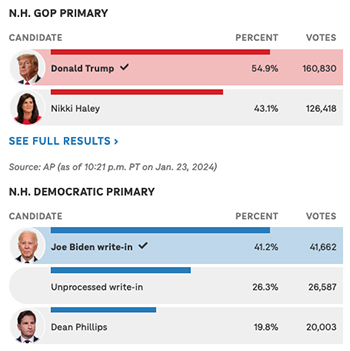
New Hampshire: Trump, Biden Win — Former President Donald Trump successfully won the New Hampshire Republican primary last night and did so by about 12 percentage points, but his performance is apparently not enough to convince former UN Ambassador Nikki Haley to leave the race.

In her concession speech, Haley pledged to continue moving forward and several times referenced going to her home state of South Carolina as a place that could reverse the political tide. Polling, however, suggests that she is not as strong there as she was in New Hampshire.

For the Democrats, President Joe Biden, despite not being on the primary ballot, won the primary with write-in ballots that tallied just over 67 percent of the vote. US Rep. Dean Phillips (D-MN), who said he had no fundamental disagreement with the president over issues but believes Democrats should have a choice particularly with an 81-year old in office, secured just over 20 percent of the vote. Author Marianne Williamson attracted the remaining votes, just under 4 percent.

The New Hampshire primary yielded a record Republican turnout. The final participation count could reach 320,000. The previous record of 284,120 was set in 2016. The final Democratic turnout number will only be in the 100,000 range.

House

NE-1: Gov. Nominee to Challenge Rep. Flood — State Sen. Carol Blood (D-Bellevue), who was the 2022 Democratic gubernatorial nominee and lost to now-Gov. Jim Pillen (R), 59-36 percent, announced that she will now challenge Rep. Mike Flood (R-Norfolk) in the state’s 1st District that surrounds the Omaha metropolitan area on three sides. Flood was elected in a 2022 special election after Rep. Jeff Fortenberry (R) resigned. He won a full term in November with 58 percent of the vote. Blood’s candidacy gives the Democrats a credible challenger in what is considered a safe Republican seat.

Rep. Flood will be favored for re-election. The 1st District carries an R+17 rating from the FiveThirtyEight data organization. Dave’s Redistricting App calculates a partisan lean of 56.7R – 40.4D. The Daily Kos Elections site ranks NE-1 as the 72nd most vulnerable seat in the Republican Conference.

Governor

North Dakota: One In, One Out — After Gov. Doug Burgum (R) on Monday announced that he will not seek a third term, other North Dakota politicos began to make public their own political plans. At-Large US Rep. Kelly Armstrong (R-Bismarck) quickly declared that he will run for governor. Armstrong leaving the House means that 46 seats will be open for the next election.

Conversely, Attorney General Drew Wrigley (R), also viewed as one of the top potential contenders to succeed Gov. Burgum, announced that he will not run for governor, instead opting to seek re-election to his current position. Former state senator and ex-congressional candidate Tom Campbell (R) will also run for governor.

The Republican statewide nominating convention is scheduled for April 6. The ND primary is set for June 11.

States

Louisiana: Redistricting Map Signed Into Law — Meeting the court-ordered requirement to draw a new majority minority seat in Louisiana, Gov. Jeff Landry (R) yesterday signed into law the legislature’s map. The new lines will cost the Republicans one seat, as an African American Democrat will be heavily favored to win a newly drawn 6th District that stretches from Baton Rouge all the way to Shreveport, cutting through the middle of House Speaker Mike Johnson’s (R-Benton) 4th CD.

Current 6th District Rep. Garret Graves (R-Baton Rouge) says he will run for the House, which likely means challenging Rep. Julia Letlow (R-Start) in the state’s newly drawn, and safely Republican, 5th CD. Rep. Graves also says he is considering filing a lawsuit against the new map.

DeSantis Suspends Campaign; Louisiana Map Passes Legislature, State Changes Primary System;
NY-3 Poll Shows Tightening Race;

By Jim Ellis — Monday, Jan. 22, 2024

President

Florida Gov. Ron DeSantis (R) / Photo by Gage Skidmore

Ron DeSantis: Suspends Campaign: Two days before Tuesday’s New Hampshire primary, Florida Gov. Ron DeSantis, once thought to be former President Donald Trump’s principal Republican challenger, announced that he is suspending his national campaign and endorsed the former president.

While DeSantis suspended his campaign, he didn’t soften his attacks on both President Joe Biden and fellow GOP challenger Nikki Haley. “I look forward to working together with him [Trump] to beat Joe Biden, who is the worst and most corrupt president in the history of our country,” DeSantis said.

Referring to Haley, Gov. DeSantis was quoted as saying, “I signed a pledge to support the nominee, and I will honor that pledge. He [Mr. Trump] has my endorsement because we can’t go back to the old Republican guard of yesteryear, a repackaged form of warmed over corporatism that Nikki Haley represents.”

The GOP presidential fight now winnows to two major contenders, former President Trump, and ex-UN Ambassador Haley. Tomorrow’s New Hampshire primary may be close; Trump, however, will easily win in Nevada on Feb. 6, after which the campaign heads to Haley’s home state of South Carolina on Feb. 24 where polling finds Trump holding a 2:1 lead. If such margin holds, the Republican nomination will effectively be clinched before Super Tuesday on March 5.

House

Louisiana: Congressional Map Passes Legislature — The Louisiana state legislature agreed upon legislation to create a new congressional map as part of their special session to satisfy a court order. The bill now goes to Gov. Jeff Landry (R) for his signature. The agreed upon plan creates a new 6th District anchored in Baton Rouge, which then stretches through Speaker Mike Johnson’s (R-Benton), virtually cutting it in half, to reach Shreveport. This satisfies the court order to create a second majority minority seat in the state (54 percent black). According to the Dave’s Redistricting App statisticians, President Biden would have carried the new 6th by a 59-39 percent majority.

The big loser on this map is five-term Rep. Garret Graves (R-Baton Rouge). He is now paired with Rep. Julia Letlow (R-Start) in a new 5th District seat that stretches along the Mississippi border on the south and east and going all the way to the Arkansas border on the north. The new 5th contains at least two-thirds of Rep. Letlow’s current constituency.

The partisan division will now award another seat to the Democrats, making the future Louisiana delegation 5R-2D. Under the plan, Speaker Johnson, Majority Leader Steve Scalise, and Reps. Troy Carter (D-New Orleans), and Clay Higgins (R-Lafayette) all get safe seats from a partisan perspective.

NY-3: New Poll Shows Tight Special Election Race — A newly released Emerson College survey (Jan. 13-15; 975 registered NY-3 voters; 819 likely voters; multiple sampling techniques) sees a close special election race developing between former US Rep. Tom Suozzi (D) and Nassau County Legislator Mazi Melesa Pilip (R). The ballot test shows a 45-43 percent split in favor of Suozzi.

The best news for the former Democratic congressman is that the most likely voters within the sample break for him on a 51-37 percent split. While the majority white vote (58 percent of the district population) favors Pilip 49-40 percent, the largest minority group, Asians (24 percent of the district population), overwhelmingly favor Suozzi (60-25 percent). Hispanics (13 percent of the population) are moving toward Pilip in a 44-33 percent clip.

Possibly the most troubling news for Suozzi are President Biden’s and Gov. Kathy Hochul’s (D) poor job approval ratings. Only one-third of voters, 33 percent, approve of President Biden’s performance in office (59 percent disapprove). Gov. Hochul’s numbers are even worse. Her approval index is 25:66 percent favorable to unfavorable. The special election is scheduled for Feb. 13.

States

Louisiana: Changing to Party Primary System — As part of the special Louisiana state legislative session, the House and Senate are sending a bill to Gov. Jeff Landry (R), one that he initiated, to change Louisiana’s primary voting system from a top-two jungle system to a partisan primary. The changes would take effect for the 2026 election and would institute a modified system where registered members of the political party must vote in their own primary while non-affiliated voters would have their choice of where to cast their ballot.

The change would mean, as in most other states, that only the political party nominees and qualified Independents would advance to the general election. The legislation would affect all federal races along with the state Supreme Court, the state school board, and the Public Service Commission. All other offices would continue with the current system of sending the top two finishers regardless of political party affiliation to the general election.

TX-6: Double R Runoff

By Jim Ellis

Susan Wright

May 4, 2021 — Republicans are guaranteed to hold Texas’ vacant 6th Congressional District in the succeeding runoff election as two GOP candidates advanced from the 23-person jungle primary election on Saturday night. Susan Wright, widow of late Congressman Ron Wright (R-Arlington), finished first, as expected, with just over 19 percent of the vote.

Accompanying Wright into the runoff contest is freshman state Rep. Jake Ellzey (R-Waxahachie). He scored a vote percentage of 13.9 in slipping past the top Democrat, 2018 congressional nominee Jana Lynne Sanchez, who finished just 354 votes behind in third place.

Ellzey was elected to the legislature in November, but immediately jumped into the congressional race when Rep. Wright passed away. In 2018, Ellzey ran for the 6th District open seat when veteran Rep. Joe Barton (R) retired, finishing second and forcing Rep. Wright, then the Tarrant County Tax Assessor, into a runoff election. Rep. Wright won the runoff 52-48 percent, which was a much closer finish than initially anticipated.

The Saturday night primary proved big for Republicans. Combined, their candidates received 61.9 percent of the 78,374 votes cast according to the initial final count. Democrats finished well below expectations with only a combined 37.3 percent split among their 10 candidates.

These totals are quite different than Rep. Wright’s victory margins in both 2020 and 2018, when he recorded almost identical splits of 53-44 percent and 53-45 percent, respectively. Former President Donald Trump carried the district with a 51-48 percent spread in November but a much stronger 54-42 percent in 2016.

Continue reading