Tag Archives: Pat McCrory

Lightfoot Drops to Third in New Poll; Dolan Prepares for Ohio Senate Bid; Mississippi, NC Governor Races

By Jim Ellis, Wednesday, Dec. 21, 2022

Cities
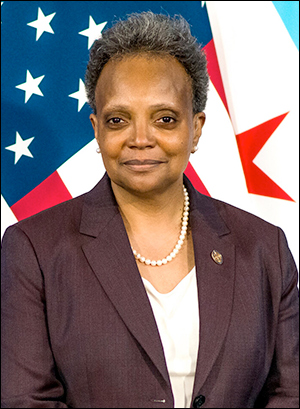
Chicago Mayor Lori Lightfoot (D)

Chicago: Mayor Lightfoot Drops to Third in New Poll — An M3 Strategies poll for News Channel Fox32 in Chicago (Dec. 11-13; 440 Chicago likely municipal election voters; SMS web to text) finds Chicago Mayor Lori Lightfoot (D) dropping to third place in anticipation of the Feb. 28 non-partisan jungle primary election. In this system, only the top two finishers would advance to an April 4 runoff election from the field of nine contenders if no individual receives a majority from the initial vote.

The M3 ballot test result sees US Rep. Jesus “Chuy” Garcia (D-Chicago) leading the field at 28 percent support with former Chicago Public Schools CEO Paul Vallas in second place with 19 percent preference. Mayor Lightfoot is in third position posting only 14 percent backing for a second term. The mayor points out that she was at one percent in polling this time four years ago.

Senate

Ohio: Former Senate Candidate Preparing Another Run — State Sen. Matt Dolan (R-Chagrin Falls) who placed third in the 2022 Republican US Senate primary, finishing nine percentage points from the lead, is reportedly building another campaign operation to this time challenge Sen. Sherrod Brown (D) in the next election. Dolan, a minority owner of the Cleveland Guardians baseball club and chairman of the state Senate’s Finance Committee, spent more than $11 million on his 2022 campaign, almost $8 million of which came from his personal finances. He began the race as a minor candidate but finished strong, making himself a viable contender as the primary campaign drew to a close.

Dolan is likely to be a stronger GOP nomination contender in 2024 in what is likely to be a crowded primary, but would have a tough run in the general election against Sen. Brown, who will be running for his fourth term after originally being elected to the statewide post in 2006. Prior to his tenure in the Senate, Sen. Brown served seven terms in the US House and eight years as Ohio’s Secretary of State.

Governor

Mississippi: Potential GOP Primary Challenge Brewing — The Politics1.com site is reporting that GOP Secretary of State Michael Watson is polling the state to test his chances against Gov. Tate Reeves (R) in the upcoming 2023 Republican gubernatorial primary. In 2019, Reeves, then the state’s lieutenant governor, defeated former state Supreme Court Associate Justice Bill Waller Jr., 49-33 ;ercent. Waller was a 22-year veteran of the high court, half of which he spent as Chief Justice.

Reeves would go on to win the general election against four-term Democratic Attorney General Jim Hood by a tighter 52-47 percent count. In a state where the GOP is the dominant party, the Republican primary is likely to be Gov. Reeves’ toughest re-election test next year.

North Carolina: Lt. Gov. Robinson Way Up in Early GOP Polling — The Differentiators Data firm conducted an early 2024 North Carolina Republican gubernatorial poll (Dec. 8-11; 500 North Carolina Republican primary voters; live interview & text) and found Lt. Gov. Mark Robinson in very strong position as speculation begins regarding who will run for what will be an open Tar Heel State governor’s position in 2024. Democratic Gov. Roy Cooper is ineligible to seek a third term.

Against former governor and 2022 US Senate candidate Pat McCrory, Lt. Gov. Robinson would lead 60-21 percent. If ex-vongressman and 2022 US Senate candidate Mark Walker (R) were his opponent, Lt. Gov. Robinson would lead by a whopping 58-8 percent. Finally, if state Treasurer Dale Folwell were Robinson’s Republican primary opponent, the lieutenant governor would lead by an even larger 60-6 percent margin.

Differentiators did not test the candidates in a multi-candidate format. None of the individuals paired with Robinson have indicated that they would run for governor. In fact, after this year’s Senate primary, McCrory indicated that he would not again pursue public office. The polling firm also did not test a potential Democratic field.
North Carolina Races Set – Part I

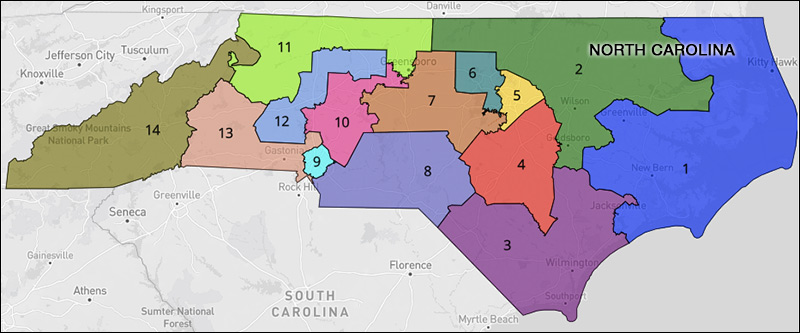
2022 North Carolina Congressional Redistricting Map

By Jim Ellis

March 8, 2022 — The chaotic Tar Heel State political scene quelled on Friday as the postponed candidate filing period finally came to a close. Today we look at the recent North Carolina redistricting past and future, along with an analysis of the open Senate race. Tomorrow, we examine the state’s 14 new US House districts.

The North Carolina state Supreme Court’s approved map will be in place for the 2022 midterm election, and as a result the candidate slate is less competitive than the originally conceived congressional plan would have yielded. While the Democrats won this most recent political battle, the state’s redistricting war, a fight between the legislature and state Supreme Court that has resulted in four different congressional maps being in passed into law and ultimately rejected since 2010, will likely continue.

The Republican legislature controls the redistricting pen because the North Carolina governor, in this case Democrat Roy Cooper, has no veto power over this subject matter. Democrats control the state Supreme Court with a 4-3 partisan majority, but there is at least an even chance that the balance of power will change after the midterm election.

Two of the Democratic judges are on the ballot this year and no Republicans. One of the two, Justice Robin Hudson, is not seeking re-election, so GOP chances of winning at least one of the two races are enhanced. If they succeed, Republicans will hold the court majority after the first of the year.

Since a court map is only an interim plan, the legislature can replace it at any time. Since the state high court did approve the legislature’s latest version of the state House and Senate maps, Republicans stand a strong chance of maintaining their majorities in both houses. Therefore, re-drawing the congressional map in 2023 should the NC Supreme Court have a different complexion could mean that the GOP would be able to enact a stronger plan next year.

Originally, North Carolina arguably looked to be the Republicans’ most important redistricting state in that it was one of just two places where the party could gain multiple congressional seats and the only one where a potential three-seat increase was within the realm of possibility. The outlook for the final 2022 map, however, gives the Democrats an advantage. It now appears more likely that the Dems will gain one or even two seats in the delegation.

The North Carolina judicial decision is a major blow to House Republican national prospects. While the party still has a good chance of re-taking the majority they lost in the 2018 election, the difficulty factor has increased through adverse court decisions here and in several other states.

Continue reading

The “Fail Up” Senate Candidates

By Jim Ellis

Nov. 16, 2021 — There is an interesting phenomenon developing in the 2022 US Senate races, and that is the number of currently leading primary nomination candidates who have lost their last race. No less than five current US Senate contenders, all topping the latest polling, were defeated the last time they were on the ballot, some even in political campaigns for offices with less prominence.

In recent election years, we’ve seen a number of candidates lose a race and then attempt to “fail up” in the next campaign year. Most of the time, the same result occurs. The seemingly lone exception to the rule is Georgia Sen. Jon Ossoff (D), who lost a special election for the US House in 2017 only to run for the Senate in 2020 and be elected.

Turning to 2022 and the unusually high number of such “fail up” candidates allows us to see if this pattern can reverse itself, or if the vast majority of these contenders will again find themselves on the short end of the vote totals when their election cycle ends either in the nomination contest or general election.

The 2022 “fail up” Senate candidates are Abby Finkenauer (D) in Iowa, Adam Laxalt (R) from Nevada, Pat McCrory (R) and Cheri Beasley (D) in North Carolina, and Pennsylvania’s Sean Parnell (R). Dr. Al Gross, who lost the 2020 Senate race in Alaska is a possibility to enter the 2022 race in the Last Frontier, but so far has not announced his candidacy.

Finkenauer, a Democrat, is a former state representative and congresswoman from Dubuque, Iowa. She was elected to the House in 2018, only to lose her seat after one term, 50-47 percent, to current US Rep. Ashley Hinson (R-Marion/Cedar Rapids).

Finkenauer is leading in early polling for the Senate Democratic nomination as she and retired Navy admiral and defeated 2020 US Senate candidate Mike Franken battle to challenge venerable Sen. Chuck Grassley (R) who has won seven US Senate elections. Early polling finds Finkenauer trailing by close to 20 points.

Laxalt was elected Nevada’s attorney general in 2014, but with only 46 percent of the vote in a place where his party swept all of the statewide offices in that election year with his being the lowest victory percentage. Laxalt then entered the open 2018 governor’s race but lost to current incumbent Steve Sisolak (D), 49-45 percent. The latest polling (September) finds him trailing Sen. Catherine Cortez Masto (D) by five points in a Mellman Group survey but holding a two-point lead in a study from WPA Intelligence.

North Carolina actually features candidates in both parties leading in nomination polling after losing their last race. McCrory is the former governor who lost his 2016 re-election campaign, even while Donald Trump and seven other Republicans were winning their statewide elections.

Continue reading

Is the McCrory Lead a Mirage
In North Carolina Senate Race?

By Jim Ellis

Former North Carolina Gov. Pat McCrory

Oct. 28, 2021 — Former North Carolina Gov. Pat McCrory’s campaign did something rather strange this week.

They released their internal Pubic Opinion Strategies poll, which in and of itself is not unusual, and extolled how well McCrory was running, but they did not publish the ballot test numbers in the polling synopsis. Why? Because the figures aren’t as good as meets the eye.

Once found, the ballot test shows McCrory leading Rep. Ted Budd (R-Advance), 40-25 percent, a 15-point edge, which was truthfully cast as a double-digit lead. The underlying story, however, is that the ballot test actually represents a net gain of 20 percentage points for Budd.

In April, POS released their first public poll of the GOP primary and it showed McCrory leading Rep. Budd, 48-13 percent. Comparing the latest 40-25 percent result shows some sustained momentum for Rep. Budd in that McCrory’s support has dropped eight points while his own climbed a dozen.

A third candidate, former Rep. Mark Walker, only registered eight percent in this poll, but it is possible that he will not even file for the Senate at the Dec. 17 deadline. If the legislature moves forward with a version of the redistricting plan that puts the Greensboro area seat back in play for Republicans – a court decision robbed Walker of the House seat he held for three terms with their ruling changing the state’s congressional map before the 2020 election – it is quite possible that Walker would have the option of returning to a winnable House contest.

If Walker were to abandon the Senate race, it would be another plus for Rep. Budd. It is likely that more Walker voters will gravitate toward Budd than McCrory since they clearly are familiar with the former governor but chose not to back him in the three-way contest.

Pat McCrory was elected governor in 2012, but lost to then-Attorney General Roy Cooper (D) on the same night that Donald Trump claimed North Carolina against Hillary Clinton. In fact, Republicans won eight of 12 statewide elections that evening, with McCrory being the only GOP incumbent to fall.

Continue reading

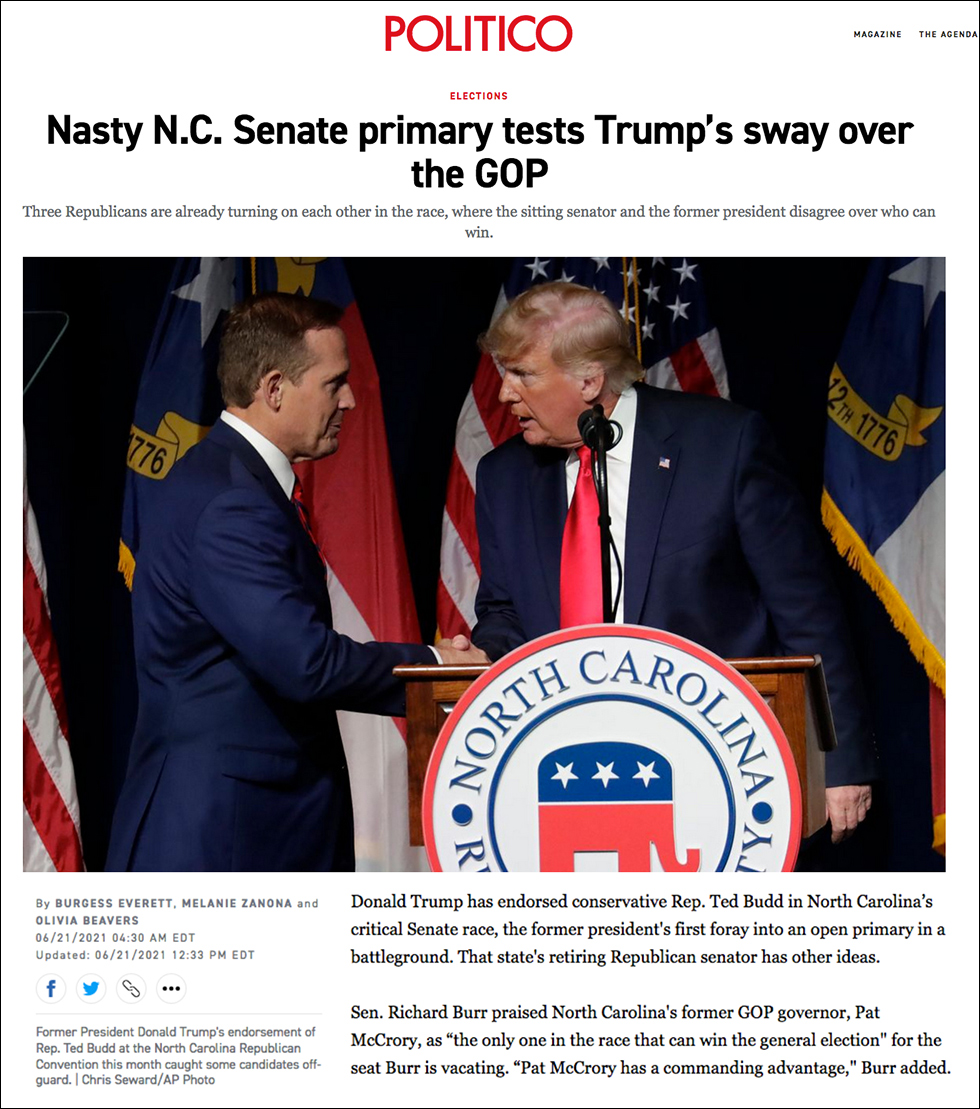
The Controversy over Donald Trump’s Endorsement of NC Senate Candidate, Rep. Ted Budd


By Jim Ellis

June 23, 2021 — Three Politico publication reporters, Burgess Everett, Melanie Zanona, and Olivia Beavers, combined on an article published yesterday (Nasty N.C. Senate primary tests Trump’s sway over the GOP) that merits refutation.

The piece details former President Trump’s public endorsement of US Senate candidate Ted Budd, the 13th District congressman, at the North Carolina Republican Party convention on June 5, and reactions to the development. Generally, and not surprisingly, it casts the endorsement and Rep. Budd’s statewide chances in a negative light.

Therefore, a number of points require balance.

1. To begin, the story quotes key Republicans, such as retiring North Carolina US Sen. Richard Burr (R) and South Carolina Sen. Lindsey Graham (R), who are downplaying the Trump endorsement’s effectiveness, with Sen. Burr going so far as claiming that ex-governor Pat McCrory is basically the only candidate who could win the upcoming general election. It is important to note here that McCrory failed to win re-election in 2016, the last time he was on a statewide ballot.

2. Secondly, a released Meeting Streets Insight poll conducted for the Budd campaign (June 9-10; 500 likely North Carolina Republican primary voters; live interview) highlights a different perspective.

The MSI survey found McCrory leading the GOP field 45-19-12 percent over Rep. Budd and former US representative, Mark Walker, respectively. When the polling sample is informed of the Trump endorsement – only 20 percent were aware before the pollsters provided the information – the ballot test completely flips to 46-27-8 percent with Rep. Budd leading, followed by ex-governor McCrory and former Rep. Walker. Obviously, this suggests the Trump endorsement still has power within the North Carolina Republican primary voter segment.

Continue reading

Trump Endorsement Matters in North Carolina Senate Primary

By Jim Ellis

Former President Donald Trump’s endorsement changes the face of the race for Senate in North Carolina.

June 16, 2021 — North Carolina US Rep. Ted Budd’s (R-Advance) Senate campaign released an internal Meeting Street Insights poll (June 9-10; 500 likely North Carolina Republican primary voters, live interview) Monday that finds former President Donald Trump’s endorsement completely changes the 2022 statewide Republican primary.

Rep. Budd is challenging former Gov. Pat McCrory and ex-US Rep. Mark Walker for the GOP nomination succeeding Sen. Richard Burr (R) who is not seeking re-election to a fourth term.

According to Meeting Streets, former Gov. McCrory would lead the field, as other polls have shown, by a wide margin. On the first ballot test, McCrory scores 45 percent preference as opposed to 19 perecent for Rep. Budd, while 12 percent choose ex-representative Walker.

The picture drastically changes, however, when the pollsters ask if the respondent is aware that former President Trump has endorsed Rep. Budd. Only 20 percent of the sampling universe expressed knowledge of this development. On what the pollster terms the “educated” ballot test, meaning the respondent is told that Trump has, in fact, endorsed Rep. Budd, we see the drastic transformation.

With the Trump endorsement becoming known, Rep. Budd soars to the lead with 46 percent support, while McCrory drops to 27 percent, and ex-Rep. Walker falls to eight percent.

McCrory’s campaign fielded a Public Opinion Strategies survey in early April (April 6-8; 500 likely North Carolina Republican primary voters, live interview) and found the former governor leading 48-13-9 percent over Walker and Budd, respectively.

This was followed later in the month by a Spry Strategies study (April 21-24; 700 likely Republican North Carolina primary voters; combination live interview and interactive voice response system) that found a 40-11-5 percent split, again with Rep. Budd trailing his two opponents.

Continue reading

Rep. Murphy to Challenge Sen. Rubio

By Jim Ellis

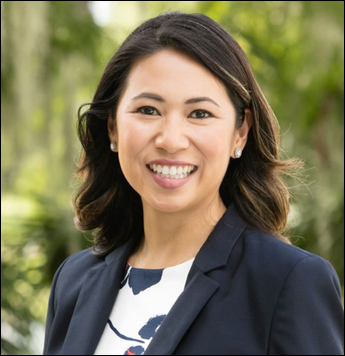
Florida Rep. Stephanie Murphy (D-Winter Park)

May 14, 2021 — According to the Axios news site, insiders close to Florida Rep. Stephanie Murphy (D-Winter Park) say that she has made the decision to challenge Sen. Marco Rubio (R) next year and will formally announce her campaign next month. The move had been expected for some time.

Rep. Murphy, a native of the country of Vietnam, was first elected to the House in 2016, defeating veteran Republican incumbent John Mica after the state Supreme Court had re-drawn the Florida congressional districts and made the 7th CD more Democratic. She unseated Rep. Mica 51-49 percent, and then scored re-election victories of 58 and 55 percent in 2018 and 2020, respectively.

A strong fundraiser, Rep. Murphy obtained over $3 million for both of her incumbent re-election campaigns. She ended the 1st quarter 2021 with a cash-on-hand figure of $1.43 million. Sen. Rubio posted $3.9 million in his campaign account during the same reporting period.

Assuming Murphy does enter the race next month, Democrats will have a credible challenger to Sen. Rubio, but one who still must be considered a decided underdog. In 2010, Sen. Rubio, then a state representative, defeated then-governor Charlie Crist, who was running as an Independent, and Democratic Congressman Kendrick Meek by a 49-30-20 percent margin. He was re-elected in 2016 with a 52-44 percent vote spread over then-congressman Patrick Murphy (D).

Florida races, as we know, are always competitive and usually very close, though the state has been trending more Republican over the past several elections. A Rubio-Stephanie Murphy race promises to become a national campaign.

With the Democrats apparently attracting a strong candidate in Florida, it is a good time to review the other key races.

In Pennsylvania, both parties are headed for very crowded primaries as each works to nominate a candidate to hopefully succeed retiring Sen. Pat Toomey (R). Afghan War veteran Sean Parnell entered the Republican primary earlier this week, but his only venture into elective politics was recording a two-point loss to Rep. Conor Lamb (D-Pittsburgh) last November in an Allegheny County suburban district.

Rep. Lamb, himself, may join the Democratic Senate campaign, meaning both parties are going to host political dogfights for the party nomination. In any event, however, the Pennsylvania race will be a top-tier national campaign.

Continue reading

Senate Action

Ohio Rep. Tim Ryan (D-Warren/Youngstown)

By Jim Ellis

April 29, 2021 — While most of the political world was focused on the census’s national apportionment announcement, several Senate moves of merit were also made this week.

In Ohio, US Rep. Tim Ryan (D-Warren/Youngstown) finally made his fledgling US Senate campaign official. Originally saying he would announce sometime in March only to postpone formal entry to an undetermined time, Ryan finally made his declaration on Monday. Once former Ohio Health Director Amy Acton — who was running slightly ahead of Rep. Ryan in early Democratic primary polling — said that she was not going to run, that paved the way for the 10-term congressman to open with an apparently clear path to the Democratic nomination.

Simultaneously, in Georgia, another announcement was made but one that contained a surprising message. Former Rep. Doug Collins (R), who placed third in the 2020 US Senate jungle primary, also declared his political intentions for 2022 on Monday. While observers were expecting the former four-term congressman to enter the current Senate race, he instead said he will not run for any office next year but didn’t close the door on returning to elective politics in another election cycle.

Yesterday, in another largely expected move, former North Carolina state Supreme Court Chief Justice Cheri Beasley (D), who lost her position in November by a scant 401 votes statewide, announced via video that she will enter the open Tar Heel State Senate race.

The three moves help further set the stage for a trio of critical Senate contests that will each contribute mightily toward determining which party breaks the 50-50 tie and assumes control of the body after the next election.

Despite Rep. Ryan looking as the candidate to beat for the Ohio Democratic nomination, the general election won’t be easy. Additionally, this political cycle could be different in terms of political options for Ryan. He has several times dipped his toe in the statewide or national waters only to return to the safety of his House district. With it now a certainty that Ohio will lose another congressional seat, and with at least one scenario suggesting that the eliminated seat could become Rep. Ryan’s 13th District, his usual fail-safe move might not again be available.

Continue reading

Major Senate Moves

By Jim Ellis

April 14, 2021 — With the Senate tied 50D-50R, and every 2022 campaign potentially meaning a change in majority status, we already see serious political moves being made or at least considered. This week began as being particularly active.

In the Last Frontier State of Alaska, 2020 Independent/Democratic nominee Al Gross, who opposed Sen. Dan Sullivan (R), confirms that he is considering challenging Sen. Lisa Murkowski (R) next year. The state’s new top four jungle primary system would virtually guarantee that both Sen. Murkowski and Dr. Gross would advance into the general election should both decide to run. For her part, Sen. Murkowski has not yet formally declared her 2022 political intentions, but she is expected to seek re-election.

Dr. Gross lost to Sen. Sullivan, 54-41 percent, despite exceeding the incumbent’s fundraising totals by almost a 2:1 margin. The Independent/Democrat spent over $19.5 million as compared to Sen. Sullivan’s expenditure total of $10.1 million. A total exceeding $27.2 million was expended from outside organizations, over $18 million of which aided Dr. Gross’ campaign.

Already announced is Republican former State Administrative Director Kelly Tshibaka; a Cygnal research firm survey of 500 Alaska registered voters taken in late March actually found her leading both Sen. Murkowski and Dr. Gross. The ballot test broke 34-19-18 percent in favor of Tshibaka with Sen. Murkowski and Dr. Gross significantly trailing. Under the new primary system, however, all three of these contenders, and a fourth candidate, would advance into the general election.

Former Kentucky state Rep. Charles Booker, who lost the 2020 US Senate Democratic primary to party nominee Amy McGrath in a close 44-42 percent result, has filed an exploratory committee for purposes of assessing his chances against Sen. Rand Paul (R) in a 2022 campaign.

Booker was literally outspent 10:1 in the Democratic primary, as McGrath hauled in more than $20 million even before advancing into the general election. She never figured on having to spend so much to defeat her intra-party opponent, however. Booker was able to maximize his political base in Louisville and with the African American community statewide to pull within 15,149 votes of McGrath with more than 544,000 people casting ballots in the primary election.

Sen. Paul won his 2014 re-election campaign with a 57-43 percent margin over Lexington-Fayette Urban County Mayor Jim Gray (D), which is the second largest municipality in Kentucky. National Democrats were high on the Gray campaign at its outset, but the race never materialized in what became a landslide Republican election year.

Reports emanating from North Carolina suggest that former Gov. Pat McCrory (R) could declare his Senate candidacy as early as today. McCrory was elected governor in 2012 with a 55-43 percent margin but would lose his attempt at re-election by just 10,263 votes from more than 4.7 million ballots cast, or less than a quarter of a percent.

Largely entangled with the infamous North Carolina bathroom bill that became a national story, the governor could not steer himself clear of the controversy and fell to then-Attorney General Roy Cooper (D). McCrory had previously run for governor in 2008, losing to incumbent Bev Perdue (D) by just three percentage points. Prior to running statewide, McCrory served 14 years as Charlotte’s mayor.

Continue reading

Inmate Scores 40% vs. Obama in W.Va.; N.C., Wis. Updates

West Virginia

Perhaps the biggest surprise of last night’s primaries came in West Virginia, where Keith Russell Judd, an inmate in a Beaumont, Texas federal prison currently serving a 17-year sentence, scored a full 40 percent of the vote against President Obama in the West Virginia Democratic primary. This clearly suggests that West Virginia will be a solid Mitt Romney state in the fall.

North Carolina

A lot of action also occurred in the North Carolina primary. In the Democratic gubernatorial primary, Lt. Gov. Walter Dalton posted a 45-38 percent victory over former Rep. Bob Etheridge. Dalton will now face 2008 gubernatorial nominee and former Charlotte Mayor Pat McCrory (R) in the general election. Gov. Bev Perdue (D) is retiring after one term.

In open seats, former state Sen. Robert Pittenger and Mecklenberg County Commissioner Jim Pendergraph will square off in a June 26 Republican run-off election for retiring Rep. Sue Myrick’s 9th District. The Charlotte suburban seat will go to eventual GOP nominee in the general election. In the Asheville-based 11th CD, being vacated by the retiring Rep. Heath Shuler (D), two non-elected officials, businessmen Mark Meadows and Vance Patterson will battle each other in the Republican run-off. The winner faces Shuler’s former chief of staff, Hayden Rogers, who won the Democratic nod. Redistricting makes the GOP nominee the general election favorite. Finally, in new District 13, former US Attorney George Holding won the Republican nomination outright and will be the heavy favorite in November.

Turning to challenger primaries, state Sen. David Rouzer won a see-saw Republican primary battle with 2010 nominee Ilario Pantano. He now faces Democratic Rep. Mike McIntyre in what will be a highly competitive general election. In Rep. Kissell’s 8th District, a run-off will occur between business consultant and former congressional aide Richard Hudson and ex-Iredell County Commissioner Scott Keadle. Hudson, a first-time candidate, came within eight points of winning outright. Kissell is highly endangered in the general election.

Wisconsin

In Wisconsin, Democrats again nominated Milwaukee mayor and former congressman Tom Barrett to face Gov. Scott Walker (R) in a June 5 recall election. Barrett easily defeated Dane County ex-Executive Kathleen Falk by a 58-34 percent count. The Walker-Barrett campaign is a re-match from 2010, when the Republican won 52-46 percent.