Category Archives: House

Results in Arizona’s 8th CD

By Jim Ellis

March 1, 2018 — Voters in the West Valley of Arizona’s Maricopa County went to the polls Tuesday and prior to that, throughout the early voting period, to cast their ballots for special election nominees to replace resigned Rep. Trent Franks (R-Peoria).

debbie-lesko-arizonaUntil she resigned her own seat in the state legislature to enter this special congressional election, Debbie Lesko (R-Peoria), was the state Senate President Pro Tempore. She became the favorite late in the voting period, and capitalized on her momentum to score a strong victory in the Republican primary. She recorded 36 percent of the vote while resigned state Rep. Phil Lovas (R-Glendale) and resigned state Sen. Steve Montenegro (R-Surprise) trailed, each posting 24 percent. Former Public Service Commissioner Bob Stump (no relation to the late Republican US Rep. Bob Stump, who served in the House for 26 years), finished a poor fourth, capturing just over five percent of the vote.

Arizona has a “resign to run” law, meaning an elected official must relinquish the office they currently hold if seeking another elected position. This explains all of the office holders running in this special contest having recently resigned their positions.

For the Democrats, physician Hiral Tipirneni scored an easy 60-40 percent victory over auto sales manager and LGBT activist Brianna Westbrook in a contest that never appeared to be in doubt. Though turnout was up substantially in the Democratic column when compared to past similar elections, their participation number still paled in comparison to majority Republicans. The unofficial count shows 36,404 total Democratic votes, while the aggregate GOP vote recorded 71,320 spread among a dozen candidates.

Continue reading

Surprising California House
Non-Endorsements

By Jim Ellis

Feb. 28, 2018 — Yesterday, we reported that the California Democratic Party state convention delegates snubbed veteran Sen. Dianne Feinstein by not officially endorsing her for re-election. The US House endorsements, or lack of them in many instances, also featured some unexpected results.

Looking at the 14 Golden State Republican incumbents, seven of whom Democratic leaders have publicly identified as targets for the upcoming election, the state delegates left four of these top conversion opportunities without an endorsed candidate.

california-39th-and-49th-congressional-districtsIn the campaigns against Reps. Jeff Denham (R-Turlock/Modesto), Steve Knight (R-Palmdale), and in the open districts of the 39th (Rep. Ed Royce retiring) and 49th (Rep. Darrell Issa retiring), the Democratic candidate contingent in each contest will head into the June 5 jungle primary election with no one carrying the official party endorsement.

In the other two top-tier targeted districts, convention delegates officially endorsed Rep. David Valadao (R-Hanford/ Bakersfield) in the 21st and Rep. Mimi Walters (R-Irvine) in the 45th. The activists chose their 2016 nominee, attorney Emilio Huerta, to run against Rep. Valadao; Huerta actually performed poorly against the congressman in 2016, losing 57-43 percent, while Hillary Clinton carried the district 55-40 percent. However, Huerta is the only announced candidate in this race; therefore, he was easily able to exceed the 60 percent threshold needed to claim the state party endorsement.

In the Walters district, the party delegates chose law professor Dave Min as their endorsed candidate. This is a bit of a surprise because fellow law professor and consumer advocate Katie Porter seems to be attracting at least an equivalent level of campaign support. Both have outside endorsements, each has raised over $675,000 (Min: $679,000; Porter: $741,000), and the two each have more than $400,000 in the bank (Min: $411,000; Porter: $510,000). In addition to these two candidates, four other Democrats are also on the ballot. Min, however, is clearly the better inside political player since he was able to convince a super majority of convention delegates to publicly back his campaign.

Continue reading

Democrats Maneuver in San Diego

By Jim Ellis

Feb. 27, 2018 — Two noteworthy Democrat events happened in San Diego over the past few days.

California Sen. Dianne Feinstein (D)

California Sen. Dianne Feinstein (D)

First, the California Democratic Party state convention, meeting in San Diego over the weekend, actually denied veteran Sen. Dianne Feinstein (D) the party endorsement. Though the delegates came close to endorsing state Senate President Kevin de Leon (D-Los Angeles), he also fell short.

In the vote to award the party endorsement for the 2018 US Senate race, it was state Sen. de Leon capturing 54 percent of the delegate votes as compared to only 37 percent for incumbent Sen. Feinstein. A total of 60 percent was needed for endorsement. This is not the first time that the liberal grassroots delegates have turned away from Feinstein. According to an NPR account of the convention proceedings, the party delegates chose then-Attorney General John Van de Kamp over Feinstein in the 1990 governor’s race.

The lack of an endorsement will not hurt the senator’s campaign, however. A January Public Policy Institute of California poll (Jan. 21-30; 1,705 California adults) favored Sen. Feinstein over Mr. de Leon, 46-17 percent, when tested in the jungle primary format. She has an even more commanding lead in campaign resources. The year-end Federal Election Commission disclosure report finds her holding just under $10 million in her campaign account as compared to an embarrassingly low $359,000 for de Leon.
Continue reading

Setting the Stage: The Texas Primary

By Jim Ellis

Feb. 23, 2018 — We’re now inside two weeks before the first-in-the-nation regular midterm primary election, as the Texas early voting process is now well underway in preparation for the March 6 regular primary vote.

texas-primary-election-2018Seventy-six candidates are running for major statewide office — races for governor, US senator, lieutenant governor, attorney general, comptroller, agriculture commissioner, land commissioner, and one slot on the state railroad commission. A record total of 304 Democrats, Republicans, Independent and minor party candidates are vying for their respective party nominations in the state’s 36 US House districts.

Texas is a run-off state, meaning if no candidate in the various primaries receives majority support, the top two finishers will advance to a run-off election on May 22. Since a vast number of races have multiple candidates, including 28 individual candidates alone fighting to succeed retiring Rep. Lamar Smith (R-San Antonio) in his open central Texas CD, the secondary election calendar promises to also have a large slate of late May voting contests.

Two Democrats off to late starts are vying to face Gov. Greg Abbott (R), and though nine candidates are on the Democratic gubernatorial ballot, there remains some possibility that either Dallas County Sheriff Lupe Valdez or businessman Andrew White, the son of the late former Gov. Mark White (D), will emerge as the party’s nominee on March 6.

Continue reading

Filing Deadlines

By Jim Ellis

2018-elections-open-seats-185Feb. 16, 2018 — Seven states have already set their candidate slate for the coming primary election season. When March ends, more than half the country (28 states) will have followed suit. For the first time, a state will hold a Wednesday primary (Rhode Island, Sept. 12), and two will vote on a Thursday (Tennessee, Aug. 2; Delaware, Sept. 6).

Below is the full candidate filing deadline calendar:

CLOSED
1. Illinois – December 4; Primary: March 20
2. Texas – December 11; Primary: March 6; Run-off: May 22
3. West Virginia – January 27; Primary: May 8
4. Kentucky – January 30; Primary: May 22
5. Ohio – February 7; Primary: May 8
6. Indiana – February 9: Primary: May 8
7. Alabama – February 9; Primary: June 5; Run-off: July 17

FEB. 27
• Maryland – Primary: June 26

FEB. 28
• North Carolina – Primary: May 8; Run-off (if no candidate receives 40%): July 18

MARCH 1
• Nebraska – Primary: May 15
• Arkansas – Primary: May 22; Run-off: June 19
• Mississippi – Primary: June 5; Run-off: June 26

MARCH 6
• Oregon – Primary: May 15

Continue reading

More Filings Close

By Jim Ellis

Feb. 14, 2018 — Two more states now have their official candidates for the 2018 election, bringing the national total to seven. Alabama and Indiana join the rank of early filing states that include Illinois, Texas, Kentucky, West Virginia, and Ohio.

2018-elections-open-seatsAlabama sees a race for governor that includes new incumbent Kay Ivey (R), who ascended to the position when Gov. Robert Bentley (R) was forced to resign last year. Ivey was elected lieutenant governor in 2010. She will face a Republican primary on June 5 that includes Huntsville Mayor Tommy Battle, and state Sens. Bill Hightower (R-Mobile) and Slade Blackwell (R-Birmingham), the latter man being a surprise filing. Two other minor candidates will also be on the ballot. If no one secures a majority in the primary, a secondary run-off election will be held July 17. Gov. Ivey is favored to win the nomination outright. The Democrats include former state Supreme Court Chief Justice Sue Bell Cobb and Tuscaloosa Mayor Walt Maddox.

In the House races, Reps. Martha Roby (R-Montgomery) and Mo Brooks (R-Huntsville) drew competitive primary challengers. Rep. Robert Aderholt (R-Haleyville) has a minor Republican opponent. Just one House member, Democrat Terri Sewell (D-Birmingham), will run unopposed in both the primary and general election.

The surprise filing is former US Rep. Bobby Bright, who represented the Montgomery-anchored 2nd District for one term as a Democrat before Roby unseated him in 2010, switching parties to run as a Republican. State Rep. Barry Moore (R-Enterprise) announced his campaign long ago, but has been slow to start. The former campaign manager for the Roy Moore for Senate campaign, Rich Hobson, is also in this race along with Army Iraq War veteran Tommy Amason. Democrats Audri Scott Williams, a former Community College dean, and Tabitha Isner, a business analyst, will compete for their party’s nomination. The GOP primary should be an interesting one, but the seat is a strong bet to remain Republican in the general election. Roby’s rather weak 49-41 percent re-election victory in 2016 questions her political strength, however.

Continue reading

Retirement Mode Returns

By Jim Ellis

Feb. 13, 2018 — After a respite from House retirements for a little more than a week, yet another announcement came on Friday.

Minnesota Rep. Rick Nolan (D), retiring. | Facebook

Minnesota Rep. Rick Nolan (D), retiring. | Facebook

Veteran Minnesota Rep. Rick Nolan (D-Crosby/ Duluth) made public a decision not to seek a fourth term from his rural northeastern swing CD, MN-8, becoming the 54th US representative not to stand for re-election and the 17th Democrat in this category.

Nolan’s retirement decision makes what was already a toss-up 2018 election campaign even more interesting. In the last two political contests, the congressman barely defeated Republican businessman Stewart Mills, 48-47 percent and 50.1 – 49.6 percent, respectively in 2014 and ’16, making MN-8 one of the most competitive districts in the country during that time span.

The presidential vote gives us a clue into the district’s transition. During the Obama years, the Democratic nominee/president, won here with 53-44 and 52-46 percent margins in 2008 (against John McCain) and 2012 (opposite Mitt Romney). But, in 2016, President Trump crushed Hillary Clinton with a 54-39 percent victory spread.

The Nolan retirement move marks the second time he is leaving the House after serving three consecutive terms. Originally elected back in 1974 from the 6th District, which was then and is today a more rural/suburban seat anchored in the northern Minneapolis-St. Paul region, the congressman chose not to seek re-election in 1980. He was out of elective politics for 32 years, until he returned to Congress in 2012 from the previously solid farm-labor Democratic district in Minnesota’s upper northeastern sector.

Continue reading

Ohio Candidates File to Run

state-of-ohio-mapBy Jim Ellis

Feb. 12, 2018 — The candidate filing deadline in Ohio passed last week — the fifth state to set its political contenders for the coming midterm election.

All of the expected gubernatorial candidates filed, meaning we will see a crowded Democratic field of eight candidates, led by former attorney general and recently resigned federal Consumer Financial Protection Bureau director Richard Cordray. The remaining field features former congressman, Cleveland mayor, state legislator, and two-time presidential candidate Dennis Kucinich; retired state Supreme Court Justice Bill O’Neill; state senator and former minority leader, Joe Schiavoni (D-Mahoning Valley); and Cincinnati ex-state Rep. Connie Pillich.

The Republicans are set for a gubernatorial one-on-one match between attorney general and former US senator, Mike DeWine, and Lt. Gov. Mary Taylor. The general election is expected to feature a DeWine-Cordray battle, which will be a re-match of the 2010 attorney general’s campaign, a contest where DeWine unseated Cordray in a close campaign.

In the US Senate race, Sen. Sherrod Brown (D) sees five Republicans battling for the right to challenge him in November. Rep. Jim Renacci (R-Wadsworth) and investment banker Mike Gibbons are the two leading GOP candidates. Rep. Renacci is leaving his north-central congressional district to run for the Senate, switching to that race from the governor’s campaign after state Treasurer Josh Mandel decided not to run because of his wife’s newly diagnosed health condition. Since Mandel is ineligible to seek another term as treasurer, he will not be on the 2018 Ohio ballot.

Continue reading

NJ-11: A Consensus Forming?

By Jim Ellis

Feb. 8, 2018 — House Appropriations Committee chairman and New Jersey Rep. Rodney Frelinghuysen’s (R-Morristown) surprise retirement announcement last week was initially met with cheers from the national Democratic establishment and local rank and file. As an open seat, they believed their conversion chances were growing even stronger. But, it appears that local Republican leaders are very quickly working to build support for a contender who may well become a consensus GOP candidate as soon as next week.

New Jersey Rep. Rodney Frelinghuysen  (R-Morristown)

New Jersey Rep. Rodney Frelinghuysen (R-Morristown)

When Rep. Frelinghuysen decided not to seek a 13th term, state Sen. Joe Pennacchio (R-Montville) immediately indicated that he would become a congressional candidate. Almost as quickly, neighboring Assemblyman Anthony Bucco (R-Randolph) followed suit. But, Assemblyman Jay Webber (R-Parsippany), who also represents the 26th Legislative District (as does Sen. Pennacchio), is now coming to the forefront as the man to beat in the GOP primary.

Upon Assemblyman Webber entering the race — who is a former New Jersey Republican Party chairman — Sen. Pennacchio quickly bowed out; Bucco also is sending signals that he, too, will soon exit. This leaves only attorney and first-time candidate Martin Hewitt remaining as an opponent for Webber.

Democrats were targeting Frelinghuysen, pointing to the fact that President Trump carried only the 11th District — originally drawn to be a decidedly Republican seat — by just a single percentage point, 49-48 percent. The district has been trending a bit more Democratic since it was first drawn. Compare the Trump numbers to both Mitt Romney and John McCain’s identical 52-47 percent showings. (The McCain numbers were re-configured into the territory comprising the current 11th CD, not the one existing in 2008. The previous seat was four points more Republican.)

Continue reading

An Open Review – Part II

By Jim Ellis

Feb. 7, 2018 — Continuing our look at the 53 open seats, today we look at those in the Lean R & D categories. It is here where Democrats will have to score big if they are to claim the House majority.

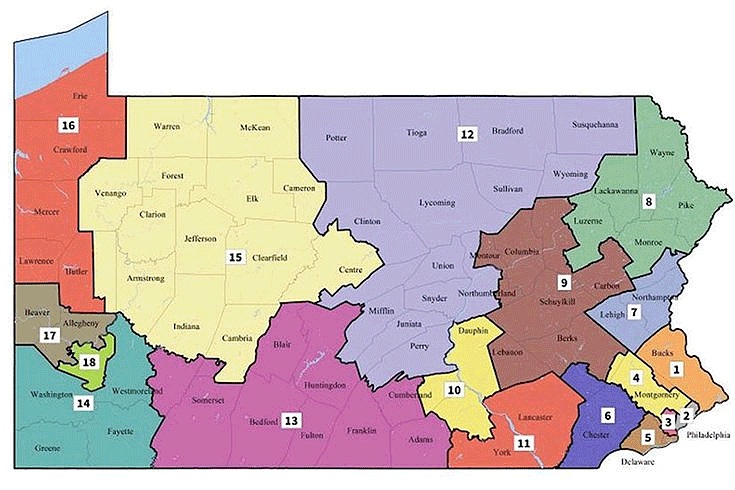
2018-elections-open-seatsThe US Supreme Court declined to hear the Pennsylvania Republicans’ arguments earlier this week to move the live redistricting case to the federal level. To review, the Pennsylvania Supreme Court ruled the current congressional map a political gerrymander, but without citing any election law statute violations. State Senate Republicans are refusing to provide the court with their requested data until the legislative bodies are informed about what is legally wrong with the current map.

In the meantime, the court has already appointed a special master from Stanford University to draw a new plan, and moved the congressional candidate filing deadline from March 6 to March 20. Additionally, Gov. Tom Wolf (D) is already saying he will veto the legislature’s map, so all of these developments suggest that a new, Democrat-friendly map will likely be in place before the 2018 elections.

In our overview of the current House open seat configuration, two of the Pennsylvania seats are either in the Lean D category (PA-7; Rep. Pat Meehan-R) or Lean R (PA-15; Rep. Charlie Dent). With a new map likely to collapse most, if not all, of the four open Republican seats, it is likely that both of the aforementioned districts will find themselves in the Democratic column after the next election.

Currently, the Lean Democrat column consists only of Republican seats. In addition to PA-7, and probably adding at least PA-15 post-redistricting, retiring GOP Reps. Ileana Ros-Lehtinen (R-FL) and Frank LoBiondo (R-NJ) are leaving seats that are also trending toward the Democratic side of the political ledger.

Continue reading