Tag Archives: Doug Jones

Senate Sleepers in Minnesota
and South Carolina

By Jim Ellis

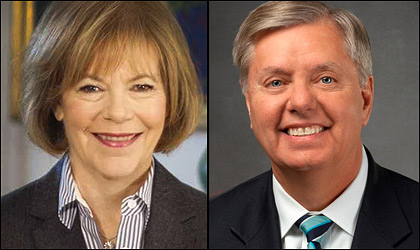
Are incumbents Sen. Tina Smith (D-MN), left, and Sen. Lindsey Graham (R-SC) in re-election trouble?

Sept. 8, 2020 — At the beginning of the 2020 election cycle, it appeared that Sens. Tina Smith (D-MN) and Lindsey Graham (R-SC) were set for re-election. That no longer appears to be the case.

Polling is now consistently showing close races in the two states, and Sen. Smith’s recent comments about the police have seemingly moved her re-election campaign closer to the toss-up category according to a just-released Harper Polling survey.

Looking at the HP data (Aug. 30-Sept. 1; 50 likely Minnesota voters via live interview), Sen. Smith’s ballot test edge has dropped to just 43-41 percent over former US Rep. Jason Lewis (R).

In May, Harper found Sen. Smith posting a 46-35 percent advantage over Lewis. After this release, Public Policy Polling forecast a 48-39 percent split toward the end of July. Lastly, Emerson College published what appears to be precursor data to the latest Harper findings. The Boston-based university poll (Aug. 8-10; 73 likely Minnesota voters) found a three-point split between the two contenders, 48-45 percent, again in Sen. Smith’s favor.

To the southeast of liberal Minnesota, in conservative South Carolina, veteran Sen. Lindsey Graham (R) has also fallen into a competitive contest with former state Democratic Party chairman Jaime Harrison, who had raised an incredible $29 million for his smaller state race through the end of June.

The most recent poll we have seen from the Palmetto State was released at the beginning of August. Quinnipiac University (July 30-Aug. 3; 91 registered South Carolina voters) detected a 44-44 percent tie between Sen. Graham and Harrison. From mid-July through the beginning of August, six surveys were conducted, including the Quinnipiac study, and Sen. Graham’s average lead was only 2.8 percentage points.

Continue reading

Sessions Looms Over Alabama Race

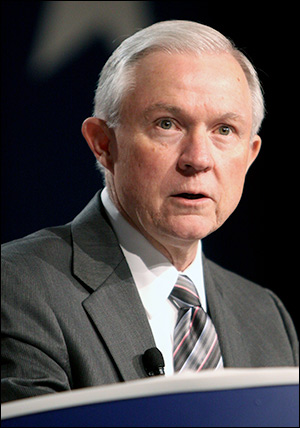
Former Senator and US Attorney General, Jeff Sessions (R)

By Jim Ellis

Nov. 4, 2019 — We’re getting close to the Nov. 8 candidate filing deadline in Alabama for the March 3 Super Tuesday state primary, and more speculation is brewing that former senator and US attorney general, Jeff Sessions (R), will decide to enter the crowded GOP primary field in order to re-claim his former position.

Reporting has indicated that Sessions, who originally won the Senate seat in the 1996 election, saw his re-election percentage substantially grow in all of his subsequent campaigns from 58.6 percent in 2002 to 63.4 percent in 2008 to 97.3 percent in 2014 when he didn’t even draw a Democratic opponent, is making calls to members of the Alabama House delegation and political leaders around the state to assess his chances. Sessions, of course, relinquished the Senate seat to accept President Trump’s appointment as US attorney general, and then his political trouble began.

To set the current stage, already in the race and running are US Rep. Bradley Byrne (R-Mobile), Secretary of State John Merrill, former Auburn University head football coach Tommy Tuberville, state Rep. Arnold Mooney (R-Shelby County), and former state Supreme Court Chief Justice Roy Moore who blew the 2017 special election when it became public that he dated under-age girls while in his 30s. Judge Moore won the special election nomination when he defeated appointed incumbent Luther Strange in the GOP run-off, which led to Doug Jones becoming the first Democrat to win an Alabama Senate seat since Howell Heflin was re-elected to his third and final term in 1990.

The 2020 Yellowhammer State race, however, may well be the most important contest in the nation to decide the next Senate majority. If the Republicans regain what is normally a safe seat for them, their chamber total increases to 54, which means the Democrats would have to sweep the top vulnerable GOP incumbent defense races in Arizona (Sen. Martha McSally vs. Mark Kelly), Colorado (Sen. Cory Gardner vs. presumably former governor and ex-presidential candidate John Hickenlooper), and North Carolina (Sen. Thom Tillis, assuming he wins the GOP nomination, against former state Sen. Cal Cunningham), and win the presidency.

This scenario would bring the 2021 US Senate into a tie but give the Democrats the majority because the new vice president, who also becomes the Senate president, would be a Democrat with the power to break a tie vote.

Most believe the Republicans would be in the political driver’s seat to defeat Sen. Jones should anyone but Moore win the GOP nomination. Alabama will be one of President Trump’s strongest states (62.1 percent in 2016), and the GOP tide should be strong enough to carry the party’s Senate nominee to victory over a Democratic incumbent who has held the party line on most controversial issues and will more than likely support President Trump’s removal from office.

Continue reading

Alabama Stats;
Minnesota’s New Senator

By Jim Ellis

Dec. 15, 2017 — Predictably, Democrats and media commentators are promoting the premise that Doug Jones’ victory in Tuesday’s Alabama special Senate election is another sign that a Democratic wave is building to transform the minority party into one that wins control of at least one congressional chamber next year. But the actual numbers do not provide evidence for such an analysis.

In actuality, Sen. Ron Johnson (R-WI) may have succinctly and correctly described what happened in the Alabama election, which caused Republicans to lose one of their safest seats in the nation. During an interview with NBC News, Sen. Johnson simply said, “Alabamians didn’t want somebody who dated 14-year-old girls.”

Looking at the actual figures, there is more supporting data for the supposition that Jones’ win is more likely due to Republican defections from former state Supreme Court Chief Justice Roy Moore, rather than a massive increase in Democratic turnout. While the Alabama special did feature a higher turnout than the last midterm election (2014), we also saw this phenomenon occur in two earlier special elections: the Montana at-large and GA-6 congressional contests. Republicans won both of those votes, proving that the GOP base was sufficiently energized in those two places to withstand increased Democratic turnout. But, Alabama doesn’t fit that same model either in the mode of Republican loyalty or an energized Democratic base.

Continue reading

Jones!

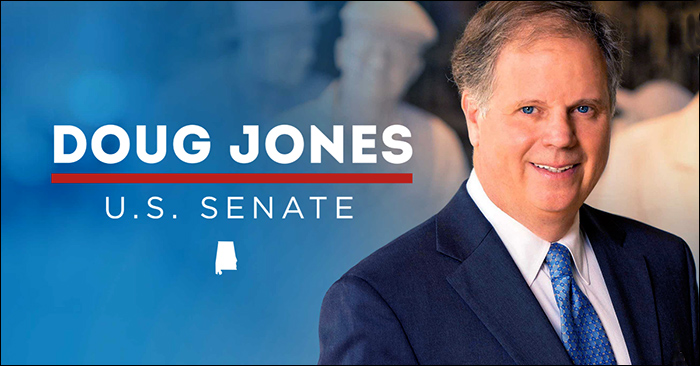
Alabama Senator-elect Doug Jones' campaign image.

Alabama Senator-elect Doug Jones’ campaign image.


By Jim Ellis

Dec. 14, 2017 — With the final polling covering all possibilities — from Democrat Doug Jones leading by 10 points, to Republican Roy Moore ahead by nine, to a straight tie — Tuesday’s Alabama special Senate election carried a great deal of uncertainty as voters cast their ballots.

Republicans were badly split between those party leaders publicly repulsed by the allegations of sexual impropriety against Moore, to those who felt that holding the seat and preventing the Democrats from having any path to obtaining the Senate majority in 2018 was most important.

The split was enough to allow Democrat Jones, a former Birmingham region US Attorney, to slip past Judge Moore and secure what previously had been a safely Republican seat for the next three years. Jones will replace appointed Sen. Luther Strange (R) who fell to Moore in the Republican run-off in late September.

The unofficial final totals give Jones 49.9 percent of the vote as compared to Moore’s 48.4 percent. Election Day’s final turnout figure showed 1,344,406 individuals having cast ballot, a total that will increase when all absentee and provisional ballots are finally added to the mix. In comparison, the last gubernatorial election (2014) drew 1,180,413. The 2016 presidential campaign saw 2,123,372 votes cast. Therefore, this special election, as did others earlier in the cycle (MT-AL; GA-6), actually produced a higher voter turnout than the state’s last regular midterm election.

Continue reading

ALABAMA: All Across the Board

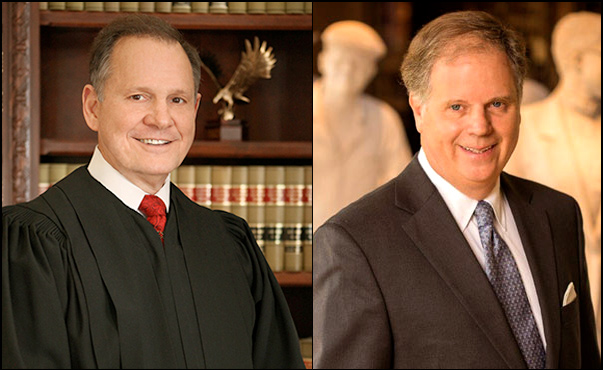
Left: Former state Supreme Court Chief Justice Roy Moore (R) | Right: Ex-US Attorney Doug Jones (D)

Left: Former state Supreme Court Chief Justice Roy Moore (R)
Right: Ex-US Attorney Doug Jones (D)

By Jim Ellis

Dec. 13, 2017
— Yesterday morning, we reported about the four weekend closing polls in the Alabama Senate election race, three of which projected former state Supreme Court Chief Justice Roy Moore (R) as the race leader in the closing days. Then on Monday, a much different story emerged. Four more surveys were released, and the results were head-scratching to say the least. If you supported Moore, favored Democratic nominee Doug Jones, or were an observer who thought the race was too close to call, poll results were published that supported your position.

Yesterday, the voters of Alabama put an end to all the speculation. Embattled Republican Senate candidate Roy Moore succumbed to the many challenges he faced and lost the election to Democrat Doug Jones by a slim 49.9-48.4 percent margin.

Which polling entity got it right? Let’s take a look: Emerson College (Dec. 7-9; 600 likely Alabama special election voters), in line with most of the data from the previous day, publicized new totals showing Judge Moore with a 53-44 percent advantage. Monmouth University (Dec. 6-9; 546 likely Alabama special election voters), however, found the two candidates tied at 46 percent, and indicated that individualized turnout models could easily produce potentially substantial victories for each man. The brand new Change Research survey (Dec. 9-11; 1,543 likely Alabama voters) projected a 51-45 percent Moore lead, almost identical to the 51-44 percent spread in their poll released over the weekend.

Continue reading

Alabama: The Last Polls

By Jim Ellis

Dec. 12, 2017 — The latest polls for today’s special Alabama Senate election were released over the weekend, and three of what are likely the final four surveys arrived at virtually the same conclusion.

Left: Former state Supreme Court Chief Justice Roy Moore (R) Right: Ex-US Attorney Doug Jones (D)

Left: Former state Supreme Court Chief Justice Roy Moore (R) | Right: Ex-US Attorney Doug Jones (D)

The Survey Monkey (Nov. 30-Dec. 7; 1,559 registered Alabama voters), Change Research (Dec. 5-7; 2,443 registered Alabama voters), Trafalgar Group (Nov. 6-7; 1,419 likely Alabama voters), and Gravis Marketing (Dec. 5-8; 1,254 likely Alabama voters) still see a close contest as the campaign surges to culmination.

CR, Trafalgar and Gravis all post embattled former state Supreme Court Chief Justice Roy Moore (R) to single-digit leads over ex-US Attorney Doug Jones (D). The Change Research ballot test result favors Moore, 51-44 percent; Trafalgar: 51-46 percent; and Gravis: 49-45 percent. On the other hand, Survey Monkey finds Jones holding a 49-47 percent edge.

The Survey Monkey study found Jones’ slight advantage through weighting the responses both from demographic data and 2016 voter performance. Though they forecast a different leader than the other three, their methodology looks to be sound and all four automated polls featured strong sampling universes. Therefore, it is difficult to discount the SM result simply because the end result is slightly different.

Continue reading

Confirming Data in Alabama

Left: Former state Supreme Court Chief Justice Roy Moore. Right: Ex-US Attorney Doug Jones

Left: Former state Supreme Court Chief Justice Roy Moore. Right: Ex-US Attorney Doug Jones.

By Jim Ellis

Nov. 30, 2017 — As we reported last week, two polls, one from WT&S Consulting (Nov. 18-20; 11,641 registered Alabama voters; Moore, 46-40 percent advantage) and one from Strategy Research for the Raycom News Network (Nov. 20; 3,000 likely Alabama special election voters; Moore, 47-45 percent advantage) first detected a swing back toward embattled Republican US Senate nominee Roy Moore in his special election contest with former US Attorney Doug Jones (D). Now another new survey, and one that is perhaps more significant, confirms the Moore advantage.

The Change Research firm, a San Francisco company that claims it brings a “Silicon Valley approach to polling,” has just reported new survey numbers, and for the third time in the Moore-Jones race. In mid-November (Nov. 9-11), CR found Judge Moore holding a 44-40 percent advantage just as the sexual impropriety scandal was beginning to become public knowledge. Later, from their November 15-16 poll, they saw the electorate sway to a 46-43 percent edge for Democrat Jones.

Yesterday, the firm released its Nov. 26-27 polling result (1,868 self-identified Alabama registered voters) and, confirming what WT&S and Strategy Research found, sees Judge Moore rebounding into the lead, 49-44 percent.

The swing to Moore is significant for several reasons. First, as the Politico publication reported, Jones and the Democrats are outspending Moore by a 7:1 margin in advertising, already running or reserving $5.6 million in media and digital advertising time versus only $800,000 for the Republican. But, assuming the consistent results from the three recent aforementioned polls are accurate, it appears either the Jones ad barrage is having no effect at best for the Democratic campaign, or worst, the piling on Moore is backfiring and leading to the opposite result.

Continue reading

The Senate Picture – Re-cap

34-in-cycle-us-senate-seats

By Jim Ellis

Nov. 28, 2017 — During the Thanksgiving holiday week, we previewed all 34 current Senate races. Today, we wrap-up with the often-described 30,000-foot national overview perspective.

The Alabama special Senate election scheduled for Dec. 12 will tell us a great deal about the coming regular cycle. While the Roy Moore-Doug Jones race is not likely to provide a voting trend preview since the contest has been tainted with scandal, it will signal whether or not the Democrats own a path to the Senate majority.

If Democrat Jones wins the Alabama special, it would give his party 49 seats, thus making their two primary Republican conversion targets in Arizona and Nevada enough to claim majority status, assuming all 25 of their defense seats are held, which, of course, is no easy task. If Republican Moore can hold Alabama, despite being jettisoned by the national GOP leadership, that would secure the Republican majority because such an outcome relegates Democrats’ chances of netting the three GOP seats they need within the regular cycle as highly unlikely.

Continue reading

Turbulent Senate Politics

By Jim Ellis

Sen. Al Franken (D-MN) and Leeann Tweeden

Sen. Al Franken (D-MN) and Leeann Tweeden

Nov. 20, 2017 — Currently, the near-term and long-range Senate outlook seems to fluctuate by the hour. Last week we repeatedly detailed the Republicans’ problem with Alabama Senate nominee Roy Moore and the effect the Dec. 12 special election will have upon the 2018 Senate cycle. But, yesterday became a day for the Democrats’ to receive similar bad news, albeit along with some good news.

While the Republicans languish in Alabama, Democrats were becoming increasingly concerned about Sen. Bob Menendez’s (D-NJ) corruption trial when a verdict appeared imminent, and what might happen should he be convicted. Last week, seeing the trial judge declare a mistrial, may mean that the senator’s legal hurdles have been cleared since it seems unlikely that the government would again pursue the case when prosecutors obviously had too little evidence to completely convince a jury that any crime had been committed.

But the positive Menendez result for the Dems was negated by the unfolding sexual harassment debacle involving Sen. Al Franken. Interestingly, though seemingly unrelated to the Alabama situation, both of these Democratic developments could influence the campaign’s course and help determine whether Judge Moore will be allowed to serve in the Senate if he rebounds to win the special election.

Continue reading

The Roy Moore Polling

By Jim Ellis

Left: Former state Supreme Court Chief Justice Roy Moore (R) | Right: Ex-US Attorney Doug Jones (D)

Left: Former state Supreme Court Chief Justice Roy Moore (R) | Right: Ex-US Attorney Doug Jones (D)

Nov. 16, 2017 — Last evening’s political news featured heavy coverage of a new National Republican Senatorial Committee poll that produced bad news for Alabama GOP special Senate nominee Roy Moore, but not enough information was released to determine the reliability aspect. In fact, the NRSC didn’t even release the name of the polling company with which they contracted to conduct the survey.

This is significant because their finding that Democrat Doug Jones is leading Judge Moore, 51-39 percent, is clearly out of line with every other poll taken in the corresponding time frame. It is also interesting that they would even release such a poll considering the Republican candidate is doing so badly. It does, however, justify their previous position of cutting the Moore Campaign from additional funding because of the sexual impropriety allegations against the candidate that has dominated recent news coverage.

Below are the post-scandal publicly reported surveys as complied by the Ballotpedia website:

• National Republican Senatorial Committee (Nov. 12-13)
No pollster credited
Jones 51%; Moore 39%
500 Sample

• Fox10 (Mobile) (Nov. 13)
News Strategy Research
Moore 49%; Jones 43%
3,000 Sample (Automated)

• Emerson College Polling Society (Nov. 9-11)
Moore 55%; Jones 45%
600 Polling Sample

• JMC Analytics & Polling (Nov. 9-11)
Jones 46%; Moore 42%
575 Sample

• Decision Desk HQ (Nov. 9)
Moore 46%; Jones 46%
515 Sample

As we can see, the NRSC poll returns the most inconsistent results in comparison to the other available data during the same time frame; the period just after the Moore sexual scandal broke.

Additionally, because the NRSC did not release the name of their pollster or the survey methodology, not enough information exists to determine if their data are skewed in any particular manner.

The lack of available information does not necessarily mean that the Senatorial Committee’s results are inaccurate. It is curious, however, that the other results — and, all have larger sample sizes than the reported NRSC calling universe — finds much different ballot test margins.

Interestingly, the Fox10 poll from a local Mobile television affiliate, which is the latest released survey prior to the NRSC study, and the Emerson College Polling Society find the complete opposite result and their methodologies utilize much larger sample sizes within the studied polling grouping. The Fox10 3,000-person sampling universe clearly suggests that the questionnaire responses were obtained through an automated device, but such does not necessarily mean this poll is less accurate than the live operator polls.

The Alabama race continues to deteriorate, and it is becoming more evident that Jones is now in a strong position to win. But, despite all the negative news coverage, this phantom NRSC poll is the only one that shows him trailing badly.

The other survey to find him dropping behind, from JMC Analytics, featured a sampling universe where 56 percent of the respondents are female, a potential skew in Jones’ favor since this subset broke his way, 46-40 percent. In comparison, men favored the Democrat only 46-45 percent in the JMC crosstabs. Therefore, with a sample where the Democratic-leaning female sector was over-sampled by approximately five percentage points, correcting this skew likely brings the Jones’ 46-42 percent ballot test result back into a tied range.

The NRSC results and partial poll release is intriguing to say the least. Hopefully, we will see more substantiation of their data later today.