Tag Archives: Roy Moore

Primary Money Count – Senate

By Jim Ellis

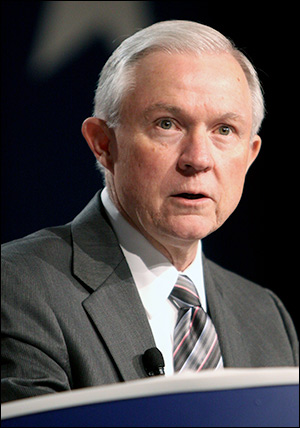
Former Alabama senator, Jeff Sessions (R)

Feb. 7, 2020 — The 4th Quarter campaign disclosure reports are published and today we look at the key early primary Senate states, those that will have an initial vote on Super Tuesday, March 3.

Five states will hold their regular primaries on that day, and four of them have Senate elections. Voters in Alabama, Arkansas, North Carolina, and Texas will take at least the first step in choosing their statewide nominees on Super Tuesday. California, which also holds its regular primary that day does not have a Senate race in this cycle. In Arkansas, Democrats failed to produce a candidate, meaning that Sen. Tom Cotton (R) will head into the general election as a virtually unopposed candidate.

ALABAMA

Alabama hosts a major Republican primary featuring former US attorney general and senator, Jeff Sessions. He is running for the seat he vacated to accept his federal appointment. Sessions is being fiercely challenged, however. Two serious candidates are also vying for the party nomination, US Rep. Bradley Byrne (R-Mobile) and retired Auburn University head football coach Tommy Tuberville. Ex-state Supreme Court chief judge and 2017 Senate special election nominee Roy Moore is back for another attempt, but his previous poor performance and lack of funding has relegated him to lower-tier status.

On the fundraising front, the Federal Election Commission reports find Sessions raising more than $530,000 but has spent more than $812,000. At the end of the year, he held over $2.5 million in cash, but most of those funds were raised during his time as an incumbent Senator.

Coach Tuberville has done an outstanding job of fundraising for a first-time candidate in a crowded field, raising over $1.3 million from individuals and loaning his campaign $1 million. His year-end cash-on-hand (CoH) figure was $1.52 million.

Rep. Byrne has accumulated over $3.3 million for his campaign, including transferring more than $2.2 million from his US House committee. His CoH total is just under $2.1 million.

Continue reading

Alabama Senate Race Begins

By Jim Ellis

Rep. Bradley Byrne, a Republican, formally announced his candidacy for the Senate.

Feb. 25, 2019 — One of the critical 2020 US Senate contests is beginning to take shape. Over the past few days, Alabama Rep. Bradley Byrne (R-Mobile) formally announced his statewide candidacy with the goal of opposing Democratic Sen. Doug Jones, who won the controversial 2017 special election that attracted national attention.

The Jones victory, defeating beleaguered Republican Roy Moore, a former state Supreme Court Chief Justice, represented the first time a Democrat won an Alabama statewide federal election since incumbent Sen. Howell Heflin secured his final term in 1990.

Prior to that, Richard Shelby, then a Democratic congressman, unseated Republican Sen. Jeremiah Denton in 1986. Shelby then switched to the Republican Party immediately after the 1994 election. Prior to the Denton victory on the same night that Ronald Reagan was first elected president, no Republican had won an Alabama seat for more than 100 years.

The Yellowhammer State Senate race could well be the lynchpin to determining which party will control the chamber after the 2020 election. With the electoral map favoring the Democrats because Republicans must defend 22 of the 34 in-cycle seats, including the Arizona special Senate election, Alabama becomes a virtual “must-win” for the GOP.

Continue reading

Democratic Enthusiasm: Overblown?

By Jim Ellis

Dec. 20, 2017 — In attempting to objectively look at the current electorate now one year before the next election, is Democratic enthusiasm about the party’s prospects of capturing the US House majority accurate or does their optimism exceed what the numbers actually say?

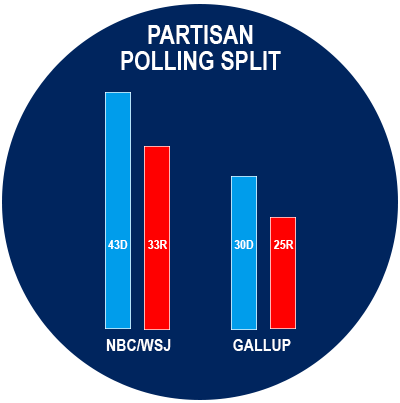
Several points need to be dispelled before examining the latest NBC News/Wall Street Journal national poll that gives the Democrats a 10-point advantage in the “enthusiasm gap.”

partisan polling splitFirst, let’s remember in looking at the current cycle’s House special election results that neither party lost a seat they previously held. This is particularly significant when Democrats use the argument in reference to the Kansas, Montana, and Georgia special elections that they over-performed even though failing to win any of the seats.

While they may have over-performed in relation to the Trump presidential percentage in Kansas and Montana, when looking back to the last time those particular seats were open the 2017 Republican special election performance was actually within the consistent realm. Therefore, as the Democratic strategists often say themselves, and correctly so, it is the Trump percentage that is generally the political anomaly and not the historical results.

” … a one-point victory in an election with such a flawed candidate, irrespective of Alabama’s voting history, simply cannot be considered the emerging beacon of a coming wave for the 2018 midterm elections.”

In Georgia, the Democrats and their allies spent a record $35 million on that particular special election campaign and still lost by four percentage points. The one seat where they unmistakably over-performed was the only special election where the party’s political apparatus didn’t target: the three-point Republican victory in the South Carolina electoral contest.

Continue reading

Another Falls — What are the Odds?

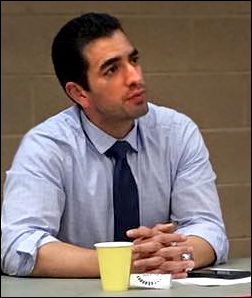
Nevada Rep. Ruben Kihuen (D--Las Vegas) | Facebook

Nevada Rep. Ruben Kihuen
(D–Las Vegas) | Facebook

By Jim Ellis

Dec. 19, 2017 — Freshman Nevada Rep. Ruben Kihuen (D-Las Vegas), who previously said he would not resign when sexual impropriety allegations were made against him, became the sixth current House member to either leave Congress or retire unexpectedly due to harassment claims. Sen. Al Franken (D-MN) and Alabama special election candidate Roy Moore (R) also succumbed to accusations that fall within this same category either through resignation or defeat at the polls.

Kihuen was accused of aggressive behavior with a former campaign staffer. When a second woman came forward with a similar story, the freshman Representative decided to end his current congressional tenure when this session adjourns. His 4th CD is a marginal political district.

When Nevada was awarded a fourth seat in 2010 reapportionment, it appeared that the new Las Vegas-anchored seat would favor the Democrats because the Hispanic population tops 29.1 percent in addition to an African American component of 15.6 percent. But, the district hasn’t always been reliable.

Despite their partisan opponents carrying the seat in the two presidential elections since its creation (Clinton: 49-45 percent; Obama: 54-44 percent), Republicans prevailed here in several statewide elections, and GOP congressional candidate Cresent Hardy (R-Mesquite) defeated one-term Rep. Steven Horsford (D-Las Vegas) in the GOP landslide year before Kihuen turned the tables on the freshman incumbent in 2016. In the district’s short history, the electorate has yet to re-elect an incumbent House member.

Continue reading

Alabama Stats;
Minnesota’s New Senator

By Jim Ellis

Dec. 15, 2017 — Predictably, Democrats and media commentators are promoting the premise that Doug Jones’ victory in Tuesday’s Alabama special Senate election is another sign that a Democratic wave is building to transform the minority party into one that wins control of at least one congressional chamber next year. But the actual numbers do not provide evidence for such an analysis.

In actuality, Sen. Ron Johnson (R-WI) may have succinctly and correctly described what happened in the Alabama election, which caused Republicans to lose one of their safest seats in the nation. During an interview with NBC News, Sen. Johnson simply said, “Alabamians didn’t want somebody who dated 14-year-old girls.”

Looking at the actual figures, there is more supporting data for the supposition that Jones’ win is more likely due to Republican defections from former state Supreme Court Chief Justice Roy Moore, rather than a massive increase in Democratic turnout. While the Alabama special did feature a higher turnout than the last midterm election (2014), we also saw this phenomenon occur in two earlier special elections: the Montana at-large and GA-6 congressional contests. Republicans won both of those votes, proving that the GOP base was sufficiently energized in those two places to withstand increased Democratic turnout. But, Alabama doesn’t fit that same model either in the mode of Republican loyalty or an energized Democratic base.

Continue reading

Jones!

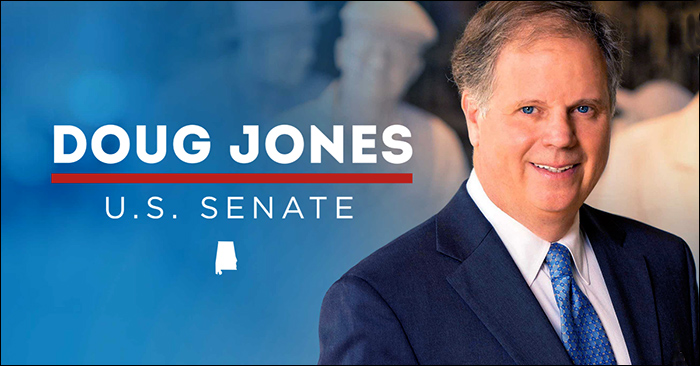
Alabama Senator-elect Doug Jones' campaign image.

Alabama Senator-elect Doug Jones’ campaign image.


By Jim Ellis

Dec. 14, 2017 — With the final polling covering all possibilities — from Democrat Doug Jones leading by 10 points, to Republican Roy Moore ahead by nine, to a straight tie — Tuesday’s Alabama special Senate election carried a great deal of uncertainty as voters cast their ballots.

Republicans were badly split between those party leaders publicly repulsed by the allegations of sexual impropriety against Moore, to those who felt that holding the seat and preventing the Democrats from having any path to obtaining the Senate majority in 2018 was most important.

The split was enough to allow Democrat Jones, a former Birmingham region US Attorney, to slip past Judge Moore and secure what previously had been a safely Republican seat for the next three years. Jones will replace appointed Sen. Luther Strange (R) who fell to Moore in the Republican run-off in late September.

The unofficial final totals give Jones 49.9 percent of the vote as compared to Moore’s 48.4 percent. Election Day’s final turnout figure showed 1,344,406 individuals having cast ballot, a total that will increase when all absentee and provisional ballots are finally added to the mix. In comparison, the last gubernatorial election (2014) drew 1,180,413. The 2016 presidential campaign saw 2,123,372 votes cast. Therefore, this special election, as did others earlier in the cycle (MT-AL; GA-6), actually produced a higher voter turnout than the state’s last regular midterm election.

Continue reading

ALABAMA: All Across the Board

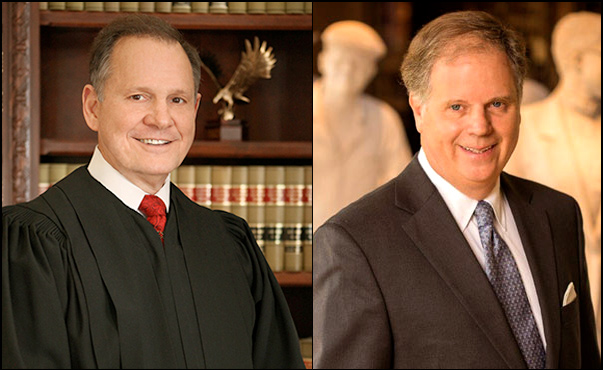
Left: Former state Supreme Court Chief Justice Roy Moore (R) | Right: Ex-US Attorney Doug Jones (D)

Left: Former state Supreme Court Chief Justice Roy Moore (R)
Right: Ex-US Attorney Doug Jones (D)

By Jim Ellis

Dec. 13, 2017
— Yesterday morning, we reported about the four weekend closing polls in the Alabama Senate election race, three of which projected former state Supreme Court Chief Justice Roy Moore (R) as the race leader in the closing days. Then on Monday, a much different story emerged. Four more surveys were released, and the results were head-scratching to say the least. If you supported Moore, favored Democratic nominee Doug Jones, or were an observer who thought the race was too close to call, poll results were published that supported your position.

Yesterday, the voters of Alabama put an end to all the speculation. Embattled Republican Senate candidate Roy Moore succumbed to the many challenges he faced and lost the election to Democrat Doug Jones by a slim 49.9-48.4 percent margin.

Which polling entity got it right? Let’s take a look: Emerson College (Dec. 7-9; 600 likely Alabama special election voters), in line with most of the data from the previous day, publicized new totals showing Judge Moore with a 53-44 percent advantage. Monmouth University (Dec. 6-9; 546 likely Alabama special election voters), however, found the two candidates tied at 46 percent, and indicated that individualized turnout models could easily produce potentially substantial victories for each man. The brand new Change Research survey (Dec. 9-11; 1,543 likely Alabama voters) projected a 51-45 percent Moore lead, almost identical to the 51-44 percent spread in their poll released over the weekend.

Continue reading

Alabama: The Last Polls

By Jim Ellis

Dec. 12, 2017 — The latest polls for today’s special Alabama Senate election were released over the weekend, and three of what are likely the final four surveys arrived at virtually the same conclusion.

Left: Former state Supreme Court Chief Justice Roy Moore (R) Right: Ex-US Attorney Doug Jones (D)

Left: Former state Supreme Court Chief Justice Roy Moore (R) | Right: Ex-US Attorney Doug Jones (D)

The Survey Monkey (Nov. 30-Dec. 7; 1,559 registered Alabama voters), Change Research (Dec. 5-7; 2,443 registered Alabama voters), Trafalgar Group (Nov. 6-7; 1,419 likely Alabama voters), and Gravis Marketing (Dec. 5-8; 1,254 likely Alabama voters) still see a close contest as the campaign surges to culmination.

CR, Trafalgar and Gravis all post embattled former state Supreme Court Chief Justice Roy Moore (R) to single-digit leads over ex-US Attorney Doug Jones (D). The Change Research ballot test result favors Moore, 51-44 percent; Trafalgar: 51-46 percent; and Gravis: 49-45 percent. On the other hand, Survey Monkey finds Jones holding a 49-47 percent edge.

The Survey Monkey study found Jones’ slight advantage through weighting the responses both from demographic data and 2016 voter performance. Though they forecast a different leader than the other three, their methodology looks to be sound and all four automated polls featured strong sampling universes. Therefore, it is difficult to discount the SM result simply because the end result is slightly different.

Continue reading

Franken to Resign Today?

UPDATE: Sen. Al Franken (D-MN) today on the floor of the US Senate announced that he would resign: “I am announcing that in the coming weeks, I will be resigning as a member of the United States Senate,” he said.

By Jim Ellis

Dec. 7, 2017 — A day after US House Dean John Conyers (D-MI) resigned from Congress over sexual misconduct allegations, the resignation drumbeat for Minnesota Sen. Al Franken to follow suit may have risen to a successful crescendo. The embattled Democratic politician has now scheduled time this morning on the Senate floor to make an announcement.
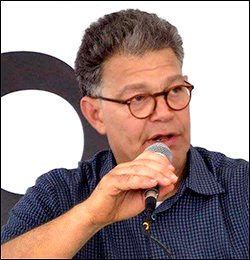
Minnesota Sen. Al Franken | Facebook

Minnesota Sen. Al Franken | Facebook

Speculation is rampant that he will make public his decision to resign because of growing sexual harassment accusations, but his spokespeople have stopped short of confirming that such will be the subject matter of his floor address.

The crushing blow to Franken’s political career may be seeing 30 Democratic senators, including Minority Leader Chuck Schumer (D-NY) and Minority Whip Dick Durbin (D-IL), go on record calling for him to resign. Democratic National Committee chairman Tom Perez has also called upon Franken to leave office.

Should he depart, the 2018 Senate election cycle will significantly change. Gov. Mark Dayton (D) will choose a replacement to serve until the next regular election, with voters then choosing an officeholder to complete the term. The Class II seat would then come in-cycle for a full term in the 2020 election.

Published Minnesota sources suggest that Gov. Dayton’s first choice would be to appoint Lt. Gov. Tina Smith (D), his former chief of staff. Most believe she would serve in a caretaker role, thus opening the race in 2018. Smith chose not to run for governor even though the seat is open saying in March when she made public her retirement decision, “just because you can do something, doesn’t mean you should do something.”

Should the involved players choose the caretaker course, we would see this open Senate race accompany an open governor’s position and Sen. Amy Klobuchar (D) seeking re-election all on the same ballot. The scenario of yielding a competitive governor and Senate race would add to the Minnesota political intrigue, since the state is likely to host as many as five contested US House campaigns among its eight congressional districts.

The Franken situation could also have reverberations for the Alabama special Senate race to be decided on Tuesday. Should Republican Roy Moore win, and he is once again leading according to most polls, the problem of having Franken in the chamber accused of similar actions would be eliminated. This means a bid to expel Moore after he is sworn in could gain steam.

Democrats wanted to get themselves on record as being strongly supportive of sexual harassment victims by vociferously calling upon Sen. Franken to resign, but they also free themselves to call for a new Sen. Moore to resign or be expelled. Since the Republican leadership is not happy with the prospect of Moore serving, the Franken situation could place the twice-removed Alabama state Supreme Court Chief Justice in an untenable position should he win on Tuesday.

Taking the Alabama scenario further, should Moore be expelled – it is unlikely he would resign since he did not remove himself from the ballot after the sexual allegation charges broke, and the voters would have just elected him even with the knowledge of such accusations – the vacancy situation would repeat itself. Gov. Kay Ivey (R) would then appoint an interim senator and the seat would immediately again be placed into special election mode.

This time the new special election would likely be scheduled concurrently with the regular election cycle. As with Franken in Minnesota, the Alabama seat in question is a Class II, meaning it would come in-cycle for a full six-year term in 2020, so filling it with a 2018 election would give the winner only a two-year term.

Whether or not Sen. Franken follows through and resigns this morning, today promises to be an interesting one in the halls of the nation’s capitol.

Confirming Data in Alabama

Left: Former state Supreme Court Chief Justice Roy Moore. Right: Ex-US Attorney Doug Jones

Left: Former state Supreme Court Chief Justice Roy Moore. Right: Ex-US Attorney Doug Jones.

By Jim Ellis

Nov. 30, 2017 — As we reported last week, two polls, one from WT&S Consulting (Nov. 18-20; 11,641 registered Alabama voters; Moore, 46-40 percent advantage) and one from Strategy Research for the Raycom News Network (Nov. 20; 3,000 likely Alabama special election voters; Moore, 47-45 percent advantage) first detected a swing back toward embattled Republican US Senate nominee Roy Moore in his special election contest with former US Attorney Doug Jones (D). Now another new survey, and one that is perhaps more significant, confirms the Moore advantage.

The Change Research firm, a San Francisco company that claims it brings a “Silicon Valley approach to polling,” has just reported new survey numbers, and for the third time in the Moore-Jones race. In mid-November (Nov. 9-11), CR found Judge Moore holding a 44-40 percent advantage just as the sexual impropriety scandal was beginning to become public knowledge. Later, from their November 15-16 poll, they saw the electorate sway to a 46-43 percent edge for Democrat Jones.

Yesterday, the firm released its Nov. 26-27 polling result (1,868 self-identified Alabama registered voters) and, confirming what WT&S and Strategy Research found, sees Judge Moore rebounding into the lead, 49-44 percent.

The swing to Moore is significant for several reasons. First, as the Politico publication reported, Jones and the Democrats are outspending Moore by a 7:1 margin in advertising, already running or reserving $5.6 million in media and digital advertising time versus only $800,000 for the Republican. But, assuming the consistent results from the three recent aforementioned polls are accurate, it appears either the Jones ad barrage is having no effect at best for the Democratic campaign, or worst, the piling on Moore is backfiring and leading to the opposite result.

Continue reading