Tag Archives: President Trump

The Maine Event

By Jim Ellis

Maine Congressional Districts

May 20, 2020 — The small state of Maine, with its two congressional districts, is going to attract a great deal of political attention between now and the election. Not only is the Pine Tree State one of the firewalls for Republican Senate majority hopes, the domain, one of two places that splits its electoral votes, will likely play a major role in determining the presidential election outcome, as well.

Maine and Nebraska divide their electoral votes such that the winning statewide candidate earns two electoral votes, while the victor in each congressional district is awarded one EV for as many districts as they carry. Maine, as mentioned, has two districts, and Nebraska three.

These districts came into play both in 2008 and 2016, when Barack Obama carried the 2nd District of Nebraska against John McCain in the former year, and Donald Trump took the 2nd District of Maine opposite Hillary Clinton in 2016. While neither CD became a factor in determining each of those elections, these CDs breaking differently than their state in a tight national election could result in the Electoral College ending in a tie.

The 48 other states and the District of Columbia use the winner-take-all system. Any state could divide their electoral votes like Maine and Nebraska, but those are the only two who choose the split vote method.

In the current presidential election scenarios, whether or not President Trump again carries ME-2 could determine if he is re-elected. Under one scenario, former vice president Joe Biden could win the national race even if he failed to carry Wisconsin so long as he takes the 2nd District of Maine and 2nd District of Nebraska. Doing so, along with winning the other swing states that touch a Great Lake, meaning Michigan and Pennsylvania, he would secure exactly 270 electoral votes, the bare minimum to claim national victory.

Continue reading

Questionable New Georgia Data

By Jim Ellis

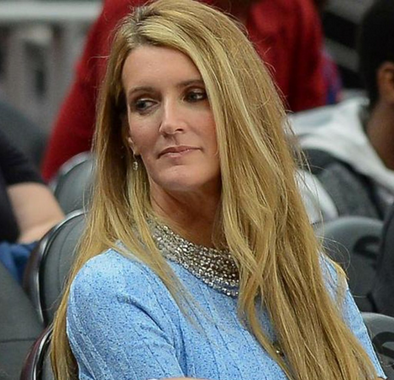
Georgia Sen. Kelly Loeffler (R)

May 18, 2020 — The Public Opinion Strategies polling company, which conducts research for appointed Sen. Kelly Loeffler (R), though that was not mentioned in their latest Georgia survey release, unveiled their new statewide study that finds the appointed incumbent moving up while other Republicans aren’t faring as well.

The statewide POS poll finds President Trump trailing former vice president Joe Biden by a single percentage point (47-46 percent), while Sen. David Perdue (R) is only edging Democrat Jon Ossoff by a 43-41 percent spread with an unknown Libertarian candidate attracting a rather high-seven percent support factor. The questionnaire then became focused upon the COVID-19 crisis and how the situation is being handled from Washington and Atlanta.

Previously Loeffler had dropped to fourth position in other Georgia polls, and she trailed Rep. Doug Collins (R-Gainesville) by a 2:1 margin while Collins led all the jungle primary candidates. The POS study (May 4-7; 500 likely Georgia voters) positions Loeffler in second, just one point behind Collins. Almost as mysteriously, while all other recent polling finds the northeast Georgia congressman capturing between 29 and 36 percent of the overall respondent preference, the Loeffler campaign poll sees him dropping 10 points and shows her leading him by a single digit (19-18 percent).

While the racial demographics of the POS 500-person sample of likely Georgia voters are a reasonable characterization of the state – though Hispanics are represented in only half of their actual percentage and Asians are under-counted, too – the partisan breakdown is flawed. (The lower Hispanic and Asian could be one reason Loeffler passed two Democrats to barely claw into second position.)

According to the poll’s small-sample data, 42 percent of the respondents are self-identified Republicans while 41 percent are Democrats. Another 16 percent say they are Independent. Additionally, while the female population base in the state is 51.4 percent statewide, women comprise more than 53 percent of respondents in this poll. Again, a relatively small number, but one that would benefit Sen. Loeffler most likely above any of the other candidates.

Let’s think about the partisan division. Georgia is one of 19 states where voters don’t register by political party, therefore it is impossible to tell exactly how many people identify as Republican, Democrat, or Independent. The electorate has certainly voted, however, in much better Republican numbers than this survey indicates.

Continue reading

Tiffany Wins in Wisconsin;
Nebraska Primary Nominees Chosen

By Jim Ellis

May 13, 2020 — Wisconsin Republican state Sen. Tom Tiffany, as expected, easily won the special congressional election last night in the Badger State’s northwest 7th District with 57.2 percent of the vote from a huge voter turnout universe of just under 192,000 individuals. The Democratic nominee, Wausau School Board member Tricia Zunker, was a consensus candidate for the special, but she raised less than $500,000 for the race and the national Democratic institution did little to assist her from the outside.

Once the vote tally is finalized, the Wisconsin Elections Commission will certify the result and Tiffany will be sworn into the House of Representatives to complete former congressman Sean Duffy’s (R-Wausau) term. Duffy resigned from office in August of last year for family reasons and the seat has been vacant ever since.

The 7th District occupies 21 central and northwest Wisconsin counties and parts of five others. For more than 40 years, former House Appropriations Committee chairman David Obey (D) represented the district. Rep. Duffy won the seat for the first time in 2010 after Obey chose to retire after serving 21 terms in office. Since the 2010 election, the district has moved toward the Republicans, and Tiffany’s victory seems to cement the seat as safe territory for the GOP.

The congressman-elect now will enter the regular 2020 primary scheduled for Aug. 11. The candidate filing deadline is June 1, but it is unlikely he will see much competition in either the primary or general election considering last night’s strong performance.


Continue reading

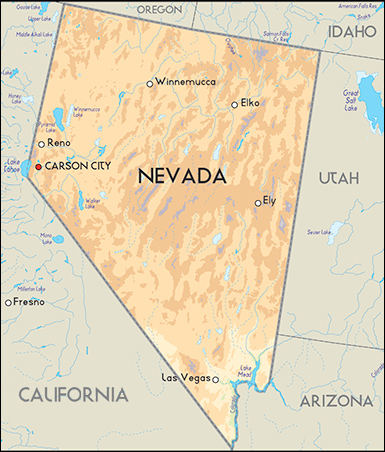
Nevada: A Target?

By Jim Ellis

May 8, 2020 — The Silver State of Nevada, with six Electoral College votes, has been regarded as a swing state in most 21st Century presidential elections, but in projecting the 2020 vote, it is routinely considered as a place destined to land in the Democratic column. But, could Nevada ultimately be in play for President Trump?

With a general election electoral vote map looking ever closer as we move toward November, introducing a new target could drastically change the eventual outcome or at least the campaign focus and strategy.

A new ALG Research poll (April 27-30; 76 likely Nevada general election voters) reports findings that are consistent with virtually all of the 2016 Nevada general election surveys. Last week, the firm found former vice president Joe Biden leading President Trump with a 49-45 percent spread. Such a margin and preference percentages fall into the same realm as all 31 polls conducted in Nevada from May through the November 2016 election.

When ‘16 ended, Hillary Clinton carried the state, but her margin was only 2.4 percentage points, meaning a 27,000-vote spread of more than 1.12 million ballots cast. And, consistent with the large number of polls that concluded a close race within the 40s would be the actual result, Clinton defeated Trump, 47.9 – 45.4 percent, validating the plethora of research conducted over the final five-plus months of that election cycle.

Four years ago, 13 different pollsters conducted the almost three dozen surveys, and in no instance did either Trump or Clinton ever reach the 50 percent plateau. On the other end of the spectrum, in just three instances did one of the candidates dip below 40 percent. Therefore, in 28 of the 31 studies logged within the 2016 Real Clear Politics polling archives, both candidates fell within the 40s, meaning this result occurred over 90 percent of the time. In terms of range, the span stretched from Clinton plus-7 to Trump plus-6, but the average between the two was only 2.7 percent, which is almost exactly the actual final total. This obviously suggests a competitive political battlefield.

Continue reading

Montana Shock Poll

By Jim Ellis

(Left) Montana Sen. Steve Daines (R); Gov. Steve Bullock (D)

May 7, 2020 — Montana State University at Bozeman’s research arm just completed a survey of their state’s electorate (April 10-27; 738 Montana adults, 458 likely Montana voters) and produced a surprising tally in the Senate race.

According to MSU Bozeman, Gov. Steve Bullock (D) has jumped out to a 46-39 percent lead over first-term Sen. Steve Daines (R) even with President Trump posting a 5.6 percentage point advantage over former vice president Joe Biden (46.3 – 39.7 percent) within the same sampling group.

Though Montana is viewed as a Republican state, and it generally performs as such in most federal races, the margins usually aren’t particularly lopsided, and Democrats have done well in statewide contests up until 2016. Except for Gov. Bullock’s 50-46 percent re-election victory that year, Republicans running in the wake of Trump’s 20-point landslide win over Hillary Clinton, swept the other races.

Several notes about this poll: first, the questioning period lasted 18 days, a very long time for a likely voter sample size of 458 individuals. Typically, such surveys are conducted over a three-day period. Such an implementation interval substantially increases the error rate.

Second, though the error factor is stated as 4.6 percent, the chairman of the university’s political science department, Dr. David Parker, stated in a local Helena KTVH television news story, that the Senate race is within the margin of error and in reality too close to call. While his conclusion may well be accurate, the ballot test shows a margin between Bullock and Daines of seven percentage points, meaning that the result is well beyond the polling margin of error. Therefore, Dr. Parker’s comments suggest the methodology actually yields an error factor larger than stated, which is more consistent with the elongated sampling time feature.

Continue reading

Georgia’s Dual Senate Races

By Jim Ellis

May 5, 2020 — Georgia is the only state this year that features two US Senate races, and a new poll suggests that both are interesting.

The Peach State’s politics have garnered more national attention since 2018 as election results suggest that Georgia is moving closer to the ideological center. Still conservative, the 2018 governor’s election that saw Republican Brian Kemp slipping past former state House Minority Leader Stacey Abrams (who has since become a national figure and one of the contenders to be Joe Biden’s vice-presidential running mate) by just over one percentage point. Additionally, the Democrats gained a congressional seat in the Atlanta metro area and came within 419 votes of converting a second.

Georgia Gov. Brian Kemp appointed businesswoman Kelly Loeffler (R) to the U.S. Senate to succeed retiring Sen. Johnny Isakson, who is leaving office at the end of the year due to health issues.

A substantial increase in the state’s minority population, almost all of which is occurring in the Atlanta metropolitan region, during the past decade (Asian, plus-31 percent; African American, plus-17 percent; Hispanic, plus-14 percent) is the chief reason for the uptick in Democratic candidate support.

With this background, the Cygnal research organization released the results of their most recent Georgia statewide poll (April 25-27; 591 Georgia voters, all but six of whom say they are definitely or probably voting) and their data finds two competitive US Senate races unfolding.

The results reveal one incumbent in serious trouble and the other headed for a potentially competitive re-election battle. In fact, appointed Sen. Kelly Loeffler (R) trails not only US Rep. Doug Collins (R-Gainesville), who leads the jungle primary field by over 17 points, but actually places fourth in the field behind two Democratic candidates yet close enough to them to become entangled in a statistical tie. Sen. David Perdue (R) maintains just a six-point lead over the only Democrat tested against him, former congressional candidate Jon Ossoff.

Continue reading

Amash Forms Exploratory Committee

By Jim Ellis

Michigan Rep. Justin Amash

May 1, 2020 — It has been speculated upon virtually since the time that Michigan Rep. Justin Amash (L-Cascade Township/Grand Rapids) left the Republican Party that he would enter the presidential race, and now he has taken the first step toward that end.

Amash made several announcements Wednesday. First, he is indeed filing an exploratory committee with the Federal Election Commission to gauge his chances of becoming Libertarian Party’s presidential nominee. Second, he informed the Clerk of the House that he is no longer an Independent, but a member of the Libertarian Party. Third, he confirmed that he will not seek re-election to his 3rd District House seat.

Let’s look at the subjects in order.

It is not surprising that Amash is taking this step. The idea of him becoming the Libertarian presidential nominee was first raised when he became an Independent US House member early last July, and the congressman never expressly ruled out that he would eventually run for president.

Some argue that Amash being on the ticket as the Libertarian nominee could take rightward leaning independent votes away from President Trump and allow former vice president Joe Biden to slip past him in crucial states like Michigan. While the scenario might have some credence in an intensely close election, it matters little that Amash’s name is the one these particular voters would be choosing.

Continue reading

Jersey House Competition

By Jim Ellis

April 27, 2020 — The Monmouth University Polling Institute conducted a statewide poll of the New Jersey electorate (April 16-19; 704 New Jersey adults, 635 registered New Jersey voters, 96 percent of whom said they are certain or likely to vote in November) and while the results returned predictable figures in the presidential and Senate races, an interesting tidbit about the House races came to light.

In the presidential race, former vice president Joe Biden led President Trump 54-38 percent according to Monmouth’s latest New Jersey poll, and Sen. Cory Booker (D) led his strongest potential Republican opponent, 55-32 percent. Both sets of numbers were predictable and consistent with recent Garden State voting history.
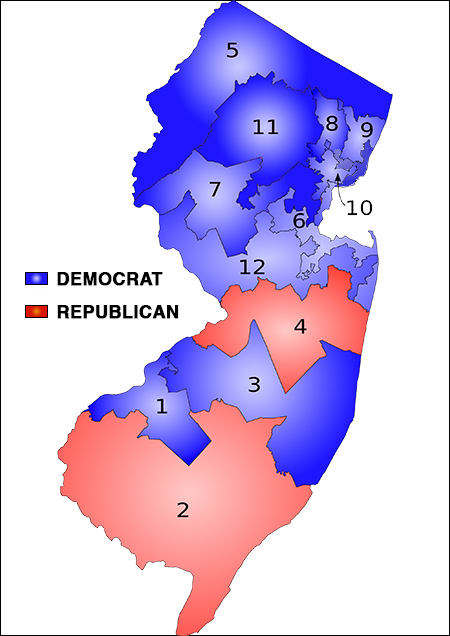
New Jersey congressional districts: Districts 1, 6, 8, 9, 10, and 12 are the six safe seats. Districts 2, 3, 4, 5, 7, and 11 comprise the competitive sector.

Though the Monmouth pollsters didn’t test the individual House races, they did ask the partisan preference question and segmented the congressional districts into two campaign categories, the competitive group and the non-competitive group.

Statewide, 50 percent of the respondents said they would vote for the Democratic candidate for the US House of Representatives as compared to 38 percent who would choose the Republican contender. But when looking at the competitive House category, Republicans look to have a glimmer of hope of potentially recapturing some of the seats they lost in the 2018 election.

In that year, Democrats converted Districts 2, 3, 7, and 11, gaining four seats and leaving the 12-member NJ federal delegation with only one Republican member at the outset, Rep. Chris Smith (R-Hamilton) in the 4th CD. Since the election, Rep. Jeff Van Drew (R-Dennis Township/Atlantic City) changed parties after being elected as a Democrat. All of these seats, including District 4, and 5 in northern New Jersey (Rep. Josh Gottheimer-D), comprise the competitive sector. Districts 1, 6, 8, 9, 10, and 12 are the six safe seats.

In the “safe” House category, 56 percent of respondents said they would vote for the Democratic candidate as compared to 31 percent who aligned themselves with the eventual Republican general election candidate. In the competitive districts, however, by a 46-45 percent plurality, the respondents said they would vote for the Republican candidate. Considering that Rep. Gottheimer will not be seriously challenged, the GOP numbers in the truly contested districts should even be stronger. This type of result should continue to make many of the Garden State seats prime 2020 Republican national targets.

The safe seats, with all incumbents seeking re-election, are held by Reps. Donald Norcross (D-Camden City), Frank Pallone (D-Long Branch), Albio Sires (D-West New York), Bill Pascrell (D-Paterson), Donald Payne (D-Newark), and Bonnie Coleman Watson (D-Ewing Township).

The competitive seats feature party-switching Rep. Van Drew seeking his first re-election. He looks strong in the Republican primary – a first vote as a party’s new incumbent can be difficult – and will face either college professor Brigid Callahan Harrison or Amy Kennedy, wife of former US Rep. Patrick Kennedy (D-RI), in what should be a competitive general election. With a solid Republican primary victory, Rep. Van Drew will be favored in November.

The 3rd District may be the Democrats’ most vulnerable seat. Freshman Rep. Andy Kim (D-Bordentown) upset then-Rep. Tom MacArthur (R) in 2018, and now faces what should be a strong GOP opponent. Venture capitalist David Richter, who was originally running in the 2nd District until Rep. Van Drew became a Republican, is considered the favorite for the GOP primary, and he appears to be a strong challenger for Rep. Kim but will have less time to develop the campaign. Gov. Phil Murphy (D) has moved the state primary from June 2 to July 7.

NJ-3 looks to be the most likely of the New Jersey seats to flip. Until Kim won here two years ago, and except for a one-term lag, Republicans had held this southern New Jersey seat since 1979.

Rep. Chris Smith (R-Hamilton), who was first elected to the House in 1980, looks to face an easier re-election contest this year than he did two years ago. In an election when he was the Republicans’ lone survivor, Rep. Smith scored a 55-43 percent victory.

Freshman Rep. Tom Malinowski (D-Rocky Hill) will almost assuredly face state Senate Minority Leader and former statewide candidate Tom Kean Jr. Sen. Kean’s father, Tom Kean, served as New Jersey’s governor from 1982-1990. This race promises to be a premier contest in a district that a Republican has represented since 1981 until Malinowski won in the most recent vote.

In northern New Jersey’s 11th District, freshman Rep. Mikie Sherrill (D-Montclair/Morristown) who won another traditionally strong Republican seat that the party had held since consecutively since 1985, stands for her first re-election. Her challenger is consensus Republican candidate Rosemary Becchi, an attorney and former Capitol Hill committee staff member, who was originally challenging Tom Kean Jr. for the party nod in the 7th District.

Party leaders were able to convince her to run in the 11th CD and helped clear the field. She will be a credible challenger to Rep. Sherrill, but the congresswoman is such a strong fundraiser (already has raised $3.4 million for this election) that the race will be a difficult one for Sherrill despite what should be a favorable district.

With Republicans developing a strong slate of New Jersey US House candidates in places where they have traditionally been successful, the Garden State elections will go a long way toward determining if the GOP has any chance of re-claiming the House majority. If the Democrats stem the tide here, they very likely will retain control.

Polling At Odds

By Jim Ellis

April 24, 2020 — A series of surveys were conducted by several independent pollsters in the most critical states that will likely determine the outcome of the 2020 presidential campaign, and the results are somewhat conflicting.

Largely consistent data comes in polls from three pollsters: Fox News, Ipsos, and Quinnipiac University. They surveyed the electorates in Florida (Quinnipiac), Michigan (Fox News and Ipsos), Pennsylvania (Fox News and Ipsos), and Wisconsin (Ipsos). All of the studies were conducted during the April 15-21 period. The pollsters did not collaborate, each directing their own surveys individually.

The results in all of these states found former vice president Joe Biden leading President Trump, obviously a strong positive sign for Biden since the candidate carrying the preponderance of these particular states will win the national election.

The Biden advantage in each poll ranges from three percentage points (Ipsos in Wisconsin) to eight (Fox News in both Pennsylvania and Michigan; Ipsos in Michigan).

Florida is one of the core states for President Trump, meaning that it’s one of the five most important places that he must carry to win the election. Here, Quinnipiac finds Biden leading the incumbent, 46-42 percent, which is more exaggerated than most current Sunshine State polls. We must also acknowledge that Republicans have been under-polling in Florida during recent elections by approximately two percentage points. If typical Florida political trends continue through this election, we will see a very close final tally.

The Great Lakes states covered in this Update are all in the swing category, and President Trump will have to at least carry one of them to claim a national victory. Conversely, if the President holds his five core states (Arizona, Florida, Georgia, North Carolina, and Texas), then Biden would likely be forced to carry all of the Great Lakes’ swings: Michigan, Pennsylvania, and Wisconsin.

Another research entity is also in the picture, however. Change Research, polling for CNBC (April 17-18; 5,787 likely voters in Arizona, Florida, Michigan, North Carolina, Pennsylvania, and Wisconsin) also tested the critical battleground states just after the other pollsters completed their questioning phase. The CNBC poll, as well, was an independent undertaking and not executed in conjunction with any other research firm.

Continue reading

This Time in 2016

By Jim Ellis

Does Arizona hold the key in a Trump-Biden candidacy?

April 23, 2020 — It is interesting to revert back to April of 2016 to see just how Donald Trump was faring against Hillary Clinton and compare those results with today’s survey research. Thanks to the Real Clear Politics website and their polling archives, the day-by-day polling data from four years ago is still available so we can track the Trump-Clinton campaign historical progress with the new Trump-Joe Biden impending national contest.

The key point to remember about national presidential polling is that the aggregate ballot test means very little yet is the subject of most political research studies. Knowing what voters think about the campaign in places like Arizona, Florida, Georgia, Michigan, North Carolina, Pennsylvania, Texas, and Wisconsin is much more important when attempting to project a final outcome, but we see far fewer numbers coming from these places than we do nationally.

In 2016, we will remember that almost all analysts and political prognosticators were predicting a Clinton win, and virtually all national polling was revealing an advantage for the former secretary of state, US senator, and First Lady, yet Trump emerged the winner. After the election, most surface analysis reported that the polling was in error, but such was not generally the case. The preponderance of polling, which predicted a narrow Clinton popular vote victory was actually correct; as we will remember, Clinton finished ahead of Trump in a close plurality.

With this background in mind, let’s look at what the various polling firms are projecting this month for the Trump-Biden race and compare it to the available data from 2016.

In April 2016, through the 15th of the month, three national polls had been released from individual or collaborating media entities: CBS News (April 8-12), NBC News/Wall Street Journal (April 10-14), and Fox News (April 11-13). This year, we see a more active April polling month that yields nine studies from eight different pollsters.

In 2016, the three testing entities all predicted Hillary Clinton to be holding the advantage over Donald Trump, by margins of 10 (CBS), 11 (NBC/WSJ), and 7 (Fox) percentage points. A little over six months later, Clinton would carry the national popular vote by 2.1 percentage points but lose the presidency because the key states broke toward Trump, which added up to an Electoral College win.

Continue reading