Tag Archives: President Trump

Dueling Polls in North Carolina Show Disparity in Candidate Numbers

By Jim Ellis

April 20, 2020 — Within a 10-day period, two statewide polls producing radically different results were conducted of the North Carolina electorate. Rather unsurprisingly, the Republican polling firm turned in better results for the GOP candidates than did the Democratic company.

As has been the political narrative for this entire election cycle, North Carolina is going to be one of the most competitive states in the nation. The presidential, US Senate, and gubernatorial races will all be pivotal within the national context.

Harper Polling, the Republican firm, went into the field during the April 5-7 period and conducted live interviews of 500 likely general election voters. Public Policy Polling, a Raleigh-based Democratic survey research company, conducted a large sample poll of 1,318 North Carolina registered voters through a combination of interactive voice and text messaging response systems.

In both the presidential and US Senate campaigns we see diverse results, and particularly so for the latter, yet for the governor’s race the two firms yielded almost identical numbers.

Harper finds President Trump leading former vice president Joe Biden, 49-42 percent, well beyond the polling margin of error. This result is obviously good news for the president in what is for him a must-win state. Conversely, PPP projects only a 48-47 percent split among the two candidates, and in Biden’s favor. In actuality, the two pollsters, while a net eight points apart on their respective ballot tests, are close – within two points – on the Trump number. They are not even within the same realm, and in fact beyond any polling margin of error, on the Biden posting.

The president’s standing could actually be a bit better in North Carolina than these results, and particularly the PPP totals, indicate. In the 2016 election, he under-polled in the Tar Heel State. In the final three polls before the vote, from three different survey research firms, Hillary Clinton held an average 1.3 percentage point advantage over then-candidate Trump. The end result, however, was a 3.3 percentage point victory for the Republican nominee.

Continue reading

The Kansas Senate Poll

By Jim Ellis

April 17, 2020 — For weeks, Democratic leaders and strategists have maintained that the open Kansas Senate seat is competitive for them if former secretary of state, Kris Kobach, who lost the 2018 governor’s race as the party nominee, wins the 2020 Republican primary on Aug. 4. Public Policy Polling released a survey a couple days ago that seems to confirm such a premise, at least on the numerical surface.

According to the PPP research (April 13-14; 1,27 registered Kansas voters via interactive response device or text message), consensus Democratic Senate contender Barbara Bollier, a state senator from Mission Hills who is a former Republican legislator, would lead Kobach 44-42 percent in a head-to-head match-up.

Kobach is not the only Republican in the race, however, and his nomination is nowhere near being a foregone conclusion. PPP did not test Rep. Roger Marshall (R-Great Bend) or Kansas state Senate president, Susan Wagle (R-Wichita), against Sen. Bollier or, if they did, such numbers were not released. Therefore, we don’t have a clear perception of the Democratic candidate’s overall strength before the Kansas electorate.

The underlying numbers would suggest another Republican would fare better against Sen. Bollier. President Trump’s job approval rating according to this poll is 52:43 percent favorable to unfavorable, and the generic partisan question – “ … would you vote for the Democratic candidate or the Republican candidate” – is 50-40 percent in favor of an unnamed Republican.

Additionally, after push questions were asked of the respondents that paint Sen. Bollier in a much more positive light than Kobach, particularly that “she is a physician and wants to run for the Senate to help other people,” the numbers don’t change significantly. Post push questions, the secondary ballot test went to only 47-42 percent in Dr. Bollier’s favor.

Considering the nature of the slanted questions, which PPP routinely uses in many of their more ideologically based surveys, one would expect the ballot test to have grown substantially in the favor of the candidate who was painted in the most positive light, in this case Dr. Bollier.

The closeness of the secondary ballot test is even more noticeable when the pollsters asked the respondents which of the two candidates would do a better job handling the coronavirus pandemic. By a 50:18 percent ratio, the respondent universe stated the belief that Dr. Bollier would do an excellent or good job in handling the situation. On the other hand, Kobach’s split was an upside-down 34:44 percent in response to the same question. Yet, the ballot test number did not significantly change.

Continue reading

Sanders Out;
Focus Now on Trump-Biden

By Jim Ellis

Sen. Bernie Sanders

April 9, 2020 — Sen. Bernie Sanders (I-VT) suspended his presidential campaign yesterday, therefore making former vice president Joe Biden the Democratic Party’s unofficial nominee. Biden, still 766-bound delegate votes away from clinching a first-ballot victory is now unencumbered in his bid to become the party standard bearer. It is likely that he will secure the 1,991 bound first-ballot delegate votes once the June 2 primary — now featuring 10 states — is held.

Sen. Sanders conceded that he could not overcome Biden’s strong lead but stopped short of endorsing him, though it is clear that he eventually will, and called for the Democratic Party to pull together in order to defeat President Trump.

How will a Trump-Biden general election campaign unfold? Very likely, the race will come down to what happens in about 10 states. In 2016, President Trump defeated Hillary Clinton with an Electoral College margin of 306-232, giving him a 36-vote cushion against Biden. This is a relatively substantial margin, but when remembering that three critical states containing 46 electoral votes came down to an aggregate vote spread of just over 77,000 votes, such a gap could quickly dissipate.

To win again, President Trump must keep intact five states that he carried as part of his 2016 coalition, three of which are giving signs of moving closer to the political center since the last election, and two that are always in the swing category. Arizona, Texas, and Georgia are must-wins for the Trump campaign, but these states are no longer locks for the Republican nominee. Though they should still remain part of the 2020 Trump coalition, they cannot be taken for granted.

Florida and North Carolina are always swing states, and any Republican presidential nominee must carry them in order to win the national election. The Democrats, because they win most of the other big states, can claim a national victory without Florida and North Carolina but a Republican cannot.

Continue reading

GA Poll: Senate/Trump

By Jim Ellis

Georgia Sen. Kelly Loeffler (R) in serious political trouble

April 7, 2020 — The Battleground Connect consulting firm that predominately polls for Republican clients in the South again surveyed the impending Georgia special Senate election as they did on March 24, but this time added questions about the presidential race.

The survey data (March 31-April 1; 1,03 likely Georgia general election voters, live interviews) confirm the previous results that found appointed Sen. Kelly Loeffler (R) languishing in deep political trouble presumably because of her highly publicized stock transactions reportedly executed after receiving Senate COVID-19 briefings. Much of this poll’s analytical coverage, however, highlights that President Trump leads former vice president Joe Biden only by two percentage points in one of his must-win states.

The Senate numbers show some changes from Battleground’s last poll conducted on March 24. Rep. Doug Collins (R-Gainesville) continues to hold first place and increases his support by two points to 36 percent in the jungle primary. Rev. Raphael Warnock (D), who the Democratic Senatorial Campaign Committee has already endorsed, moves into second place (16 percent) but remains a full 20 points behind the leader.

Sen. Loeffler pulls just 13 percent preference while Atlanta businessman Matt Lieberman, son of former Connecticut senator and 2000 vice presidential nominee Joe Lieberman who was in second position in the last poll, drops to 11 percent. Former US Attorney Ed Tarver (D) then falls to just three percent preference.

In the presidential race, President Trump leads Biden 48-46 percent. Trump’s favorability index is the same as the ballot test, 48:46 percent favorable to unfavorable. Biden’s favorability was not tested, but Rep. Collins posted a 35:29 percent positive ratio while Gov. Brian Kemp (R) recorded a relatively strong 50:32 percent. Sen. Loeffler, on the other hand, notched a very poor 20:55 percent, thus providing further statistical evidence of the appointed incumbent’s recent severe downward trend.

The president’s numbers are not particularly surprising even though some analysts are pointing out that his small margin is a warning sign toward potentially losing the state in the fall. Looking back to 2016, however, suggests that a two-point lead seven months before the general election in a southern state where Republicans typically under-poll tracks with where Trump found himself at a commensurate time four years ago.

Continue reading

Will Michigan & Wisconsin Voters Determine 2020 Presidential Election?

By Jim Ellis

April 6, 2020 — Polls were just released in both Michigan and Wisconsin, obviously two critically important states that will weigh heavily in determining the final outcome of the next presidential election. While it’s too early to take any general election poll as a true projection of what may happen in November, particularly in light of the current unique situation, the survey did reveal some interesting points.

Progress Michigan’s Lake Effect newsletter: “The governors’ approval ratings pertaining to the [coronavirus] crisis are better than those of the president.”

Public Policy Polling tested the Michigan electorate for the Progress Michigan progressive left organization (March 31-April 1; 1,01 registered Michigan voters) and Marquette Law School just completed their quarterly survey of Wisconsin voters (March 24-29; 81 registered Wisconsin voters). Both made public their results.

We won’t pay too much attention to the ballot tests because it is so far away from the actual vote and the political situation is obviously going to change during the coming months, but the two pollsters found President Trump and former vice president Joe Biden within the margin of error in each state. In both cases, it was Biden who enjoyed a three-point lead.

Within this prism, it is important to recall the 2016 race in which polling badly underestimated Trump’s strength against Hillary Clinton in these two places. According to the 270 To Win organization, which tracked polling throughout that election year, the final averages going into the final weekend found Trump trailing by six points in Michigan and seven in Wisconsin. He won each state by approximately one percentage point, thus proving a large error factor in virtually all of the late polling.

A post-election analysis in which the Pew Research Center and CNN participated, among other firms and media outlets, concluded that a major reason for the flawed projections were the much larger number of Democrats willing to respond to the polling questions than Republicans. Even understanding this was the case at the time, the pollsters’ weighting formulas and algorithms still badly missed the mark throughout the crucial Great Lakes region.

Continue reading

Graham Getting Close

(Former South Carolina state Democratic Party chairman, Jaime Harrison’s negative ad on opponent Sen. Lindsey Graham (R))

By Jim Ellis

March 27, 2020 — A new statewide South Carolina political survey finds Sen. Lindsey Graham (R) falling into a surprisingly close race with former state Democratic Party chairman Jaime Harrison. According to the Brilliant Corners Research and Strategies firm (March 3-11; 804 likely South Carolina general election voters), Sen. Graham’s lead over Harrison has dwindled to just 47-44 percent.

Several points about this survey. First, the Brilliant Corners operation is a relatively new firm, one that we are only seeing for the first time, and the entity doesn’t even have a reliability rating from the FiveThirtyEight statistical operation that evaluates all polling firms. Therefore, little exists with which to compare their work. Second, this poll is not in line with other published data and, third, the survey was already two weeks old before publishing.

The other two surveys released this year both give Sen. Graham double digit polling margins. East Carolina University went into the field in early February (Jan. 31-Feb. 2; 1,756 registered South Carolina voters) and projected the senator to be holding a 51-38 percent lead over Harrison. NBC News/Marist College followed a couple of weeks later (Feb. 18-21; 2,382 registered South Carolina voters) and found a similar ballot test result, 54-37 percent, in the senator’s favor.

On the other hand, the national Democrats believe this is a sleeper race for them, and based upon Harrison’s prolific fundraising, they might be right. At year’s end, Harrison had raised an impressive $7.6 million with no candidate investment. That amount cost a fair amount to raise, however, as he was left with $4.7 million in his account to begin the election year.

This is a far cry from the gross amount obtained, but is still more than enough to already run a credible campaign effort in a smaller state with inexpensive media markets. Accounting for likely outside spending and considerably more that Harrison will raise, the South Carolina Senate campaign could become an “A” level race in terms of competitive effort.

Continue reading

Runoff Review – Part II

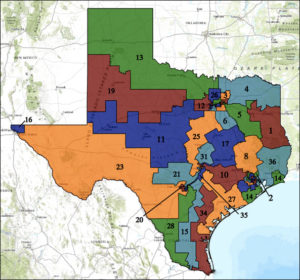
Map of US Congressional districts in Texas

By Jim Ellis

March 26, 2020 — With Gov. Greg Abbott (R) moving the Texas runoff election date, it has drastically changed the short-term Lone Star State political scene. At the end of last week, Abbott transferred the post-primary runoff election date from May 26 to July 14 in consideration of COVID-19 virus precautions.

Statewide, the US Senate Democratic primary is headed to a runoff election, as well as 15 different congressional campaigns.

In the Senate race, retired Army helicopter pilot M.J. Hegar, who held Rep. John Carter (R-Georgetown) to a 51-48 percent re-election victory in 2018, placed first in the Democratic primary with 22.4 percent of the vote, but a long way from the 50 percent plateau a candidate needs to claim a party nomination. She will face state Sen. Royce West (D-Dallas) who slipped into second place by just over a percentage point in the 12-candidate field. Sen. Royce scored 14.5 percent statewide.

The eventual nominee faces three-term Sen. John Cornyn (R), who easily secured re-nomination in his Republican primary (76 percent over four opponents). The longer runoff cycle should typically help the second place finisher, since the individual has more time to change the campaign’s flow. In this case, however, the Democratic nominee, who already starts as a severe underdog to Sen. Cornyn, would lose valuable general election time with the later runoff, thus making the task of overcoming the incumbent even more formidable.

Of the 15 House runoffs, nine are viable to some degree. The six that are not lie in districts that are safe for one party or the other. For example, it matters little which Democrat wins the 13th District runoff (Trump ’16: 79.9 percent), or who eventually becomes the victorious Republican in the 18th CD secondary vote (Clinton ’16: 76.5 percent).

Rep. Van Taylor’s (R-Plano) north Texas seat is typically thought of as safely Republican, but his 54 percent win percentage in 2018 was considerably below the average GOP vote. Two attorneys, Sean McCaffity and Lulu Seikaly will now do battle until July 14 to see who faces Rep. Taylor in his first re-election bid. The two were virtually tied in the Democratic primary, 44.5 – 43.7 percent, with the slight edge going to McCaffity. Rep. Taylor will be the decided favorite in November.

Continue reading

Numbers Rolling in From the
Texas and California Primaries

By Jim Ellis

March 5, 2020 — Tuesday’s elections in Texas and California were subject to slow counting, but at least in the Lone Star State, the numbers are near final.
More than 780,000 votes have currently been received in California but not yet counted. More votes are coming into county offices. To be valid, voters could have postmarked their mail ballots on Election Day and as long as they are received in the county election offices by close of business on March 6, they will be counted. Therefore, an unknown number will be added to the received but uncounted total.

The large total explains why some of the California congressional races remain uncalled even though the vote spreads among the affected candidates is sometimes quite large.

Map of US Congressional districts in Texas

In Texas, US Senate candidate Cristina Tzintzun Ramirez conceded the second Democratic run-off position to state Sen. Royce West (D-Dallas). The two battled for the slot all evening and into yesterday, but the small margin in Sen. West’s favor was definitive enough that Ramirez officially ended her bid. The May 26 statewide run-off election will feature first-place finisher M.J. Hegar, a retired Army helicopter pilot who held veteran Rep. John Carter (R-Georgetown) to a 51-48 percent re-election victory in the 2018 CD-31 campaign that encompasses Williamson and Bell Counties, and now Sen. West. The winner opposes Sen. John Cornyn (R) in November.

The final unofficial Democratic presidential tally finds former vice president Joe Biden scoring 34.5 percent of the vote as compared to 30.0 percent for Sen. Bernie Sanders (I-VT). Though Biden and Sanders were the only candidates to break the 15 percent barrier to qualify for at-large delegates, former New York City mayor Michael Bloomberg and Sen. Elizabeth Warren (D-MA) both obtained the threshold percentage in certain congressional districts, so they, too, earned several delegate votes; both, however, have ended their campaigns, Sen. Warren just this morning. The final unofficial delegate board finds Biden capturing 111 bound Texas first-ballot delegates, Sen. Sanders 102, Bloomberg 10, and Sen. Warren, five.

Just over 2 million people voted in the Democratic presidential primary. President Trump garnered 94 percent of the Republican vote, translating into more than 1.863 million votes. Just under 2 million voters cast ballots in the GOP primary despite there being no real race for president.

Continue reading

Candidate Filings Completed in Battleground State of Pennsylvania

Pennsylvania Congressional Districts

By Jim Ellis

Feb. 21, 2020 — While the Democratic presidential debate of a couple nights ago is getting most of the political news coverage, Democrats and Republicans completed their filings to run for office in one of the country’s major political battlegrounds, the Keystone State of Pennsylvania.

While the state will be one of the most important in the presidential race, it also yields a significant political playing field for the House of Representatives. There is no Senate or gubernatorial election in Pennsylvania this year.

From their 18 House districts, we see only three incumbents drawing primary opposition, and only one of the intra-party challengers appears credible. The state primary is April 28.

Rep. Brian Fitzpatrick (R-Levittown) has one primary challenger, investment company executive Andrew Meehan, but he had raised only $35,000 through the end of last year. It is assumed that Meehan has personal wealth, but whether or not he invests in his own long-shot campaign is as yet unknown.

Freshman Rep. Mary Gay Scanlon (D-Swarthmore) draws Democratic opposition from businessman Lou Lanni, but he does not appear politically credible. Raising only $8,000 through the end of last year, Lanni is not running a competitive campaign. With little to fear from Republicans in this district, Rep. Scanlon appears to have an easy run for her first re-election.

The most interesting primary likely lies in Pittsburgh. Veteran Rep. Mike Doyle (D-Pittsburgh) faces two Democratic opponents, one of whom looks credible. While pastor Janis Brooks does not appear to be a competitive primary contender, attorney Gerald Dickinson, on the other hand, had already raised $173,000 at the end of the year, all from individual contributors. It is still very doubtful that Rep. Doyle will be denied re-nomination, but this is the one primary campaign to watch for a developing challenge.

Continue reading

Special Election Nominees Chosen
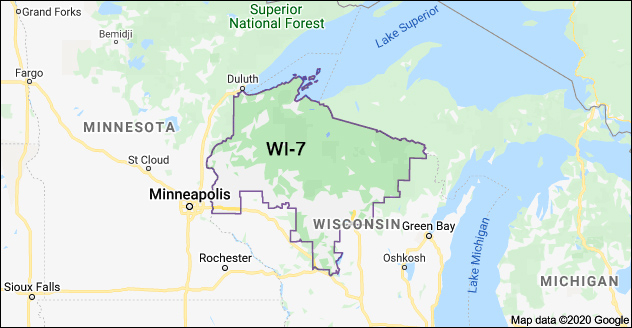
In WI-7: Tiffany (R), Zunker (D)

By Jim Ellis

Feb. 20, 2020 — Wisconsin Republican state Sen. Tom Tiffany (R-Minocqua) and Wausau School Board member Tricia Zunker (D) won their respective party primaries Tuesday night and now head to the special general election scheduled for May 12. The winner of the succeeding contest replaces resigned Rep. Sean Duffy (R-Wausau) in WI-7 who departed Congress earlier in the year for family reasons.

Sen. Tiffany recorded a 57-43 percent win over Army veteran Jason Church who was previously a staff member for Sen. Ron Johnson (R-WI). Church, who lost both legs in Afghanistan, made military service the centerpiece of his campaign. Sen. Tiffany was originally elected to the state assembly in 2010. He won his state Senate seat in 2012 and was re-elected in 2016.

Zunker was an easy winner on the Democratic side, amassing a landslide 89-11 percent victory margin in a race where she became the obvious consensus candidate early in the process.

Sen. Tiffany now becomes the heavy favorite to win the seat in May. The northern Wisconsin region has transformed into a dependable Republican area after this district laid in Democratic hands from early 1969 all the way to the beginning of 2011 in the person of former House Appropriations Committee chairman David Obey.

Over his five elections here, Rep. Duffy averaged 57.9 percent of the vote. President Trump carried the 7th with a 58-37 percent majority, which was a substantial upgrade over Mitt Romney’s 51-48 percent performance. The Republican trend has clearly grown as the decade progressed.

Turnout in the primary election greatly favored the Republican candidates. When the final count is tabulated, the combined GOP participation factor looks to be well over 76,000 as compared to the Democratic total of just over 40,000 votes. The turnout ratio is another factor that provides Sen. Tiffany with a major advantage heading into the special general election.

Continue reading