By Jim Ellis — Monday, October 19, 2026
 Late last week, a Concord Public Opinion Partners poll drew attention for producing a Montana US Senate result that showed Independent candidate Seth Bodnar, the former University of Montana president, leading Republican former US Attorney Kurt Alme. A new Concord survey now reports a similarly competitive finding in the South Dakota Senate race.
The Montana poll, however, was largely debunked due to a sampling universe that skewed Democratic. In response, the Alme campaign released a counter‑survey from Peak Insights (Oct. 7-12; 500 likely Montana voters; live interview) showing Alme ahead of Bodnar and Democrat Alani Bankhead, 44-29-12 percent. This result aligns with all other polling of the race aside from Concord’s.
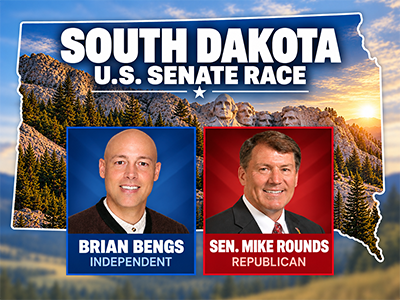
In South Dakota, Concord’s numbers fall within the range of other post‑primary surveys. The new study (conducted for Democrats for Education Reform; Oct. 6-8; 400 likely South Dakota voters; live interview & text) finds Sen. Mike Rounds (R) in a virtual dead heat with Independent Brian Bengs, trailing 42-43 percent.
Within the same sampling universe, Republican Gov. Larry Rhoden leads Democratic former state legislator Dan Ahlers by 10 points, 48-38 percent. Concord also shows Attorney General Marty Jackley running ahead of Democrat Nikki Gronli by just a 44-41 percent spread, also a closer‑than‑expected margin for the open at‑large US House race.
It is likely that Concord’s surveys undercount Republican support across all three contests, but the South Dakota Senate numbers are consistent with other recent polling.
Three Democratic surveys conducted between Aug. 13 and Sept. 9 also found tight results: Impact Research (Aug. 13-17; 500 likely voters) reported a 44-44 percent tie between Rounds and Bengs; Lake Research Partners (Aug. 26-30; 500 likely voters) showed Bengs ahead 51-44 percent; Public Policy Polling (Sept. 8-9; 629 likely voters) found Rounds narrowly leading 45-42 percent. A later poll, from Zenith Research (Sept. 24-27; 500 likely voters), projected the Senator expanding his advantage to 44-38 percent.
The new Concord Partners survey bringing the race back to a virtual tie is therefore within the broader South Dakota trend, unlike the firm’s Montana findings. As a result, the South Dakota Senate race warrants attention. While Sen. Rounds, seeking a third term after serving two consecutive four‑year terms as Governor, remains the likely favorite, the contest appears competitive as the campaign enters its final days.
South Dakota is one of three Senate races in which Democratic leaders persuaded their nominee to withdraw after winning the primary so the party could consolidate behind a former Democrat running as an Independent, thus abandoning the party label. The other two are in Idaho and Nebraska. Democrats attempted a similar maneuver in Montana, urging Bankhead to step aside for Bodnar, but she refused.
According to Concord’s South Dakota analysis, Rounds leads Bengs among Republicans by 36 points, a margin 10 points lower than Gov. Rhoden’s 47‑point advantage within the GOP cell. Bengs, meanwhile, holds a 58‑point lead among Democrats. Most concerning for Rounds is the finding that he loses one in four Republicans to Bengs.
While the published research information may be accurate, it is likely that the Rounds campaign will be able to marshal the GOP troops and secure a third term on Nov. 3. The polling suggests, however, that this is yet another Senate race that merits monitoring on election night.