By Jim Ellis — Tuesday, October 27, 2026
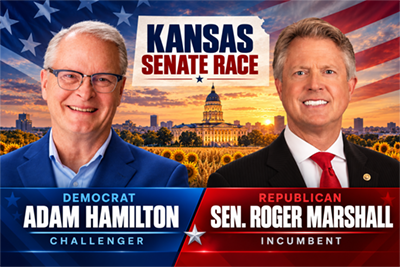 The 2026 Kansas Senate race is polling close, but the same was true in 2014 and 2020. Yet, Republican candidates in those years, Sen. Pat Roberts and then-Rep. Roger Marshall, ultimately won by 10 and 11 points, respectively. Will the same pattern emerge this year? That remains the unanswered question. The most practical conclusion is yes, though likely by a smaller margin.
At a comparable point in the 2014 campaign, SurveyUSA (Oct. 22-26) projected Independent Greg Orman leading Sen. Roberts, 44-42 percent. Fox News (Oct. 28-30) found a similar result, giving Orman a 44-43 percent advantage.
Two other polls showed Roberts holding a slight lead: YouGov (Oct. 25-31) found a 38-37 percent split, while Public Policy Polling (Oct. 30-31), conducting a better poll, posted Roberts ahead 47-46 percent. Going into Election Day, PPP (Nov. 1-3) again gave Orman a narrow 47-46 percent edge.
On election night, however, Roberts prevailed by a decisive 53.1 – 42.5 percent margin.
In 2020, when Roger Marshall was running from his position as the western Kansas 1st District Congressman, the polling trajectory looked similar to that of Sen. Roberts’ 2014 campaign.
Public Policy Polling (Oct. 19-20) found Democrat Barbara Bollier, a state legislator who had switched parties after originally winning election to the Kansas Senate as a Republican, tied with Republican Marshall at 43 percent apiece. GBAO Strategies (Oct. 25-27) projected Bollier holding a slight 46-45 percent advantage, numbers very similar to those currently seen between Sen. Marshall and Democrat Adam Hamilton.
As Election Day approached, polling began moving in Marshall’s direction. VCreek/AMG (Oct. 25-27) showed Marshall leading 47-43 percent, while Data for Progress (Oct. 27-Nov. 1) found him ahead 51-45 percent.
On election night, Marshall won comfortably, 53.2 – 41.8 percent.
Some Kansans believe the historical polling pattern will not repeat itself this year. They point to President Trump’s weak approval ratings and signs of declining support among centrist Republicans. Historically, Kansas has experienced some of the Republican Party’s sharpest internal divisions between its conservative and moderate factions. That split has existed for years, yet it generally has not prevented Republican statewide candidates from winning general elections, with the possible exception of Democratic Gov. Laura Kelly.
Even Gov. Kelly’s victories, however, offer a cautionary note for Democrats. Although she won twice, she never reached the 50 percent majority threshold. In 2022, despite being viewed as a strong favorite, she secured re-election by only a small margin.
Of course, rising diesel and fertilizer costs have adversely affected Kansas’ agricultural communities, creating a campaign dynamic that differs from the historical races discussed above. That issue does not help Marshall.
Early voting statistics may provide additional clues. Comparing the 2026 numbers through Oct. 23 with those from the most recent midterm election in 2022 reveals a reversal in partisan participation. Democrats are casting ballots earlier and at a significantly higher rate than they did four years ago. Such a shift suggests greater Democratic enthusiasm for this election.
There is still time for those patterns to change. Additionally, because early voting behavior itself appears to be evolving, it remains unclear if the pre-election participation numbers will continue to be predictive. Nevertheless, the 2026 data are more favorable to Democrats than those seen in recent Kansas elections.
Another factor is the attack ad against Marshall stemming from a former obstetrics patient who claims he had her arrested over an unpaid $50 medical bill. The Marshall campaign has pushed back, arguing that accumulated interest and fees eventually increased the obligation to more than $3,000. Sen. Marshall also explained that a judge directed the arrest of the individual because she failed to appear in court after being ordered to do so on 16 separate occasions.
Sen. Marshall is likewise challenging Methodist Pastor Adam Hamilton’s efforts to portray himself as a moderate. The Senator’s campaign has highlighted Hamilton’s political contribution history and his support for far left political figures by associating him with candidates connected to the Democratic Socialists of America.
The financial advantage in candidate fundraising clearly belongs to Hamilton, while outside spending favors Marshall. With more than $20 million being spent on each side in a state with approximately 1.87 million registered voters, both campaigns have ample resources to deliver their messages.
This has been a competitive race, as Hamilton has performed like a top-tier challenger despite initially being viewed as a second-tier candidate. It remains to be seen whether he can overcome Kansas voting history to win, but he is likely to perform better than previous challengers who sought to become the first Democrat or Independent elected to a Kansas Senate seat since 1932.
Ultimately, more underlying indicators and historical data points suggest that Sen. Marshall is positioned slightly better to prevail. Nonetheless, if Sen. Marshall wins re-election, the margin will likely be smaller than Kansas voting history would normally project.