Tag Archives: Jim Ellis

Georgia Rep. Rob Woodall to Retire:
A Look at the Seat’s 2020 Contenders

By Jim Ellis

Georgia Rep. Rob Woodall (R-Lawrenceville)

Feb. 11, 2019 — Five-term Georgia Rep. Rob Woodall (R-Lawrenceville), who survived the closest raw vote election of any winning incumbent last November (419 votes from just over 280,000 ballots cast against former state Senate committee staff director Carolyn Bourdeaux), announced late last week that he won’t seek re-election in 2020.

This opens a seat that was obviously highly competitive in the ’18 election cycle, but this lone result might not tell the entire story.

Only at the very end of the election cycle did Rep. Woodall launch a campaign, previously believing that his seat would perform as a safe Republican enclave just as it had since its inception under the 2001 redistricting plan, and then reconfigured in the 2011 remap. Then-Congressman John Linder (R) represented the district at the time and until his retirement before the 2010 election, always enjoying landslide re-election percentages.

Woodall was badly outspent by challenger Bourdeaux, falling behind her by a 2:1 ratio as his campaign posted less than $1.5 million in direct expenditures.

Continue reading

Mississippi’s Dead Heat

By Jim Ellis

Mississippi state flag

Feb. 7, 2019 — The open Mississippi governor’s race will be decided later this year, and a new Mason-Dixon Polling & Strategy survey (Jan. 30-Feb. 1; 625 registered Mississippi voters) finds Attorney General Jim Hood (D) and Lt. Gov. Tate Reeves (R) locked in a virtual tie. The Republican incumbent, Gov. Phil Bryant, is ineligible to seek a third term.

While Hood, a four-term AG, holds a slight 44-42 percent edge, Reeves has closed the original six-point spread that Mason-Dixon first found in their December 2017 poll (Hood 43 percent; Reeves 37 percent). In April of last year, M-D projected Hood’s advantage to be 44-39 percent.

But, winning the popular vote is not all that’s required to win a Mississippi statewide race. In similar fashion to a presidential candidate needing to score a victory in the Electoral College, a Mississippi gubernatorial candidate must not only record the most votes in the statewide aggregate count, he or she must also win a majority of the 122 state House districts.

Currently, Republicans hold a 72-46 split in the state House with four vacancies. Thus, it would appear Reeves would have a strong opportunity to capture at least a bare majority 63 House districts, assuming the statewide count is close. If no candidate carries a majority of state House districts, the state House members would then vote to decide the election between the top two finishers.

Continue reading

Two New Polls Show Tracking Trends In 2020 Presidential Race

By Jim Ellis

Feb. 6, 2019 — The Emerson College Polling Institute and Monmouth University just released two presidential polls, the former of Iowa voters, the latter, a national study.

The Emerson poll (Jan. 30-Feb. 2; 831 registered Iowa voters, 260 likely Iowa Democratic caucus attenders) finds former Vice President Joe Biden leading Sens. Kamala Harris (D-CA) and Bernie Sanders (I-D/VT), 29-18-15 percent, while Sen. Elizabeth Warren (D-MA) posts 11% support.

The other candidates land in single digits: ex-Rep. Beto O’Rourke (D-TX) at six percent; Sens. Cory Booker (D-NJ) and Sherrod Brown (D-OH) both with four percent; Sen. Amy Klobuchar (D-MN) has three percent; while former HUD Secretary Julian Castro posts two percent, and ex-Rep. John Delaney (D-MD) each register one percent support.

The results are consistent with previous polls conducted of the Iowa Caucus sampling universe even though the Democratic sample in this survey is very low.

During the period of Jan. 25-27, Monmouth University tested a national sample of 735 registered US voters from a pool of 805 adults to determine perceptions mostly of the Democratic candidates, but also queried the aggregate respondent universe about President Trump.

Continue reading

Special Election Called in PA

By Jim Ellis

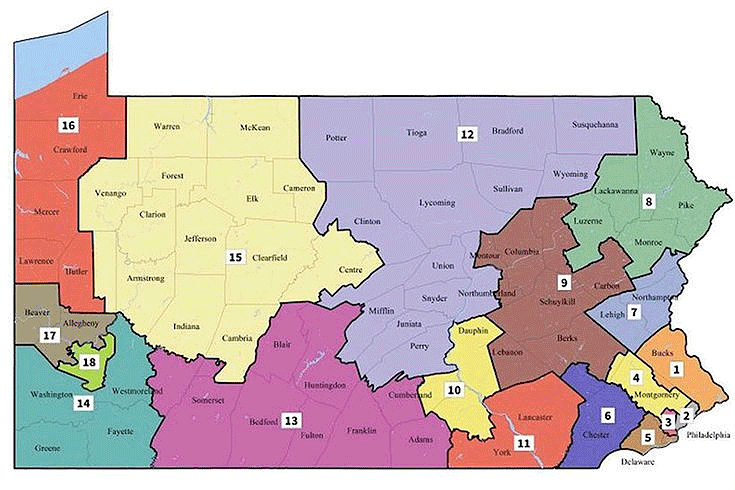
Pennsylvania Congressional Map | Source: Pennsylvania State Supreme Court (click on image to see full size)

Jan. 29, 2019 — While most of the special election banter surrounds the still undecided North Carolina situation (NC-9), the first new election of the year has just been scheduled.

With Pennsylvania Rep. Tom Marino’s (R-Williamsport) surprise announcement earlier this month that he was resigning from the House, a move he made official on Jan. 23 to accept a position in the private sector, Gov. Tom Wolf (D) has already called the replacement special election to fill the new vacancy.

As expected, Gov. Wolf made the 12th District special election concurrent with the Pennsylvania statewide municipal primary, which is scheduled for May 21. There will be only the one election, and the candidate receiving the most votes, regardless of percentage attained, will serve the balance of the current term.

In the meantime, the 15 county chairmen from the qualified political parties will schedule a convention in the district to choose their respective nominee. Generally, the convention is weighted to accurately reflect the population spread throughout the district. Therefore, the most populous counties within the 12th CD, Lycoming and part of Centre that together possess 29 percent of the district’s population, will likely have a commensurate number of votes at the special nominating convention.

Continue reading

The Justice Democrats

By Jim Ellis

The Justice Democrats logo (click on image to go to their website)

Jan. 18, 2019 — Similar to the time when the Republicans controlled the House, it appears the most ideologically committed faction of the Democratic Party is already beginning to target the more centrist majority members for primary defeat.

The Justice Democrats organization spokespeople reiterated yesterday that they will be opposing certain incumbents in Democratic primaries beginning with Texas Rep. Henry Cuellar (D-Laredo).

The group boasts of having newly-elected Reps. Alexandria Ocasio-Cortez (D-NY) and Ayanna Pressley (D-MA) as members after the pair defeated Reps. Joe Crowley (D-Queens) and Mike Capuano (D-Somerville) in their respective 2018 primaries. The Justice Democrats also list veteran Reps. Raul Grijalva (D-AZ), Ro Khanna (D-CA), and Pramila Jayapal (D-WA) as members along with newly elected freshmen Ilhan Omar (D-MN), and Rashida Tlaib (D-MI).

The Justice Democrats have a published issue agenda that includes “Medicare for All”, guaranteed living wages, federal guaranteed jobs, taxpayer financed higher education for anyone who wants to attend a university or college, their “Green New Deal” pertaining to environmental policy, and law enforcement reform, among other issues.

Continue reading

Senate Approvals

By Jim Ellis

Jan. 14, 2019 — The Morning Consult firm just released their quarterly ranking of Senate job approval scores. All 100 senators are surveyed, and the numbers cover the fourth quarter of 2018. Several categories are of interest.

First, a number of ratings are similar for both senators in a particular state. Vermont respondents were particularly pleased with Sens. Bernie Sanders (I/D-VT) and Patrick Leahy (D). The duo placed first and second nationally, with approval ratings of 64:28 percent and 62:23 percent favorable to unfavorable, respectively.

They were closely followed by Republican senators John Barrasso (R-WY; 62:26 percent) and John Thune (R-SD; 59:27 percent). The two senators’ state mates, Sens. Mike Enzi (R-WY; 56:27 percent) and Mike Rounds (R-SD; 56:29 percent), were also in the top 10.

Now-former Sen. Jeff Flake (R-AZ) recorded the worst rating in the body, with a 28:49 percent negative ratio. Two Senate leaders, Majority Leader Mitch McConnell (R-KY; 38:47 percent) and Minority Whip Dick Durbin (D-IL; 36:39 percent) were also in the Bottom 10.

Since this is the fourth quarter 2018 report, the five senators who lost re-election along with those who won competitive races are included. Below are their favorability scores Continue reading

Biden Up Twice

By Jim Ellis

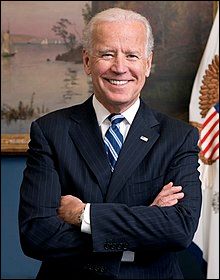
Former vice president and ex-Delaware senator Joe Biden

Dec. 18, 2018 — A pair of Democratic presidential primary polls were just released — one with a national respondent universe, and the other for the first-in-the-nation Iowa Caucus. In both, former vice president and ex-Delaware senator Joe Biden is staked to a lead. The most disappointing performer appears to be Massachusetts Sen. Elizabeth Warren, who settles into middle-of-the-pack status in both surveys.

CNN conducted the national poll (conducted by the SSRS firm; Dec. 6-9; 463 Democrats and independent-leaning Democrats). For two reasons, this survey is of little statistical relevance. First, the national sample of only 463 individuals is very low, thus leading to a huge error factor. Second, as we know, the presidential nomination process is decided by winning delegate support in every state and territory, thus monitoring a candidate’s national standing, while being of media interest, actually provides little in the way of tangible political value.

The Des Moines Register/CNN Mediacom Iowa poll (conducted by Selzer & Company; Dec. 10-13; 455 likely Iowa Democratic Caucus attenders) is the more relevant of the two studies since it previews the Iowa Caucus, which is responsible for apportioning the state’s nominating delegates and tentatively scheduled for Feb. 3, 2020.

In the national poll, Biden places first with 30 percent preference followed by Vermont Sen. Bernie Sanders (I/D-VT) who posts 14 percent. These are the only two potential candidates in double figures.

Continue reading

Potential Specials in North Carolina

By Jim Ellis

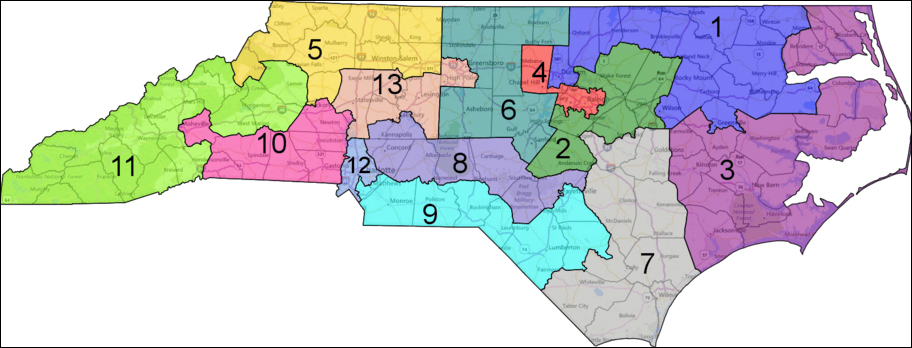
Dec. 12, 2018 — Rep. Mark Meadows (R-Skyland/Asheville) being mentioned as a possible successor to outgoing White House chief of staff John Kelly means that a special election would be called for western North Carolina if the congressman were to vacate his district. Should this come to pass, the state may be forced to host two congressional special elections but possibly under different rules.

North Carolina Congressional Districts

The 9th District, which stretches from Charlotte to Fayetteville along the South Carolina border, is likely headed to a new vote since the state Board of Elections refuses to certify Republican Mark Harris’ 905-vote lead over Democrat Dan McCready due to election irregularities in one county.

Though the two potential elections could reasonably be held under the same schedule, the process parameters surrounding each are likely to be different.

If Rep. Meadows’ district opens, the special election will be run under traditional rules, meaning open partisan primaries and a general election once nominees are chosen. But, not so in the 9th District.

Under North Carolina law, should the Board of Elections declare the original election null and void after their investigation into the alleged irregularities concludes, a new special election would be a rerun of the 2018 general election, meaning the candidates would be Harris, McCready, and Libertarian nominee Jeff Scott.

Continue reading

Projecting Apportionment

By Jim Ellis

Dec. 7, 2018 — New population growth numbers are now available from the Census Bureau, allowing us to gain more clues about how the coming 2020 post-census apportionment might look for the nation’s congressional districts.

Every 10 years, states gain and lose CDs based upon their total population and percentage growth figures. The current US population of 327,774,453 represents a growth rate of 5.96 percent when compared to 2010.

Currently, Idaho is the fastest growing state for 2018, with a gain of 2.15 percent for the current year, the only state to break the two percent barrier for the period. Nevada (1.96 percent), Utah (1.85 percent), Washington (1.69 percent), and Florida (1.56 percent) round out the top five.

The group constituting the bottom half of the top 10 in 2018 growth contains Arizona (1.53 percent), Texas (1.41 percent), Colorado (1.37 percent), Oregon (1.37 percent), and South Carolina (1.28 percent).

On the other hand, eight states, led by Wyoming (-0.97 percent), actually lost population during the year. The others are West Virginia, Illinois, Alaska, Hawaii, Mississippi, Louisiana, and North Dakota.

Continue reading