Tag Archives: Wyoming

Senate: Open Race Recap

By Jim Ellis — Friday, March 27

Senate

Below is a status update of the 11 open US Senate races that will go a long way toward determining which party controls the chamber in the next Congress:

Alabama: Rep. Barry Moore (R-Enterprise), after receiving the Trump endorsement and now Majority Leader John Thune’s backing, has pulled ahead of state Attorney General Steve Marshall (R) in polling and fundraising. Marshall is Rep. Moore’s principal Republican opponent. Still, Moore winning the party nomination outright in a field of six candidates is a tall order.

The Alabama primary is May 19. If no candidate receives majority support, the top two finishers advance to a June 16 runoff election. The eventual Republican nominee wins the seat in November.

Illinois: With her victory in the March 17 open Democratic primary, Lt. Gov. Juliana Stratton has punched her ticket to the Senate. She will succeed retiring Sen. Dick Durbin (D) in the next Congress with an easy general election victory.

Iowa: Rep. Ashley Hinson (R-Marion/Cedar Rapids) is the consensus Republican nominee and will open the general election as the favorite to carry the state in November. The Democrats feature a tightly contested primary between state Sen. Zach Wahls (D-Des Moines) and state Rep. Josh Turek (D-Council Bluffs). The VoteVets group just announced they will spend $825,000 in an independent expenditure for Turek. The Iowa primary is June 2.

Kentucky: Rep. Andy Barr (R-Lexington) and former Attorney General and 2023 Republican gubernatorial nominee Daniel Cameron are locked in a very tight race with businessman Nate Morris a distant third. Rep. Barr, however, had a 10:1 cash-on-hand advantage over Cameron at the end of 2025. Democrats have a crowded primary with former state Representative and ex-US Senate candidate Charles Booker taking an early lead.

The Kentucky plurality primary is May 19. The eventual Republican nominee will be heavily favored in the general election.

Michigan: An intense Democratic primary is underway among Rep. Haley Stevens (D-Birmingham), state Sen. Mallory McMorrow (D-Royal Oak), and former Wayne County Health Director Abdul El-Sayed. Polling and fundraising are relatively even, though Rep. Stevens has the resource edge.

This primary won’t be decided until Aug. 4, which is a boon to GOP candidate Mike Rogers, the former Congressman who came within three-tenths of a percentage point of winning the 2024 Senate race. This contest will be in toss-up mode all the way to election day.

Minnesota: While Democrats feature a primary battle between Lt. Gov. Peggy Flanagan and Rep. Angie Craig (D-Prior Lake), Republicans have a consensus candidate in former national sports broadcaster Michele Tafoya. This race has the underpinnings of evolving into a surprisingly competitive general election even though Minnesota is a reliable Democratic state.

A tough and late Democratic primary (Aug. 11), unrest within the state, and Republicans united behind a strong candidate makes this contest more interesting than one would have expected after Sen. Tina Smith (D) announced her retirement.

Montana: The surprise withdrawal of Sen. Steve Daines (R) just before the candidate filing deadline expired and basically handing the party nomination to his chosen successor, former US Attorney Kurt Alme, will likely work even though the move does not sit well with most Montanans. At this point, Alme must be rated as the favorite to win the seat. Democrats have a five-way primary and former state Rep. Reilly Neill is considered the favorite to win the party nomination.

The most formidable non-Republican contender is likely former University of Montana President Seth Bodnar who is running as an Independent. The Montana primary is June 2, so it remains to be seen how a three-way general election race will evolve once both major parties have nominees in place.

New Hampshire: Democrats have a consensus candidate to replace retiring Sen. Jeanne Shaheen (D) in the person of Rep. Chris Pappas (D-Manchester). A new St. Anselm’s College Poll finds the Congressman leading former Sen. John E. Sununu (R) by only a 46-43 percent margin in the Senate general election ballot test.

Sununu, who served in the Senate from 2003-2009, is the clear favorite in the Republican primary opposite former Massachusetts Sen. Scott Brown, who challenged Sen. Shaheen in 2014.

North Carolina: Nominees are already set in the Tar Heel Senate race, as both former Gov. Roy Cooper (D) and ex-Republican National Committee chairman Michael Whatley each won their respective primaries outright in the March 3 primary election.

Cooper, who has won six statewide North Carolina races (two as Governor and four for Attorney General), may be in the best position of any Democratic Senate candidate to flip a Republican seat. Expect this race to end in a close finish as do most North Carolina political campaigns.

Oklahoma: With no serious opposition mounting in the Republican primary against Rep. Kevin Hern (R-Tulsa), who is quickly becoming a consensus GOP candidate in one of the strongest Republican states, the party does not have to worry about keeping Oklahoma in the red column.

Former Sen. Markwayne Mullin (R) was just confirmed as US Homeland Security Secretary. Gov. Kevin Stitt (R) appointed energy executive Alan Armstrong (R) to replace Sen. Mullin until the regular election cycle is complete. Because the Mullin seat is in-cycle, a special and regular election for the full six-year term will be held concurrently.

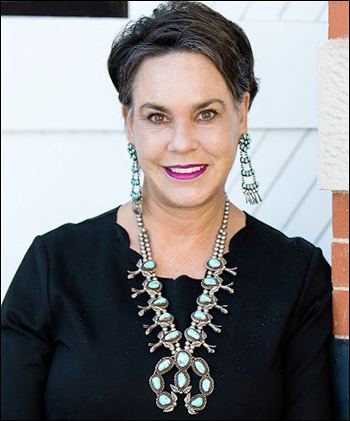
Wyoming: Sen. Cynthia Lummis (R) deciding not to seek a second six-year term has opened the door for at-large Rep. Harriet Hageman (R-Cheyenne) to become her successor. Expect Rep. Hageman to easily win both the Republican primary and the general election with the state’s other major political figures either running for the open Governor’s position or Hageman’s open congressional seat.

Primary Results:
Alaska, Florida, Wyoming

By Jim Ellis — Wednesday, August 21, 2024

Primary Results

Alaska Rep. Mary Peltola (D)

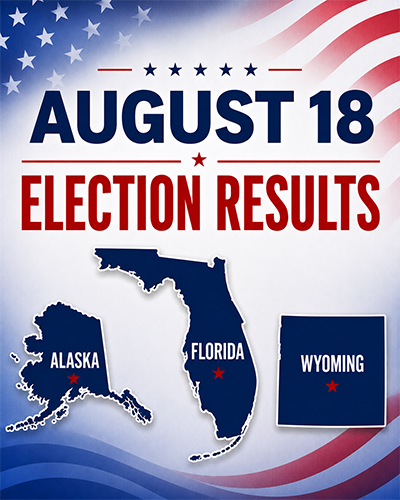
Alaska: Peltola, Begich Finish 1, 2 — As expected, at-large Rep. Mary Peltola (D-Bethel) finished first in the top-four Alaska jungle primary, but the unanswered question was whether businessman Nick Begich III or Lt. Gov. Nancy Dahlstrom, the choice of the Republican establishment and former President Donald Trump, would become her prime competitor. While Rep. Peltola is knocking on the door of the majority support threshold as ballots continue to be counted, it was Begich who secured second place, while Dahlstrom finished almost seven points behind him and 30 points behind the congresswoman.

The next few days of jockeying will be interesting. The Republicans will have their best chance of unseating Rep. Peltola if they unite behind one candidate, and it appears their only choice will be Begich. If they remain divided among two major GOP contenders, then the outcome will be the same as we’ve seen before, which is that Rep. Peltola will continue representing the most Republican congressional district in the country to elect a Democrat to the House.

Florida: Scott Romps; No Major Upsets — The Florida primary unfolded as expected. Sen. Rick Scott (R) and former Rep. Debbie Mucarsel-Powell (D) were easy winners in their respective primaries. Sen. Scott posted over 84 percent in the Republican primary, while Mucarsel-Powell captured just over two-thirds of the Democratic vote.

Sen. Scott and Mucarsel-Powell will now advance to the general election where the incumbent is favored in a state where the Republican registered voter factor exceeds its Democratic counterparts by more than 1 million individuals.

In the 1st Congressional District, Rep. Matt Gaetz (R-Niceville/Pensacola) was again an easy winner, exceeding 72 percent of the vote over Navy veteran Aaron Dimmock who moved into the district to challenge the congressman. Gaetz will now advance into the general election where he becomes a prohibitive favorite in a seat that the FiveThirtyEight data organization rates as R+38.

In the Atlantic coastal 8th District, as expected, former state Senate President Mike Haridopolos topped 72 percent of the vote to claim the Republican nomination. He will replace retiring Congressman Bill Posey (R-Rockledge) who announced that he would not seek re-election just before the candidate filing deadline expired. Haridopolos now becomes a sure winner in the general election.

In a St. Petersburg-anchored congressional district that can become competitive, marketing consultant Whitney Fox, as expected, easily won the Democratic primary and advances into the general election to oppose freshman Rep. Anna Paulina Luna (R-St. Petersburg). The congresswoman is favored, but the district electorate is relatively close. The Republican general election vote is likely to land in the low to mid-50s.

Rep. Laurel Lee (R-Tampa), who Trump targeted for defeat before he decided to endorse her when no major GOP competition emerged, also topped 72 percent in last night’s GOP primary. Hillsborough County Commissioner Patricia Kemp, who was unopposed in the Democratic primary, will now become Rep. Lee’s November opponent. Since Kemp has under-performed on the fundraising circuit, Rep. Lee is viewed as a clear November favorite in central Florida’s most competitive seat.

Veteran Rep. Vern Buchanan (R-Sarasota) faced a credible Republican primary opponent, but the congressman easily prevailed with 61 percent voter preference. The primary should prove to be Rep. Buchanan’s most formidable challenge in a 16th District that the FiveThirtyEight data organization rates as R+13.

In South Florida, we saw a minor upset as Miami-Dade County School Board member Lucia Baez-Geller defeated former Key Biscayne Mayor Mike Davey with a 54 percent vote total. She now will face two-term Rep. Maria Elvira Salazar (R-Miami) in what appears to be a dead-even district on paper demographically, but with an electorate that tends to vote more conservatively.

Wyoming: Barrasso, Hageman Renominated — As predicted, Wyoming Sen. John Barrasso (R) and at-large Rep. Harriet Hageman (R-Cheyenne) were easily renominated with landslide Republican primary victories last night. Sen. Barrasso’s 68 percent victory at this writing and Rep. Hageman scoring 81 percent of the primary vote will send both office holders to the general election in what promises to be Donald Trump’s strongest state in the country.

Electoral College — Left Coast, Right Coast; Republicans Choose Nominee in VA-4; North Carolina Supreme Court Rejects Map

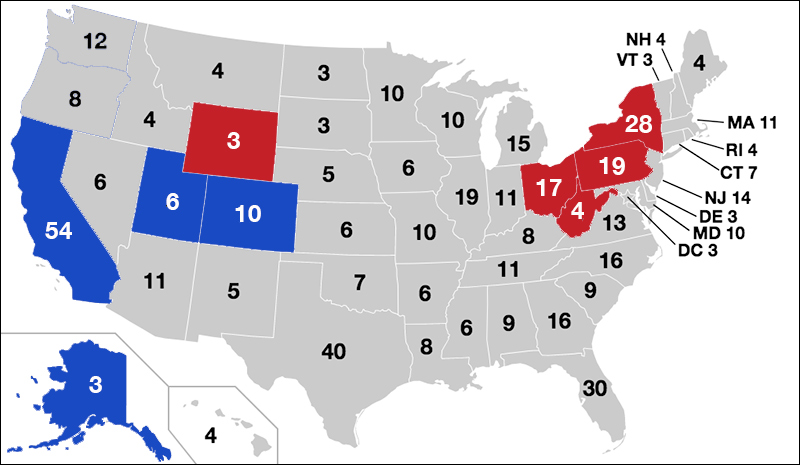
Electoral College Votes Per State, 2022 — blue moving more left, red moving more right


By Jim Ellis — Tuesday, Dec. 20, 2022

President

Electoral College: West Moving Left, East Moving Right — The researchers at the University of Virginia’s Center for Politics have completed a study regarding the country’s ideological shift during the past 20-plus years. Tracking all 50 states’ presidential votes from the 2000-2020 elections, we first see all of the western states now voting Democratic in greater percentages with the exception of Wyoming. The biggest shifts came in Alaska, California, Colorado, and Utah, though two of those four states still regularly produce at least smaller majority or plurality Republican victories.

Conversely, the south and east have trended more Republican with the strongest swings generally occurring in central south with only Maryland, Rhode Island, Vermont, and Virginia becoming more Democratic. Mid-Atlantic states such as New York, Ohio, Pennsylvania, and West Virginia have moved decidedly more Republican, though two of these four continue to regularly deliver clear Democratic majorities. Remaining constant in their voting pattern during this entire 20-year span are Illinois, Maine, Massachusetts, Minnesota, and South Carolina.

House

VA-4: Republicans Choose Special Election Nominee — Republicans re-nominated their 2020 and 2022 candidate in the Saturday, Dec. 17 “firehouse primary” through Ranked Choice Voting. The local 4th District Republican Party leadership did not release the actual results, only to say that pastor and US Navy veteran Leon Benjamin had defeated former Mecklenburg School Board member Dale Sturdifen, and non-profit advocacy organization director Derrick Hollie. Benjamin now advances to the Feb. 21 special general election to replace the late Rep. Donald McEachin (D-Richmond). He will again be a decided underdog in a district that the FiveThirtyEight data organization rates D+30.

The Democratic firehouse primary will be held today. Four candidates filed to run: state Sens. Jennifer McClellan (D-Richmond) and Joseph Morrisey (D-Richmond), former state Delegate Joseph Preston, and businessman Tavorise Marks. While the special election will be held in late February, Gov. Glenn Younkin’s (R) call required the parties to choose nominees by Dec. 23.

In another development, Colette McEachin, the late congressman’s widow, announced her endorsement of Sen. McClellan, joining most of the Virginia Democratic establishment who has already done so.

States

North Carolina: NC Supreme Court Tosses State Senate Map — The North Carolina state Supreme Court, with the 4-3 Democratic majority on the cusp of expiring, rejected the NC Senate map on a partisan vote as a partisan gerrymander. But, the action is likely to be short-lived and adds fuel to the speculation that the new legislature will re-draw all of the state’s redistricting maps after commencement. Doing so may well render moot the partisan gerrymandering case that the US Supreme Court recently heard.

Under North Carolina legislative procedure, the governor has no veto power over redistricting legislation, so whatever the legislature passes will become law. Because of the current court’s farewell action, the state Senate map must be re-configured. Since Republicans gained two seats on the state Supreme Court in the November election and will have a 5-2 majority beginning in January, the likelihood of not only the Senate map being redrawn but also the state House and congressional delegation plans is greater. The latter two maps are court-drawn interim placeholders, which the legislature can replace at any time.

Early Voting Open in Four States; Sen. Bennet Up Comfortably in Colorado; Utah Senate Polling Shows Close Results; Florida House Turmoil

By Jim Ellis — Tuesday, Sept. 27, 2022

Voting

Early voting has begun in Minnesota, South Dakota, Virginia, and Wyoming.

Voting Begins: Early Voting Open in Four States — The first general election votes of the 2022 election cycle will be received soon. The early voting calendar has opened in Minnesota, South Dakota, Virginia, and Wyoming. Ballots have been mailed to voters in North Carolina and Pennsylvania, so we can expect to see early voting commence in those two states, as well.

Most of the states return to their pre-2020 voting status, since the court-ordered Covid related universal mailing voting rules were in effect only for the previous election year unless the state enacted new electoral procedures in their 2021-22 legislative session. Even though the universal mail balloting provisions revert to previous law, 45 states now feature some type of early voting procedure.

Senate

Colorado: Sen. Bennet Up Comfortably — Emerson College tested the Centennial State electorate (Sept. 18-19; 1,000 likely Colorado general election voters; multiple sampling techniques) and found Sen. Michael Bennet (D) leading GOP businessman Joe O’Dea by a ten-point, 46-36 percent, margin. Republicans have tagged this race as an upset possibility, but this poll shows little weakness for the Democratic incumbent who is seeking his third full term.

Utah: Another Close Result — Polling data suggests that the Utah Senate race is the closest campaign that attracts the least national attention. A new Dan Jones & Associates survey for the Deseret News/Hinckley Institute of Politics (Sept. 3-21; 815 registered Utah voters; 786 likely general election voters) finds Sen. Mike Lee (R) ahead of Independent Evan McMullin by only a 37-34 percent margin. Though this poll has a very long sampling period, which adversely affects accuracy, it is consistent with some others we’ve seen of this race.

Early in September, both Impact Research and Kurt Jetta, polling for the Center Street PAC, found the candidates languishing within a combined four-point range. Impact Research actually found McMullen claiming a one-point edge.

Back in April, the majority of Utah Democratic Party convention delegates voted not to field a candidate for the purpose of coalescing behind McMullin. Though he is more conservative than what most of the delegates would have desired in a candidate, they did want to see McMullin have a one-on-one shot to challenge Sen. Lee.

House

FL-22: Rep. Deutch Announces Resignation Plans — In February, Florida Rep. Ted Deutch (D-Boca Raton) announced that he would leave the House before the end of the current legislative session in order to assume the leadership of the American Jewish Committee. At the time, Deutch said he would leave sometime on or around Oct. 1. Late last week, the congressman confirmed he will officially resign his seat before the end of September.

It is unlikely that Gov. Ron DeSantis (R) will have the time to call a special election to replace Deutch for a probable lame duck session since Florida law dictates a relatively long voting schedule period once such an election is called. Therefore, with the party nominations having been decided in the Aug. 23 primary, the new 23rd District will remain open until the new Congress convenes on Jan. 3, 2023. In the open seat general election, Broward County Commissioner Jared Moskowitz (D) is favored over Republican Joe Budd in a South Florida district that the FiveThirtyEight data organization rates D+9.

Alaska: Peltola, Palin Advance; Murkowski, Tshibaka to General; Wyoming Rep. Cheney Loses Big

By Jim Ellis — August 17, 2022

Primary Results

Former state Rep. Mary Peltola (D) is leading the Alaska special election race to fill the state’s at-large congressional district.

Alaska: Peltola, Palin Advance; Murkowski, Tshibaka to General — With just under 70 percent of the voting tabulated, and as expected by consolidating the smaller Democratic vote, former state Rep. Mary Peltola (D) is leading the special election race to fill the state’s at-large congressional district left vacant when veteran Rep. Don Young (R-Ft. Yukon) passed away in March.

Former governor and vice presidential nominee Sarah Palin (R) holds a 5,266 vote lead over Nick Begich III (R) for the all-important second place position. Under Alaska’s new voting procedure, ballots postmarked yesterday have until Aug. 31 to reach the county clerk’s office and be tabulated. The extra time is important for the outlying rural areas to be included.

Second position is so important because the third-place finisher in this electoral situation, at this point that being Begich, will be eliminated and the Ranked Choice Voting process will begin. If Begich is eliminated, the ballots listing him as the first choice will be found and the second choice votes from only these ballots will be added to the process. The eventual winner will immediately be sworn into the House. All three of the aforementioned candidates also advanced into the regular general election.

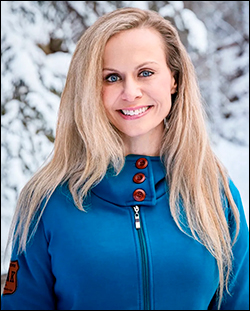
Alaska republican Senate candidate Kelly Tshibaka

Turning to the US Senate race, incumbent Sen. Lisa Murkowski (R), running for a fourth full term, is first at this point in the counting process with 43.7 percent of the vote among 19 jungle primary candidates, and just ahead of former Alaska Director of Administration Kelly Tshibaka (R), who former President Trump long ago endorsed. Tshibaka’s current vote percentage is 40.4. It appears Democrat Patricia Chesbro (6.2 percent) is well-positioned to take a distant third place; vying for the fourth and final position are Republicans Buzz Kelley and Pat Nolin.

In the governor’s race, incumbent Mike Dunleavy (R) looks to have secured first position with 41.7 percent of the jungle primary vote among 10 candidates. Also clinching general election ballot slots are former state Rep. Les Gara (D) with 22.0 percent of the vote, and ex-Gov. Bill Walker (I) who so far has posted a close 21.9 percent. The final general election qualifying position appears undecided between two Republicans, Charlie Pierce and Christopher Kurka.

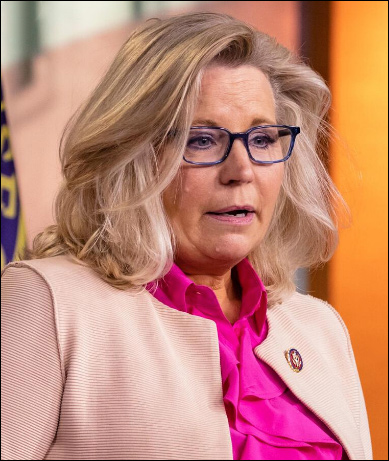
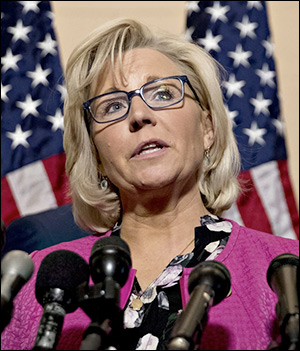
At-Large Wyoming Rep. Liz Cheney (R)

Wyoming: As Expected, Rep. Cheney Loses Big — Early in the counting process, it was clear that At-Large Wyoming Rep. Liz Cheney (R-Wilson/Jackson) would lose her US House seat to attorney Harriet Hageman, the candidate former President Donald Trump supported early.

The vote count was a landslide in favor of Hageman — 66-29 percent — who ran a measured campaign. Her theme was concentrating on serving the constituency while highlighting that Rep. Cheney used the position to fulfill her own political goals.

Incumbent Sen. Cheney carried only her home county of Teton, which houses the cities of Jackson and Jackson Hole, and southeastern Albany County; Hagman topped the vote totals in the state’s other 21 counties. Republican turnout overwhelmed that of the Democrats, 170,409 to just 7,233 ballots cast, suggesting that a large number of the latter party’s members did what Cheney asked them to do and crossed over to vote for her in the Republican primary.

The GOP turnout was up 58.7 percent compared to 2020, while Democratic participation was down 30.7 percent, providing more evidence that a significant number of Democrats voted in the Republican primary. Two years ago, Cheney won a contested Republican primary with 73.5 percent of the vote, and scored a 68.6 percent win in the general election.

Hageman will now face the new Democratic nominee, Native American community activist Lynette Grey Bull, the 2020 party standard bearer against Cheney. Hageman now becomes the prohibitive favorite to win the general election.

Senate

New Hampshire: Candidate Staked to Big Lead — St. Anselm’s College released the results of their quarterly poll of Granite State voters, this one taken a month before the state’s late primary election. This New Hampshire sampling universe (Aug. 9-11; 1,898 registered New Hamshire voters; 900 likely New Hampshire Republican primary voters; live interview), as have those from two other St. Anselm’s 2022 polls, sees President Biden with an upside-down job approval rating. Biden registers 42:57 percent favorable to unfavorable status.

Republicans hold a three-point lead on the generic party vote questions, and 68 percent of the respondents believe the country is on the wrong track versus just 21 percent who believe America is headed in the right direction. Democrats have a clear advantage on the abortion issue by a 49-23 percent margin.

In the Senate GOP primary, retired general and 2020 Senate candidate Don Bolduc holds a significant 32-16-4-4 percent advantage over state Senate President Chuck Morse (R-Salem), former Londonderry Town Manager Kevin Smith, and investor Bruce Fenton, respectively.

House

NH-1: 2020 Nominee Mowers Leading in New Poll — The co/efficient survey research firm tested the upcoming Sept. 13 Republican congressional field in the state’s swing 1st District. New Hampshire’s eastern CD has defeated more incumbents than any seat in the country since the 2004 election.

In the Republican primary where candidates hope to challenge Rep. Chris Pappas (D-Manchester) in the general election, the survey (Aug. 13-14; 829 likely NH-1 Republican primary voters; live interview & text) projects 2020 nominee Matt Mowers to be leading the field with 31 percent support. Former Trump White House media aide Karoline Leavitt 16 percent, state Rep. Tim Baxter (R-Portsmouth) nine percent, and former news reporter and wife of ex-Massachusetts Sen. Scott Brown (R), Gail Huff Brown, at eight percent preference. This district electorate will once again witness a highly competitive general election.

Our Primary Preview Shows Liz Cheney Down Big in Latest Wyoming Poll; Key California Race Polls; Incumbents in Trouble in Four States

By Jim Ellis — Aug. 15, 2022

Primary Preview

Rep. Liz Cheney, (R-WY)

WY-AL: Cheney Down 29 Points in Poll — The University of Wyoming Survey & Analysis Center conducted a poll of Tuesday’s Republican congressional primary (July 25-Aug. 6; 562 likely WY-AL Republican primary voters; live interview) and sees GOP attorney Harriet Hageman leading US Rep. Liz Cheney (R-Wilson/Jackson) by a whopping 57-28 percent count as the candidates wrapped up their final campaign activities during the weekend.

Remembering that Wyoming has an open primary where Democrats and Independents can vote in a Republican primary (and vice-versa), Cheney’s numbers among self-identified Republican voters are even worse, 68-15 percent, in favor of Hageman. The congresswoman gets 98 percent of the crossover Democratic vote, however, while the Independents are split about evenly with the incumbent leading 43-40 percent within this voter segment.

Former Wyoming Republican National Committeewoman Harriet Hageman (R)

The pollsters wanted to see how many people are actually voting for a Cheney opponent, namely Hageman, or to make a statement of opposition against the congresswoman. Therefore, after the individual had stated a candidate preference, the interviewer asked the respondents if their vote is to “mainly support” (the named candidate) or oppose Liz Cheney? The reverse was asked of those people saying they are voting for the congresswoman.

Among Republicans voting for Hageman or one of the other Cheney opponents, 39.5 percent said they were making a statement of opposition toward the Congresswoman, while 31.5 percent said they were stating support for their chosen candidate. The remaining 29.0 percent volunteered that they were doing both. Among the Democrats voting for one of the Republicans other than Cheney, 100 percent of them said they were doing so to oppose the congresswoman. Within the Independent non-Cheney voter segment, 47.1 percent said their vote opposes Cheney versus 21.6 percent to support their chosen contender.

For those supporting Rep. Cheney, 77.8 percent of Republicans, 60.0 percent of Democrats, and 58.8 percent of Independents said their vote is a sign of support for the congresswoman. It appears clear that Hageman will defeat Rep. Cheney on Tuesday night.

A Cheney defeat would mean that of the 10 Republican House members who voted to impeach former President Trump, only one, Rep. Dan Newhouse (R-WA) who survived his jungle primary with less than 30 percent of the vote, is on a track to win re-election. Rep. David Valadao (R-CA) could also win, but he fared poorly in his jungle primary, barely capturing second place, and currently trails in polling opposite Democratic state Assemblyman Rudy Salas (D-Bakersfield). Therefore, his re-election path is more difficult.

Should Cheney lose on Tuesday as expected, four of the impeachment Republicans would have lost re-nomination (Tom Rice (R-SC); Peter Meijer (R-MI); Jaime Herrera Beutler (R-WA); and Ms. Cheney), and four did not seek re-election (Reps. Adam Kinzinger (R-IL), Anthony Gonzalez (R-OH), John Katko (R-NY), and Fred Upton (R-MI)).

House

California: Series of Key Race Golden State Polls — RGM Research conducted polls in House districts throughout the country including three in northern California contested districts. All are in close competition at this point. Each of the polls consisted of 400 respondents for the individual tested districts. The CA-9 poll was conducted during the July 19-26 period.

In the Stockton anchored district, Rep. Josh Harder (D-Turlock) and San Joaquin County Supervisor Tom Patti (R) are tied at 38 percent. In the new open 13th CD that stretches from the southern Sacramento County border to Fresno, the survey was conducted during the July 26 – Aug. 2 period. On this ballot test, rancher John Duarte (R) and state Assemblyman Adam Gray (D-Merced) are tied at 37 percent.

In Rep. David Valadao’s (R-Hanford) 22nd CD (July 30-Aug. 5), the ballot test finds state Assemblyman Rudy Salas (D-Bakersfield) leading the congressman, 39-34 percent.

IN-2: Special Election Scheduled — Gov. Eric Holcomb (R), as expected, announced that the special election to replace the late Rep. Jackie Walorski (R-Elkhart) will be held concurrently with the Nov. 8 general election. Republicans will gather in a precinct committee convention on Aug. 20 to choose a nominee for the special election, and a replacement for Walorski, who won the May Republican primary, in the regular election. Democrats are expected to nominate the party’s regular election nominee, educator Paul Steury.

Incumbents: Polls Find Four Incumbents Trailing — The RMG Research firm is polling around the country and found an additional four races where the incumbent House member is trailing. This, in addition to Rep. David Valadao (R-CA) falling behind in his Fresno/Bakersfield seat as covered in the California report above.

  1. In Iowa, state Sen. Zach Nunn (R-Bondurant) holds a substantial 49-41 percent advantage over Rep. Cindy Axne (D-Des Moines) according to 400 respondents on the RMG survey conducted over the July 29 – Aug. 5 period.
  2. Former New Jersey state senator and 2020 Republican congressional nominee Tom Kean Jr. leads Rep. Tom Malinowski (D-Rocky Hill) 46-38 percent on the 400-person sample RMG Research survey conducted in the Garden State’s 7th CD (July 23-28).
  3. Moving to the Kansas City, KS area, challenger Amanda Adkins, the 2020 Republican congressional nominee, holds a 46-45 percent edge over Rep. Sharice Davids (D-Roeland Park). This RMG poll also surveyed 400 likely voters, and in KS-3 over the period of July 21-28.
  4. Finally, in the Las Vegas area, the RMG poll for Nevada’s 3rd District (July 23-29; 400 likely NV-3 general election voters) finds challenger April Becker (R) holding a 44-41 percent lead over two-term Rep. Susie Lee (D-Las Vegas).

Utah’s Sen. Lee in Competitive Primary; Cheney’s Tumbling Numbers in WY

By Jim Ellis — June 13, 2022

Senate

Utah: McMullin Competitive with Sen. Lee — A new Dan Jones & Associates survey for the Deseret News and the Hinckley Institute of Politics (May 24-June 4; 810 registered Utah voters; live interview) suggests that the Utah Democrats’ move to forego fielding their own party nominee and instead coalescing behind Independent former presidential candidate Evan McMullin was the right course of action. The general election ballot test finds Sen. Mike Lee leading McMullin only 41-37 percent. It is probable that Sen. Lee is in better standing than this poll indicates, but it does appear that the Democrats’ coalition move apparently makes this race significantly more competitive.

House

Rep. Liz Cheney (R-WY), one of 10 Republican House members who voted to impeach former President Donald Trump.

WY-AL: Rep. Cheney Decimated in New Poll — A new survey from the Fabrizio Lee & Associates firm conducted for the Wyoming Values PAC (June 1-2; 400 likely Wyoming Republican primary voters; live interview and text of a repeat universe from the Dec. 14-15 poll) reveals a brewing landslide for challenger Harriet Hageman in her Aug. 16 Republican primary contest with at-large US Rep. Liz Cheney (R-Wilson/Jackson). The poll shows just how upset the Wyoming Republican voter base is with Rep. Cheney, as her personal favorability of 26:73 percent favorable to unfavorable is even worse than her atrocious job approval rating of 27:70 percent.

On the ballot test, Hageman leads the congresswoman 56-28 percent with state Sen. Anthony Bouchard (R-Laramie) trailing badly at the eight percent support level. This is a significant improvement for Hageman, who led in the December poll only 34-26 percent. The Fabrizio Lee numbers are also consistent with a recent Club for Growth survey that found an almost identical 56-28 percent division in favor of Hageman.

AL-5: New Runoff Data — The May 24 open 5th Congressional District Republican primary ended with Madison County Commission chairman Dale Strong and former Assistant US Army Secretary Casey Wardynski advancing into a June 21 runoff. Strong led in the first vote, 45-23 percent, which was five points short of clinching the party nomination outright. The Cygnal research organization conducted their survey (June 4-6; 400 likely AL-5 GOP runoff voters) and it posts Strong to a 46-31 percent lead, similar to the actual primary election’s finish. The winner replaces current representative and US Senate contender Mo Brooks (R-Huntsville) in the northern Alabama congressional district.

AK-AL: Special Primary Election — The special primary, the first step in replacing the late Rep. Don Young (R-Ft. Yukon), will be held Saturday. Voting in the all-mail primary has been going on for the past several weeks, and is scheduled to culminate this weekend. The huge field of 48 candidates, all placed on the same ballot in a jungle primary format, will be whittled to four, as the state’s new top-four qualification system is in use for the first time.

It appears likely that former governor and 2008 vice-presidential nominee Sarah Palin, party-endorsed Republican candidate Nick Begich III, and Independent surgeon Al Gross, who was the 2020 Democratic nominee for Senate, will advance into the special general election to be held concurrently with the regular state primary on Aug. 16. The fourth qualifying position appears up for grabs, with Anchorage Democratic City Assemblyman Chris Constant, state Sen. Josh Revak (R-Anchorage), who Anne Young, the late congressman’s widow, endorses, state Rep. Adam Wool (R-Fairbanks), and several others all vying for the final chance to slip into the general election.

The special general will be a regular in-person vote. If no one receives majority support in that election, the Ranked Choice Voting system takes effect. All voters will have ranked their choices from 1-4, and the process continues through rounds and candidate elimination until one contender breaks the 50 percent majority support level.

FL-2: Rep. Lawson Announces Bid — In another indication that the congressional redistricting map Gov. Ron DeSantis (R) drove through the legislature will be the plan at least for the 2022 election despite its legal challenges, Rep. Al Lawson (D-Tallahassee), whose 5th District was collapsed in the draw, has announced his re-election intentions. He will challenge GOP Rep. Neal Dunn (R-Panama City) in the new 2nd District.

This new 2nd contains Rep. Lawson’s home city of Tallahassee, a Democratic domain, but is also rated as R+16 from the FiveThirtyEight data organization, and earns a 54.5 percent R – 43.8 percent D rating from Dave’s Redistricting App. Former President Trump would have carried this new district 55-44 percent in the 2020 election. Looking at these ratings and numbers suggests that Rep. Lawson has a difficult road ahead of him if he is to return to the House next year.

Campaign Dollars – Quarter 1

By Jim Ellis

April 25, 2022 — The Federal Election Commission (FEC) has released the campaign finance reports for the quarterly period ending March 31, and the Daily Kos Elections site analysts have published their regular comprehensive summaries for all Senate and House incumbents and candidates.

In the Senate, the top fundraisers for the campaign-to-date are familiar names, and they are repeating their overwhelming performance from the 2020 election cycle. For the 2022 race, Georgia Sen. Raphael Warnock (D) reports $44.2 million in receipts with a cash-on-hand total of $25.6 million. Both are higher than any individual running for the Senate in the 2022 cycle. Sen. Mark Kelly (D-AZ) is close behind, raising $39.0 million for the campaign cycle with $23.3 million in his treasury.

Based upon state population segments, Sen. Kelly is actually the stronger of the two because he comes from a smaller state. Dividing the funding evenly by congressional district, Sen. Kelly averages $4.3 million per his state’s nine congressional districts, while Sen. Warnock posts $3.2 million per Georgia’s 14 CDs.

The next most prolific fundraisers come from the same race. Florida Congresswoman Val Demings (D-Orlando) is the top money producing challenger in the country, posting $30.5 million in receipts for the campaign cycle. Her opponent, Sen. Marco Rubio (R), is virtually even with her, attracting $29.3 million. Cash-on-hand is about dead even, too. Rep. Demings reports $13.2 million in her account; Sen. Rubio, $13.1 million.

For the Republicans, the top challenger fundraiser, though he is leagues behind general election opponent Sen. Warnock, is Georgia’s Herschel Walker with $14.2 million raised.

The aggregate group of Senate candidates raising the most in one challenger contest is found in Wisconsin, as Democrats Alex Lasry, state Treasurer Sarah Godlewski, and Lt. Gov. Mandela Barnes have cumulatively brought in $18.2 million. Lasry, an executive with the Milwaukee Bucks professional basketball club, has gross receipts of over $9 million, but $5.8 million is self-sourced. Godlewski reports $5.1 million in total dollars raised, but $3.3 million comes from herself. Lt. Gov. Barnes has raised $4 million without any self-funding. For his part, Sen. Ron Johnson (R) has obtained $10.8 million for his 2022 re-election campaign.

The most prolific open seat fundraisers are in Pennsylvania and Ohio. The combined candidate dollar total in the Keystone State exceeds $45 million, but almost $18 million of that total is self-funded from Dr. Mehmet Oz (R) and former hedge fund CEO David McCormick (R). The group from Ohio is close behind with $44.8 million obtained. In this case, we see a combined self-funding total that exceeds $21 million.

On the House side, a total of 32 incumbents and challengers raised over $1 million just during the first quarter. Naturally, the party leaders, Minority Leader Kevin McCarthy ($4.3 million), Minority Whip Steve Scalise ($3.4 million) and Speaker Nancy Pelosi ($3.3 million) are the most prolific.

Majority Leader Steny Hoyer ($510,000) and Majority Whip Jim Clyburn ($284,000) are clearly not in the top echelon, but are likely spending their time raising funds for their leadership PACs or the Democratic Congressional Campaign Committee (DCCC). Additionally, with Democratic incumbents and candidates raising considerably more than their Republican counterparts, the individual campaigns need less from Washington.

The top non-incumbents breaking the $1 million mark for the quarter are Jessica Cisneros, now in a Texas Democratic runoff with Rep. Henry Cuellar (D-Laredo) and Marcus Flowers, who is challenging Georgia Rep. Marjorie Taylor Greene (R-Rome), both at $2.4 million.

Continue reading

House Incumbent Primaries, Part I: Republicans

By Jim Ellis

Feb. 18, 2022 — As the states complete their individual redistricting processes and candidate filing deadlines appear on the political horizon, some incumbents find themselves facing serious primary challenges. Today, we look at Republican nomination situations in states where redistricting is complete, and Monday next week, we’ll look at the Democrats.


CA-5: Rep. Tom McClintock

Primary: June 7 (Jungle)

• McClintock Cash-on-Hand (Dec. 31, 2021): $372,569
FiveThirtyEight Statistical Rating: R+17
Dave’s Redistricting App Historical Voting: 56.6% R

The California Citizens Redistricting Commission made significant changes to the Golden State congressional map. As a result, veteran northern California Rep. Tom McClintock (R-Elk Grove) had his choice of two districts, one less Republican that contained more of his home area, and the other more strongly favoring the GOP but stretched from the Sacramento suburbs all the way to the Fresno area. McClintock chose the latter.

The congressman’s most serious opponent is Fresno County Supervisor Nathan Magsig (R). California imposes a jungle primary system meaning that the top two finishers in the June qualifying election advance to the general election. Considering the Republican trends in this district, it is wholly possible that both Rep. McClintock and Supervisor Magsig will advance into the general election, especially with three Democratic candidates dividing the liberal base.


IL-15: GOP Pairing

Primary: June 28

Rep. Rodney Davis (R-Taylorville)
Rep. Mary Miller (R-Oakland)
• Davis Cash-on-Hand (Dec. 31, 2021): $1,234,171
• Miller Cash-on-Hand (Dec. 31, 2021): $414,795
FiveThirtyEight Statistical Rating: R+42
Dave’s Redistricting App Historical Voting: 64.6% R

The Illinois Democratic gerrymander created a new uber-safe Republican 15th District that attracted both Reps. Rodney Davis and Mary Miller. Therefore, the new member here will be chosen in the June 28 Republican primary.

The race is shaping up as a clear GOP establishment versus movement conservative contest. Virtually all of the state and national Republican leaders, including House Minority Leader Kevin McCarthy, have endorsed Davis. All of the movement right-of-center groups such as the Club for Growth and Freedom Works, along with former President Donald Trump, have endorsed Rep. Miller.

Davis also has a major fundraising advantage. Miller, on the other hand, sees 31 percent of her constituents carrying over to the new 15th, versus 28 percent for Davis. Rep. Darin LaHood (R-Peoria) has the largest contingent of current constituents in the new IL-15 (36 percent) but he is running for re-election in the new 16th CD.


MI-4: GOP Pairing

Primary: Aug. 2

Rep. Bill Huizenga (R-Holland)
Rep. Fred Upton (R-St. Joseph)
• Huizenga Cash-on-Hand (Dec. 31, 2021): $1,141,056
• Upton Cash-on-Hand (Dec. 31, 2021): $1,467,055
FiveThirtyEight Statistical Rating: R+9
Dave’s Redistricting App Historical Voting: 51.6% R

With Michigan losing a seat in reapportionment, two of the state’s western members were destined to be paired. The new 4th District features a potential contest between Reps. Huizenga and Upton, though the latter man has not yet decided whether to seek re-election. A third candidate, state Rep. Steve Carra (R-Kalamazoo), who carries former President Trump’s endorsement, is also in the race.

Carra is not likely to be a major factor because he represents very little of the new 4th Congressional District constituency in the state legislature. This race will come down to Rep. Upton’s decision whether to seek a 19th term in the House or retire. If he runs, this will be a major summer primary contest. Should he retire, Rep. Huizenga becomes the prohibitive favorite in the primary, with the inside track for the general election, though the new 4th is more competitive than his current 2nd CD.


MS-4: Rep. Steven Palazzo

Primary: June 7 | Runoff: June 28

• Palazzo Cash-on-Hand (Dec. 31, 2021): $ 385,211
FiveThirtyEight Statistical Rating: R+42
Dave’s Redistricting App Historical Voting: 66.5% R

A congressional ethics investigation into Rep. Steven Palazzo’s (R-Biloxi) use of campaign funds is an obvious negative as he strives to win re-nomination for a seventh term.

The investigation prompted state Sen. Brice Wiggins (R-Ocean Springs) and Jackson County Sheriff Mike Ezell to launch a primary challenge against the congressman, in addition to four others. Local business owner Carl Boyanton has thrown $550,000 of his own money into his campaign, making him a factor, too. This field could grow or retract as the March 1 candidate filing deadline looms on the political horizon.

It remains to be seen whether the investigation hinders Rep. Palazzo to the point of forcing him into a runoff — he has survived other tough primary challenges with larger than expected percentages — but the possibility of going to a secondary vote is certainly real. Should Palazzo be forced into a runoff, his re-nomination could be in serious jeopardy.
Continue reading

Trump Chooses Cheney Opponent

By Jim Ellis

Sept. 14, 2021 — Movement is occurring in the Wyoming Republican primary challenge race against at-large Rep. Liz Cheney (R-Wilson). At this point, however, the latest developments may still not be enough to deny her re-nomination in a crowded open GOP primary scheduled for Aug. 16, 2022.

Former Wyoming Republican National Committeewoman Harriet Hageman late last week announced her candidacy as a Republican representative in the state’s lone congressional district to challenge Rep. Liz Cheyney (R-Wilson).

Attorney and former Wyoming Republican National Committeewoman Harriet Hageman late last week announced her candidacy in the Equality State’s lone congressional district. She joined a throng of eight GOP candidates opposing Rep. Cheney in the 2022 primary.

A day after Hageman’s announcement, former President Donald Trump, who is the focal point of Rep. Cheney’s actions relating to the Jan. 6 uprising at the Capitol and her vote to impeach him, is now actively supporting one of the candidates.

Hageman, in a coordinated announcement and endorsement over a two-day period, entered the race knowing she had the support of the former national chief executive. Such backing has often helped other endorsed candidates prevail in similar Republican primaries.

After Trump publicized his Hageman endorsement, the field slimmed to seven as US Air Force veteran Bryan Miller and attorney Darin Smith ended their campaigns, thus answering the former President’s call for the party to unite behind one candidate.

The remaining group of contenders, state Sen. Anthony Bouchard (R-Laramie), state Rep. Chuck Gray (R-Casper), retired Army Colonel Denton Knapp, former Pavillion mayor, Marissa Joy Selvig, and two minor candidates, have not yet followed suit.

Polling suggests that the crowded field, with the anti-Cheney vote split multiple ways, could allow the congresswoman to win re-nomination with a rather small plurality. Another point in her favor is that Wyoming does not register voters by political party affiliation. In this state’s nomination elections, and in many other places, voters simply choose the party primary in which they desire to participate.

This system would allow disaffected Democrats to vote in the Republican primary. They would likely support Cheney, having the goal of thwarting the Trump and conservative forces who are attempting to oust her.

Because Rep. Cheney has gone so far to oppose Mr. Trump’s post-election actions and stances, denying her re-nomination becomes a significant test of the former president’s party leadership. Cheney has even aligned herself with House Speaker Nancy Pelosi (D-CA) in taking her Trump opposition to the ultimate level by serving as a member of the House select committee investigating the Capitol uprising. This was knowingly done so in defiance of House Republican Leader Kevin McCarthy’s (R-CA) directive to the GOP members vis-a-vis committee participation.

Continue reading