
Tag Archives: Alabama

2020 Open House Seats Review

By Jim Ellis

June 12, 2019 — Since the last national redistricting completed in 2011 for the 2012 election cycle, we have seen 222 US House seats come open, for a mean average of 55.5 per cycle during the eight-year period. Prior to this decade, the average House open seat factor was typically closer to 35.

In 2012, reflective of the new reapportionment from the 2010 census, the House featured 62 open seats. This was followed by 47 more in 2014, another 49 in 2016, and finally 64 opens in the 2018 election cycle.

So far in this current 2020 election cycle, the exodus syndrome appears to be winding down as we see only nine districts now opening, assuming that Montana at-large Rep. Greg Gianforte follows through with his stated plans to announce his gubernatorial campaign later this week. One open district, PA-12, was already filled at the end of May as Republican Rick Keller replaced resigned Rep. Tom Marino (R-Williamsport).

Below is a listing of the nine seats and the preliminary replacement outlook:


Special Elections – Sept. 10, 2019

NC-3: Rep. Walter Jones (R) – passed away Feb. 10, 2019
The Republicans are in a run-off election that will be decided on July 9. Participants are state Rep. Greg Murphy (R-Greenville) and physician Joan Perry of Kinston. The winner faces Democratic nominee Allen Thomas, the former mayor of Greenville. The eventual GOP nominee will begin the special general election as a heavy favorite for a seat that has been in Republican hands since 1995.


NC-9: Vacancy, non-declaration of 2018 election winner due to alleged voter fraud
Both parties nominated outright in this special election. Democrats feature 2018 nominee Dan McCready, who ran unopposed in the special primary. Republicans nominated outright state Sen. Dan Bishop (R-Charlotte), who captured 48 percent of the vote in a crowded Republican primary. A minimum total of 30 percent was needed to win outright nomination and avoid a run-off. Two polls have been released, both showing the race in toss-up mode with each candidate leading in one of the surveys.


Regular-Cycle Open Seats

AL-1: Rep. Bradley Byrne (R-Mobile) running for Senate
With the Republican presidential nominee topping 60 percent of the vote here in the past three national elections, including President Trump attracting 63.5 percent, the Republicans will be in strong position to hold this seat. With candidate filing coming on Nov. 8 for the March 3 primary, the field of four announced candidates could swell to as many as 10 before the filing cycle concludes. No Democrat has yet come forward to declare.


Continue reading

The Early Primary Cycle

By Jim Ellis

June 6, 2019 — Looking at the 2020 primary calendar, it is obvious that the presidential race is already having an impact upon what is becoming an accelerated congressional campaign schedule in many states.
The analysts for the Daily Kos Elections website released their research posting all of the 2020 state primary dates giving us a better indication of which congressional primaries will be held earlier than their traditional scheduled primary slot.

Several states that have moved to early presidential primary dates have also transferred their entire ballot, meaning the congressional cycle will start earlier than usual for many members and challengers.

Texas and Illinois are typically the first states to hold primary elections, and they are again at the forefront of the congressional calendar. Texas will hold its presidential and congressional nominating elections on March 3, which will become the 2020 Super Tuesday. Illinois, along with Florida and Arizona, will vote on March 17. But, on that date, only Illinois will hold congressional nomination elections.

Next year, however, several other states, will join Texas with a full ballot primary on March 3.

Continue reading

Weekly Political Synopsis,
Period Ending May 17, 2019

By Jim Ellis

PRESIDENT
• Gov. Steve Bullock: As has been expected for some time, Montana Gov. Steve Bullock (D) officially announced his presidential effort this week, becoming the 23rd Democratic candidate. Bullock made the argument that he will be an effective national candidate because he’s won two elections in a conservative state and has been able to earn legislative achievements, like Medicaid expansion, in negotiating with Republican leaders.

• Mayor Bill de Blasio: Following Gov. Bullock, New York City Mayor Bill de Blasio released an announcement video at the end of the week making him the 24th Democratic presidential candidate for the 2020 election cycle. His declaration centered around being the candidate for “working families,” and cited the $15 minimum wage, a free pre-K school program, a comprehensive healthcare program that especially covers mental health, and paid sick leave.

• Florida: Former Vice President Joe Biden continues to see strong polling numbers, with the latest data coming from Florida. The Tel Opinion Research organization is reporting its latest results (released May 8; 800 likely Florida Democratic primary voters) that show Biden pulling away from his Democratic opponents on an open-ended ballot test poll. An open-ended ballot test is one where the respondent is not given the candidates’ names. That approach tests for committed strength.
According to Tel Opinion, Biden leads Sen. Bernie Sanders (I-VT), 39-16 percent, with Sens. Elizabeth Warren (D-MA) and Kamala Harris (D-CA) each pulling only five percent support. South Bend (IN) Mayor Pete Buttigieg follows at three percent preference. All of the candidates scored well on the favorability index scale. Biden is viewed positively with an 81:13 percent ratio, where Sen. Sanders’ score is 68:23 percent.

SENATE
• Arizona: Phoenix-based pollster OH Predictive Insights released their latest data from their May 1-2 poll (600 likely Arizona voters) where they queried the respondent universe about the impending Senate race between appointed Sen. Martha McSally (R) and retired astronaut Mark Kelly (D). Though we are more than a year before Arizona’s 2020 late August primary, the chances are strong that the aforementioned will be their respective party standard bearers.
According to the OH poll results, the early race again earns toss-up status. The sample breaks 45-44 percent in Sen. McSally’s favor, which is virtually identical with the firm’s late February poll giving the incumbent a 46-44 percent edge.

Continue reading

Judge Moore Leads Again in Alabama

By Jim Ellis

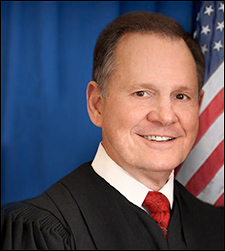
Are we about to see the return of Judge Roy Moore in the 2020 Alabama Senate race?

April 17, 2019 — Mason-Dixon Polling & Strategy just surveyed the Alabama electorate (April 9-11; 625 registered Alabama voters), testing Sen. Doug Jones’ (D) pre-campaign political strength and the fledgling potential Republican candidate field.

The Alabama Senate race may be the most important in the 2020 cycle. If the majority Republicans unseat Sen. Jones, who was the beneficiary of former state Supreme Court Chief Justice Roy Moore imploding in the 2017 special election to replace Sen. Jeff Sessions (R), they will increase their chamber advantage to 54-46 at a time when the party has to defend 10 more seats than their Democratic counterparts. If they fail to convert and Sen. Jones is re-elected, the Democrats will exponentially increase their odds of re-capturing Senate control.

Though the M-D poll did not pair Sen. Jones with potential Republican nominees, they do provide us some important information. On the question of whether Sen. Jones deserves to be re-elected, a majority response of 50 percent say he should be replaced. Conversely, 40 percent believes he should be re-elected.

The senator’s job approval ratio is virtually dead even, with 45 percent of the respondents providing positive comments about how he is performing in Washington versus 44 percent who believe he is not performing well. Jones is viewed positively in the Birmingham metro area (48:41 percent), and very positively in the Montgomery region (71:21 percent). In all other Alabama geographic sectors, he is perceived negatively with his worst numbers coming in eastern Alabama where the ratio drops to 35:53 percent.

Continue reading

Coach Declares for Senate

By Jim Ellis

Former Auburn Football coach Tommy Tuberville (center)

April 9, 2019 — Rumors have been flying for some time that former NCAA Football coach Tommy Tuberville was looking forward to a run for public office, and now the speculation has come to fruition.

Tuberville officially announced his candidacy for the Alabama US Senate Republican nomination over the weekend. He coached the Auburn University Tigers from the 1999 through 2008 football seasons, won Coach of the Year honors in 2004 and 68 percent of his games while at the Alabama university.

The new Senate candidate released a statement through Twitter this past Saturday saying, “after more than a year of listening to Alabama’s citizens, I have heard your concerns and hopes for a better tomorrow. I am humbled to announce the next step — I will be a GOP candidate for US Senate. I invite you to join my team.”

As often stated in our Updates, the Alabama Senate race is the most important contest on the Republican target board. Increasing their 53-seat majority to 54 in defeating Democratic Sen. Doug Jones, in what should be one of the safest Republican states, is a must for the GOP and would provide them an important cushion for their majority margin.

Continue reading

2020 Senate Review – Part I

By Jim Ellis

March 25, 2018 — Only nearing the end of March in the off-year, already a great deal of early 2020 Senate action has occurred. Thus, it is a good time to begin reviewing all 34 statewide federal races that will adorn next year’s ballot in a three-part series. Today, we look at the first dozen in alphabetical order:

  • Alabama – Sen. Doug Jones (D) – From the Republican perspective, this could be the most important race in the country. The GOP must convert this seat in order to provide a better cushion to protect their Senate majority.
    The 2017 special election became a debacle for the Republicans that allowed Sen. Jones to unexpectedly slip past politically wounded former state Supreme Court Chief Justice Roy Moore. Already, Rep. Bradley Byrne (R-Mobile) and state Auditor Jim Zeigler (R) have announced their 2020 Senate candidacies. Judge Moore claims to be seriously considering running again, which could again create the same adverse situation that previously plagued the Republicans. Toss-up

  • Alaska – Sen. Dan Sullivan (R) – At this point, there seems little in the way of opposition developing either in the Republican primary or general election against Sen. Sullivan. Safe Republican

  • Arizona – Appointed Sen. Martha McSally (R) – Another critically important Senate race that has already featured substantial action. Sen. McSally’s appointment came after her defeat in the 2018 Senate race and she faces a difficult campaign ahead to win the 2020 special election. Whoever wins next year serves the remaining two years of the late Sen. John McCain’s (R) final term. The seat next comes in-cycle for a full six-year term in 2022.
    Mark Kelly, a retired astronaut and husband of former Rep. Gabrielle Giffords (D-Tucson), has already announced his candidacy and will be a major candidate. In early April, Rep. Ruben Gallego (D-Phoenix), whose ex-wife, Kate Gallego, was just elected Mayor of Phoenix in a special election, is expected to enter the Democratic primary. Since Arizona holds a late August primary, a tough Democratic nomination fight would benefit McSally just as her difficult 2018 Republican primary played to Democratic Sen. Kyrsten Sinema’s advantage. Toss-up

  • Continue reading

Alabama Senate Race Begins

By Jim Ellis

Rep. Bradley Byrne, a Republican, formally announced his candidacy for the Senate.

Feb. 25, 2019 — One of the critical 2020 US Senate contests is beginning to take shape. Over the past few days, Alabama Rep. Bradley Byrne (R-Mobile) formally announced his statewide candidacy with the goal of opposing Democratic Sen. Doug Jones, who won the controversial 2017 special election that attracted national attention.

The Jones victory, defeating beleaguered Republican Roy Moore, a former state Supreme Court Chief Justice, represented the first time a Democrat won an Alabama statewide federal election since incumbent Sen. Howell Heflin secured his final term in 1990.

Prior to that, Richard Shelby, then a Democratic congressman, unseated Republican Sen. Jeremiah Denton in 1986. Shelby then switched to the Republican Party immediately after the 1994 election. Prior to the Denton victory on the same night that Ronald Reagan was first elected president, no Republican had won an Alabama seat for more than 100 years.

The Yellowhammer State Senate race could well be the lynchpin to determining which party will control the chamber after the 2020 election. With the electoral map favoring the Democrats because Republicans must defend 22 of the 34 in-cycle seats, including the Arizona special Senate election, Alabama becomes a virtual “must-win” for the GOP.

Continue reading

The Early Senate Maneuvers

By Jim Ellis

Jan. 23, 2019 — Though it is only January of the off-year, already early moves are being made in anticipation of an active 2020 US Senate campaign cycle. With 34 in-cycle Senate races on the ballot, as many as 16, at this point, could become competitive in either the primary or general election.

Below is a quick synopsis of the latest happenings in several states:


OPEN SEATS

• Kansas: The open seat is Kansas is already active with backroom discussions. After first indicating that he would not leave his current position to run for the Senate, pressure is being put on Secretary of State Mike Pompeo to re-consider his decision to stay out of the battle to succeed the retiring Sen. Pat Roberts (R).

Facing a badly split Republican Party in the Sunflower State, many GOP leaders at the state and federal level believe that Pompeo would be the best candidate to unify the disparate factions, which would enable him to easily hold the seat in the general election. This, after the party just lost the governorship.

• Tennessee: Former Gov. Bill Haslam (R) left office on Saturday and says he will decide in the next few weeks whether to seek retiring Sen. Lamar Alexander’s (R) open seat. No one has yet come forward to announce his or her candidacy — the prospective field presumably frozen until Haslam makes public his political plans. Should the former governor decide to run, he would quickly become a prohibitive favorite in the Republican primary and general election.
Continue reading

Senate: Early Handicapping

By Jim Ellis

Jan. 17, 2019 — The 2020 Senate election cycle features 34 races instead of 33 because of the Arizona special, and this time it is the Republicans who must defend the preponderance of seats. In 2018, Democrats held 26 of the 35 seats up for election; in this cycle, Republicans must protect 22 of the 34 Senate positions.

Republicans are first risking two open seats, those of Sen. Pat Roberts in Kansas and Lamar Alexander of Tennessee. At this point, both should remain in the GOP column. They also face a slew of competitive races in as many as eight incumbent states. Democrats, on the other hand, must defend in one highly competitive campaign, that of Sen. Doug Jones in Alabama, and a potentially viable contest in Minnesota.

But the most vulnerable Republican races will attract serious political attention. Appointed Sen. Martha McSally (AZ), Sen. Cory Gardner (CO), and North Carolina first term incumbent Thom Tillis are facing difficult election or re-election campaigns, in addition to Sen. Jones.

Martha McSally lost the 2018 Arizona Senate race to new Sen. Kyrsten Sinema (D) by 55,900 votes of more than 2.384 million ballots cast, or a margin of 2.4 percentage points. This, however, in the same election where Republican Gov. Doug Ducey scored a strong 56-42 percent re-election victory.

Continue reading

Apportionment Projections:
Who is Gaining, Who is Losing

By Jim Ellis

Jan. 3, 2019 — Late last year, we covered the new Census Bureau report for the states gaining and losing population during the past 12-month period. Now, we see the agency’s latest just-released numbers for the decade through this past July. Armed with the new data, outside mathematicians have made apportionment projections to provide a more defined picture as to which states will be gaining or losing US House seats in the 2020 post-census reapportionment.

With two years remaining in the present decade, trends can still change and we must remember that the reapportionment formula is complex, but the new projections give us a strong idea as to just how many seats, give or take a small variance, will transfer. At this point, according to the Washington, DC-based Election Data Services, it appears that as many as 22 seats could change location affecting 17 states.

Texas, having gained 3.55 million people since the 2010 census, looks to be adding as many as three seats for the 2022 elections and beyond. This will give the Lone Star State 39 seats during the next decade, and 41 electoral votes in the succeeding presidential elections.

Florida was the second largest gainer with just under 2.5 million new residents, meaning the Sunshine State will likely gain two seats, going from 27 to 29. In terms of raw numbers, California gained more than 2.3 million people, but it actually dropped a tenth of a point below the national growth average of 6.3 percent for the past eight years. This means the Golden State is currently on the hook to actually lose a district for the first time in history.

Continue reading