Tag Archives: Rita Hart

Iowa Map Enacted

By Jim Ellis

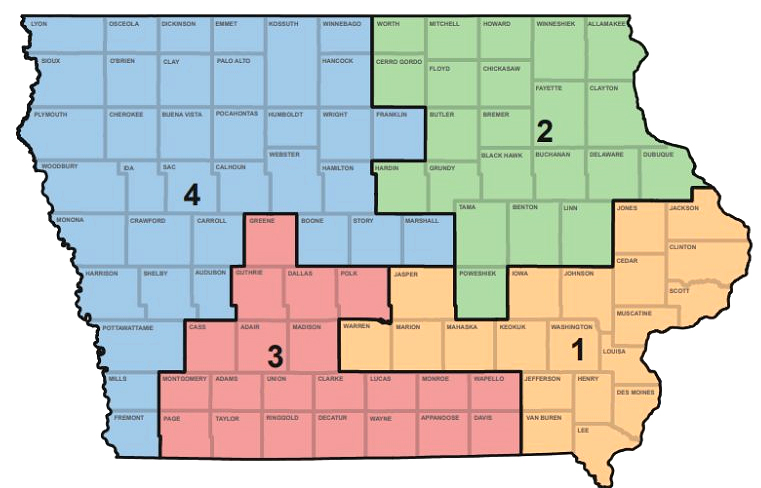
Nov. 10, 2021 — Gov. Kim Reynolds (R) signed the new Iowa redistricting map package, legislation that contained the new US House, state Senate, and state House of Representatives maps. The new congressional plan makes what appear to be minor changes to the state’s four districts, while again crafting a new quartet that would have voted in unison for former President Donald Trump. As is the case on the current map, Trump’s district victory margins featured varying percentages.

The Iowa redistricting system is unique. Some believe the state redistricts through a commission, but that is not the case. Rather, a state legislative committee is tasked with drawing the three-map plans and presenting them to the legislature for final approval. The plans must be submitted as a package, and the legislators may only vote up or down on the whole group, as no amendments to any of the maps are allowed.

The committee also employs a formulaic algorithm to create the districts without regard to political proclivities or deference to incumbents. If three map packages are rejected, the legislature then takes full control of the process.

The adopted package is the second plan iteration. The committee staff first put forth a series of maps that failed to make it through the first state Senate committee of jurisdiction. That congressional map was much different than the ultimately enacted plan. In the first draw, freshman Rep. Ashley Hinson (R-Marion/Cedar Rapids) would have been placed in a decidedly Democratic district that would have made her an underdog for re-election in 2022.

It is likely, however, that alone was not the reason for the Senate committee members rejecting the map package. The committee staff created two separate pairings of three incumbent senators apiece, thus dooming the entire package. Once returned, the congressional map plan, using a changed formula, returned to a similar configuration as under the current map.


Continue reading

IA-2: Hart Concedes;
NM-1: Dems Nominate

Iowa Rep. Mariannette Miller-Meeks’ (R-Ottumwa)

By Jim Ellis

April 2, 2021 — Former Iowa state senator, Rita Hart (D), withdrew her challenge late Wednesday afternoon, before the House Administration Committee pertaining to Rep. Mariannette Miller-Meeks’ (R-Ottumwa) six-vote victory in the November election. Also, the New Mexico Democratic State Central Committee met virtually over the past two days in order to choose a congressional nominee to fill the state’s 1st District vacancy. The seat is in special election cycle because Deb Haaland resigned her federal legislative office in order to join the Biden cabinet as Interior Secretary. Details below:

Iowa

In a released statement, IA-2 challenger Hart said, “Despite our best efforts to have every vote counted, the reality is that the toxic campaign of political disinformation to attack this constitutional review of the closest congressional contest in 100 years has effectively silenced the voices of Iowans.”

In actuality, the miniscule victory margin is the first such result of this type since 1984, not in 100 years, when in a similar case the House of Representatives decided in early 1985 that then-Rep. Frank McCloskey (D-IN) was re-elected with a four-vote margin.

The IA-2 result was a point of controversy ever since the new Congress was sworn into office on Jan. 3. Instead of challenging the six-vote margin in the Iowa court system, Hart chose to bring her complaint directly to the House of Representatives. She claimed that Iowa election authorities has not counted 22 legal ballots that would have changed the final outcome. The officials retorted that they rejected the ballots for various reasons of noncompliance with state election laws.

After the body’s internal organization process was completed, the House Administration Committee voted on a 6-3 party line vote to hear Hart’s case. There had been much chatter in the news media and blogosphere during the past two weeks about the Democratic leadership wanting to award the seat to Hart, thus displacing Rep. Miller-Meeks who had been provisionally seated on Jan. 3 pending the outcome of the Hart challenge.

Continue reading

IA-2 Controversy Heating Up

By Jim Ellis

IA-2 Republican congresswoman, Rep. Mariannette Miller-Meeks

March 31, 2021 — Iowa Democratic congressional candidate Rita Hart’s 2020 election result challenge has recently attracted significant media attention. With rhetoric sharpening on both sides over Rep. Mariannette Miller-Meeks’ (R-Ottumwa) state certified six-vote victory, let’s examine where the situation stands.

To review, Miller-Meeks held a 47-vote edge on the original canvass, a total that was reduced to just six votes after the state’s full recount. Miller-Meeks was certified the victor based upon the original final total, and then re-certified post recount. The bipartisan Iowa state canvassing board issued both certifications on unanimous votes.

The losing Democratic nominee, former state senator and 2018 lieutenant governor nominee Hart, filed her challenge directly with the US House instead of turning to the Iowa court system. She claims there are 22 uncounted votes that would change the outcome. The local Iowa election authorities rejected these ballots for various reasons. At the time of commencement for the new Congress, the House seated Miller-Meeks provisionally until the Hart challenge is resolved.

The motion was referred to the House Administration Committee, a panel of six Democrats and three Republicans. California Rep. Zoe Lofgren (D-San Jose), a close ally of Speaker Nancy Pelosi, is the committee chair. Illinois Rep. Rodney Davis (R-Taylorville) is the ranking Republican member. The committee held one hearing on the challenge and agreed on a partisan roll call vote to conduct an investigation and hear her case. The committee has not voted to remove Rep. Miller-Meeks, nor has the case been sent from the committee to the House floor.

Should the complaint come before the full body, and with a 6-3 Democratic majority on the Administration Committee, chances are strong that the Hart case will advance, the Democratic leadership may have a difficult time in obtaining the votes to remove Miller-Meeks.

They certainly would face a united Republican conference, meaning 211 votes assuming that Miller-Meeks would not be allowed to vote on her own seating. If they move after the April 24 Louisiana special election where a double-Democratic runoff assures them of gaining an extra seat and increasing the majority conference total to 220, they could afford to lose no more than four Democratic votes in order to successfully take the seat from Miller-Meeks and award it to Hart.

Continue reading

Will Miller-Meeks’ 6-Vote Win Stand?

By Jim Ellis

IA-2 Republican congresswoman Mariannette Miller-Meeks

March 12, 2021 — Yesterday, the House Administration Committee met virtually to consider Iowa Rep. Mariannette Miller-Meeks’ (R-Ottumwa) motion to dismiss the Federal Contested Elections Act challenge from Democrat Rita Hart in relation to the state certified results of the 2020 congressional election in Iowa’s 2nd District. The committee voted 6-3 on partisan lines to postpone the dismissal action.

To review, Rep. Miller-Meeks’ victory margin is only six votes of 394,800 ballots cast. Hart is challenging the results before the House Administration Committee claiming that 22 ballots, enough to overturn the final result, were legal but not counted.

Yesterday’s hearing was procedural in that committee chair Zoe Lofgren (D-CA) moved to postpone hearing the dismissal motion in order for the members to fully consider Hart’s argument of contestant. Rep. Lofgren indicated that both the Iowa Republican and Democratic Parties, along with Iowa election officials, will be sent identical questionnaires to fully investigate the matter. This means we can expect a much longer process to fully examine the contested ballots, allow testimony, and review the Iowa recount process.

Committee Minority Ranking Member Rodney Davis (R-IL) countered, indicating that the Iowa officials have twice counted the votes and, as committee member Bryan Steil (R-WI) reported, recount boards in all 24 counties that form the 2nd District – three member panels comprised of a Miller-Meeks’ appointed member, a Hart appointed member, and a county appointed member – all agreed on the final totals in each local entity.

Davis further explained to the committee members and listening audience that Hart, a former Iowa state senator and 2018 nominee for lieutenant governor, had eschewed the available legal process, which is to petition the Iowa court system. Davis said he concludes Hart made the decision to come directly to the House because she knew the courts would reject her legal arguments.

The Iowa recount process changed the original totals. The first reported outcome revealed a 44-vote Miller-Meeks margin. It then dropped to 30 votes during the recount and Scott County (Davenport), the district’s largest entity, reduced the number even further culminating in the current six-vote final result that the Iowa secretary of state certified as official, with which the bipartisan Iowa Election Canvass Board unanimously concurred. On Jan. 3rd, the House voted to provisionally seat Miller-Meeks until the Hart challenge is resolved.

Continue reading

NY-22 Vote on Brink of Certification

By Jim Ellis

Former New York Rep. Claudia Tenney (R)

Feb. 2, 2021 — After being suspended in political limbo for three months after Upstate New York voters cast their ballots, it appears that former Rep. Claudia Tenney (R) is on the threshold of being declared the winner of the disputed NY-22 contest.

State Supreme Court of Oswego County Justice Scott DelConte issued his ruling late Friday after weeks of hearings regarding disputes over more than 1,000 contested ballots and 2,100-plus individuals who registered to vote in a timely manner but whose documentation were not properly processed.

Justice DelConte released a 23-page ruling detailing his findings. As a result, it appears his acceptance or rejection of various ballots and a decision governing the mis-applied voter registrations allow Tenney to increase her lead from 29 votes to 122.

The justice first ordered Tioga County’s election officials, the only entity from the eight-county district that had no issues, to immediately certify their final totals. From the remaining seven counties with outstanding ballots, those election officials were ordered to appear in court Monday to count or remove votes at the Justice’s direction.

Once completed, the DelConte ruling ordered the counties to then implement a final canvass and certify their results by mid-day today. At this point, the final results from all eight counties will be sent to the State Elections Board in Albany for final certification.

In summary, the original totals found the two candidates, Tenney and 116th Congress incumbent Anthony Brindisi (D-Utica), separated by just 12 votes from the 317,727 ballots cast: 155,492 to 155,480, respectively, and including 6,755 votes for the Libertarian candidate. Through the ballot challenge period, we saw Brindisi moving ahead by 14 votes, and then back to Tenney’s most often reported 29-vote edge. It was only through Friday’s ruling when her advantage expanded to 122.

In all, 1,118 ballots were challenged. A total of 533 of those were withdrawn through agreement between the two campaigns, and after the two camps had resolved challenges to an additional 43 ballots. Three more ballots were “not preserved for judicial review.” Of the 609 challenges the justice considered, 470 were admitted to the count while 139 were rejected and ordered removed.

Continue reading

NY-22: Judge Rules

By Jim Ellis

Former US Rep. Claudia Tenney (R) leads freshman Rep. Anthony Brindisi (D-Utica) by just 12 votes out of 317,727 tabulated ballots.

Dec. 10, 2020 — The only House race still uncertified or undecided will remain in political limbo for at least a couple of more weeks. Tuesday, in a 20-page ruling, state Supreme Court Justice Scott DelConte returned the contested race back to the counties to properly complete the canvass process in order to ensure that all eligible votes are counted and recorded.

At this point, former US Rep. Claudia Tenney (R) leads freshman Rep. Anthony Brindisi (D-Utica) by just 12 votes of 317,727 tabulated ballots.

At one point, Tenney led the count by 28,422 votes, but that lead all but disappeared when the 60,000-plus mail votes were recorded. At one point, Brindisi took a 13-vote lead, but a discovered mistaken count in Herkimer County changed the outcome to give Tenney her present 12-vote edge.

In New York, the local district court — or superior court as some states label it — is referred to as a Supreme Court. Justice DelConte has assumed jurisdiction for the case and determined that seven of the congressional district’s eight counties did not follow New York election law or procedure as to how county personnel handled many of the contested ballots and those that are seemingly uncounted.

Additionally, the judge denied both Tenney’s motion to certify the current count and Rep. Brindisi’s motion to recount only some of the counties and precincts. Justice DelConte wrote that Tenney’s motion ignored the clear fact that a bevy of ballots remain uncounted and recorded, and Brindisi only wants to adjust the areas that are favorable to him.

Only Tioga County correctly completed the counting and canvass process and is therefore not involved in this post-election adjustment period. Personnel in the other seven counties, however, at least failed to adhere to New York law that requires a written explanation on the invalid ballot itself as to why it was rejected and who made the challenge. Instead, many contested ballots were affixed with post-it notes, many of which have become dislodged and lost.

Continue reading

IA-2: Hart Petitions the House

By Jim Ellis

IA-2 Republican congresswoman-elect Mariannette Miller-Meeks – or is she?

Dec. 4, 2020 — As things officially stand, Rita Hart, the Democratic nominee in the open IA-2 congressional district that occupies the southeastern part of the state, has lost to state Sen. Mariannette Miller-Meeks (R-Ottumwa) by a grand total of six votes from more than 393,000 ballots cast, but the challenge process from the Democrat is apparently not over.

Though the state has certified the race, Hart is reportedly preparing to take the results directly to the US House of Representatives, asking the House Administration Committee to investigate the counting process. Ultimately, the House itself has the power to seat all of its members.

Normally, any individual possessing a duly authorized certificate of election from the state’s official election administrator, usually the Secretary of State, is seated. There is precedence, however, for denying duly elected candidates their seats.

Under Iowa election law and procedure, Hart had another way to challenge the results. Her campaign staff claims that certain ballots were not counted in the original or recount process, and there are enough, they say, to flip the final outcome in Hart’s direction.

In Iowa, such a disputed election goes to a judicial panel over which the state Supreme Court Chief Justice presides. In addition to the Chief Justice, the high court then chooses four other judges from around the state to comprise the special panel. In this case, the judges would have had to declare an official winner by Dec. 8 in order to comply with Iowa law. The Hart campaign contended that was not adequate time to consider the ballot challenges, so they opted to petition the House itself.

Rep. Zoe Lofrgen (D-CA) chairs the House Administration Committee, which includes five additional Democrats, two more from California, and three Republicans. The other members are: Reps. Jamie Raskin (D-MD), Susan Davis (D-CA), G.K. Butterfield (D-NC), Marcia Fudge (D-OH), and Pete Aguilar (D-CA). The Republicans are Ranking Minority Member Rodney Davis (R-IL) and Reps. Mark Walker (R-NC), and Barry Loudermilk (R-GA).

Continue reading

Final House Tally: 223-212?

By Jim Ellis

Dec. 1, 2020 — The latest outstanding congressional race numbers suggest that the House may break 223 Democrats to 212 Republicans when some very close elections are finally decided. If this is indeed the final party division among the 435 seats, the GOP will only be six congressional districts away from re-claiming the House majority in the 2022 elections.

Currently, we see Real Clear Politics projecting California Rep. Mike Garcia (R-Santa Clarita) as the winner over state Assemblywoman Christy Smith (D-Newhall) in the state’s 25th CD, which lies in parts of both Los Angeles and Ventura Counties.

With still a small undetermined number of votes to be verified and counted, Garcia’s tight 405-vote margin appears to be holding. Our own rudimentary projections suggest that the freshman Republican congressman will hold by just under 400 votes. It is probable we will see a recount and potential ballot challenges, so the result may be challenged before and after certification. Under California election law, certification for all races must occur by Dec. 11.

We have seen several projections made suggesting former California Rep. David Valadao (R-Hanford) has defeated freshman Rep. T.J. Cox (D-Fresno) in the state’s Central Valley 21st CD. Valadao has a 1,820-vote lead according to the California Target Book organization’s in-depth analysis.

Our more rudimentary estimates suggest that Valadao will win the final count by approximately 1,400 votes based upon the potential number of outstanding ballots in the three counties, Kern, Kings, and Tulare, that are still verifying and counting mail votes. Fresno County has completed its count.

Later today, we expect to see the second certification of Iowa candidate Mariannette Miller-Meeks (R) in the state’s 2nd Congressional District. Under Iowa law, a certification had to be issued one week after the election, in this case Nov. 10, and Miller-Meeks, a state senator from Ottumwa who is in her fourth run for the US House, was originally certified as the winner with a 47-vote margin. The full recount finds former state senator and 2018 lieutenant governor nominee Rita Hart (D) gaining votes but still losing by a total of just six votes districtwide from more than 394,400 ballots cast, a Miller-Meeks winning percentage of 50.0008 percent.

Continue reading

Outstanding Races Near Conclusions

By Jim Ellis

Nov. 23, 2020 — We are now down to four undetermined US House campaigns and one that will go to a double Republican runoff on Dec. 5.

Last week, the NJ-7 race that was called for Rep. Tom Malinowski (D-Rocky Hill) on election night but rescinded when the post-election votes were drawing state Senate Minority Leader Tom Kean, Jr. (R-Westfield) close to dead heat range, has now culminated. Again, Rep. Malinowski was determined to be the winner when the number of uncounted votes became less than the margin between the two candidates.

The open 5th District in Louisiana is headed to a Dec. 5 runoff election. Here, Republicans Luke Letlow and state Rep. Lance Harris (R-Alexandria) will battle to replace retiring Rep. Ralph Abraham (R-Alto). Since both finalists are Republicans, the GOP keeping this seat is not in doubt.

The Iowa 2nd District race between state Sen. Mariannette Miller-Meeks (R-Ottumwa) and former state senator and 2018 lieutenant governor nominee Rita Hart (D) continues in full recount. Miller-Meeks had a 47-vote lead as the recount began. Under Iowa law, the leader has been certified as the winner, but that would change should the recount produce a different result.

Hart filed recount petitions in all of the district’s 24 counties. The various election officials have 18 days to complete their additional canvass, which means we should see a conclusion here sometime near Dec. 1.

In New York, counting continues in the 22nd District where former US Rep. Claudia Tenney (R) continues to lead freshman Rep. Anthony Brindisi (D-Utica) by a relatively substantial margin as the number of uncounted ballots slowly dwindles. The latest count finds the former congresswoman and ex-state Assembly member leading Rep. Brindisi by 10,967 votes according to the CNN count, which appears to have the most updated data.

Almost 292,000 ballots have been counted with an estimated 26,000-plus votes remaining. To overcome the difference, Rep. Brindisi would have to attract approximately 71 percent of the outstanding ballots. In the 2016 election, 296,086 individuals voted in the congressional race. Therefore, if the estimated outstanding total of 26,000-plus is near correct, then turnout would have increased approximately nine percent from the last presidential election turnout model when compared to the current vote.

In the last group of approximately 25,000 votes, Congressman Brindisi garnered closer to 68 percent in reducing Tenney’s lead from 21,812 votes to the current number. Unless the remaining ballots are even more Democratic than the latest batch, Tenney will likely remain in the lead and soon claim victory.

Continue reading

US House Open Seat Status

By Jim Ellis

Sept. 17, 2019 — With US House retirements coming in bunches, it can be confusing to remember how many open seats currently exist for the 2020 cycle and where they stand in terms of political projections. Now that the two North Carolina special elections have been decided, it is a good time to review the future open seat contests.

As things currently stand, 20 seats are known to be open, including the WI-7 seat that Rep. Sean Duffy (R-Wausau) will resign from next week. Of the 20, only four seats are Democratic, meaning the remaining 16 belong to the Republicans.

Most of the districts are safe – likely 14 of the 20 – and are projected to remain with the succeeding incumbent party nominee. The remaining six either lean to one party or the other (4) or are already cast in the toss-up category (2).

At this point, 13 of the 14 least competitive seats are in the safe category with one in the Likely segment:

Safe D:

  • CA-53: Rep. Susan Davis (D-San Diego) – retiring
  • NM-3: Rep. Ben Ray Lujan (D-Nambe) – running for Senate
  • NY-15: Rep. Jose Serrano (D-Bronx) – retiring

Safe R:

  • AL-1: Rep. Bradley Byrne (R-Mobile) – running for Senate
  • AL-2: Rep. Martha Roby (R-Montgomery) – retiring
  • IL-15: Rep. John Shimkus (R-Collinsville) – retiring
  • KS-1: Rep. Roger Marshall (R-Great Bend) – running for Senate
  • MI-10: Rep. Paul Mitchell (R-Dryden/Macomb County) – retiring
  • TX-11: Rep. Mike Conaway (R-Midland) – retiring
  • TX-17: Rep. Bill Flores (R-Bryan/Waco) – retiring
  • UT-1: Rep. Rob Bishop (R-Brigham City) – retiring
  • WI-5: Rep. Jim Sensenbrenner (R-Menominee Falls) – retiring
  • WI-7: Rep. Sean Duffy (R-Wausau) – resigning for family reasons

Likely R:

  • IN-5: Rep. Susan Brooks (R-Carmel) – retiring

The most competitive seats are as follows:

Lean D:

  • IA-2: Rep. David Loebsack (D-Iowa City) – retiring

Lean R:

  • MT-AL: Rep. Greg Gianforte (R-Bozeman) – running for Governor
  • TX-22: Rep. Pete Olson (R-Sugar Land) – retiring
  • TX-24: Rep. Kenny Marchant (R-Coppell) – retiring

Toss-Up:

  • GA-7: Rep. Rob Woodall (R-Lawrenceville) – retiring
  • TX-23: Rep. Will Hurd (R-San Antonio) – retiring

Analysis

  • GA-7: This district produced the closest raw vote margin in the country last year, as Rep. Rob Woodall was re-elected with just a 417-vote spread over former state Senate budget director Carolyn Bourdeaux (D), who returns to run again in 2020.
    Bourdeaux, however, will not have the nomination field to herself. Six other Democrats have filed, including state Sen. Zahra Karinshak (D-Duluth), state Rep. Brenda Lopez (D-Norcross), and former Fulton County commission chairman John Eaves. Nine Republicans are in the race including state Sen. Renee Unterman (R-Buford) and former Atlanta Falcons football player Joe Profit.
    This race will have to gel after the primary in order to obtain a better read on how the political contest will ultimately end. It appears both parties are headed to run-off elections to settle upon a nominee. The Georgia primary is May 19, with a run-off, if necessary, scheduled for July 21.
  • TX-23: No matter who the major party candidates turn out to be, the 2020 TX-23 race will end in a razor-thin margin. The highest percentage attained by a winning candidate throughout the current decade is 50.3 percent in 2012, and no one has won with a majority since. With each major party nominee virtually assured of a percentage in the high 40s, this will be a competitive race regardless of who eventually advances into the general election.
    Grace Ortiz Jones, the 2018 Democratic nominee who came within 926 votes of unseating Rep. Will Hurd, returns to run again. She has a strong chance of becoming a consensus candidate. Republicans will likely have a contested primary and possibly a run-off. This race, in a district that stretches from San Antonio to El Paso, will go down to the wire before it is ultimately decided.
  • MT-AL: Republicans should have an advantage here in a presidential year, as Montana figures to be one of President Trump’s strongest states in 2020. Two Republicans elected statewide, Secretary of State Corey Stapleton and state auditor and 2018 US Senate nominee, Matt Rosendale, are competing for the open seat in a field of five candidates to date.
    Democrats look to have strong candidates, as well. Former state Rep. Kathleen Williams, who held Rep. Greg Gianforte to a 51-46 percent win last November, returns for another try. Her Democratic opponents are state Rep. Tom Winter (D-Missoula) and rancher Matt Rains.
  • TX-22: Rep. Pete Olson (R-Sugar Land) is retiring after four terms from a district that is becoming much more competitive. The minority complexion is now high, with the non-Hispanic white percentage dropping to 45.9 percent among citizens of voting age. Six Republicans have announced with possibly wealthy donor and conservative activist Kathaleen Wall, who ran in the 2nd District open seat in 2018, could be the person to beat.
    Democrats are likely to back 2018 nominee Sri Preston Kulkarni, who held Rep. Olson to a 51-46 percent win. Expect this race to be a major battleground House campaign, and though the district is clearly changing, the GOP still maintains at least a slight advantage.
  • TX-24: Veteran Rep. Kenny Marchant (R-Coppell), who had a close call last November with a 51-47 percent win against an opponent who didn’t even spend $100,000, decided to retire after serving what will be eight terms. Republicans appear to be coalescing behind former Irving mayor, Beth Van Duyne, who will be a credible and energetic candidate.
    Democrats already have a crowded field that already features six candidates. The early favorite for the party nomination is retired Air Force colonel and 2018 state agriculture commission nominee Kim Olson, who lost her statewide campaign, 51-46 percent, which is one of the stronger Democratic showings in the recent past. The 24th will host another Texas competitive contest in 2020, but the seat still leans the Republicans’ way.
  • IA-2: The only competitive Democratic open seat that could come into play is Iowa’s southeastern district. With seven-term Rep. David Loebsack (D-Iowa City) retiring, Democrats are coalescing around former state senator and lieutenant governor nominee Rita Hart.
    Republicans appear to have their own consensus candidate, former Illinois Rep. Bobby Schilling, who served one term after winning the 2010 election in the Rock Island/Moline district across the Mississippi River from the Iowa border. Several years later, Schilling moved to Iowa and now is looking to revive his short-lived political career.
    Democrats have a clear advantage here, but in this open seat where the candidates already appear set and President Trump outpolled Hillary Clinton, a meaningful campaign could develop.