
By Jim Ellis — Thursday, July 16, 2026
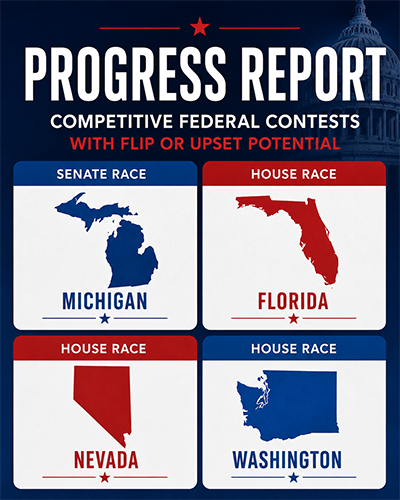 Continuing our progress reports on competitive federal contests with flip or upset potential, today’s update reviews new polling from one Senate race (Michigan) and three House campaigns, one each in Florida, Nevada, and Washington.
Michigan Senate
The Michigan Democratic primary has undergone significant change within the past 10 days. State Sen. Mallory McMorrow’s (D-Royal Oak) withdrawal leaves Rep. Haley Stevens (D-Birmingham) and former Wayne County Health, Human, and Veterans Services Department director Dr. Abdul El‑Sayed competing for her supporters.
Two new polls, conducted during the same period, present sharply different pictures of the race. The Glengariff polling firm that regularly surveys the Michigan electorate (for the Detroit News; July 8-11; 500 likely Michigan Democratic primary voters) posts Rep. Stevens to a 48-41 percent lead over Dr. El-Sayed.
The Data for Progress firm, however, sees a much different result. Their survey (for the American Priorities Super Pac; July 10-14; 614 likely Michigan Democratic primary voters) projects Dr. El-Sayed as holding a double-digit lead of 54-41 percent. Taken together, the surveys show a net 20‑point swing in the candidates’ respective leads, underscoring how unsettled the primary remains.
Florida’s 14th District
Florida Rep. Kathy Castor (D-Tampa) has held a safely Democratic Tampa anchored seat for 20 years, but she now faces the most difficult campaign of her career because of the new Sunshine State redistricting map.
According to Dave’s Redistricting App, the new configuration carries a 55.5R – 43.4D partisan lean – a net shift of nearly 31 points toward the GOP when compared with the 2021 map.
Florida’s primary is Aug. 18, so Castor will not know her Republican opponent for several weeks. A new St. Pete Polls survey (July 14-15; 469 likely FL-14 voters; automated calling and text) projects Rep. Castor to be holding a lead over the two most likely individuals favored to win the GOP primary.
According to the St. Pete data, Rep. Castor leads both former state Rep. Mike Beltran and current state Rep. Kevin Steele (R-Hudson), one of whom is likely to top the field of eight Republican hopefuls. Isolated with Beltran, the Castor advantage is 46-38 percent. If Rep. Steele becomes the party nominee, the early result is an almost identical 46-39 percent.
These early numbers likely reflect Castor’s strong name recognition. Once Republicans choose a nominee and the general election begins in earnest, the race is expected to tighten. FL‑14 is a must‑win for Republicans if they hope to maintain their narrow House majority.
Nevada’s 2nd District
Controversy surrounds Republican nominee David Flippo, a retired Air Force Lieutenant Colonel, in Nevada’s safest GOP seat. Critics highlight his recent political history: Flippo ran for Congress in NV‑4 in 2024 and for the state Assembly in a North Las Vegas district in 2022 – both far from the northern, Reno‑anchored NV‑2.
Despite the 2nd District’s strong Republican partisan lean (53.8R – 40.5D, per Dave’s Redistricting App), the new GOP congressional nominee trails in a recent ballot test. A Wedgewood Polls survey (July 9-12; 350 likely voters; online panel) shows former state House Majority Leader Teresa Benitz‑Thompson (D) leading Flippo 48-46 percent.
While the margin suggests a statistical tie, Flippo’s standing represents a significant underperformance in a district that should yield a mid- to high-50s Republican victory in November.
Washington’s 3rd District
Southwest Washington remains one of the GOP’s strongest non‑redistricting conversion opportunities. Rep. Marie Gluesenkamp Perez (D–Skamania County) has twice surprised Republicans by winning a district with a 52.0R – 45.6D partisan lean, but she now faces a more formidable challenger.
State Senate Minority Leader John Braun (R–Chehalis) is the likely general‑election finalist emerging from the Aug. 4 jungle primary. A new Emerson College survey (July 8–10; 500 likely voters; multiple sampling techniques) forecasts Sen. Braun as holding a slight edge over Rep. Perez, 45-44 percent.
In the jungle primary, Sen. Braun leads the nine‑candidate field with 26 percent, while Rep. Perez posts 25 percent – a major warning sign for the incumbent. Once the primary concludes, this race is poised to become one of the cycle’s major battles.