
By Jim Ellis — Wednesday, July 15, 2026
Senate
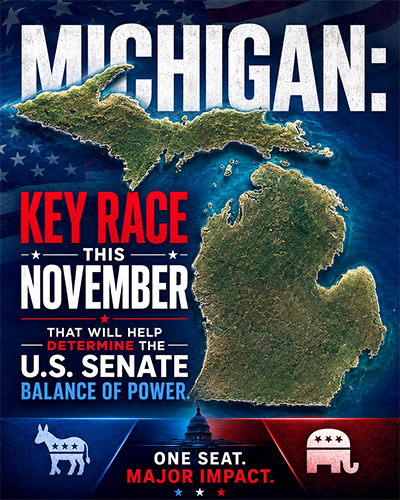 On election night, Nov. 3, the Michigan Senate race is likely to offer one of the earliest and clearest signals about the direction of the Senate majority. If Republican Mike Rogers wins, it would strongly suggest that the GOP is positioned to retain its current majority. If the Democratic nominee prevails, it would re-open the path for Democrats to reclaim the majority they lost in 2024.
As you know, Republicans currently hold 53 seats, while Democrats hold 45, plus two Independents who caucus with the Democrats, bringing their total to 47. At present, Democrats are favored to convert the open North Carolina seat being vacated by Republican Sen. Thom Tillis.
If they hold Michigan and flip North Carolina, they would still need three additional seats to reach majority control. If they lose Michigan, the conversion requirement rises to four, likely putting the majority out of reach for this election.
The Michigan primary is fast approaching on Aug. 4, and the final shape of the race may still produce a razor‑thin outcome, but now between just two contenders.
Last week, state Sen. Mallory McMorrow (D‑Royal Oak) suspended her campaign largely due to lagging polling. Her exit leaves Rep. Haley Stevens (D‑Birmingham) and former Wayne County Health, Human, and Veterans Services director Abdul El‑Sayed as the principal Democratic contenders.
A month ago, all three candidates were polling competitively and had comparable financial resources. Since then, movement has shifted toward Rep. Stevens after Dr. El‑Sayed held early leads in several surveys.
This week, retiring Sen. Gary Peters (D), previously neutral in the race to succeed him, endorsed Stevens. Additional Democratic establishment figures have followed suit. Dr. El‑Sayed responded by emphasizing his outsider status, saying, “this is the establishment backing the establishment.”
Mike Rogers, the former seven‑term Congressman, will again be the Republican nominee. He lost the open 2024 Senate race to current incumbent Elissa Slotkin (D) by just three‑tenths of a percentage point – 19,006 votes out of more than 5.58 million cast. Viewed as an underdog for much of that campaign, Rogers surged late as polling tightened and ultimately finished with a narrow loss after leading through much of the vote count.
His biggest challenge in 2024 was fundraising; Slotkin outspent him by more than a 4:1 ratio. Outside groups helped narrow the gap, but she maintained a decisive resource advantage. That dynamic has changed in 2026. Rogers, largely unencumbered in the Republican primary and buoyed by his strong 2024 finish, is now at financial parity with the Democrats and holds a stronger cash‑on‑hand position because his opponents have spent heavily in their nomination fight.
Polling shows Rogers performing slightly better against Rep. Stevens than against Dr. El‑Sayed, though all matchups remain close. Aggregate polling sites – Real Clear Politics, Race to the White House, and 270toWin – show Dr. El‑Sayed with small average leads between 0.5 and 2.5 points.
Rep. Stevens holds average leads between 0.5 and 1.3 points, though her overall margin is inflated by a single outlier survey from TIPP Insights (May 20–23; 1,456 registered Michigan voters; online) showing her ahead by seven points. Rogers has led Stevens in four of the nine 2026 surveys that isolate the pair.
The general election promises to be hard‑fought, intensely competitive, and close. The outcome will be highly consequential and may offer an early indication of broader trends in the remaining Senate contests.