Tag Archives: Public Policy Polling

Alaska: Polling Uncertainty

By Jim Ellis

Anchorage, Alaska

July 10, 2020 — Public Policy Polling, the most prolific national pollster of late, just released a new survey of the upcoming Alaska elections from what could be the most difficult state in America to poll.

The PPP data find close races for president, Senate and US House, which isn’t particularly surprising when comparing today’s numbers to the previous Alaska polling ratio. Past actual results, however, reveal a relatively consistent Republican under-poll.

To begin, the PPP survey tested 1,081 “voters” via automated response device during the July 7-8 period. This firm is recently using the “voters” term to describe their sample. It is clear the respondents are not likely voters, but there is no associated definition that clearly identifies the “voters” universe.

The fact that the individuals are not identified as registered voters could mean they are eligible voters, which would translate into adults. Such a sample would substantially increase the polling error rate. Therefore, it is not surprising to see the poll producing some unusual totals.

The presidential race finds President Donald Trump holding a mere 48-45 percent edge over former vice president Joe Biden in a state that he won by 15 points in 2016. Additionally, the spread seems rather inconsistent with the results produced from the favorability questions. The President’s job approval was 46:49 percent positive to negative, which, despite being upside down, is far better than Trump’s national approval average. The more surprising number, however, was Biden’s poor 36:53 percent favorability index. Overlaying these numbers with the ballot test provides a seemingly inconsistent response pattern.

Sen. Dan Sullivan (R), standing for his first re-election, holds only a 39-34 percent lead over likely Democratic nominee, surgeon Al Gross. Looking back at the 2014 polling records when Sen. Sullivan was challenging then-incumbent Mark Begich (D), July polling of that year found Begich holding leads of 46-35 percent (CBS News/New York Times), and 44-37 percent (Harstad Strategic Services). Sullivan would then turn the race around and win 48-46 percent in that election year.

Continue reading

The Senate Barometer

Sen. Cory Gardner Senate campaign attack ads hitting former Colorado Gov. John Hickenlooper hard (see COLORADO writeup below)


By Jim Ellis

June 18, 2020 — Next to discussion of the presidential race, the political contests attracting the most political attention and debate are the 2020 US Senate campaigns.

As we know, Republicans have a 53-47 Senate majority, meaning the Democrats will have to convert a net three GOP seats if Joe Biden wins the presidency, or four if President Trump is re-elected. Many believe that the winning presidential candidate will also sweep in a Senate majority for his party.

Below is an update of the key races:


• ALABAMA: In many ways, this could be the most important race on the board. Republicans must convert this seat back to their column in order to provide a greater cushion toward protecting their chamber majority. Sen. Doug Jones (D), who scored a fluke special election win in 2017, stands for a full six-year term in November.

Republicans are in a runoff election that will be decided on July 14, postponed from the original March 31 date. In the March 3 primary, retired Auburn University head football coach Tommy Tuberville placed first over former attorney general and ex-Alabama senator Jeff Sessions within a field of seven total candidates, 33-32 percent.

Runoff polling, however, gives Tuberville a large lead as the contenders enter the last month of the secondary election campaign. The May 26-27 OnMessage survey gave Tuberville a 49-43 percent edge, down considerably, however, from the 55-32% margin the former coach posted in a Cygnal research group poll conducted over the May 7-10 period.

Tuberville, with President Trump’s endorsement and running an ad saying Sessions’ appointment as AG is the president’s top regret since taking office, clearly has the advantage. In the general election, this race is a must-win for the GOP. If converted, the Republican majority expands to 54, which will be critical for their chances to hold.


• ARIZONA: Things continue to break retired astronaut Mark Kelly’s (D) way in the early going opposite appointed Sen. Martha McSally (R). Being one of the top national fundraisers with $31 million raised and millions more coming into the state in the form in independent expenditures, Kelly is the favorite to convert the seat in November. He has led in the last 11 publicly released polls, the latest coming from the Civiqs organization, polling for the Daily Kos Elections website (June 13-15), which posts Kelly to a 51-42 percent advantage.


• COLORADO: Sen. Cory Gardner (R) seeks a second term, and with the state’s electorate moving decidedly to the left since the incumbent’s original election in 2014, the Colorado race sets up well for Democratic conversion.

There is some weakness developing, however, surrounding Sen. Gardner’s likely Democratic opponent, former governor and presidential candidate John Hickenlooper. Recently, the Colorado Ethics Commission ruled that Hickenlooper, while governor, twice violated the state’s gift ban, which has caused him negative statewide publicity.

Now, the National Republican Senatorial Committee has launched an ad campaign underscoring the commission finding just as the former governor approaches his June 30 primary election against former state house speaker Andrew Romanoff. Sen. Gardner also is on the air in a new ad highlighting Hickenlooper’s statements during the presidential campaign when he was quoted extensively as saying he didn’t want to be a US senator. Taking this into consideration, more people are looking toward the Democratic primary, in which Romanoff is gaining some momentum. This general election is a must-win for the Democrats.
Continue reading

Dueling Polls in North Carolina Show Disparity in Candidate Numbers

By Jim Ellis

April 20, 2020 — Within a 10-day period, two statewide polls producing radically different results were conducted of the North Carolina electorate. Rather unsurprisingly, the Republican polling firm turned in better results for the GOP candidates than did the Democratic company.

As has been the political narrative for this entire election cycle, North Carolina is going to be one of the most competitive states in the nation. The presidential, US Senate, and gubernatorial races will all be pivotal within the national context.

Harper Polling, the Republican firm, went into the field during the April 5-7 period and conducted live interviews of 500 likely general election voters. Public Policy Polling, a Raleigh-based Democratic survey research company, conducted a large sample poll of 1,318 North Carolina registered voters through a combination of interactive voice and text messaging response systems.

In both the presidential and US Senate campaigns we see diverse results, and particularly so for the latter, yet for the governor’s race the two firms yielded almost identical numbers.

Harper finds President Trump leading former vice president Joe Biden, 49-42 percent, well beyond the polling margin of error. This result is obviously good news for the president in what is for him a must-win state. Conversely, PPP projects only a 48-47 percent split among the two candidates, and in Biden’s favor. In actuality, the two pollsters, while a net eight points apart on their respective ballot tests, are close – within two points – on the Trump number. They are not even within the same realm, and in fact beyond any polling margin of error, on the Biden posting.

The president’s standing could actually be a bit better in North Carolina than these results, and particularly the PPP totals, indicate. In the 2016 election, he under-polled in the Tar Heel State. In the final three polls before the vote, from three different survey research firms, Hillary Clinton held an average 1.3 percentage point advantage over then-candidate Trump. The end result, however, was a 3.3 percentage point victory for the Republican nominee.

Continue reading

The Kansas Senate Poll

By Jim Ellis

April 17, 2020 — For weeks, Democratic leaders and strategists have maintained that the open Kansas Senate seat is competitive for them if former secretary of state, Kris Kobach, who lost the 2018 governor’s race as the party nominee, wins the 2020 Republican primary on Aug. 4. Public Policy Polling released a survey a couple days ago that seems to confirm such a premise, at least on the numerical surface.

According to the PPP research (April 13-14; 1,27 registered Kansas voters via interactive response device or text message), consensus Democratic Senate contender Barbara Bollier, a state senator from Mission Hills who is a former Republican legislator, would lead Kobach 44-42 percent in a head-to-head match-up.

Kobach is not the only Republican in the race, however, and his nomination is nowhere near being a foregone conclusion. PPP did not test Rep. Roger Marshall (R-Great Bend) or Kansas state Senate president, Susan Wagle (R-Wichita), against Sen. Bollier or, if they did, such numbers were not released. Therefore, we don’t have a clear perception of the Democratic candidate’s overall strength before the Kansas electorate.

The underlying numbers would suggest another Republican would fare better against Sen. Bollier. President Trump’s job approval rating according to this poll is 52:43 percent favorable to unfavorable, and the generic partisan question – “ … would you vote for the Democratic candidate or the Republican candidate” – is 50-40 percent in favor of an unnamed Republican.

Additionally, after push questions were asked of the respondents that paint Sen. Bollier in a much more positive light than Kobach, particularly that “she is a physician and wants to run for the Senate to help other people,” the numbers don’t change significantly. Post push questions, the secondary ballot test went to only 47-42 percent in Dr. Bollier’s favor.

Considering the nature of the slanted questions, which PPP routinely uses in many of their more ideologically based surveys, one would expect the ballot test to have grown substantially in the favor of the candidate who was painted in the most positive light, in this case Dr. Bollier.

The closeness of the secondary ballot test is even more noticeable when the pollsters asked the respondents which of the two candidates would do a better job handling the coronavirus pandemic. By a 50:18 percent ratio, the respondent universe stated the belief that Dr. Bollier would do an excellent or good job in handling the situation. On the other hand, Kobach’s split was an upside-down 34:44 percent in response to the same question. Yet, the ballot test number did not significantly change.

Continue reading

Wisconsin Primary Moving Forward

By Jim Ellis

Wisconsin Gov. Tony Evers

April 8, 2020 — Whether or not the Wisconsin primary would be held as scheduled took rulings from two Supreme Courts to decide, but we will see voting today throughout the Wolverine State.

The Democratic presidential primary is interesting since the Wisconsin electorate will be the first to vote post-March 17, and so far, becomes the only group to cast ballots during the COVID-19 lockdown situation. How this affects today’s vote in terms of turnout and candidate loyalty will be interesting to analyze.

Whether or not this election would even happen today has been a point of discussion for the past two weeks. Many Democratic strategists were lobbying Gov. Tony Evers, a fellow Democrat, for several days to move the election, but he was slow to act. Late last week, Gov. Evers decided to ask the legislature to pass a bill changing the election date, but the Republican majority leadership in the two chambers refused. Gov. Evers then made a last-ditch effort to declare a state of emergency and attempted to move the election.

The latter action drew the Republican leadership’s ire, and they immediately petitioned the state Supreme Court arguing that the governor has no power to arbitrarily move an election. They also went to the US Supreme Court attempting to get a lower-court ruling to extend the absentee ballot return deadline past the original election schedule countermanded.

At the heart of the election date becoming a political football was not the presidential race, but rather an important state Supreme Court election. Though the race is ostensibly nonpartisan, it is clear that Democrats believe chances for the candidate they are backing improve in a later election, while Republicans think the appointed incumbent they support fares better in a quicker, and presumably lower turnout contest.

Continue reading

Will Michigan & Wisconsin Voters Determine 2020 Presidential Election?

By Jim Ellis

April 6, 2020 — Polls were just released in both Michigan and Wisconsin, obviously two critically important states that will weigh heavily in determining the final outcome of the next presidential election. While it’s too early to take any general election poll as a true projection of what may happen in November, particularly in light of the current unique situation, the survey did reveal some interesting points.

Progress Michigan’s Lake Effect newsletter: “The governors’ approval ratings pertaining to the [coronavirus] crisis are better than those of the president.”

Public Policy Polling tested the Michigan electorate for the Progress Michigan progressive left organization (March 31-April 1; 1,01 registered Michigan voters) and Marquette Law School just completed their quarterly survey of Wisconsin voters (March 24-29; 81 registered Wisconsin voters). Both made public their results.

We won’t pay too much attention to the ballot tests because it is so far away from the actual vote and the political situation is obviously going to change during the coming months, but the two pollsters found President Trump and former vice president Joe Biden within the margin of error in each state. In both cases, it was Biden who enjoyed a three-point lead.

Within this prism, it is important to recall the 2016 race in which polling badly underestimated Trump’s strength against Hillary Clinton in these two places. According to the 270 To Win organization, which tracked polling throughout that election year, the final averages going into the final weekend found Trump trailing by six points in Michigan and seven in Wisconsin. He won each state by approximately one percentage point, thus proving a large error factor in virtually all of the late polling.

A post-election analysis in which the Pew Research Center and CNN participated, among other firms and media outlets, concluded that a major reason for the flawed projections were the much larger number of Democrats willing to respond to the polling questions than Republicans. Even understanding this was the case at the time, the pollsters’ weighting formulas and algorithms still badly missed the mark throughout the crucial Great Lakes region.

Continue reading

Montana’s Competitive Races

By Jim Ellis

Montana

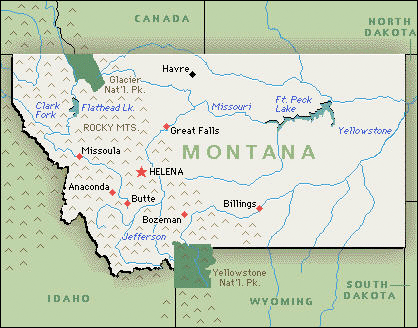
March 23, 2020 — Today, Montana has the reputation of being a Republican state, and GOP candidates have won more races here than their Democratic counterparts of late, but the latter party is far from moribund in Big Sky Country. As an at-large political domain with a sizable number of statewide offices, Democrats have had plenty of opportunities to win.

Montana holds its major statewide races in the presidential election year as opposed to the mid-term. In the state’s seven major statewide offices, Republicans currently enjoy a 5-2 edge, though Democrats hold the governorship and a US Senate office. In the 2012 election, however, the outcome was completely reversed as Democrats took five of the same seven positions.

With this background, a just-released research survey from Public Policy Polling (March 12-13; 903 registered Montana voters) tested a newly formed US Senate race between first-term Sen. Steve Daines (R) and Gov. Steve Bullock (D), along with the open at-large congressional contest. Both parties have contested primaries for the House, but state auditor and former US Senate nominee Matt Rosendale (R) and former state representative and 2018 congressional nominee Kathleen Williams (D) appear to be the favorites to win their respective party nominations.

The state is also hosting an open governor’s race, but the PPP poll did not test that campaign. The progressive left group End Citizens United sponsored the Public Policy Polling survey, and they sampled a universe that contained 37 percent self-identified Republicans, 32 percent Democrats, and 31 percent who describe themselves as Independents. It’s difficult to compare this sampling universe with the actual state electorate because Montana does not have party registration and the state features an open primary system.

That being said, the ballot test finds Sen. Daines and Gov. Bullock locked in a 47-47 percent tie, with an almost identical conclusion for a hypothetical pairing between Rosendale and Williams (45-45 percent).

Continue reading

Within a Week . . .

By Jim Ellis

Feb. 27, 2020 — Now, just two days away from the South Carolina primary and a mere five from Super Tuesday, it’s time to again determine candidate progress for what is arguably the most important primary election day of this presidential nomination cycle.


Currently, now that the Nevada Democratic Party has ostensibly tabulated the remaining caucus preference sheets from last Saturday’s Nevada vote, the aggregate bound delegate count gives Sen. Bernie Sanders (I-VT) the lead with 45, former South Bend mayor Pete Buttigieg is second at 26, former vice president Joe Biden posts 15, Sen. Elizabeth Warren (D-MA) eight, and Minnesota Sen. Amy Klobuchar holds seven. These numbers will change significantly by this time next week. A total of 1,398 delegate votes will be bound on Super Tuesday evening and 18 states and one territory will have completed their voting process.

We’ve had some polling movement in several of the Super Tuesday states that make a tight race even closer. North Carolina, with 110 first ballot delegates, at least according to one polling firm has lapsed into a three-way tie. Spry Strategies (Feb. 21-23; 561 likely North Carolina Democratic primary voters) finds former VP Biden, ex-New York City mayor Michael Bloomberg, and Sen. Sanders locked into a three-way tie, each with 20 percent support. None of the other candidates appear close to the 15 percent delegate allocation threshold in the Tar Heel State.

The new Public Policy Polling North Carolina survey turns in similar numbers (Feb. 23-24; 852 likely North Carolina Democratic primary voters) with Biden leading Sanders and Bloomberg, 23-20-17 percent, respectively. PPP agrees with Spry in projecting that only these three men will qualify for delegates. Such a split, assuming the congressional delegation allocation yields the same ratio, would find each of the three candidates receiving approximately 35-37 first-ballot votes.

The latest YouGov poll (Feb. 6-18; 1,352 likely Texas Democratic primary voters; online) also finds a tie, but this time in the Lone Star State with again three candidates winning bound delegates. The data finds Biden and Sanders tied with 20 percent, and Sen. Warren getting into delegate contention with 17 percent. If the actual Texas votes break similarly to this ratio, it would mean Bloomberg would fail to qualify for at-large delegates, leading to a fight for delegate allocation within each of the 31 state Senate districts. While other states divide by congressional districts, Texas uses state Senate seats.

Continue reading

New Arizona Data

By Jim Ellis

Arizona Senate candidate, retired astronaut Mark Kelly (D), and Sen. Martha McSally (R)

Jan. 10, 2020 — Public Policy Polling conducted a study of the Arizona electorate (Jan. 2-6; 760 registered Arizona voters) to test the highly important impending US Senate race between appointed Sen. Martha McSally (R) and retired astronaut Mark Kelly, the presumed Democratic nominee.

PPP also ran ballot tests involving President Trump paired individually against the major Democratic presidential contenders. Even though Arizona is a critical state in the 2020 presidential general election, the early projection numbers are not particularly salient because the contest has yet to begin in earnest, but the Trump results do provide a credibility foundation to analyze the PPP Senate numbers.

The Senate ballot test shows, as does every other previous survey of this race, that the McSally-Kelly battle is within the polling margin of error. The PPP numbers, at 46-42 percent in Kelly’s favor, project a four-point spread between the candidates, which is a bit more separation than revealed in past Arizona surveys.

Both Kelly and McSally have been near the top of national Senate fundraising charts, so it is clear that each will have plenty of resources to communicate their specific campaign messages in addition to expected independent expenditures that will come into the state to aid and attack both candidates. It is already clear that the Arizona Senate race will become a national campaign.

At this point, the Grand Canyon State campaign looks to be the Democrats’ best conversion opportunity, and a victory for them becomes even more important to offset what is likely a predicted loss for Sen. Doug Jones (D) in Alabama. With the Democrats needing a net gain of at least three seats, or four depending upon the presidential race outcome, every swing seat becomes critical for both parties.

Continue reading

Biden Showing Up Strong in North Carolina – But Is It Enough?

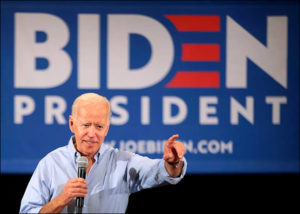
Former vice president and 2020 Democratic presidential candidate, Joe Biden

By Jim Ellis

Oct. 11, 2019 — Raleigh-based Public Policy Polling just released their latest North Carolina survey (Oct. 4-6; 963 likely North Carolina voters, 410 likely North Carolina Democratic primary voters) Wednesday, which projects a two-person race developing in the Tar Heel State as former Vice President Joe Biden leads Sen. Elizabeth Warren (D-MA), 39-22 percent. South Bend Mayor Pete Buttigieg receives nine percent support, while Sen. Bernie Sanders (I-VT) earns only a disappointing six percent. All other candidates fail to break the three percent level.

North Carolina is one of the Super Tuesday states, a state whose electorates will cast ballots on March 3, the largest voting day of the nominating season. On March 3, a total of 14 states and one territory will host primaries or caucuses, seven of which come from the south. It is here where former Biden would have to make his stand, since his southern numbers are the best of any candidate by a wide margin.

The question being posed is whether a sluggish Biden start in the first three voting states, Iowa, New Hampshire, and Nevada, where he could conceivably fail to place first in any, would derail his momentum to the point of lessening his southern advantage.

Making rudimentary delegate calculations from the 19 entities that would vote on or before Super Tuesday, we find that current polling would place the former vice president in the lead on the evening of March 3, but that his delegate edge would certainly not be dominating.

To re-cap, based upon the latest polling from Iowa, New Hampshire, and Nevada, the delegate estimate prior to South Carolina would find the former VP and Sen. Warren tied with 37 delegates apiece, while Sen. Sanders would have 27, meaning a virtual three-way tie despite Biden not winning any of the states outright. If he can stay in the hunt — with neither of his key opponents establishing themselves as a clear leader — the tide turns Biden’s way.

Continue reading