Category Archives: Super Delegates

Delegate Reallocation
Brings Increase to 4,750

By Jim Ellis

Jan. 22, 2020 — As we approach the first votes being cast for the Democratic presidential nomination next month, the Democratic National Committee has reallocated delegate slots among certain state contingents, thus increasing the size of the overall delegate universe to 4,750.

The changes are relatively substantial within the states when compared to the last national convention in 2016, while the recent Super Delegate total sees an increase of five new votes. The alterations within the state counts — an increase in every affected place but California — feature an additional 210 delegate votes when compared with the totals from four years ago.

Most of the boosts reflect a reward for increased Democratic votes in the 2016 and 2018 elections. The calculations include results in the recent races for president, US Senate, US House, governor, and for state legislature. States that hold their presidential nominating event after April 1 are also rewarded.

The largest increases are found in New York, Pennsylvania, and New Jersey where their respective delegations have grown by 50, 33, and 19 slots respectively, largely due to Democratic gains in the US House and state legislatures particularly from the 2018 elections. New Jersey, for example, converted a governor’s chair to the Democratic column in their 2019 election, after gaining five congressional seats in 2018 and ‘16, thus accounting for their delegation increase. And, all three states vote after April 1.

California’s regular delegate total has been reduced by one vote, possibly for moving their previous June primary to before April 1, on Super Tuesday, March 3. The state still has, by far, the largest contingent with 494 total delegates and 415 of those voting on the first ballot. The next largest delegation, after calculating their increase, is New York with 320 overall delegate slots, 274 of which are eligible to cast first-ballot votes.

Continue reading

Yesterday’s Odd-Year Election Day

Kentucky Gov. Matt Bevin (L) and Attorney General Andy Beshear

By Jim Ellis

Nov. 6, 2019 — The odd-year Election Day hit yesterday, with voters going to the polls in Kentucky, Mississippi, New Jersey, and Virginia. Governors’ chairs were at stake in Kentucky and Mississippi, while state legislators were on the ballot in all of the aforementioned with the exception of Kentucky.

Bluegrass State Gov. Matt Bevin (R) ran for a second term after a tenure that has seen him dwell at the bottom of the 50-state approval polls for almost his entire time in office. Bevin was a surprise winner in 2015, defeating then-Attorney General Jack Conway (D) who was viewed as the favorite for the entire campaign. Similarly, Gov. Bevin again faced a Democratic Attorney General in this election, Andy Beshear, the son of the man who he replaced in Frankfort, former Gov. Steve Beshear (D).

Polling suggested a close race. Polling was right. As of publish time, the election still was too close to call despite Beshear claiming victory. Bevin would not concede. Fewer than 5,000 votes separate the two candidates, the advantage going to Beshear at the moment.

Bevin lagged behind early in the general election cycle, but returned to parity. The polling pattern was similar in Bevin’s last contest, so he is obviously hoping for a repeat performance. In 2015, Bevin defeated AG Conway by a surprisingly large 52-44 percent spread, a margin that surprised pollsters.

Mississippi featured an interesting gubernatorial campaign between GOP Lt. Gov. Tate Reeves, who attempted to succeed term-limited Gov. Phil Bryant (R), and state Attorney General Jim Hood (D), serving his fourth consecutive term. This race, as in Kentucky, has been close in the polls with Reeves maintaining a small lead. And Reeves is ahead with 53 percent of the vote.

The Mississippi race included a budding controversy that could take shape after the election. Under state law, a gubernatorial candidate must not only win a popular vote majority at the statewide level, he or she must also carry a majority of the 122 state House districts. A federal judge appears ready to strike down the result if the state legislature is forced to decide because no candidate wins both a majority in the statewide vote and in the state House districts.

The entire Virginia House of Delegates and state Senate was on the ballot, and Democrats were confident that they would assume the majority in both houses. Before yesterday, Republicans held a 20-19 edge in the state Senate with one vacancy, and a three-seat margin in the House with one vacancy. The latter majority was literally decided by pulling lots from a hat when the final 2015 Delegate race ended in a tie. The Democrats took back both the House and Senate; it looks like the Democrats will win 21 seats in the state Senate, with the Republicans holding on to 19. In the House, the Democrats are ahead with 53 seats to the Republicans 43 seats with a few races still outstanding.

It was estimated that the redistricting decision since the last election, which mandated the re-drawing of several Delegate districts, would likely give the Democrats an extra boost.

New Jersey voters selected state Assembly members, however the state Senate won’t come before the electorate until 2021. Democrats maintain a huge 54-25 majority with one vacancy, and that could increase. Republican chances of winning a majority in the state Assembly were nil.

Continue reading

Biden Showing Up Strong in North Carolina – But Is It Enough?

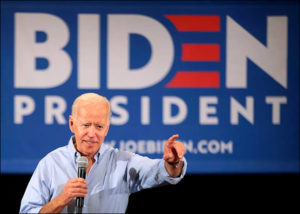
Former vice president and 2020 Democratic presidential candidate, Joe Biden

By Jim Ellis

Oct. 11, 2019 — Raleigh-based Public Policy Polling just released their latest North Carolina survey (Oct. 4-6; 963 likely North Carolina voters, 410 likely North Carolina Democratic primary voters) Wednesday, which projects a two-person race developing in the Tar Heel State as former Vice President Joe Biden leads Sen. Elizabeth Warren (D-MA), 39-22 percent. South Bend Mayor Pete Buttigieg receives nine percent support, while Sen. Bernie Sanders (I-VT) earns only a disappointing six percent. All other candidates fail to break the three percent level.

North Carolina is one of the Super Tuesday states, a state whose electorates will cast ballots on March 3, the largest voting day of the nominating season. On March 3, a total of 14 states and one territory will host primaries or caucuses, seven of which come from the south. It is here where former Biden would have to make his stand, since his southern numbers are the best of any candidate by a wide margin.

The question being posed is whether a sluggish Biden start in the first three voting states, Iowa, New Hampshire, and Nevada, where he could conceivably fail to place first in any, would derail his momentum to the point of lessening his southern advantage.

Making rudimentary delegate calculations from the 19 entities that would vote on or before Super Tuesday, we find that current polling would place the former vice president in the lead on the evening of March 3, but that his delegate edge would certainly not be dominating.

To re-cap, based upon the latest polling from Iowa, New Hampshire, and Nevada, the delegate estimate prior to South Carolina would find the former VP and Sen. Warren tied with 37 delegates apiece, while Sen. Sanders would have 27, meaning a virtual three-way tie despite Biden not winning any of the states outright. If he can stay in the hunt — with neither of his key opponents establishing themselves as a clear leader — the tide turns Biden’s way.

Continue reading

Democratic National Convention Shaping Up to be Historic

By Jim Ellis

Oct. 8, 2019 — At this point, Democratic presidential primary patterns are beginning to reveal themselves.

The February First Four states are becoming a hodgepodge of political strength with both Sens. Elizabeth Warren (D-MA) and/or Bernie Sanders (I-VT) potentially stealing Iowa and New Hampshire away from national front-runner Joe Biden. That means the former vice president may have his back up against the proverbial wall when the campaign streams into Nevada, the third voting state whose caucus participants will convene on Feb. 22. He may well need a victory there, before getting to South Carolina and his southern states political oasis.

As the new Fox News South Carolina Democratic primary poll shows (Sept. 29-Oct. 2; 803 likely South Carolina Democratic primary voters), Biden’s lead is very strong in the Palmetto State at 41-12-10 percent over Sens. Warren and Sanders, respectively. These numbers are commensurate with his standing in other recently polled southern domains.

But new data coming from delegate-rich states that are not frequently polled give us a further perspective about just how the nomination drama might unfold.

Four new state surveys were released at the end of last week with clear separation only detected in Arizona. Data coming from California and Ohio show dead heats among the three major candidates. Additionally, the latest Wisconsin poll gives Biden only a small lead.

The first three states in this group will vote in March, on Super Tuesday (March 3, California), March 10 (Ohio), and March 17 (Arizona). The fourth state’s electorate, Wisconsin, will cast their ballots on April 7.

Change Research (Oct. 27-28; 396 likely Arizona Democratic primary voters) finds that Arizona is polling as one of the ex-vice president’s weakest states and the only one that shows a relatively competitive four-way race. The Change results finds Sen. Warren claiming a significant lead with 35 percent support, ahead of Sen. Sanders’ 19 percent, Biden’s 15 percent, with South Bend Mayor Pete Buttigieg making a viable appearance with 13 percent preference.

Continue reading

The “First Four” And The Scramble
For Delegate Apportionment

By Jim Ellis

Sept. 11, 2019 — The YouGov international polling organization conducted four simultaneous surveys in the states whose electorates will cast presidential nominating ballots in February of next year, referred to in the college basketball tournament vernacular as “the First Four”. The quartet of states are Iowa, New Hampshire, Nevada, and South Carolina.

Looking at the polls’ aggregate totals, it appears the contest is already gelling into a three-way race that could meld into a free-for-all should this particular YouGov polling trend translate into actual results.

All of the polling was conducted during the Aug. 28 – Sept. 4 period, and sampled between 492 (New Hampshire) and 785 (South Carolina) likely Democratic primary voters or caucus participants. All four polls found former Vice President Joe Biden, and Sens. Bernie Sanders (I-VT) and Elizabeth Warren (D-MA) occupying the first three positions, but in different orders.

Sen. Kamala Harris (D-CA) and South Bend Mayor Pete Buttigieg placed in the fourth and fifth positions in each entity, again not in the same order in all four states, yet neither reached double-digit percentages in any of the polls. Under this set of data, neither Harris nor Buttigieg would qualify for at-large delegates in any of the First Four states.

To reach the at-large delegate apportionment plateau, a candidate must receive 15 percent of the statewide vote. Candidates can also qualify for individual congressional district delegates, but those projections are not readily available from these polling results.

In Iowa, scheduled for caucus meetings on Feb. 3, Biden begins with a small lead according to the YouGov research. From the 682 individuals surveyed, the former vice president would score 29 percent, with Sanders closely following with 26 percent, and Warren posting 17 percent. Iowa has 41 delegates, and if the congressional district result followed the statewide percentage, Biden would receive 16 delegate votes, Sanders 15, and Warren 10.

Moving to New Hampshire, which will host the first-in-the-nation primary on Feb. 11, 2020, it is Sen. Warren who places first, but the result among the trio is a virtual three-way tie. Warren recorded 27 percent in the YouGov poll, with Biden getting 26 percent, and Sanders 25 percent. Again, assuming New Hampshire’s two congressional districts would vote in the same proportion as the state, each candidate would receive eight delegate votes, equally splitting the state’s 24-person delegation.

Continue reading

Seven State Polls

By Jim Ellis

Aug. 2, 2019 — In the latter half of July, several different pollsters conducted Democratic presidential primary polls in seven important primary states. In Iowa, New Hampshire, South Carolina, California, Texas, Michigan, and Illinois — all states whose voters will cast primary ballots on or before March 17 — contain an aggregate 1,012 first-ballot delegates.

The seven polls give us an idea as to how Democratic primary participants in the corresponding states would vote if their presidential nomination elections had been in mid to late July. Additionally, we make delegate dispersion projections from the polling data to the qualified candidates and attempt to determine whether any one individual could garner the 50 percent delegate support necessary to claim a first ballot victory.

The Firehouse/Optimus organization polled in Iowa (July 23-25; 630 likely Iowa Democratic caucus voters), New Hampshire (July 23-25; 587 likely New Hampshire Democratic primary voters), and South Carolina (July 23-25; 554 registered South Carolina voters). The Public Policy Institute of California surveyed the Golden State Democratic primary (July 14-23; 766 likely California Democratic primary voters). The University of Texas at Tyler (July 24-27; 554 registered Texas voters), Climate Nexus (July 14-17; 324 likely Michigan Democratic primary voters), and Victory Research (July 26-29; 1,200 likely Illinois Democratic primary voters) tested the Texas, Michigan, and Illinois electorates.

For the purposes of this exercise, let us assume that all of these surveys accurately depict how the Democratic electorates in each of these states would vote. Let us further assume that the congressional district delegate apportionment directly corresponds to the at-large state vote.

Doing so allows us to make delegate apportionment estimates for each of these states with the understanding that the conclusions are not precise. They do, however, give us an idea as to how the delegate dispersion might break. Understanding that several of the polled minor candidates will not be on the ballot when actual voting occurs allows us to project additional votes going to the close finishers, those at 13-14% in these polls. Doing so likely boosts them to the 15 percent threshold that party rules mandate as a qualification requirement for delegate votes.

The aggregate total of 1,012 delegates from these seven states represents just under 27 percent of the entire first ballot universe at the Democratic National Convention, so the combined tested states are significant in terms of the number of delegates they possess and their voting schedule position.

Continue reading

The 2020 Democratic Nomination
Will Look Much Different From 2016

By Jim Ellis

May 24, 2019 — As the Democratic presidential field swells to 24 candidates — with the first Democratic presidential forum on tap for late June in Miami, and the first votes being cast in Iowa now just over eight full months away — it’s a good time to review how different this presidential nomination contest will be from the 2016 version.

To review, Hillary Clinton won 34 primaries and caucuses in 2016 as compared to 23 for Sen. Bernie Sanders (I-VT). There are 57 sanctioned delegate voting entities in the Democratic nomination universe. The 57 are comprised of the 50 states, the District of Columbia and the five territories, and a Democrats Abroad category that combines all US citizens living in foreign countries who will still have voting privileges in US elections.

Clinton won 55.2 percent of the 2016 national Democratic popular vote versus Sen. Sanders’ 43.1 percent when combining the totals from all the primaries and caucuses. Though the Sanders Campaign called foul over the Super Delegate voting inflating Clinton’s delegate total, and actually turning six states’ first-ballot roll call from Sanders to Clinton and sending one more state into a tie, Clinton still carried the pledged, or elected delegate, count 2,205 to 1,846, translating to a 54.4 percent margin. When adding the Super Delegate and uncommitted delegate votes, she captured 58.3 percent of the convention total.

Continue reading

Dems Looking Ahead to a
Looming Nomination Battle

By Jim Ellis

May 13, 2019 — The Hill newspaper ran a pair of articles late last week that discussed several points about the upcoming Democratic presidential nomination battle. The first piece was a story covering former Vice President Joe Biden’s prediction that many of the candidates will drop out of the race soon after the Iowa Caucus, thus winnowing the 22-person (and possibly as high as 24) contest down to a more manageable number.

What kind of role will super delegates play in 2020?

The second piece delved into the new Super Delegate status, and about their re-emergence if the convention lapses into a multiple ballot situation before choosing a nominee. The story also highlighted several candidates, and in particular Sen. Bernie Sanders (I-VT), who are already reaching out to Super Delegates in an attempt to identify which candidate they might support if presented with the chance to vote.

The Biden comments reflect a traditional view that one candidate may begin to build an early consensus by doing well in the first two voting events, the Iowa Caucus and the New Hampshire primary. Currently, these are scheduled for Feb. 3 and Feb. 11, 2020, respectively.

The flaw in the Biden argument is that, combined, Iowa and New Hampshire only carry 65 first-ballot delegates, less than two percent of the entire first-ballot universe of 3,768. A candidate must obtain 1,885 delegate votes to win the nomination on the first ballot. Therefore, such a small early number is unlikely to be determinative, but the lowest tier of candidates, as fallout from the first votes actually being cast, collapsing due to a lack of funding is certainly a possibility.

The Super Delegates were a source of major controversy at the 2016 Democratic National Convention. At the time, the Sanders campaign contended that the nomination process was “rigged” because the non-elected Super Delegates were a block for Hillary Clinton, which would enable her to win the nomination even if Sanders forged a majority among the elected delegates. In the end, the Sanders’ supposition proved untrue – Clinton did win among the elected delegates – but, nevertheless, the Democratic National Committee changed the Super Delegates’ voting status as a result of the Sanders’ complaint.

Continue reading

Poll: Sanders Up in California

By Jim Ellis

April 12, 2019 — The Change Research polling organization released a new Democratic primary poll of the California electorate (April 6-9; 2,003 likely California Democratic primary voters) and projects Sen. Bernie Sanders (I-VT) to be nipping former Vice President Joe Biden and home state Sen. Kamala Harris. In a secondary ballot test that excludes Biden, Sanders prevails over Harris even under this scenario.

Earlier in the week, Emerson College released a Massachusetts Democratic primary poll (April 4-7; 371 likely Massachusetts Democratic primary voters) that found Sen. Sanders leading Biden and Massachusetts home state Sen. Elizabeth Warren (26-23-14 percent). Therefore, we are clearly seeing a Sanders rise in the early part of April.

In the Change California poll, Sanders has a slight 22-21-19 percent lead over Biden and Harris – obviously a statistically insignificant margin – but it does show that Sen. Harris is not dominating her own electorate. Taking fourth, fifth, and sixth in this poll are ex-US Rep. Beto O’Rourke (D-TX) with 10 percent, South Bend (IN) Mayor Pete Buttigieg at nine percent, and Sen. Warren pulling only eight percent of the vote.

If Biden chooses not to run, since he is still not an announced presidential candidate, Change finds that Sen. Sanders would edge Sen. Harris 28-27 percent, with O’Rourke (16 percent), Buttigieg (11 percent), and Warren (nine percent) following.

This tells us, at least in the early going, that California, with its large 416 first ballot delegate contingent, is clearly up for grabs even with its home state senator in the field of candidates.

Continue reading

Sanders’ Problem as an Independent

By Jim Ellis

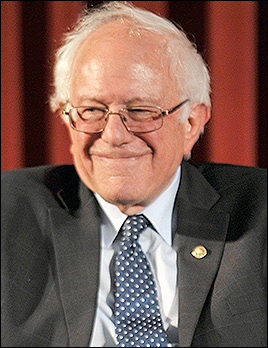
Sen. Bernie Sanders of Vermont — an Independent, not a Democrat

Feb. 22, 2019 — A day after announcing his entry into the 2020 presidential campaign, Vermont Sen. Bernie Sanders jumped off to a strong start, raising a reported $6 million in just his first 24 hours as a repeat candidate. But, a technical problem also looms in the distance.

Last year, the Democratic National Committee adopted a new party rule that states any future presidential nominee must be an official Democratic Party member or, if an office holder, must have served as a Democrat. Sen. Sanders meets neither requirement.

Vermont has no party registration, so he is not a party member in that regard, and has continually, including during the present time, represented Vermont as an Independent. In fact, when offered the Vermont Democratic senatorial nomination for his re-election campaign in 2018, Sanders turned down the overture.

The fact that Sanders is still not a Democrat is confirmed when looking at the list of unpledged delegate slots, those commonly referred to as “Super Delegates.” An unpledged delegate is one who can vote as he or she pleases and is not subject to any binding vote law their particular state may have enacted.

Those who qualify as Super Delegates are Democratic National Committee members (430), every elected Democratic US senator (45), the two District of Columbia “Shadow” senators, all elected Dems in the House of Representatives (235 at the present time), the four Democratic delegates to the US House (District of Columbia, Guam, the Northern Marianas Islands, and the US Virgin Islands), and all of the party’s elected governors (26, including the District of Columbia mayor, and the territorial governors from American Samoa and Puerto Rico).

Continue reading