Tag Archives: President Trump

A Biden Resurgence?

Former Vice President, Joe Biden

By Jim Ellis

Oct. 25, 2019 — A series of recently released national political polls finds former Vice President Joe Biden re-establishing the type of horse race leads over the Democratic field that he enjoyed before the debate process first began. Yet, how reliable are the polls?

CNN, YouGov, Emerson College, and HarrisX, all report new data and see Biden again posting significant leads, two of which are well beyond the polling margin of error.

CNN (Oct. 17-20; 424 US Democratic registered voters) gives the ex-VP a 34-19-16 percent lead over Sens. Elizabeth Warren (D-MA) and Bernie Sanders (I-VT). HarrisX (Oct. 21-22; 440 US registered Democratic voters) finds the Biden lead reaching 27-19-14 percent over Warren and Sanders. Emerson College (Oct. 18-21; 430 US Democratic likely voters) sees a similarly close cut among the top three candidates, but they find Sen. Sanders slipping past Warren into second place. The Emerson split shows Biden up 27-25-21 percent over Sanders and Warren, respectively.

Looking more closely at the polling methodology for each, we find that all three of these surveys have very low sample sizes, which means the error factor is high. The respective respondent universes are only between 424 and 440 people from which to derive a national trend. These numbers are more typically found in a congressional district or small state survey.

The YouGov poll (Oct. 20-22; 628 US Democratic likely voters) used a larger national sample and found a much tighter standing among the candidates, but with the prevalent Biden-Warren-Sanders order intact through a 24-21-15 percent result. In all of the aforementioned surveys, no other candidate reaches double-digit support.

Continue reading

New Data in Mississippi Gov. Race

By Jim Ellis

Mississippi Lt. Gov. Tate Reeves (R)

Oct. 24, 2019 — One of the more intriguing current elections is the Mississippi governor’s campaign. Here, GOP Lt. Gov. Tate Reeves is attempting to continue the Magnolia State Republican advantage, since the only Democrat to clinch the top elected job since the 1991 election is Ronnie Musgrove in 1999. Prior to Kirk Fordice winning in ’91, Democrats had held the governorship for 116 consecutive years.

Reeves arguably faces the strongest Mississippi Democratic opponent in this century’s state politics. Attorney General Jim Hood (D) has won four consecutive statewide elections to his current position, making him the most successful Democratic politician in the Deep South.

A just released Mason-Dixon Polling & Strategy survey (Oct. 17-19; 625 registered Mississippi voters) finds the electorate breaking closely between the two contenders, as Reeves leads AG Hood, 46-43 percent according to the ballot test responses.

But the Mississippi election, going to the voters on Nov. 5, has an interesting caveat. Winning a statewide majority is not enough to be elected governor. In addition to reaching the 50 percent plateau for the statewide vote, a candidate also must carry a majority of the state’s 122 (meaning 62) state House of Representatives’ districts.

If neither candidate wins both a majority of votes and districts, then the state House members will cast their own votes to choose the next governor. With Republicans holding a 74-44 state House majority with 2 Independents and two vacancies, the chances of the GOP nominee carrying the majority of districts are high, and the Republican winning a vote among House members is a virtual certainty.

According to Mason-Dixon, the two candidates’ favorability indexes are similar. Reeves records a 41:26 percent positive to negative ratio, while Hood posts a 39:29 percent favorable score.

Most of the segments break as one would expect: Democrats going for Hood, 87-2 percent; Republicans favoring Reeves, 82-8 percent. Men favor Reeves, 50-38 percent, while women choose Hood in a 47-43 percent cut. The under 50 years of age segment leans to Hood 46-41 percent, while the over 50 group chooses Reeves, 51-39 percent. Whites support Reeves, 66-24 percent, and blacks back Democrat Hood in their typical division, 80-7 percent.

Continue reading

Florida Rep. Rooney to Retire

By Jim Ellis

Florida Rep. Francis Rooney (R-Naples)

Oct. 23, 2019 — Two-term Florida Rep. Francis Rooney (R-Naples) announced over the weekend that he would not seek election to a third term next year, thus FL-19 becomes the 27th open House seat for the current cycle.

Three of the open seats are vacant, meaning they will each go to special election to fill the balance of their respective terms. The trio of districts are: MD-7 (the late Elijah Cummings-D), NY-27 (Chris Collins-R), and WI-7 (Sean Duffy-R). The Wisconsin election calendar has been set for a Feb. 18 special primary and May 12 general. Maryland election law dictates that Gov. Larry Hogan (R) announce the 7th District special election calendar on or before Oct. 28. No calendar announcement has yet been made for the New York situation.

Rooney, despite serving in Congress for only a brief while, had been on the unofficial retirement watch list because he had raised only $6,600 cycle-to-date for his next campaign and is at odds with his party on several issues. The congressman is independently wealthy, so the low total was not solely an indication of his intention since he has the wherewithal to self-fund his campaigns. Rep. Rooney had been a Republican critic of President Trump, took the no corporate PAC contribution pledge, and indicated he may support the impeachment inquiry.

Florida’s 19th District is a safely Republican southwest Florida seat. President Trump carried the district, 60-37 percent, while Mitt Romney won here with a similar 60-39 percent margin. In his two elections, Rep. Rooney racked up victory percentages of 62 (2018) and 66 percent (2016).

In a similar configuration over four previous terms, then-Rep. Connie Mack IV (R) averaged 65 percent of the vote. And, after Mack left the House to run for the Senate, Republican Trey Radel, who a year later would be convicted for cocaine possession and forced to resign, scored a 62 percent victory in 2012. GOP businessman Curt Clawson followed with win margins of 67-29 percent in the 2014 special election, and then 65-33 percent in the regular election cycle before choosing not to seek re-election in 2016.

Therefore, it is probable that the next Republican primary winner will summarily be elected to the House in November, 2020. The 19th District contains two-thirds of Lee County along with approximately half of Collier County. Its main population centers are the Cape Coral, Ft. Myers, Naples, and Marco Island localities.

Gov. Bevin Pulls Even in Kentucky

By Jim Ellis

Oct. 18, 2019 — Though the Louisiana governor’s race has received most of the recent national political attention largely because of their just concluded jungle primary election that somewhat surprisingly forced Gov. John Bel Edwards (D) into a run-off, news is now breaking in the Kentucky statewide electoral contest.

Kentucky Gov. Matt Bevin (L) and Attorney General Andy Beshear

Democrats have been outwardly predicting that Kentucky Attorney General Andy Beshear, the son of former two-term Gov. Steve Beshear (D), would oust Gov. Matt Bevin (R) in the coming election.

They first cited a pair of August polls that projected Beshear to be holding a substantial nine percentage point advantage over the governor (Garin-Hart-Yang Research and Clarity Campaign Labs both found Beshear leading 48-39 percent). Additionally, they point to the Morning Consult gubernatorial surveys that ranked Bevin dead last in job approval among the 50 state chief executives with a 34:53 percent favorable to unfavorable ratio.

Now, however, the race appears to be reversing course less than a month before the Nov. 5 election. Mason-Dixon Polling & Strategy just released their latest data (Oct. 10-13; 625 registered Kentucky voters) finding that the two major party candidates have fallen into a tie at 46 percent apiece, meaning Gov. Bevin has captured current momentum.

Both parties will spend heavily to help their respective candidate cross the finish line first, but Bevin has at least two tangential points going for him in the final weeks.

First, independently wealthy, the governor has the ability to self-fund his race, which largely accounts for his $1.58 million to just over $628,000 cash-on-hand advantage as revealed in the final regular pre-election financial disclosure report.

Continue reading

A Brewing Battle Emerging in Kansas

Freshman Rep. Steve Watkins (R-Topeka)

By Jim Ellis

Oct. 17, 2019 — Former legislative aide Abbie Hodgson, the only announced Democratic candidate in the KS-2 congressional race, withdrew her challenge to freshman Rep. Steve Watkins (R-Topeka) Wednesday because she claims not to possess the fundraising ability to conduct a credible campaign. At this point, there is no alternative Democrat on the horizon in the Kansas district, but that will soon likely change.

Rep. Watkins won a tight 48-47 percent general election victory over former state House Minority Leader and 2014 gubernatorial nominee Paul Davis (D) last November to succeed retiring Rep. Lynn Jenkins (R). This came after political newcomer Watkins, a West Point graduate, Army Ranger and Afghanistan veteran, won a tight seven-way Republican primary but with only 26.5 percent of the vote. Controversy arose when a major independent expenditure committee emerged, which was principally funded by the candidate’s father, to back Watkins.

More potential upheaval surrounds Rep. Watkins, but it simmers below the surface. Rumors were flying around in August that the congressman would imminently resign his office because of a rumored scandal that was about to become public. Watkins took no such action, and to date nothing involving scandalous activity has come to light.

This has not stopped certain Republicans from taking action, however. In early September, reportedly at the behest of former Gov. Jeff Colyer (R) who lost his own bitter primary to then-Secretary of State Kris Kobach, state Treasurer Jake LaTurner made a surprising move. He was the first declared US Senate candidate after incumbent Pat Roberts (R) announced his retirement, but he then transferred from the statewide campaign to instead enter the primary to challenge Watkins in the Topeka-anchored congressional district.

Kansas’ 2nd is a decidedly Republican seat, but not intensely so. The CD occupies 23 eastern Kansas counties and parts of two others. It runs vertically from the Nebraska border to Oklahoma and consumes the territory between the Kansas City metro area and Wichita.

Continue reading

New NC State Poll

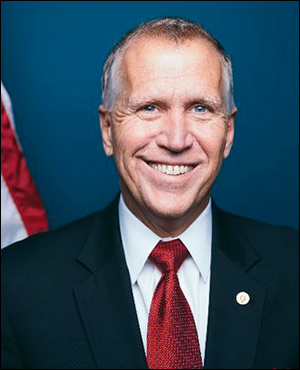
North Carolina Sen. Thom Tillis (R)

By Jim Ellis

Oct. 16, 2019 — A new Meredith College political survey (Sept. 29-Oct. 7; 998 registered North Carolina voters) shows electoral weakness for Sen. Thom Tillis (R) as he seeks a second term next year.

The poll places the first-term US senator in a statistical tie with both of his potential Democratic opponents, state Sen. Erika Smith (D-Gaston) and former state Sen. Cal Cunningham. The large number of uncommitted voters, however, suggests the race could go to either party and will likely break late, similar to many previous North Carolina election results.

According to the Meredith data, Sen. Tillis would tie both Smith and Cunningham with each of the three candidates receiving 33 percent support in all pairings. Obviously, these are not particularly favorable numbers for any incumbent and must be taken more seriously in this instance because of North Carolina’s history of either defeating its senators or seeing them not serve a second term for another reason.

In fact, the only two Tar Heel senators who have been re-elected since 1974 are Jesse Helms (R) and current three-term incumbent Richard Burr (R). During that span, the following senators were no longer in office after one term:

ONE-TERM NORTH CAROLINA SENATORS

  • Robert Morgan (D), 1980 – lost re-election
  • John East (R), 1986 – committed suicide in June before seeking a second term
  • Jim Broyhill (R), 1986 – appointed to fill Sen. East’s term; lost 1986 election)
  • Terry Sanford (D), 1992 – lost re-election
  • Lauch Faircloth (R), 1998 – lost re-election
  • John Edwards (D), 2004 – did not seek a second term to instead run for president
  • Elizabeth Dole (R), 2008 – lost re-election
  • Kay Hagan (D), 2014 – lost re-election

The Meredith College pollsters also tested Gov. Roy Cooper (D) as he fights for a second term likely against Lt. Gov. Dan Forest (R). Here, Meredith finds the incumbent holding a 46-33 percent margin over his eventual GOP challenger.

Continue reading

Impeachment in the States

By Jim Ellis

Oct. 9, 2019 — The Civiqs polling firm, as covered in the Daily Kos Elections site, has been testing all 50 states regarding impeachment in a national tracking survey that attracted 150,070 online respondents from May 16 through Oct. 6. The latest numbers suggest that 51 percent of those respondents favor impeaching President Trump, while 45 percent oppose. But, it is in the breakdown of the states’ numbers where the true political story is being told.
Looking at the 50 individual states, it is no surprise that the respondents from almost all of the places that voted for Hillary Clinton support impeachment. But at this point, it appears President Trump has the potential of losing some of his coalition states. Arizona, Michigan, and Wisconsin all are now leaning toward impeachment.

Whether a person would or would not vote for an impeached president is not necessarily indicative about how their state would vote regarding a 2020 national candidate, but it does appear to be a reasonable gauge.

Arizona, a normally reliable Republican state but one that appears to be moving leftward, has 11 electoral votes. The Civiqs poll finds the Arizona respondents supporting impeachment 50-46 percent. The Michigan sample favors the impeachment inquiry, 51-45 percent. The Wolverine State has 18 electoral votes. Wisconsin, with 10 votes, also sees its Civiqs respondents currently favoring impeachment by a tight 49-47 percent margin.

Nevada, a Clinton 2016 state, and Iowa, a Trump state, are in flat ties according to Civiqs’ impeachment track. If the electoral vote count were based upon these results, the presidential election might come down to one state, or could even conceivably evolve into a 269-269 tie.

It is impossible to predict what twists and turns we will see before the impeachment issue is settled, nor can anyone accurate forecast how the electorate will respond. Right now, at least the Civiqs state tracking operation slightly favors the Democratic position on the impeachment question, but most of the margins are tight enough to quickly change.

Continue reading

Hunter Reeling

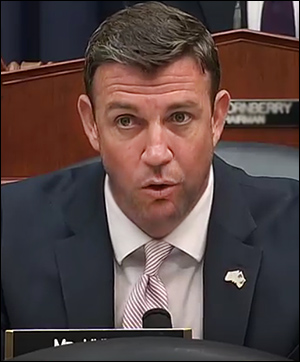
California Rep. Duncan Hunter (R-Alpine)

By Jim Ellis

Oct. 7, 2019 — In addition to his legal woes, indicted California Rep. Duncan Hunter (R-Alpine) now appears to have severe political problems according to a new just-released CA-50 district study.

A Survey USA poll conducted for the San Diego Union-Tribune (Sept. 27-Oct. 2; 592 likely CA-50 voters; 671 respondents were asked favorability questions about the top four candidates, but the electoral questions were asked only of those who described themselves as likely voters) tested the seven announced candidates for the March 3 California jungle primary.

The S-USA results find Democrat Ammar Campa-Najjar, the 2018 party nominee who held Rep. Hunter to a four-point win, holding 31 percent support. Former San Diego City councilman and mayoral and congressional candidate Carl DeMaio (R) follows with 20 percent, ex-Rep. Darrell Issa, who recently announced his candidacy records 16 percent, while Rep. Hunter posts only an 11 percent preference factor.

Rather surprisingly, state Sen. Brian Jones (R-Santee), also a recent candidate but a public official who represents almost 90 percent of the 50th District, records a very low four percent. The two independent candidates have three percent combined.

It is no surprise that Campa-Najjar is leading. In a crowded field with only one candidate from a particular party, it becomes a simple strategy to coalesce the party members behind the lone contender. While Campa-Najjar will almost certainly advance to the general election in this type of jungle format with so many candidates splitting his opposition party vote, we also must see that 52 percent of the poll respondents chose a Republican candidate. This obviously bodes poorly for the sole Democrat in the general election.

The setup here is similar to last year’s open 49th District, the adjacent seat from which Rep. Issa retired. In the June 2018 election, Republican Diane Harkey finished first by an eight-point margin in a field of 16 candidates but, in the general with only two contenders, it was Democrat Mike Levin who recorded a 56-44 percent victory.

Continue reading

Collins Resigns; Thornberry to Retire

By Jim Ellis

Rep. Chris Collins (R-NY)

Oct. 2, 2019 — Reportedly planning to plead guilty to an insider trading charge after being indicted last year, Rep. Chris Collins (R-NY) resigned his seat in the House, officially informing Speaker Nancy Pelosi (D-CA) and New York Gov. Andrew Cuomo (D) Monday of his intentions.

Despite having an indictment hanging over his head, Rep. Collins won a close re-election in NY-27 — normally a safe Republican upstate district that occupies all or parts of eight counties in the region’s rural area east of Buffalo and south of Rochester.

The congressman defeated Democrat Nate McMurray, a Grand Island town supervisor, by a razor-thin 49.1 – 48.8 percent spread, a margin of just 1,087 votes. Clearly the indictment played a major role in the outcome being so close, as Collins’ re-election percentages were an identical 67.2 percent in 2014 and 2016 after unseating then-Rep. Kathy Hochul (D) in the 2012 general election.

Anticipating an open seat or a weakened Collins seeking re-nomination, several Republicans had already announced their intentions to run. Two state senators, Chris Jacobs (R-Buffalo) and Rob Ortt (R-Lockport), are already in the race as is attorney and former town judge Beth Parlato. The 2018 Democratic nominee, McMurray, is also a declared candidate.

It is likely that other Republicans will jump into either the special election, if it is called, or the regular election now that it is an open seat race. It is also likely that Democratic leaders will make sure that McMurray has a clean shot for re-nomination in order to make him as strong as possible against a different GOP nominee.

The New York state primary is scheduled for June 23. The eventual GOP nominee should begin as a favorite to hold the seat.
Continue reading

The Politics of Impeachment

By Jim Ellis

Sept. 26, 2019 — With the House beginning the impeachment inquiry, it is a good time to overlay the political map regarding those Democratic members who may find themselves in a difficult position as a result of this procedure.

In all, President Trump carried 31 congressional districts that elected a Democratic representative in 2018. In 16 of the 31 CDs, 2012 Republican presidential nominee Mitt Romney also won. Additionally, the president carried 13 of the 31 districts by more than six percentage points.

To impeach, the Democratic leadership would need a minimum of 218 votes, and at the outset all but one will have to come from the majority side. Republican-turned-Independent Justin Amash (R-MI) left the GOP earlier in the year over the impeachment issue, so he is a likely “yes”, giving the leadership a little more cushion.

Turning back to the 2016 election, Trump carried Amash’s 3rd Congressional District with 51.6 – 42.2 percent victory margin, meaning this would likely be a tough vote for him, too, since he presumably will appear on the ballot as an Independent or minor party candidate.

In the end, however, should a vote proceed to the House floor, 15 of the 31 members listed below will more than likely have to vote for impeachment in order for the motion to carry.

With Trump being popular in their districts, 10 of the succeeding members with 2020 competition saw the President’s 2016 margin exceed six points. Three more with potential but as yet undeveloped competition, also saw Trump exceed a base six percentage point margin.

Therefore, one less than half of the following members will need to vote to impeach if the resolution is to move to the Senate.

ST-DIST INCUMBENT PARTY TRUMP % CLINTON % ROMNEY %
AZ-1 O’HALLERAN, TOM D 47.7 46.6 50.4
GA-6 McBATH, LUCY D 48.3 46.8 60.8
IA-1 FINKENAUER, ABBY D 48.7 45.2 42.5
IA-2 LOEBSACK, DAVID D 49.1 45.0 42.7
IA-3 AXNE, CINDY D 48.5 45.0 47.2
IL-14 UNDERWOOD, L. D 48.7 44.8 54.2
IL-17 BUSTOS, CHERI D 47.4 46.7 40.6
ME-2 GOLDEN, JARED D 51.4 41.1 44.4
MI-8 SLOTKIN, ELISSA D 50.6 43.9 51.1
MI-11 STEVENS, HALEY D 49.7 45.3 52.3
MN-7 PETERSON, COLLIN D 61.8 31.0 53.9
MN-2 CRAIG, ANGIE D 46.5 45.3 49.0
NH-1 PAPPAS, CHRIS D 48.2 46.6 48.6
NJ-2 VAN DREW, JEFF D 50.6 46.0 45.4
NJ-3 KIM, ANDY D 51.4 45.2 47.2
NJ-5 GOTTHEIMER, JOSH D 48.8 47.7 50.9
NJ-11 SHERRILL, MIKIE D 48.8 47.9 52.4
NM-2 TORRES SMALL, X. D 50.1 39.9 51.7
NV-3 LEE, SUSIE D 47.5 46.5 48.7
NY-11 ROSE, MAX D 53.6 43.8 47.3
NY-19 DELGADO, ANTONIO D 50.8 44.0 45.9
NY-22 BRINDISI, ANTHONY D 54.8 39.3 49.2
OK-5 HORN, KENDRA D 53.2 39.8 59.2
PA-8 CARTWRIGHT, MATT D 53.3 43.7 43.4
PA-17 LAMB, CONOR D 49.4 46.8 51.7
SC-1 CUNNINGHAM, JOE D 53.5 40.4 58.3
UT-4 McADAMS, BEN D 32.4 40.4 67.2
VA-2 LURIA, ELAINE D 48.8 45.4 50.5
VA-7 SPANBERGER, A. D 50.5 44.0 54.6

Red percentage figures: Denote districts Romney also carried