
By Jim Ellis — Thursday, June 23, 2026.
US Senate
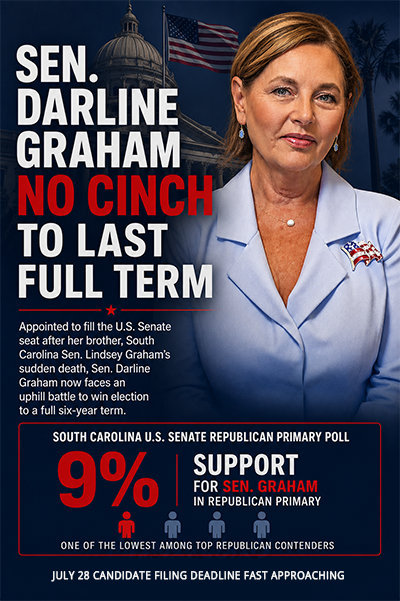 There has been some question as to whether the announced South Carolina special election Senate Republican candidates would reconsider their plans now that appointed Sen. Darline Graham has decided to run for the full six-year term. Two new polls may have just provided early answers.
With the July 28 candidate filing deadline approaching, two new surveys suggest that Reps. Ralph Norman (R Rock Hill) and Russell Fry (R Murrell’s Inlet/Myrtle Beach), along with businessman Mark Lynch, have little incentive to withdraw. Contrary to early assumptions, Sen. Darline Graham apparently does not begin the race with a clear advantage.
The new polling, conducted by Peak Insights (July 18–20; 900 likely Republican special primary voters; live interview & text) and Innovative Communication Strategies (July 20-21; 788 likely Republican special primary voters; text to web), indicates that another individual – one not currently running – holds the early lead.
Peak Insights finds former Congressman and Fox News host Trey Gowdy holding a 38 percent preference figure, well ahead of Rep. Norman at 13 percent, and Rep. Fry and Sen. Graham (listed on the survey questionnaire as Darline Graham Nardone) tied with nine percent. Lynch follows with seven percent support. ICS did not test Gowdy; without him in the field, their results show Rep. Norman holding a 19-16-12-9 percent edge over Sen. Graham (also listed as Darline Graham Nardone on the survey questionnaire), Rep. Fry, and Lynch.
Gowdy’s strength is notable given that he has made no visible move toward entering the race. Sen. Tim Scott (R), now the state’s senior Senator, has publicly argued – prior to Sen. Graham’s announcement – that Gowdy would be the strongest possible Republican nominee. The Peak Insights data suggests that the Senator’s assessment is correct.
Another central question in what now appears to be a competitive contest is campaign finance. Sen. Graham begins with no funds, as she must form a new federal campaign committee. Only $2,000 from Lindsey Graham’s account could be transferred to her campaign, assuming the committee treasurer has authority to make disbursements following the principal’s death.
Rep. Fry is in the strongest financial position: his June 30 FEC report shows $1.04 million available for transfer to a Senate committee. Rep. Norman reports $90,314 cash on hand but he has substantial personal wealth and could quickly self fund. Lynch, who challenged Sen. Lindsey Graham in this year’s regular primary, retains more than $568,000 cash on hand after loaning his campaign over $5 million.
Among the major contenders, Sen. Graham is therefore at the greatest financial disadvantage, and the compressed timeline makes lightning-fast fundraising difficult. A supportive Super PAC could intervene on her behalf, and given her endorsement from President Trump, such an effort is plausible. If her campaign can assemble an operational structure – likely with significant assistance from Lindsey Graham’s former political staff – she will be able to communicate the Trump endorsement, which has been a decisive asset in almost all Republican primaries.
The key question is whether a newly formed Graham campaign, even with Trump’s backing, can win outright on Aug. 11. If these polls are reasonably accurate – and both point to similar conclusions about Sen. Graham’s early standing – it appears unlikely that any candidate will reach a majority.
Based upon current information, the Aug. 11 primary is likely to force a runoff on Aug. 25 between the top two finishers. In a head-to-head contest between Sen. Graham and either Rep. Norman or Rep. Fry, the available data suggests that the result is uncertain.