Tag Archives: North Dakota

New Hampshire Primary Today; Close Race in Delaware; Gov. Burgum to Retire; Opponents Look to Change Alaska’s Ranked-Choice Voting

By Jim Ellis — Tuesday, Jan. 23, 2024

President

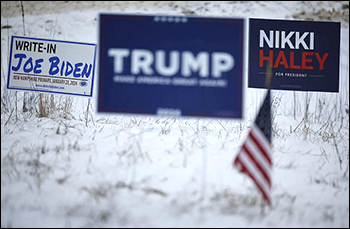
Candidate signs along the road in New Hampshire.

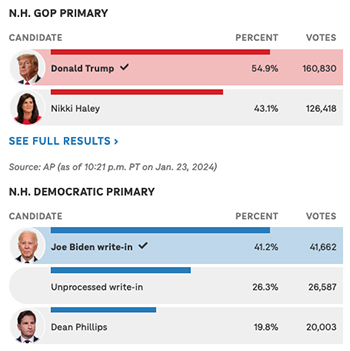
New Hampshire: Primary Election Today — At one point it appeared that former UN Ambassador Nikki Haley was well positioned against former President Donald Trump in the New Hampshire primary, but a plethora of late polls find the former president expanding his advantage well into double digits.

Also on the ballot tonight is the Democratic presidential primary, though sans President Joe Biden. He is bypassing this event because the state refused to accept the Democratic National Committee recommended primary schedule change that would have deprived New Hampshire of its cherished first-in-the-nation primary status.

Ten polls have been released since Saturday from as many different pollsters, and except for the American Research Group, all show Trump holding leads between 10 and a whopping 27 percentage points. The ARG survey finds Trump holding only a 33-29 percent edge.

The Democratic race is much more difficult to forecast because of the write-in campaign underway for the president. The three polls, from the American Research Group, the University of New Hampshire for CNN, and Emerson College for WHDH-TV in Boston, see the Phillips support line falling between 10 and 18 percentage points.

The New Hampshire primary could effectively spell the end to competitive challenges.

First, for Haley: it’s hard to see a path going forward should she lose by the amounts suggested in most polls. The candidates’ next stop is Nevada. The legislature and former governor forced a primary law upon the state, but Republicans still wanted to have their caucus as in years past. Thus, the Nevada GOP is holding both a primary and a caucus, with the caucus being the delegate apportionment body, not the primary.

The candidates could only participate in one of the contests, and curiously Haley entered the primary. The other candidates, when they were in the race, chose the caucus. Therefore, regardless of how many primary votes Haley attracts in the primary, Trump is going to sweep the Nevada delegation because he is the only active candidate who will be receiving pledged delegates.

The South Carolina primary — Haley’s home state — will hold their primary on Feb. 24, and it will be interesting to see whether her candidacy will even remain alive at that time. Polling already shows Trump holding strong leads in the Palmetto State.

For the Democrats, US Rep. Dean Phillips (D-MN) may well be a “one and done” candidate. He will have little in the way of an argument moving forward against President Biden if he fails to overtake him in New Hampshire where the incumbent’s name was not even on the ballot.

With data showing the respective party leaders expanding their leads, it will be an even bigger upset tonight if either President Biden or Donald Trump fail to meet their enhanced expectations.

Governor

Delaware: First Dem Primary Poll Suggests Close Race — With Gov. John Carney (D) being ineligible to run for a third term, lieutenant governor and gubernatorial candidate Bethany Hall-Long (D) released the results of her internal Public Policy Polling Democratic primary survey (Jan. 10-11; 643 likely Delaware voters; live interview & text).

The study finds the lieutenant governor posting an early 30-23 percent lead over New Castle County Executive Matt Meyer. National Wildlife Federation CEO Collin O’Mara, also an announced candidate, was not included on the Democratic primary ballot test.

The Delaware primary is one of the latest in the cycle, scheduled for Sept. 10, so much time remains for this race to develop. The eventual Democratic nominee will be in commanding position to win the open race in November.

North Dakota: Gov. Doug Burgum to Retire — Former presidential candidate Doug Burgum (R) announced yesterday that he will not seek a third term as North Dakota’s governor despite high approval ratings. With his endorsement of former President Trump, and the ex-chief executive indicating that Gov. Burgum would be primed for a position in a new Trump Administration should the 2024 election go the Republicans’ way, Gov. Burgum’s time in politics may not be coming to an end.

The decision to leave the governorship when his current term ends will open a highly competitive race for the Republican nomination through the state party convention and potentially a June 11 open primary. The eventual Republican nominee becomes a prohibitive favorite to succeed Gov. Burgum.

States

Alaska: Ranked Choice Voting Opponents File Petition Signatures — The proponents of a ballot proposition to repeal the state’s Top Four and Ranked Choice Voting systems have presented 55 percent more than the required number of signatures to reach the ballot, but they may be short on another qualifying requirement. While the group will likely have the proper aggregate number of valid signatures, there are questions as to whether they have met the requirement that certain numbers of the signatures must come from all the required districts. Therefore, it remains to be seen if this repeal measure will qualify for the 2024 election ballot.

The Ranked Choice system could have a wide-ranging effect on the coming presidential race, just as it has in the last two Alaska congressional campaigns.

Burgum Qualifies for GOP Debate; Support for Montana Senate Candidate Wans; Democratic Competition in CA-22; Returning Candidate in FL-9

By Jim Ellis — Thursday, July 27, 2023

President

North Dakota Gov. Doug Burgum (R)

Gov. Doug Burgum: Qualifies for GOP Debate — North Dakota Gov. Doug Burgum’s campaign team announced that the candidate has qualified for the first Republican debate on Aug. 23 in Milwaukee. Gov. Burgum is showing an uptick in backing from both Iowa and New Hampshire and has attracted enough small dollar contributions and polling support to qualify for a podium on the debate stage.

Gov. Burgum is the seventh debate participant joining former President Donald Trump, Florida Gov. Ron DeSantis, Sen. Tim Scott (R-SC), ex-UN Ambassador Nikki Haley, former New Jersey Gov. Chris Christie, and businessman Vivek Ramaswamy. Ex-Vice President Mike Pence remains the most well-known candidate who has not yet qualified.

Senate

Montana: Club for Growth Hedges on Support for Rosendale — The Club for Growth leadership several months ago said they would back US Rep. Matt Rosendale (R-Glendive) to the tune of $10 million if he decided to challenge Sen. Jon Tester (D), as he did five years ago. In the 2018 election, Rosendale, then the state auditor, lost to Sen. Tester, 50-47 percent.

Now, CfG president David McIntosh, himself a former Republican congressman, is hedging on such a support level, saying that retired Navy SEAL and aerospace company CEO Tim Sheehy is an impressive candidate and Rep. Rosendale is needed in the House. Rosendale has long been a presumed Senate candidate but has yet to come forward and formally announce his political plans.

House

CA-22: Democratic Competition — In November, Golden State Rep. David Valadao (R-Hanford) defeated then-state Assemblyman Rudy Salas (D), 51.5 – 48.5 percent, in a district the FiveThirtyEight data organization rates as D+10. Salas, who many regard as the congressman’s most difficult opponent from the group of candidates he faced during his five victorious federal campaigns, has already announced that he is returning for a rematch. Now, however, further competition looms on the horizon. State Sen. Melissa Hurtado (D-Sanger/Bakersfield) is reportedly preparing to announce for Congress and will enter the March 5, 2024, all-party jungle primary.

While Hurtado’s Senate district covers just over 96 percent of the 22nd Congressional District, she was only re-elected in November by just a 22-vote margin from more than 138,000 ballots cast. Therefore, it appears that Salas should still be favored to advance into the general election against Rep. Valadao.

FL-9: Republican to Try Again — Former state Rep. John Quinones (R), who ran for the 9th District seat in 2012 but lost soundly (63-37 percent) to then-Rep. Alan Grayson (D), is returning to run again in 2024, this time hoping to challenge incumbent Rep. Darren Soto (D-Kissimmee). The 9th District, which contains the south Orlando area, was the most over-populated of the 27 Florida congressional districts prior to reapportionment and redistricting. It has 30 percent different territory from when Quinones ran the first time.

Rep. Soto was re-elected to a fourth term in November with a 54-46 percent margin, which was much lower than expected against an opponent who spent less than $600,000. The FiveThirtyEight data organization rates FL-9 at a substantial D+16, with a partisan lean calculation from Dave’s Redistricting App of 58.8D – 39.2R.

Early House Outlook – Part II

By Jim Ellis

Jan. 21, 2021 — Continuing with our electoral stage preview for the US House, today we look at 12 states in the country’s central region. Tomorrow and the following Monday, we move further east.


• Arkansas – 4 Seats (4R)

Arkansas holds four Republican districts, and the GOP controls the redistricting pen. They will obviously attempt to draw a new map that protects all four incumbents, and they should be able to do so with relative ease as the state continues to move toward the ideological right.

Arkansas had previously received Justice Department approval to draw a map where all of its 75 counties whole within the individual congressional districts, and thus exceeding the plus-or-minus one individual congressional district population variance requirement.


• Iowa – 4 Seats (1D3R)

Iowa has a hybrid redistricting system. The legislature voluntarily cedes power to a particular legislative committee, which then draws the four congressional districts based upon a mathematical population algorithm without regard to incumbent residences or political preferences. The legislature must then approve or reject the map without amendment.

The current map has produced competitive districts as is evidenced in the 2nd District being decided by just six votes in the 2020 election. Three of the state’s four CDs have seen both Republican and Democratic representation during this decade. It is likely we will see the process produce a similar map later this year.


• Kansas – 4 Seats (1D3R)

Both parties have seats at the redistricting table as Republicans control the state House and Senate while Democrats have the governorship. Republicans will attempt to at least protect the status quo but Democratic Gov. Laura Kelly can be expected to hold out for a 2R-2D plan. Any prolonged impasse will send the map to either a state or federal court in order to produce an interim map for the coming 2022 election.


• Louisiana – 6 Seats (0D4R; 2 Vacancies)

The more immediate political task Louisiana sees is filling its two vacant congressional districts. The New Orleans-Baton Rouge 2nd District has no representation because Rep. Cedric Richmond (D-New Orleans) resigned to accept a White House appointment from the Biden Administration. Rep-Elect Luke Letlow (R) tragically passed away after his election and before he was officially sworn into office. Therefore, both seats will be filled in a two-tiered March 20/April 24 special election calendar.

Republicans control the legislature, but Gov. John Bel Edwards (D) holds the veto pen. The number of seats will remain constant since the population appears relatively even through the state’s six districts. The 1st (Rep. Steve Scalise-R) and the 6th (Rep. Garret Graves-R) are over-populated while the 4th (Rep. Mike Johnson-R) and the 5th (Letlow vacancy) will need to gain residents.
Continue reading

Last Night’s Results

By Jim Ellis

June 10, 2020 — Voters in Georgia, Nevada, North Dakota, South Carolina, and West Virginia chose nominees last night or sent finalists to runoffs in the two southern states.


• GEORGIA: Former vice president Joe Biden clinched his party’s presidential nomination with an 83 percent victory in the Georgia primary and sweeping the state’s 105 delegates. By all counts, Biden has secured the 1,991 bound first-ballot delegate votes to seal the nomination.

In the Democratic US Senate primary, former congressional candidate and documentary filmmaker Jon Ossoff looks to have fallen just short of the 50 percent mark to secure the party nomination. If the trend holds as the final votes are counted, he will advance to an Aug. 11 runoff election. After trailing former lieutenant governor nominee Sarah Riggs Amico most of the night, ex-Columbus mayor Teresa Tomlinson appears to have secured the second runoff position in a close vote.

Logistical problems in the Atlanta area could delay the final totals, so whether Ossoff won outright and deciding the second runoff position are still not necessarily determined. It is likely, however, that a runoff will occur between Ossoff and Tomlinson, assuming the latter candidate chooses to continue. The percentage spread between the two is a lopsided 49-16 percent.

Numbers are also not final in the Atlanta suburban 7th District, but it appears that 2018 Democratic nominee Carolyn Bourdeaux, who came within 420 votes of winning the seat in that year, came close to avoiding a runoff with 46 percent of the vote. Should this trend hold, she will face state Rep. Brenda Lopez Romero (D-Norcross) in the secondary election.

On the Republican side, retired Navy officer and physician Rich McCormick won the crowded primary outright as he topped 55 percent, an impressive total within a field of seven candidates. State Sen. Renee Unterman (R-Gwinnett County) placed a distant second.

In the open 9th District, the seat that Rep. Doug Collins (R-Gainesville) is leaving to run for the Senate, state Rep. Matt Gurtler (R-Tiger) and retired Navy officer Andrew Clyde will advance to the Aug. 11 runoff. Former US Rep. Paul Broun finished in fourth position. In this safely Republican northeast Georgia district, the runoff winner will clinch the general election.

Continue reading

Primaries Today

By Jim Ellis

June 9, 2020 — While some national Democratic delegate counts show former vice president Joe Biden already reaching the 1,991 bound first-ballot votes he needs to clinch the party’s presidential nomination, others have him only knocking on the door.

The difference surrounds interpretation of state delegate selection rules and whether to count projected delegates in places like Iowa where state convention delegates have more authority to veer away from the original popular vote count.

Regardless of the count observed, delegate votes earned in today’s Georgia and West Virginia presidential primaries will certainly give him enough to mathematically clinch the Democratic presidential nomination.


• GEORGIA: The Georgia vote, with its 105 bound first-ballot delegates should alone be enough to put Biden over the top. The more suspenseful statewide race is the US Senate Democratic primary featuring the two principle candidates vying for the right to challenge Sen. David Perdue (R) in the general election.

Former congressional candidate Jon Ossoff and ex-Columbus mayor Teresa Tomlinson are the top two contenders, while 2018 lieutenant governor nominee Sarah Riggs Amico appears to be running a distant third. If neither Ossoff nor Tomlinson reach the 50 percent mark, and polling suggests the former is close to the majority mark, the two will runoff in a secondary election on Aug. 11.

A pair of major national congressional races are on the docket for today. In the swing 6th District, freshman Rep. Lucy McBath (D-Marietta) will face former Rep. Karen Handel (R) in a re-match of their 2018 campaign that ended in a 50-49 percent result. This year promises another tight general election battle.

In the adjacent open 7th District, both parties bring crowded fields in a campaign that was decided by just 419 votes two years ago. With Republicans having seven candidates and Democrats’ six, seeing both parties advance to runoff elections becomes a probable result tonight. This, too, will be a toss-up general election campaign.
Continue reading

Turnout 2020: Up, then Down

By Jim Ellis

June 8, 2020 — In most political campaigns, the final electoral result is determined not necessarily from transforming undecided individuals into positive votes, but rather ensuring that the candidate’s committed supporters actually cast their ballot. Therefore, accurately projecting and influencing voter turnout becomes critical for every campaign.

Before the COVID-19 virus struck, many analysts and political prognosticators were predicting a record turnout in the 2020 general election, thus exceeding 2016’s all-time high 136.8 million presidential election ballots. Many stated that breaking 150 million voters was possible, with some even believing that was likely. The post-COVID primary vote participation figures now suggest otherwise, however.

There is a big difference in voter turnout before and after the COVID-19 virus attack. Prior to the March 18 societal shutdown, 25 states had held presidential primary or major caucus elections, meaning up to and including the March 17 election date in Arizona, Florida, and Illinois. North Dakota and Wyoming, because of the small attendance figures in their caucuses and reporting system, are not included in this matrix.

By mid-March, former vice president Joe Biden had broken away from the pack of Democratic candidates, and all of his major opponents had either dropped out of the race or were headed down that path. When voters cast their ballots on March 17, only Sen. Bernie Sanders (I-VT) and Rep. Tulsi Gabbard (D-HI) were advancing to the April 7 primary in Wisconsin.

Through March 17, Democratic primary turnout was up substantially from 2016, and on projected pace to meet the high turnout general election predictions if such a trend continued throughout the remainder of the election year. Republican turnout was down substantially in comparison to 2016, but that is obviously because President Trump had no serious opposition for re-nomination. Therefore, only the Democratic turnout numbers are viable for making statistically relevant calculations and projections.

Through the 25 tested presidential primaries ending March 17, turnout was up 14.8 percent when compared to the open race four years ago in the 17 states that held primary or major caucus elections in both 2016 and 2020. Since the COVID shutdown, however, Democratic voter participation has fallen. In the 11 post-COVID states that held Democratic primary elections in both 2016 and 2020, turnout dropped 21.2 percent when comparing the participation figures from the aforementioned election years.

Continue reading

Not Quite a Sweep for Biden

By Jim Ellis

March 11, 2020 — Former vice president Joe Biden expanded his lead for the Democratic presidential nomination, but he didn’t quite deliver the knockout blow that many predicted.

He racked up big percentages over Sen. Bernie Sanders (I-VT) in Michigan (53-37 percent), the biggest delegate prize of the night with 125 bound first-ballot votes, Mississippi (81-15 percent), and Missouri (60-35 percent), and carried Idaho with a smaller margin (49-43 percent), but looks to have fallen short in North Dakota (42-49 percent), and Washington (33-33 percent).

Biden earned an approximate total of 211 bound first-ballot delegates as opposed to Sen. Sanders’ projected 138, as the following unofficial list suggests (updated vote totals as reported in the Daily Kos Elections website; delegate projections from The Green Papers website):

Idaho (99% reporting)

Biden ……………….. 48.9%
Sanders …………….. 42.5%
Total First-Ballot Delegates: 20
Biden ……………….. 11
Sanders …………….. 9
Turnout: …………… 103,577   |   2016 Turnout: 23,884 (caucus)


Michigan (99% reporting)

Biden ……………….. 52.9%
Sanders …………….. 36.5%
Total First-Ballot Delegates: 125
Biden ……………….. 73
Sanders …………….. 52
Turnout: …………… 1,557,615   |   2016 Turnout: 1,205,552


Mississippi (98% reporting)

Biden ……………….. 81.0%
Sanders …………….. 14.9%
Total First-Ballot Delegates: 36
Biden ……………….. 34
Sanders …………….. 2
Turnout: …………… 262,252   |   2016 Turnout: 227,164


Missouri (100% reporting)

Biden ……………….. 60.1%
Sanders 34.6%
Total First-Ballot Delegates: 68
Biden ……………….. 44
Sanders …………….. 24
Turnout: …………… 664,305   |   2016 Turnout: 629,425


North Dakota (78% reporting)

Biden ……………….. 42.4%
Sanders …………….. 48.5%
Total First-Ballot Delegates: 14
Biden ……………….. 6
Sanders …………….. 8
Caucus: North Dakota does not report caucus turnout figures


Washington (67% reporting – all mail vote)

Biden ……………….. 32.5%
Sanders …………….. 32.7%
Warren ……………… 12.3%
Bloomberg …………. 11.1%
Total First-Ballot Delegates: 89 (projected results)
Biden ……………….. 43
Sanders ……………….. 43
Bloomberg …………. 2
Warren ……………….. 1
Turnout: …………… 1,024,530 (in progress)   |   2016 Turnout: 26,314 (Caucus)


Continue reading

Biden Poised to Have Potentially Defining Day in Today’s Primaries

Former VP Joe Biden

By Jim Ellis

March 10, 2020 — During the early prognostication phase regarding the Democratic presidential nomination campaign, the two most important primary dates appeared to be March 3, Super Tuesday, and March 17. The latter date is important because more than 60 percent of the first ballot would be locked into place once St. Patrick’s Day voting ends.

That actually may not now be the case, however. Rather, the clinching primaries may be today.

The March 10 elections, featuring six states, haven’t attracted much attention, but the half-dozen results tonight could be the defining moment for coalescing around a new nominee.

Looking at today’s voting in Idaho, Michigan, Mississippi, Missouri, North Dakota, and Washington, Sen. Bernie Sanders (I-VT) looks to have his back up against the wall. It would be hard to see him continuing in viable fashion if he fails to win all of the day’s northern states, and particularly Michigan, which has 125 first-ballot bound delegates.

Late polling, however, is suggesting that former vice president Joe Biden may sweep the six states, and that might be what he needs to at least unofficially clinch the party nomination.

Three late Michigan surveys, from a place where Sen. Sanders held the lead over the Democratic field and slipped past Hillary Clinton in 2016, 50-48 percent, suggest the electorate is now turning toward Biden in a big way. In fact, the Target Insyght poll taken on Sunday, typically not a good polling day, through an automated voice response system (March 8; 600 likely Michigan Democratic primary voters) finds Biden outpacing Sen. Sanders by 41 percentage points, a breathtaking turnaround from pre-Super Tuesday research studies. The TI result finds the Biden split over Sanders at 65-24 percent.

Others don’t show this level of separation, but they are projecting Biden to be developing a substantial advantage. YouGov (March 6-8; sample size not disclosed) finds the Biden margin to be 54-42 percent. Monmouth University (March 5-8; 411 likely Michigan Democratic primary voters) sees a 15-point Biden advantage, 51-36 percent. Michigan-based pollster EPIC-MRA (March 4-6; 400 likely Michigan Democratic primary voters) finds a similar 51-27 percent. All suggest a big Wolverine State night for Biden, the exact opposite of what Sen. Sanders needs to rebound.

Continue reading

With Warren Out, Projecting
the Future Trajectory of
the Democratic Candidacy

By Jim Ellis

Feb. 6, 2020 — Sen. Elizabeth Warren (D-MA) yesterday announced that she was suspending her presidential campaign, which became an eventuality when she finished third in her home state primary last Tuesday. Her exit helps evolve the Democratic presidential contest into a two-way affair.

Can Sen. Bernie Sanders (I-VT) win a two-person race when starting behind in the delegate count?

With political endorsements regularly being announced for former vice president Joe Biden during the post-Super Tuesday period, and momentum clearly behind his reinvigorated campaign, Sen. Sanders appears to have his political back against the figurative wall.

Currently, the unofficial delegate standing according to The Green Papers statistical website, a group that fully extrapolates the count in conjunction with Democratic National Committee apportionment rules, projects Biden to hold 656 bound first-delegate votes as compared to Sanders’ 584, an obvious difference of 72, which is a much better position than the media is currently portraying.

The March 10 primaries, which have not received much attention to date largely because most of the six states voting are relatively small, will become very important. Combined, the states possess a total of 352 bound first-ballot delegates led by Michigan’s 125 votes. The other states are Idaho (20 delegates), Mississippi (36), Missouri (68), North Dakota (14), and Washington (89).

From a national perspective, Sen. Sanders may well be in a position of having to score first-place finishes in four of these states. In the remaining two, Mississippi and Missouri, Biden has run strong in their region so there is little reason to believe that Sen. Sanders will be particularly competitive in either state.

The Vermont lawmaker has done well in traditionally Republican states among Democratic voters, so his chances in small Idaho and North Dakota should be strong.

Continue reading

The Senate Approvals

By Jim Ellis

April 29, 2019 — The Morning Consult organization released the first quarter approval ratios for all 100 senators, and it appears that quite a number of the 2020 in-cycle incumbents need to improve their ratings before facing the voters next year. In fact, when looking at the ratio spread from positive to negative, seven of the 10 weakest performers will be on the next ballot.

The senator with the highest positive score, 62 percent, is presidential candidate Bernie Sanders. The Vermont electorate is the most pleased with their senators. Not only did Sen. Sanders score a 62 percent favorable job approval rating, but his veteran seat mate, seven-term incumbent Patrick Leahy (D), is right behind him with a 59 percent positive total.

But, the swing between the individual positive and negative scores may be the better indicator of an office holder’s actual standing. The senator with the widest range, in his case seeing his positive score (55 percent) run 33 points higher than his negative (22 percent), is North Dakota Sen. John Hoeven (R).

Continue reading