Tag Archives: North Dakota

Biden Poised to Have Potentially Defining Day in Today’s Primaries

Former VP Joe Biden

By Jim Ellis

March 10, 2020 — During the early prognostication phase regarding the Democratic presidential nomination campaign, the two most important primary dates appeared to be March 3, Super Tuesday, and March 17. The latter date is important because more than 60 percent of the first ballot would be locked into place once St. Patrick’s Day voting ends.

That actually may not now be the case, however. Rather, the clinching primaries may be today.

The March 10 elections, featuring six states, haven’t attracted much attention, but the half-dozen results tonight could be the defining moment for coalescing around a new nominee.

Looking at today’s voting in Idaho, Michigan, Mississippi, Missouri, North Dakota, and Washington, Sen. Bernie Sanders (I-VT) looks to have his back up against the wall. It would be hard to see him continuing in viable fashion if he fails to win all of the day’s northern states, and particularly Michigan, which has 125 first-ballot bound delegates.

Late polling, however, is suggesting that former vice president Joe Biden may sweep the six states, and that might be what he needs to at least unofficially clinch the party nomination.

Three late Michigan surveys, from a place where Sen. Sanders held the lead over the Democratic field and slipped past Hillary Clinton in 2016, 50-48 percent, suggest the electorate is now turning toward Biden in a big way. In fact, the Target Insyght poll taken on Sunday, typically not a good polling day, through an automated voice response system (March 8; 600 likely Michigan Democratic primary voters) finds Biden outpacing Sen. Sanders by 41 percentage points, a breathtaking turnaround from pre-Super Tuesday research studies. The TI result finds the Biden split over Sanders at 65-24 percent.

Others don’t show this level of separation, but they are projecting Biden to be developing a substantial advantage. YouGov (March 6-8; sample size not disclosed) finds the Biden margin to be 54-42 percent. Monmouth University (March 5-8; 411 likely Michigan Democratic primary voters) sees a 15-point Biden advantage, 51-36 percent. Michigan-based pollster EPIC-MRA (March 4-6; 400 likely Michigan Democratic primary voters) finds a similar 51-27 percent. All suggest a big Wolverine State night for Biden, the exact opposite of what Sen. Sanders needs to rebound.

Continue reading

With Warren Out, Projecting
the Future Trajectory of
the Democratic Candidacy

By Jim Ellis

Feb. 6, 2020 — Sen. Elizabeth Warren (D-MA) yesterday announced that she was suspending her presidential campaign, which became an eventuality when she finished third in her home state primary last Tuesday. Her exit helps evolve the Democratic presidential contest into a two-way affair.

Can Sen. Bernie Sanders (I-VT) win a two-person race when starting behind in the delegate count?

With political endorsements regularly being announced for former vice president Joe Biden during the post-Super Tuesday period, and momentum clearly behind his reinvigorated campaign, Sen. Sanders appears to have his political back against the figurative wall.

Currently, the unofficial delegate standing according to The Green Papers statistical website, a group that fully extrapolates the count in conjunction with Democratic National Committee apportionment rules, projects Biden to hold 656 bound first-delegate votes as compared to Sanders’ 584, an obvious difference of 72, which is a much better position than the media is currently portraying.

The March 10 primaries, which have not received much attention to date largely because most of the six states voting are relatively small, will become very important. Combined, the states possess a total of 352 bound first-ballot delegates led by Michigan’s 125 votes. The other states are Idaho (20 delegates), Mississippi (36), Missouri (68), North Dakota (14), and Washington (89).

From a national perspective, Sen. Sanders may well be in a position of having to score first-place finishes in four of these states. In the remaining two, Mississippi and Missouri, Biden has run strong in their region so there is little reason to believe that Sen. Sanders will be particularly competitive in either state.

The Vermont lawmaker has done well in traditionally Republican states among Democratic voters, so his chances in small Idaho and North Dakota should be strong.

Continue reading

The Senate Approvals

By Jim Ellis

April 29, 2019 — The Morning Consult organization released the first quarter approval ratios for all 100 senators, and it appears that quite a number of the 2020 in-cycle incumbents need to improve their ratings before facing the voters next year. In fact, when looking at the ratio spread from positive to negative, seven of the 10 weakest performers will be on the next ballot.


The senator with the highest positive score, 62 percent, is presidential candidate Bernie Sanders. The Vermont electorate is the most pleased with their senators. Not only did Sen. Sanders score a 62 percent favorable job approval rating, but his veteran seat mate, seven-term incumbent Patrick Leahy (D), is right behind him with a 59 percent positive total.

But, the swing between the individual positive and negative scores may be the better indicator of an office holder’s actual standing. The senator with the widest range, in his case seeing his positive score (55 percent) run 33 points higher than his negative (22 percent), is North Dakota Sen. John Hoeven (R).

Continue reading

Apportionment Projections:
Who is Gaining, Who is Losing

By Jim Ellis

Jan. 3, 2019 — Late last year, we covered the new Census Bureau report for the states gaining and losing population during the past 12-month period. Now, we see the agency’s latest just-released numbers for the decade through this past July. Armed with the new data, outside mathematicians have made apportionment projections to provide a more defined picture as to which states will be gaining or losing US House seats in the 2020 post-census reapportionment.

With two years remaining in the present decade, trends can still change and we must remember that the reapportionment formula is complex, but the new projections give us a strong idea as to just how many seats, give or take a small variance, will transfer. At this point, according to the Washington, DC-based Election Data Services, it appears that as many as 22 seats could change location affecting 17 states.

Texas, having gained 3.55 million people since the 2010 census, looks to be adding as many as three seats for the 2022 elections and beyond. This will give the Lone Star State 39 seats during the next decade, and 41 electoral votes in the succeeding presidential elections.

Florida was the second largest gainer with just under 2.5 million new residents, meaning the Sunshine State will likely gain two seats, going from 27 to 29. In terms of raw numbers, California gained more than 2.3 million people, but it actually dropped a tenth of a point below the national growth average of 6.3 percent for the past eight years. This means the Golden State is currently on the hook to actually lose a district for the first time in history.

Continue reading

Senators’ Approvals vs. Votes

By Jim Ellis

Dec. 13, 2018 — Reviewing documentation from the 2018 US Senate races, it appears there is at least a tangential correlation between an incumbent senator’s pre-campaign approval rating and the vote percentage garnered on Election Day.

(Click on image to go to full story at Morning Consult.)

The Morning Consult public affairs firm routinely surveys senators and governors to produce approval indexes for every member. Their 3rd Quarter 2018 sampling was publicly released on Oct. 10, one month before the election and just at the beginning of prime time campaigning.

Looking at the 32 incumbent senators who were on the ballot in November, the mean average increase from the individual’s approval score to the final vote percentage is 9.6 points when using the Morning Consult favorability index as our constant and the median is nine points.

The senator dropping the furthest from approval to vote percentage, down five points, was Maine Sen. Angus King (I), but the number is a bit deceiving. King scored a 58 percent positive approval rating in mid-October, but only received 53 percent in the election. Because the senator is an Independent and the Democrats with whom he caucuses did file their own candidate, the next closest opponent scored 35 percent. Therefore, his political standing still proved strong.

On the other end of the spectrum, the senator who improved the most from an upside-down favorability index rating to the vote was New Jersey Sen. Bob Menendez (D). While his October index was a poor 31:46 percent favorable to unfavorable, the worst by far among the 32 senators standing for re-election, he was successfully re-elected, 54-43 percent, over retired pharmaceutical company CEO Bob Hugin (R).

Continue reading

The Senate (Presidential) Cash

By Jim Ellis

Dec. 11, 2018 — The Federal Election Commission just released the post-election campaign financial disclosure reports (through the period ending Nov. 26), and the information allows us to draw some interesting conclusions.

The most eye-opening dollar statistic comes from Florida, where Sen. Bill Nelson (D) is reporting more than $3 million remaining in his campaign account after losing the closest statewide race in the country, a 9,763-vote loss (from over 8.19 million ballots cast) for the state’s governor’s seat, won by Rick Scott (R).

Sen. Heidi Heitkamp (D-ND) has twice that amount ($6,781,146) in her campaign account, but it became evident weeks before the election that she was doomed to defeat. Therefore, and considering her state has the population for only one congressional district, it is not as surprising that she would have a major post-election cash balance.

Additionally, we also include the amount of campaign money held in the accounts of those senators who are looking to enter the presidential campaign, or at least publicly not ruling out consideration of such.

Immediately below are the financial statistics for the closest 2018 Senate campaigns. Remembering that the campaigns all have post-election expenses, it is prudent that some money be held back to pay bills that present themselves after the official election cycle ends. We will see that most of these campaigns have kept a reasonable amount of money, though several have kept more than an average amount.

Continue reading

Election Day Is Here

2018-elections-open-seatsBy Jim Ellis,

Nov. 6, 2018 — At long last, the 2018 midterm Election Day has arrived. Democrats appear well positioned to capture the House of Representatives, but the question of how big a majority margin we will see remains. The large number of dead-even campaigns heading into today suggests that a small majority margin is the most likely outcome.

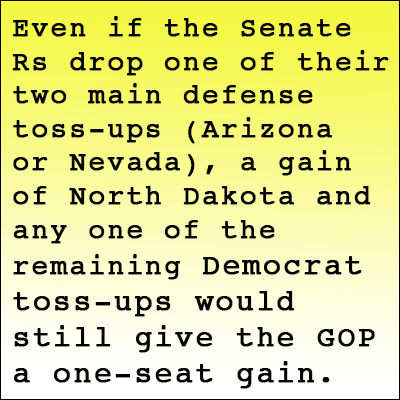
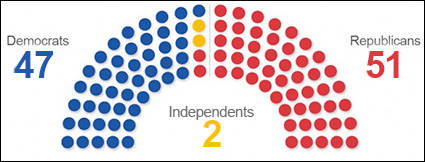
Republicans, largely because Democrats are defending 26 of the 35 Senate races, should hold control but, again, to what degree? Will their 51-49 margin increase? It appears they will successfully unseat North Dakota Sen. Heidi Heitkamp (D), but will Arizona and Nevada both hold for them, allowing more substantial gains? Does Rep. Beto O’Rourke’s (D-El Paso) new-found celebrity status and national fundraising prowess allow him to overcome Texas voting history to unseat first-term senator and former presidential candidate Ted Cruz? These and many other yet-to-be determined answers will be uncovered late tonight.

Several races may not finish tonight. Today is also the first time Louisiana voters will go to the polls during this cycle. Without a formal nomination process, the Bayou State consolidates its primary and general election into one vote. Therefore, if a candidate receives an absolute majority tonight, that individual is elected. If not, the top two finishers will advance to a Dec. 8 run-off. With no governor or Senate election on the ballot and little competition within the state’s six House districts, it appears likely that all congressional incumbents will win tonight. Next up, Gov. John Bel Edwards (D), possibly facing US Sen. John Kennedy (R), will defend his position in the 2019 odd-numbered year election.

Continue reading

Senate: The Latest Polling Numbers

1200px-Seal_of_the_United_States_Senate.svgBy Jim Ellis

Nov. 5, 2018 — The pollsters are publishing their final pre-election studies, and here’s were the tightest, top Senate races stand:


ARIZONA

Rep. Martha McSally (R) vs. Rep. Kyrsten Sinema (D)
• Fox News (Oct. 27-29; 643 likely Arizona voters)
McSally 46; Sinema 46
• SSRS for CNN (Oct. 24-29; 702 likely Arizona voters)
Sinema 51; McSally 47
• OH Predictive Insights for ABC Channel 15 (Oct. 22-23; 600 likely Arizona voters)
McSally 52; Sinema 45


FLORIDA

Sen. Bill Nelson (D) vs. Gov. Rick Scott (R)
• Cygnal (Oct. 27-29; 495 likely Florida voters)
Nelson 50; Scott 48
• SSRS for CNN (Oct. 24-29; 781 likely Florida voters)
Nelson 49; Scott 47
• St. Pete Polls (Oct. 30-31; 2,470 likely Florida voters, automated)
Nelson 49; Scott 47
• Trafalgar Group (Oct. 29-30; 2,543 likely Florida voters, automated)
Nelson 49; Scott 47


INDIANA

Sen. Joe Donnelly (D) vs. Mike Braun (R)
• Fox News (Oct. 27-30; 722 likely Indiana voters)
Donnelly 45; Braun 38
• NBC News/Marist College (Oct. 24-28; 496 likely Indiana voters)
Donnelly 43; Braun 40
Continue reading

The Democrats’ Path

By Jim Ellis

Sept. 25, 2018 — Most of the contemporary political talk surrounds the Democrats’ ability to gain the US House majority, but is there a viable path for a power shift in the Senate? Their road to a new Senate majority is much rockier than for the House, but at least a mathematical chance of that becoming reality does exist.

senate 2018 midterm election competitionLast week we reviewed the status of the 17 states that see legitimate competition for the in-cycle Senate seats. Now, looking at the latest Fox News Senate ratings, we can draw some conclusions about the Democrats’ victory chances.

It is important to remember that the minority Dems must defend 26 of the 35 in-cycle Senate races in the current election cycle. Thus, the party’s least complicated path is to run the table of their current 26 seats, and then take two of the five GOP states where they are fielding credible opposition candidates. Doing so would give the Dems a 51-49 majority.

But, this is easier said than done. According to Fox, and virtually all other media prognosticators, one of the Democratic seats, North Dakota, is already leaning to the Republicans, while three more (Florida, Indiana, and Missouri) reside in the “Toss-up” column.

Of the nine seats the Republicans need to defend, three reside in the Toss-up category (Arizona, Nevada, and Tennessee), while one is classified as a Lean Republican (Texas), and the remaining five (Nebraska, the two Mississippi seats, Utah, and Wyoming) are rated as Likely Republican. (Fox does not use a “safe” designation. The best a candidate of either party can achieve from a Fox News political rating is “likely.”)

Continue reading

Senate Recap – Part II

By Jim Ellis

US Senate makeup

US Senate makeup

Sept. 24, 2018 — Today we continue our look at the most competitive 17 US Senate contests with our second and final installment. To take a look at our Part I recap, please see our writeup this past Friday at: Senate Recap – Part I.


NEVADA

Sen. Dean Heller (R) is embroiled in an intense re-election battle with freshman Rep. Jacky Rosen (D-Henderson) as the two compete for a toss-up Senate seat. Heller won here in 2012 by a single percentage point over then-Rep. Shelley Berkley (D-Las Vegas), but that was in the election when President Obama carried Nevada, 52-46 percent.

Polls go back and forth between the senator and congresswoman, but neither leads beyond the margin of polling error. Since the beginning of September three polls have been released, and the average spread between the contenders is just two points. This is a pure toss-up election and, as a Republican defense seat, one of the most important campaigns in the nation.


NEW JERSEY

The Garden State is often a teaser for Republicans, meaning polls routinely suggest their candidates will fare better than actual results portend. The Senate race between incumbent Bob Menendez (D) and pharmaceutical CEO Bob Hugin (R) is likely no exception. Though several polls have indicated the race is competitive, it is probable that Sen. Menendez will pull away and score a comfortable win.

Polling has been scarce. The most recent survey was released in mid-August from Quinnipiac University (Aug. 15-20; 908 registered New Jersey voters) and projects the senator to be leading Hugin, 43-37 percent. Obviously, Menendez corruption trial that ended in the case against him falling apart and being dropped has taken a toll on his favorability index, but it is doubtful that even a 29:47 percent positive to negative personal approval rating (aforementioned Q-Poll) would cost him the election.


NORTH DAKOTA

If polling were the only factor in determining race outlook, then North Dakota would be the Republicans’ best conversion opportunity. Though polls have been anything but plentiful, those that have been published find at-large Rep. Kevin Cramer (R-Bismarck) leading incumbent Sen. Heidi Heitkamp (D).

The most recent study came in early September from Fox News (Sept. 8-11; 701 likely North Dakota voters) and finds Rep. Cramer holding a 48-44 percent advantage. This is the first survey release since the beginning of July.

The North Dakota race is a strong Republican conversion opportunity, but though Cramer appears to have a discernible edge right now, this contest is far from over.


Continue reading