Tag Archives: Virginia

2020 Senate Review – Part III

By Jim Ellis

March 27, 2019
— The third and final segment of our three-part Senate review covers the races alphabetically from North Carolina through Wyoming, with a re-visit to the new open seat in New Mexico:

  • New Mexico – Sen. Tom Udall (D)Open Seat – Since our Senate review began, Sen. Udall, who looked to be a lock for election to a third term, announced he will not run in 2020. Democrats will be favored to hold the seat, but Republicans have won statewide races here as late as 2014, so the potential for a competitive 2020 campaign exists.
    So far, Attorney General Hector Balderas (D) and US Rep. Ben Ray Lujan (D-Nambe/Santa Fe) both confirm they are considering running, as is 2018 Republican nominee Mick Rich. Two individuals have already said they will not enter the Senate race: Gov. Michelle Lujan Grisham (D) and Santa Fe Mayor Alan Webber (D). Many more potential candidacies from both parties are being discussed. Currently, this open seat earns at the very least a Lean Democrat rating but is realistically Likely Democratic.

  • North Carolina – Sen. Thom Tillis (R) – This will be a top-tier race, as are almost all North Carolina Senate races. Sen. Tillis ousted then-Sen. Kay Hagan (D) in 2014 in a state that has re-elected only one senator since the days of Sam Ervin (D) and Jesse Helms (R).
    The Democrats failed to recruit their top target in Attorney General Josh Stein (D), and so far, their field is second tier. Only Mecklenburg County commissioner-at-large Trevor Fuller (D) and state Sen. Erica Smith (D-Gaston) have declared their candidacy.
    Sen. Tillis received pushback for originally opposing President Trump’s emergency border declaration, which has fueled rumors of a potential primary challenge. Therefore, the North Carolina campaign is in a state of flux. Much will change here in the coming year to affect the outcome. Currently, rate this seat as Lean Republican.

  • Oklahoma – Sen. Jim Inhofe (R) – The major discussion surrounds whether 84-year-old veteran Sen. Inhofe will retire. If he runs, the election campaign may be slightly more competitive based upon the 2018 Oklahoma results, in which the Democrats made some significant gains. Even if they continue to build momentum, their chances of winning a statewide election in the Sooner State still remain slim. Likely Republican until it becomes clear whether or not Sen. Inhofe will seek re-election.

  • Continue reading

The Campaign Begins

By Jim Ellis

Feb. 8, 2019 — President Donald Trump used his State of the Union Address on Tuesday night to informally begin his re-election drive.

While some theorized that the president might decide not to seek a second term as we got closer to the primaries, the text of his speech told us just the opposite. In fact, instead of being a State of the Union Address, his subject matter and delivery made it closer to a campaign announcement speech.

In addition to using the address to frame the beginning of his re-election effort, the president also outlined what will likely become his key strategic tenets. In other words, he showcased the speech to begin painting the picture of his Democratic opponents that he wants the electorate to see.

It was clear from his emphasis points that Trump intends to create a clear contrast between he and the Democrats, and certainly the future party nominee whomever that may be, by attempting to position himself as the center-right candidate and driving his opponents into the far left ideological realm.

He also displayed the key points that will likely serve as the foundation for his campaign offensive: increasing jobs, economic prosperity, and the number of small businesses; re-emphasizing his America First theme with both the country’s allies and adversaries in relation to foreign affairs and trade issues; and, how the Trump Administration has made the world a safer place because of its foreign policy decisions and initiatives.

The president also used the speech as a tool to put the Democrats on the defensive, and even apparently shocked them at least a couple of times if their initial reaction is any indication.

Continue reading

Northam on the Edge

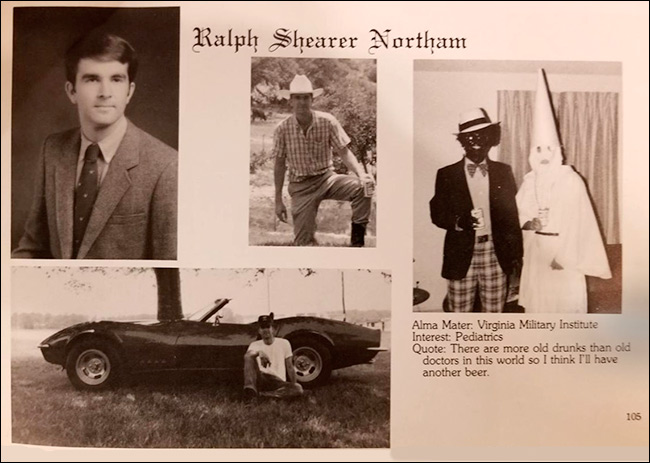
The racially charged photo compilation above appeared in the 1984 yearbook of the medical school Gov. Ralph Northam attended with his name on the page.


By Jim Ellis

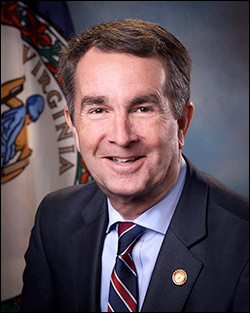
Virginia Democratic Gov. Ralph Northam

Feb. 5, 2019 — Virginia Democratic Gov. Ralph Northam continues to reel, and many believe the increasing pressure upon him to resign will force him from office within the next 48 hours.

Northam defeated former Republican National Committee chairman Ed Gillespie, 54-45 percent, in the 2017 statewide election. His term will expire at the beginning of 2022.

The number of Democrats publicly opposing Northam over the publication of a racially charged medical school year book picture increased substantially over the weekend, capped by a joint pro-resignation statement issued from Sens. Mark Warner and Tim Kaine, along with House Education & Labor Committee chairman Bobby Scott (D-Newport News).

Former Gov. Terry McAuliffe, who Northam served as lieutenant governor, and Congressional Black Caucus member Donald McEachin (D-Richmond) also joined the chorus of detractors in addition to Democratic National Committee chairman Tom Perez, former Vice President Joe Biden, several other presidential candidates, and ex-Virginia Gov. Doug Wilder, the state’s first African American governor who was elected in 1989.

Continue reading

The Final Outlook

2018-elections-open-seatsBy Jim Ellis

Nov. 6, 2018 — Election Day has arrived, but it is likely that a majority of those planning to vote have already done so. Early voting totals are way up in most of the 37 states that employ a pre-election ballot casting procedure in comparison to the 2014 midterm election.

According to the University of Florida’s United States Elections Project, 25 of the 37 states report receiving more early votes than they did four years ago. None, however, is larger than Texas where early voting has already exceeded that grand total votes cast in 2014. The same also has occurred in Nevada, but it’s less surprising since the last midterm aggregate turnout there was unusually low.

In Texas, just under 4.9 million votes already have been received. In 2014, the aggregate early and Election Day vote was 4.72 million. In 2014, 44 percent of the total vote was cast early. If this same pattern occurs, the current election total turnout will exceed the 2016 presidential level participation figure of 8.96 million votes, however it is unlikely that will happen. How the increased turnout will affect the election outcome is undetermined at this point, but the high number of first-time voters suggest that Democrats could improve their typical standing.

Continue reading

National Early Voting Report

By Jim Ellis

i-vote-i-countOct. 31, 2018 — Now more than halfway through the early voting period in the 37 states that offer early voting options for the populace, some places are turning in record participation rates. Each state has various nuances in their early voting procedures, so comparing the early reports to each other is of little value. Going back to contrast the current 2018 reported numbers with how that particular state voted in the last midterm election (2014) does have significance, however.

Already, in the latest available reports according to the United States Election Project administered by the personnel at the University of Florida, seven states are reporting more received early voting ballots than were recorded for the entire 2014 pre-election period. They are:

• Tennessee – 162.3% more ballots (1,029,846 versus 634,364 recorded in 2014)
• Texas – 144.3% increase (2,980,915 versus 2,066,368 recorded in 2014)
• Indiana – 127.9% increase (292,726 versus 228,932 recorded in 2014)
• Nevada – 122.5% increase (372,455 versus 304,005 recorded in 2014)
• Georgia – 111.1% increase (1,188,636 versus 1,069,912 recorded in 2014)
• Minnesota – 106.0% increase (249,909 versus 235,808 recorded in 2014)
• Delaware – 103.2% more ballots (8,550 versus 8,288 recorded in 2014)


An additional seven states have so far recorded better than 85 percent of their early voting total in comparison to their entire 2014 pre-election voting universe:

• North Carolina – 97.1% of previous (1,140,657 versus 1,174,188 recorded in 2014)
• Virginia – 94.2% of previous total (191,755 versus 203,556 recorded in 2014)
Continue reading

Surprising Q3 Financial Disclosures

By Jim Ellis

Oct. 19, 2018 — The third quarter financial disclosure reports are now public, and more details are readily available. Thus, we are able to learn about various record-setting fundraising efforts.

FEC-moneyIn addition to Texas US Senate candidate Beto O’Rourke (D) attracting $38 million in the third quarter, an all-time record for any such campaign, several House candidates also reported financial numbers that have never been seen for district-level politics.

In the third quarter of 2018, nine House contenders exceeded raising $3 million, eight Democrats and one Republican.

In California’s 22nd District, incumbent Rep. Devin Nunes (R-Tulare), the chairman of the House Intelligence Committee, was the top Republican fundraiser and appears to have accumulated more financial resources for the entire campaign than any other congressional candidate of either party. In the quarter, Rep. Nunes raised $3.14 million. For the campaign, he has exceeded the $10.5 million mark.

But his Democratic opponent, attorney Andrew Janz, brought in over $4 million for the quarter, the only congressional candidate in the US to do so, and an all-time record for a quarter. He still trails Rep. Nunes in overall receipts (Janz posted $7.13 million for the campaign), however. Together, this campaign leads the nation in combined fundraising with over $17 million. For a regular cycle congressional campaign – not including the special elections we saw earlier that became national contests – this, too, is likely an all-time record for a House contest.

Continue reading

Forecasting the Results – Part II

By Jim Ellis

2018-democrat-house-majority-breakdown-text-graphicOct. 8, 2018 — The Democrats need to convert a net 24 seats to secure a one-seat majority in the US House on Election Day, Nov. 6. Many reports quote the number 23 as what is necessary to win control, but the new Pennsylvania map will yield one seat coming back to the Republicans — the new open 14th District — thus pushing the total up to 24.

As stated Friday, our forecasts listed below are based upon a series of factors, including current polling numbers, voter history, candidate personal and job approval favorability, fundraising, other races on the state ballot that could drive turnout, and outside issues such as the confirmation vote to for Judge Brett Kavanaugh to become a Supreme Court Justice, which could change the turnout model, etc.

According to our new analysis, the Democrats are on the cusp of converting the requisite number of Republican seats to take a bare majority and seeing their caucus become significantly larger. At this point, the Democratic gain range appears to reach 23 on the low side and 35 at the apex.

Looking at the country by state and region, it appears the Democrats will do well in the Midwest, in particular. The Great Lakes region that delivered President Trump his surprise victory appears to be snapping back to the Democrats in the midterm House races. Michigan looks particularly good for them at both the statewide and district levels.

Continue reading