Category Archives: US Supreme Court

Redistricting Disarray: Alabama Yes, Georgia No, Louisiana Back to Jungle

By Jim Ellis — Monday, May 4, 2026

Redistricting

The Supreme Court ruling on the Callais v. Louisiana racial gerrymandering case has thrown the House election cycle into disarray. As a result of the high court’s decision, redistricting options are again being contemplated in several states.

Alabama Gov. Kay Ivey (R), despite previously stating she opposed redistricting ahead of the 2026 elections, issued a proclamation on Friday calling the legislature into special session later today to redraw the state’s congressional and state Senate maps.

Alabama is in exactly the same situation now as Louisiana. Under court orders, both states were required to redraw their 2021 congressional maps to add a majority minority district. Following last week’s Supreme Court Callais ruling, those revised maps are now invalid.

It is probable that the Alabama legislature will revert to a map like the one enacted in 2021. Such a plan would collapse Rep. Shomari Figures’ (D‑Montgomery) current District 2 and shift the seat back to southeast Alabama. That change would likely return the state’s congressional delegation to a 6R–1D alignment, rather than the current 5R–2D split.

The principal beneficiary of such a map would be former Congressman Jerry Carl (R), who lost his seat in a 2024 paired‑incumbent primary. He is currently running in the reconfigured 1st District now that incumbent Rep. Barry Moore (R) is seeking a Senate seat. Carl, however, trails state Rep. Rhett Marques (R‑Enterprise) in a recently released poll.

A new map would likely restore Mobile County as the population anchor of District 1 and shift District 2 back to southeast Alabama. Such a draw would allow both Carl and Marques to run in separate districts. While each would still face primary competition under a new configuration, they would no longer be forced to run against one another.

The Alabama primary is scheduled for May 19, which means the legislature will have to act quickly. The most likely scenario is that the regular primary proceeds as planned for all offices except the US House of Representatives and state Senate. Once new maps are enacted, a separate filing period and new primary dates for those offices would be set for later in the year.

Georgia is another state that could potentially redraw its congressional map, but with candidate filing already closed and the May 19 primary fast approaching, Gov. Brian Kemp (R) is taking the opposite position of Gov. Ivey. Kemp said he does not support redistricting for 2026, though indicated he would be open to considering a new map for the 2028 election cycle.

In Louisiana, state Senate President Cameron Henry (R‑Metairie) said Friday that the 2026 election scheduling decision will likely return the state’s US House races to the jungle primary format that has been in place since the late 1970s.

Gov. Jeff Landry (R) has already suspended the May 16 primary for US House campaigns in response to the Supreme Court ruling. The other affected contests, most notably the US Senate race, will continue to proceed under the May 16 partisan primary schedule.

With other offices still operating under the jungle primary system, which runs concurrently with the November general election and employs December runoffs when no candidate wins a majority, it is likely the Governor will simply return the US House races to this previous format and election calendar. Such would be the least expensive way for the state to conduct elections under a revised schedule.

Once the Virginia state Supreme Court renders a decision upholding the April 21 redistricting referendum, and the new Florida plan wins approval from its state Supreme Court after a lawsuit is formally filed, along with Alabama and Louisiana overcoming the legal objections to moving their primaries, the national redistricting landscape will finally come into clear focus.

Assuming all of these courts rule as suggested, we can reasonably predict that the new California and Texas maps would offset one another in terms of partisan gains, as would the changes in Virginia and Florida. Republicans would probably gain one seat each in Alabama, Louisiana, Missouri, and North Carolina, with the potential for one or two additional seats in Ohio. Democrats would gain one seat in Utah under that state’s new court‑ordered map.

Therefore, if the national redistricting picture ultimately unfolds as outlined above, the 2026 changes would likely result in Republicans achieving a net gain of four to five seats nationwide.
Louisiana Suspends House Primaries

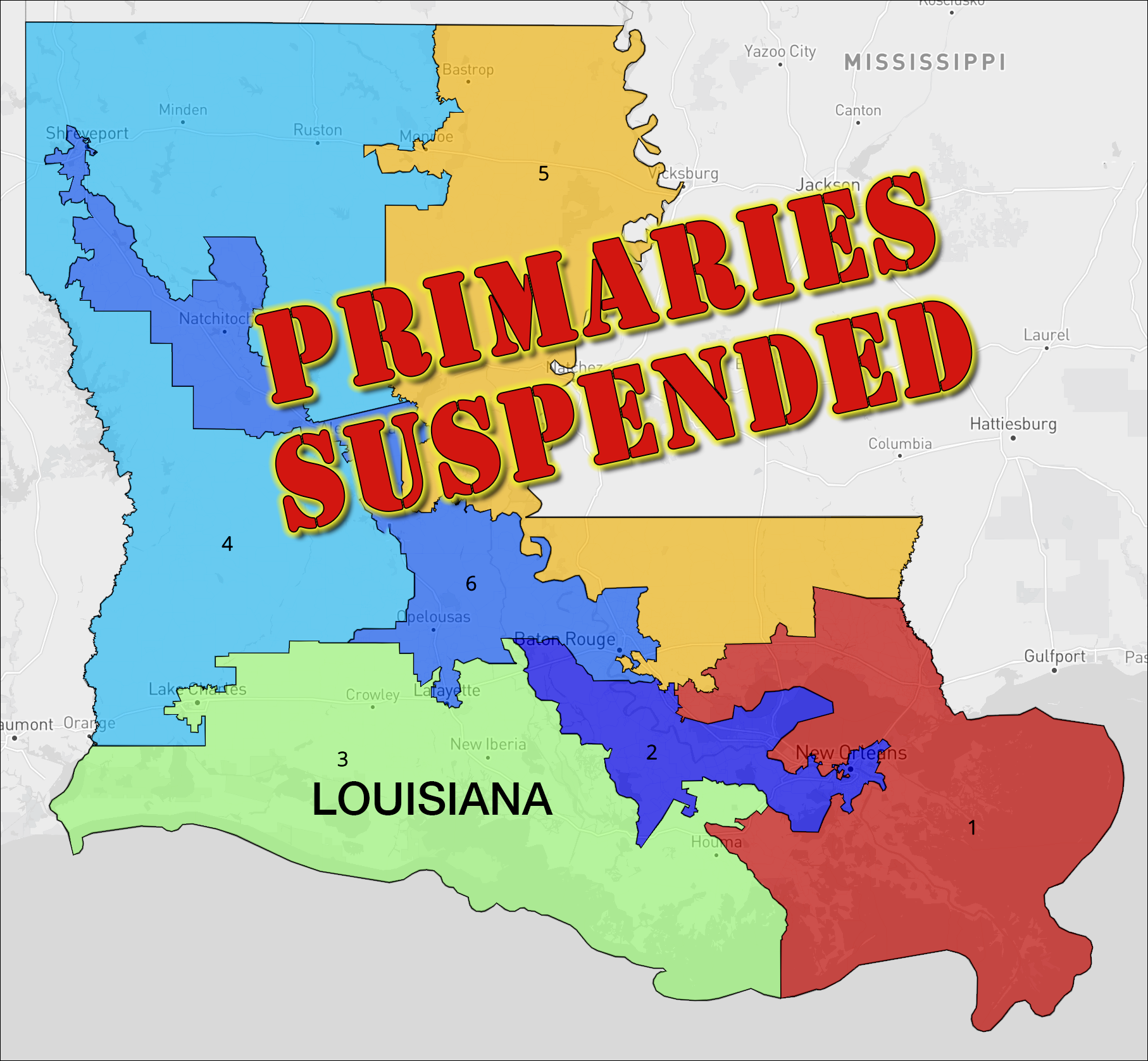
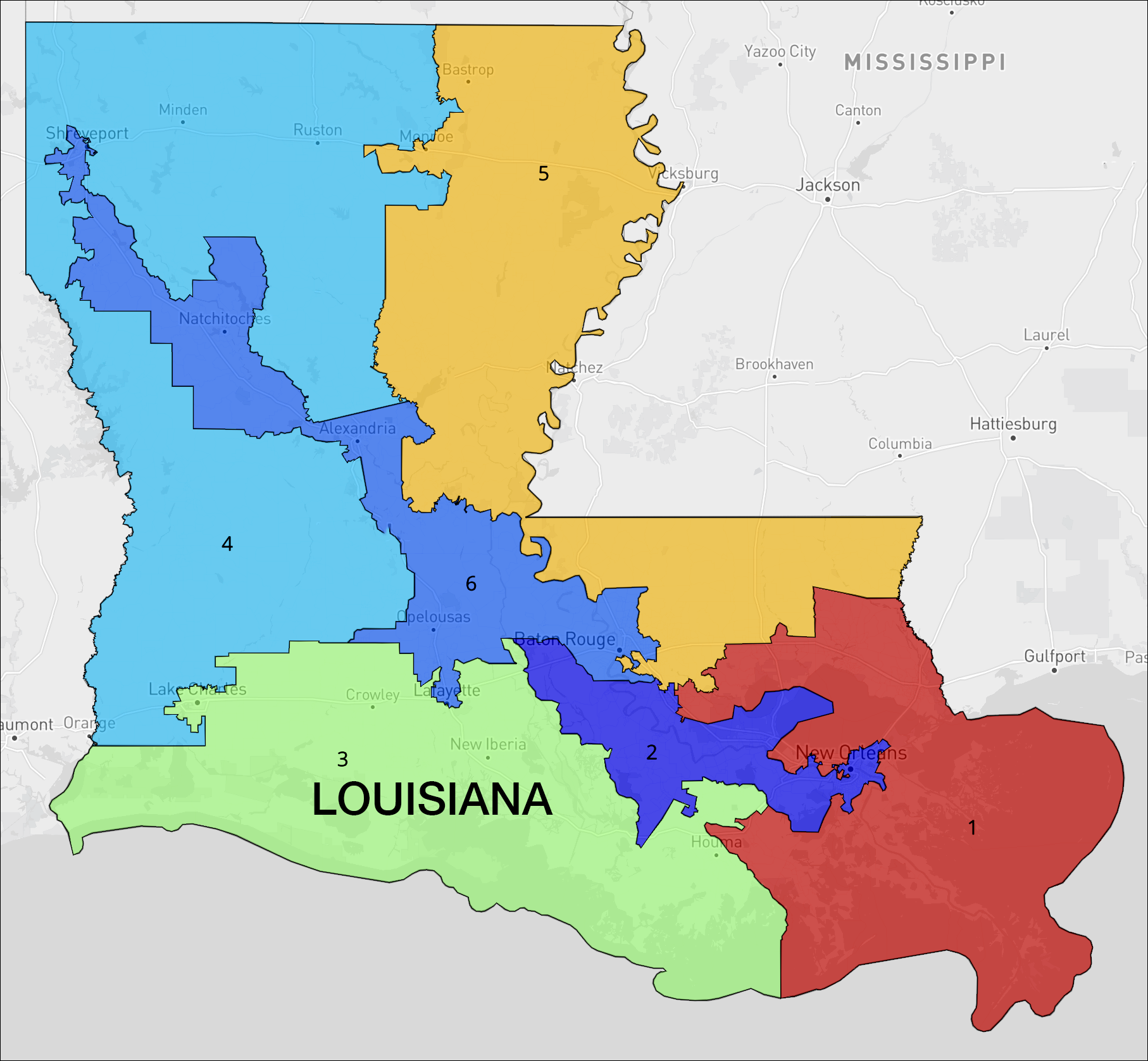
Louisiana Governor suspends US House elections (view interactive 2024 Louisiana Congressional Districts map on Dave’s Redistricting App).

By Jim Ellis — Friday, May 1, 2026

House

A day after the US Supreme Court ruled Louisiana’s congressional map an unconstitutional gerrymander, Gov. Jeff Landry (R) issued an executive order affecting the state’s May 16 primary election.

With early voting set to begin tomorrow and the state’s congressional map declared illegal by the nation’s highest court on Wednesday, Gov. Landry moved quickly to suspend the House primaries. He said the nomination election will remain in abeyance to give legislators time to redraw and approve a new congressional map and identified July 15 as the target date for rescheduling the House contests.

All other races, including the US Senate primaries in both parties, will proceed as planned on May 16.

Democrats, and even some Republicans, criticized the decision, arguing that early voting ballots have already been distributed and that postponing only the US House primaries would create confusion and likely depress turnout.

One of the Republican critics, Sen. Bill Cassidy, who faces a difficult renomination fight under the new partisan primary system, warned that running two different nomination schedules will mislead voters. For that reason, he opposes allowing the Senate primary to proceed on May 16.

What is likely a more salient reason for Sen. Cassidy’s push to postpone the primary is a new Emerson College poll released yesterday. The survey (April 24–26; 500 likely Republican primary voters; multiple sampling techniques) shows Sen. Cassidy trailing both former state Treasurer John Fleming and Rep. Julia Letlow (R‑Start), whom President Trump has already endorsed.

The ballot test produced a 28-27-21 percent split, with Fleming narrowly leading Rep. Letlow, and Sen. Cassidy following. Clearly, the race is headed toward a runoff, and it is not even certain that Sen. Cassidy will qualify for the second round.

At the end of 2024, the Louisiana legislature and the Governor overhauled the state’s preliminary election system. The new law created a partisan primary in May of the election year, followed by a June runoff in any race where no candidate secures a majority. Once nominees are chosen, they advance to a November general election, as in all other states.

Previously, Louisiana used a jungle primary system in which all candidates, regardless of party, appeared on the same ballot. Any candidate who received more than 50 percent of the vote in the first round was elected outright. If no one reaches a majority, the top two finishers, again, regardless of party affiliation, advance to the general election.

In past years, Louisiana held its initial election concurrently with the national general election. If a runoff was required, the top candidates would meet again in an early December second round. For the state legislature and many statewide offices, including the governorship, that system remains in place. The new partisan primary structure applies only to federal offices and certain designated state positions.

The act of drawing a new congressional map will almost certainly guarantee Republicans at least one additional seat in the current 4R–2D Louisiana delegation. Some observers, most notably reporters at the liberal political blog The Down Ballot, have speculated that Republican legislators might even attempt to convert both Democratic seats. Whether such an effort will materialize remains uncertain.

In addition to Louisiana, other states may also undertake redistricting ahead of the 2026 election. Reports indicate that President Trump has urged Tennessee Gov. Bill Lee (R) to eliminate the state’s lone Democratic‑held district; Georgia is also viewed as a potential candidate for a 2026 redraw.

Other states could be in the mix, as well. If such efforts move forward, they will almost certainly unfold on a very compressed timeline.

SCOTUS Decides Louisiana Case;
Florida Rep. Webster to Retire

2024 Louisiana Congressional Districts map (view interactive version on Dave’s Redistricting App)

By Jim Ellis — Thursday, April 30, 2026

Louisiana

The US Supreme Court, months after initially hearing the Louisiana racial gerrymandering case, released its ruling yesterday.

In authoring the Court’s opinion, Associate Justice Samuel Alito outlined the reasons the justices upheld the three‑judge panel’s ruling in Callais v. Louisiana, which found that the congressional map used before the 2024 election constituted a racial gerrymander.

The ruling is viewed as favorable to Republicans and will almost certainly require Louisiana’s congressional map to be redrawn before the 2026 statewide primary on May 16. It is possible that the legislature could simply revert to the 2021 map that was in place for the 2022 election.

Activists in several states are already urging their legislators to redraw congressional maps. Such is the case in Georgia, Mississippi (for their state Supreme Court districts), and potentially South Carolina. The Florida legislature is now likely to pass the map that Gov. Ron DeSantis (R) produced, which was drawn in anticipation of a favorable Republican Louisiana ruling.

In the Callais decision, Justice Alito outlined the parameters of the Voting Rights Act. He wrote, “Because the Voting Rights Act did not require Louisiana to create an additional majority-minority district, no compelling interest justified the State’s use of race in creating SB8, and that map is an unconstitutional racial gerrymander.”

He further explained when race can be used as a factor in drawing legislative district boundaries. From later in the ruling, Justice Alito stated, “The Court’s precedents have identified “only two compelling interests” that can satisfy strict scrutiny: avoiding imminent and serious risks to human safety in prisons,” and “remediating specific, identified instances of past discrimination that violated the Constitution or a statute.”

Further explaining, the Justice wrote, “Properly understood, §2 thus does not intrude on States’ prerogative to draw districts based on nonracial factors, including to achieve partisan advantage. In short, §2 imposes liability only when the evidence supports a strong inference that the State intentionally drew its districts to afford minority voters less opportunity because of their race. Not only does this interpretation follow from the plain text of §2, but it is consistent with the limited authority that the Fifteenth Amendment confers.”

It remains to be seen which states besides Louisiana will redraw their maps before the 2026 election. Alabama, where officials were also required to add another minority district ahead of the 2024 election, is one possibility. With primary elections already underway in many states, most significant redistricting activity is likely to shift to the 2028 election cycle.

FL-11

Although he would have continued to represent a safely Republican district under Gov. Ron DeSantis’ proposed congressional map, eight-term US Rep. Dan Webster (R-Clermont) announced just after celebrating his 77th birthday that he will not seek re-election later this year.

Rep. Webster had been viewed as a potential retirement candidate throughout this election cycle. Under the DeSantis map, his central Florida 11th District is rated as safely Republican. In the proposed FL‑11, President Trump would have recorded a 57.2 to 41.5 percent victory margin over Kamala Harris.

Dan Webster was first elected to the Florida House of Representatives in 1980 and later became the chamber’s first Republican Speaker since Reconstruction. He was elected to the state Senate in 1998, where he went on to serve as Majority Leader.

The number of open House seats has now grown to 64. Thirty-eight of these seats are currently Republican held with 21 from the Democratic column. Five additional open districts have been created as a result of redistricting maps in California, Texas, and Utah.

Of the 64 seats in the open category, only 28 involve members retiring from elective office. This group includes two lawmakers who were paired in a new redistricting map with another incumbent of his own party, Reps. Lloyd Doggett (D-TX) and Burgess Owens (R-UT).

Twenty-seven Representatives are running for a different office, three have resigned their seats, two districts are open due to the incumbent’s death, and one has already been defeated in his primary election.

Once the Florida redistricting process is resolved, a crowded Republican field is expected to emerge for the now‑open 11th District. The Sunshine State candidate‑filing deadline for US House races is June 12, and the state’s primary is scheduled for Aug. 18.

Redistricting News

By Jim Ellis — Wednesday, April 29, 2026

Redistricting

As the election cycle progresses and a new round of candidate filing deadlines are fast approaching, redistricting action is coming quickly.

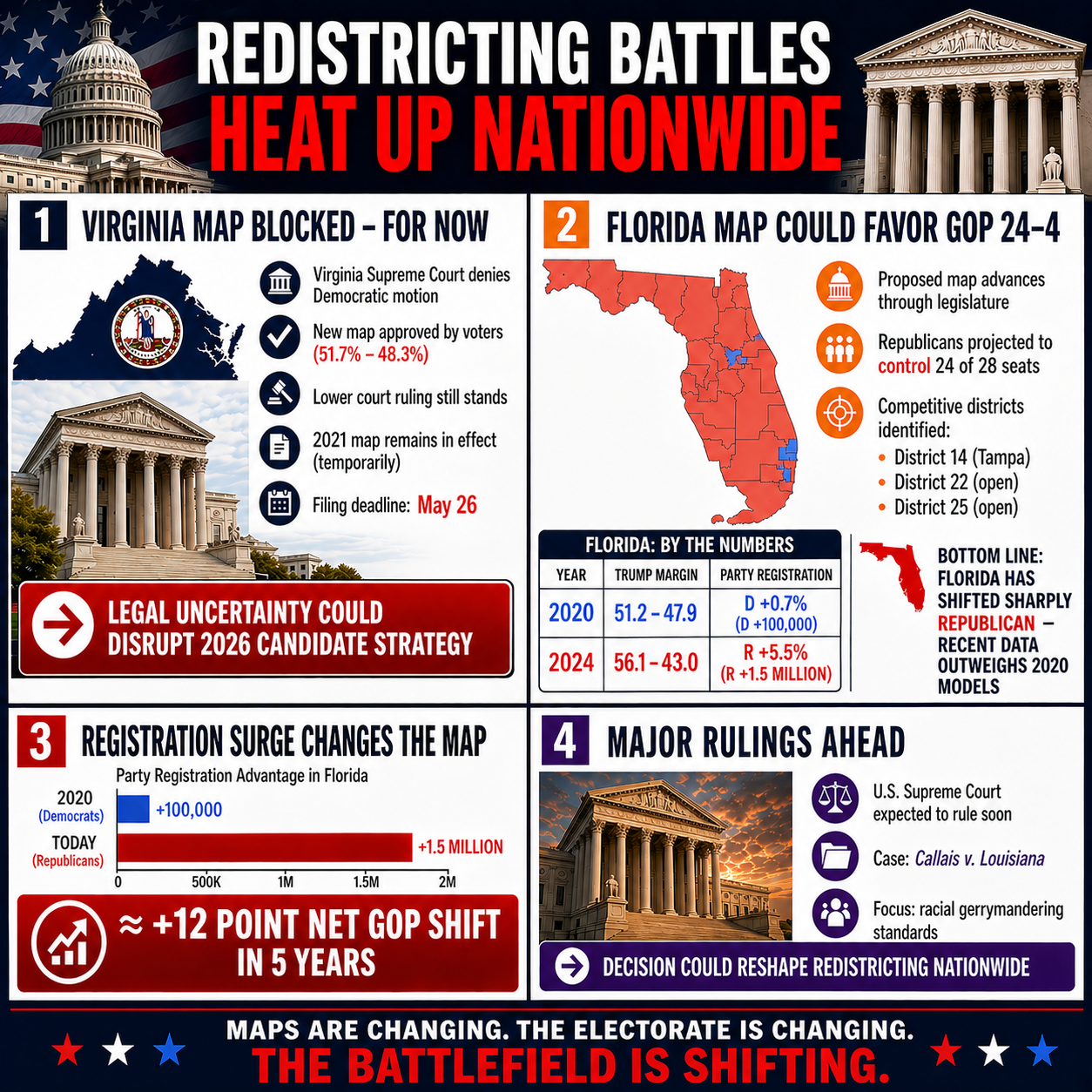
Yesterday, the Virginia Supreme Court heard arguments on the Democratic Party’s motion to lift the lower court’s stay that had invalidated the new map. The original ruling, issued before the statewide referendum election, stemmed from the judge’s finding that the legislature violated its own rules by rushing the measure onto the ballot.

After the circuit judge’s ruling, the Democrats appealed to the state Supreme Court. The justices have not yet heard the appeal but allowed the referendum to proceed. On April 21, voters approved the new congressional map by a narrower than expected 51.7 to 48.3 percent margin. With the candidate‑filing deadline approaching on May 26, the Democratic Party moved to ensure that the 2026 elections can proceed under the newly adopted map.

In a rather surprising ruling, the state Supreme Court yesterday denied the motion. As a result, the 2021 congressional map remains in effect until the justices hear the Democratic Party’s appeal of the lower court ruling and issue a final decision.

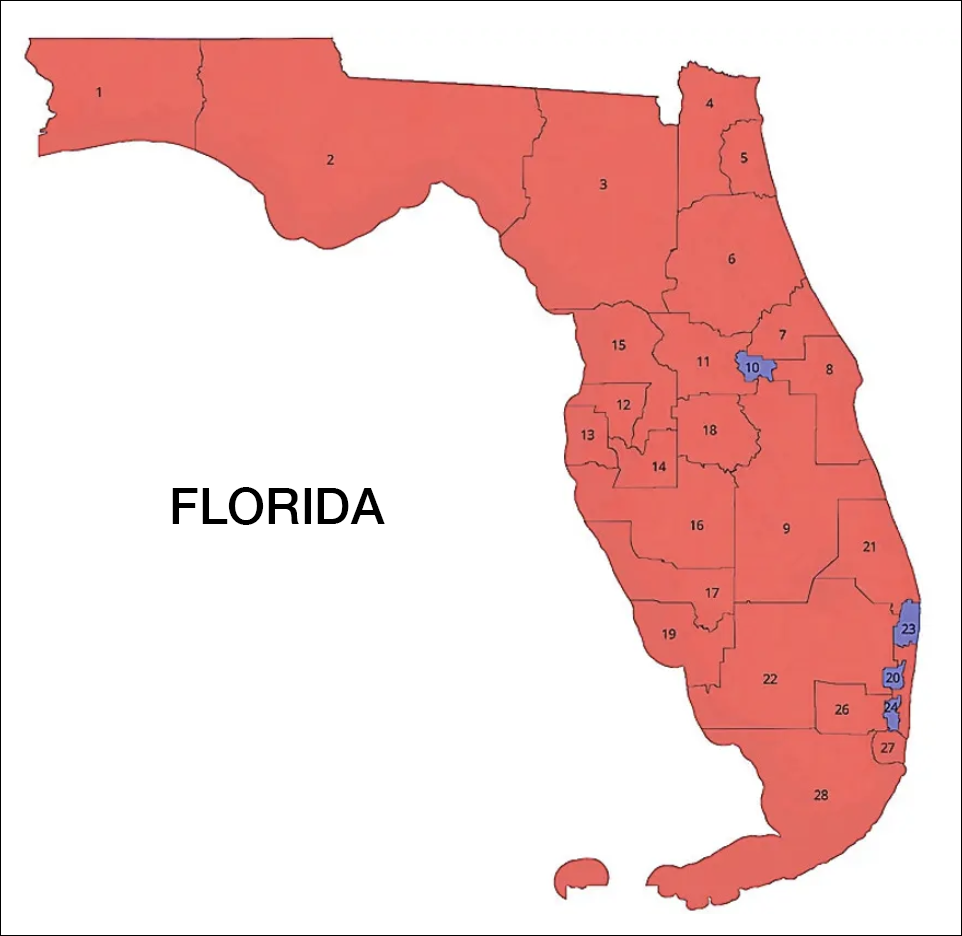
More details are emerging about the newly proposed Florida congressional map, which is expected to come before the state House of Representatives this week. If approved, the plan would then advance to the state Senate.

The new plan is being characterized as one that would deliver 24 of Florida’s 28 congressional districts to Republicans.

Researchers at the University of Virginia’s Center for Politics have conducted a preliminary review of the proposed districts and suggest that several of the new seats may be more competitive than Republicans are indicating.

The Center’s report specifically identifies new Districts 14 (Rep. Kathy Castor-D; Tampa), 22 (likely a new open seat), and 25 (also likely an open seat) as competitive contests that could present opportunities for Democratic holds.

While the weakest of these districts is the new 25th, which would have given President Trump a 54-45 percent victory in 2024, the Center compares the totals to the 2020 election when President Trump faced Joe Biden. In that scenario, the Center’s analysis shows new District 14 narrowing to a two‑point Trump advantage, while Biden would have carried District 22 by 2.9 points and District 25 by a wider 5.1‑point margin.

While competitive races in these districts are certainly possible, particularly in the 14th, which features a long‑serving incumbent (Rep. Castor was first elected in 2006), the two presidential elections are not equally comparable in terms of political significance.

Florida has undergone drastic political change since 2020, largely to the benefit of Republicans. In 2020, Democrats held a 36.5 to 35.8 percent advantage in party registration, amounting to just under 100,000 more registered Democrats than Republicans.

Today, Republicans hold a 41.3 to 35.8 percent advantage, giving the party a registration lead of roughly 1.5 million voters. Measured as a percentage shift over the past five years, this represents a net Republican gain of nearly 12 points.

In 2020, President Trump carried Florida with just a 51.2 – 47.9 percent victory margin. In 2024, his margin increased to 56.1 to 43.0 percent. When these statewide shifts are considered alongside the substantial changes in voter registration and the per‑district analysis, the 2024 projections are likely a more accurate reflection of the current electorate than the numbers derived from the 2020 results.

Expect additional redistricting developments soon, particularly the US Supreme Court’s decision in Callais v. Louisiana, which many observers anticipate will be a significant ruling on racial gerrymandering.

Texas Redistricting Ruling; Fla. Gov. DeSantis Releases Redistricting Map

By Jim Ellis — Tuesday, April 28, 2026

Texas Redistricting

In a move that could signal how it may approach the Louisiana racial gerrymandering dispute, the US Supreme Court yesterday took a very unusual step regarding the Texas redistricting appeal.

A majority of the justices voted to issue a reverse summary judgment in the challenge to Texas’s new congressional map. The move effectively overturned the lower court’s ruling without requiring additional briefing or oral argument.

Yesterday’s court action is exceedingly rare, and its use adds weight to predictions that the forthcoming Louisiana decision could become a defining ruling on racial gerrymandering. The Court is scheduled to release additional opinions tomorrow, and it remains unclear whether Callais v. Louisiana will finally be among the cases issued this week.

For more detailed information, visit the Florida Senate redistricting map.

Florida Redistricting

Gov. Ron DeSantis (R) yesterday released a new congressional map that he is urging the legislature to approve during the special session scheduled to begin today.

The Governor issued a statement saying that redistricting is necessary because “Florida got shortchanged in the 2020 Census, and we’ve been fighting for fair representation ever since. Our population has since grown dramatically, and we have moved from a Democrat majority to a 1.5 million [person] Republican advantage. Drawing maps based on race, which is reflected in our current congressional districts, is unconstitutional and should be prohibited.”

Widely viewed as a response to the 10D–1R Virginia map approved by voters last week, the Governor unveiled a Florida proposal that would likely shift the delegation from a 20-8 Republican advantage to a 24-4 advantage.

The current Florida map features 20 Republicans and 8 Democrats. It appears that at least three current Democratic House members — Reps. Kathy Castor (D-Tampa), Darren Soto (D-Kissimmee), and Debbie Wasserman Schultz (D-Weston) — would likely face significantly more difficult paths for re-election and enter the general election as underdogs.

In a new 23rd District lying in the Ft. Lauderdale area, it is probable that Reps. Jared Moskowitz (D-Parkland) and Lois Frankel (D-West Palm Beach) would be paired in a Democratic primary, with the winner favored to hold the seat in the general election.

The sitting Democrats who would have a district on the new map are: Reps. Maxwell Frost (D-Orlando), Frederica Wilson (D-Miami Gardens) and the open 20th District.

In the latter seat, former Congresswoman Sheila Cherfilus-McCormick (D-Miramar), who resigned from the House while facing federal indictments in addition to violating 25 House ethics provisions, would see an open Democratic seat in her area. Although she has stepped down from Congress, Cherfilus‑ McCormick has not closed her campaign account and indicated that she intends to run for the new seat.

The new 20th District is one she would likely have been able to hold were it not for her legal troubles. Six other Democrats had already entered the race, and the new configuration suggests that all of them will remain in the contest. Although she is running again, Cherfilus‑McCormick’s prospects for returning to Congress appear slim at best.

The South Florida portion of the map appears to create two new open Republican seats: one coastal district (FL‑25) between Fort Lauderdale and Miami, and another to the west (FL‑22) that stretches across the peninsula to the Gulf Coast.

Political data for the proposed districts has not yet been released or analyzed, so decisions about where certain members ultimately run could shift as more information becomes available. For example, because many of the South Florida districts are expected to lean only slightly Republican, Reps. Wasserman Schultz and Moskowitz may have multiple potential districts to consider if they choose to remain in Congress, though none would offer a particularly favorable political landscape.

There are still many unanswered questions surrounding the proposed Florida map, but the DeSantis plan is currently the most fully developed option on the Republican side. It remains to be seen if the Governor can capture majority support in each legislative chamber. If he does, the plan would significantly strengthen Republican prospects for retaining their narrow US House majority in the 2026 election.

US Supreme Court Hears
Louisiana Redistricting Case

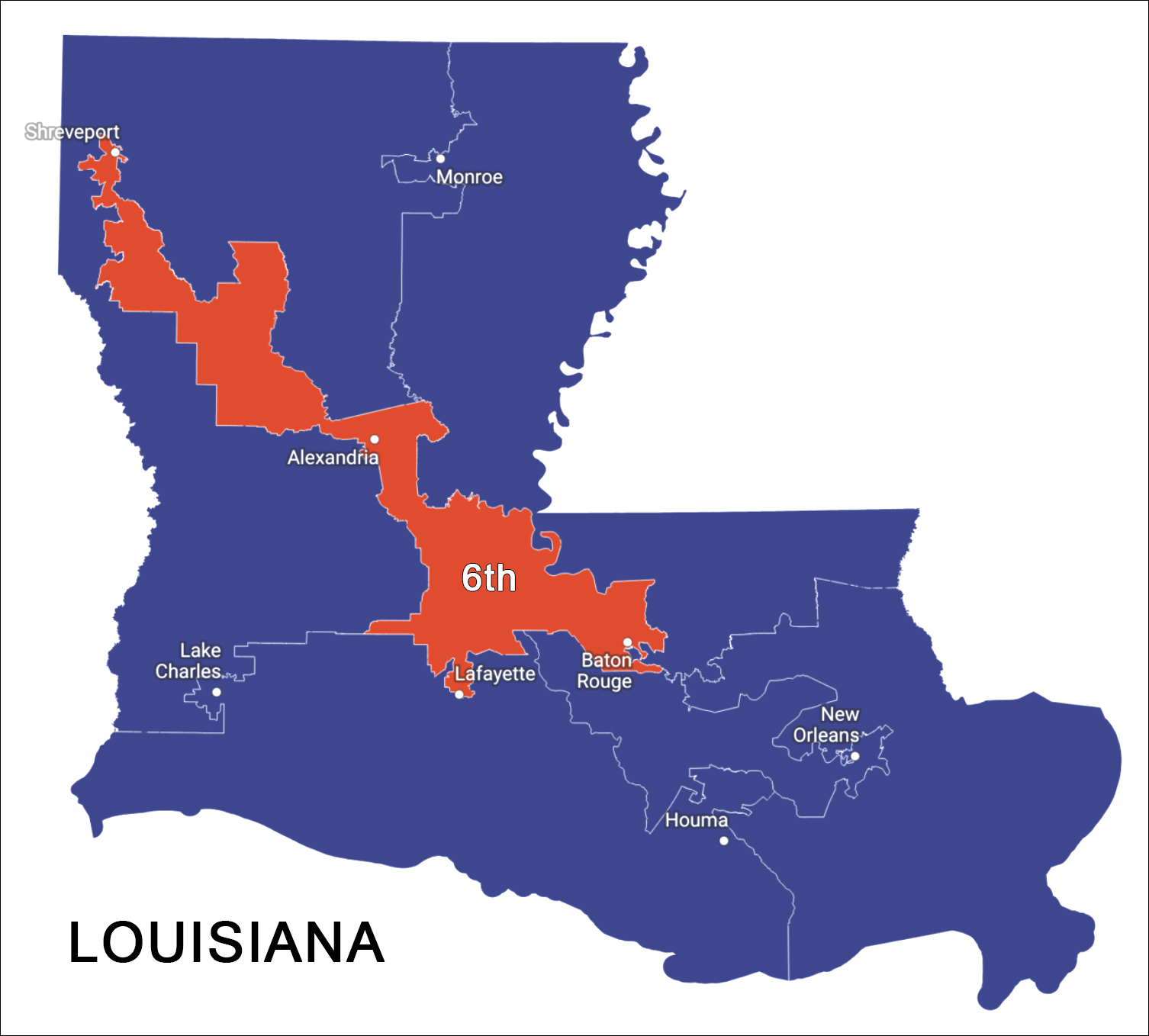
Louisiana’s 6th Congressional District / Graphic by VeriteNews.org

By Jim Ellis — Thursday, Oct. 16, 2025

Redistricting

Yesterday, the nine United States Supreme Court justices heard oral arguments for the second time on the Louisiana racial gerrymandering case. How this case is decided could have a major impact on the 2026 US House election cycle and in district elections throughout the remainder of the current decade.

At issue is Louisiana’s 6th Congressional District (in red on above map), which stretches from Baton Rouge to Shreveport. This CD was put in place before the 2024 election in response to a court order to create a second majority minority district that would elect an African-American Representative. Ironically, this very draw was rejected in a 1994 ruling, but the 2024 map drawers reinstated the same district 30 years later.

A lawsuit was filed over the redraw and the plaintiffs earned a favorable decision from the initial three-judge federal panel constructed to hear the case, but the US Supreme Court stayed the ruling. After briefs and oral arguments were conducted, the high court chose not to rule in June opting for a second round of oral arguments, which were held yesterday.

According to news stories and observations, impressions suggest that several justices appear favorable toward changing the particulars that heretofore have governed the parameters relating to minority district construction. Whether a majority exists to do so and to what extent change may be forthcoming remains unanswered.

The eventual decision could have wide-ranging ramifications to maps in several other states, and not just those where legislators are currently either drawing new districts or contemplating such action.

A SCOTUS decision to uphold the three-judge panel ruling would allow the Louisiana legislature to return to the previous map, or a similar one. That particular map produced a 5R-1D partisan division. The current Louisiana congressional delegation consists of a 4R-2D split.

If the three-judge panel ruling is upheld or expanded upon, the Alabama map would be affected because that state is in virtually the same situation as Louisiana with regard to minority district composition. Such a decision would also virtually eliminate any serious challenge to the new Texas map.

Therefore, with the updated Lone Star State map projected to net Republicans five seats — and should the previously described scenario in Louisiana and Alabama come to fruition and before the 2026 election — the Republicans could net seven seats from the three states. Even if the California redistricting referendum passes and the Democrats net five seats to neutralize the GOP’s Texas gains, the net Republican increase from the four domains would be two. Adding the new completed Missouri map, and the Republicans would see a net three-seat national gain.

Other states in some way, shape, or form considering redistricting either with a special legislative session or when their next regular session begins, or through a court directive are Florida, Georgia, Indiana, Kansas, Nebraska, North Carolina, and Ohio. These could favor Republicans. While Illinois, Maryland, and Utah would likely produce Democratic gains.

Not all of these states will move forward, but should the Supreme Court ruling on the Louisiana case be of a landmark proportion, some of these states and others may then be compelled to follow suit.

Another factor is when SCOTUS rules. Louisiana now has an April partisan primary schedule, so one would think the ruling will be revealed in time for the nomination elections to be conducted as scheduled. A later ruling would suggest that a great deal of the redistricting action will greatly affect the 2028 House election schedule instead of 2026.

We can expect many future political twists and turns in the pending redistricting war, but the catalyst to developing clear district construction criteria lies with the US Supreme Court.

Split Tickets in AZ, NV? SCOTUS Rules in SC; Dead Heat in CA-41; Mace Leads in Two South Carolina Polls

By Jim Ellis — Friday, May 24, 2024

Senate

Former President Donald Trump

Polling: Potential Split Tickets in AZ, NV — Two new surveys find Democratic Senate candidates pulling away from their presumed Republican opponents in two southwestern swing states while former President Donald Trump continues to lead within the same polling samples.

Phoenix-based Noble Predictive Insights (May 7-14; 1,003 registered Arizona voters; online) finds Rep. Ruben Gallego (D-Phoenix) maintaining a double-digit lead, 46-36 percent, over Republican former news anchor and 2022 gubernatorial nominee Kari Lake. Yet, on the presidential ballot test, former President Trump holds a 43-36-8-2-1 percent advantage over President Joe Biden, Robert F. Kennedy Jr. (I), Jill Stein (Green), and Dr. Cornel West (I).

In Nevada, we see a similar pattern. Mainstreet Research, polling for Florida Atlantic University (May 19-21; 522 registered Nevada voters; interactive voice response system & online), finds Sen. Jacky Rosen (D) leading Republican Sam Brown, 48-37 percent. When turning to the presidential contest, however, the results flip. According to this data, Trump would hold a 44-40-9 percent advantage over Biden and Kennedy. Both the most recent Arizona and Nevada polling results suggest that each electorate could engage in ticket splitting for the top two offices on their respective ballots.

House

SCOTUS: Overturns South Carolina Lower Court’s Redistricting Ruling — On a 6-3 vote, the United States Supreme Court overturned the lower court ruling that declared South Carolina’s 1st Congressional District (Rep. Nancy Mace — R-Charleston) as a racial gerrymander. Writing for the majority, Justice Samuel Alito stated that the lower court’s ruling saying race had been the predominate factor in drawing the 1st District was “clearly erroneous,” according to the Daily Kos Elections site analysts. Therefore, the current South Carolina map will stand.

The state had already proceeded under the current lines since the high court’s decision came after the candidate filing deadline. Therefore, the current campaigns will continue along their present path.

This decision could well affect the Louisiana case, which the high court stayed. The lower court had overturned the Louisiana legislature’s original map as a racial gerrymander. The appellate court then reversed the ruling, but the Supreme Court stayed that decision. It is possible the stay was ordered because the court was making an important ruling on the South Carolina case, and that decision could again change the Louisiana situation.

CA-41: Rep. Calvert in Dead Heat — Veteran Rep. Ken Calvert (R-Corona) is again in a highly competitive race with his 2022 opponent, former federal prosecutor Will Rollins (D). The Rollins campaign just released the results of their latest internal poll from David Binder Research (May 1-6; 600 likely CA-41 general election voters; live interview & text). According to the ballot test, Rollins would hold a slight one-point lead, 45-44 percent, over Rep. Calvert. Both candidates see 31 percent of their support being recorded as definite, while 14 percent of Rollins’ voters say they could change their vote, as do 13 percent of Calvert voters.

While the polling is virtually even, the all-party jungle primary results gave Rep. Calvert a 53-38 percent advantage from 162,066 individuals who voted. The FiveThirtyEight data organization rates CA-41 as R+7.

SC-1: Rep. Mace Leads in Two Polls — While the US Supreme Court was ruling on the legality of the state’s 1st Congressional District, a new Republican primary poll was simultaneously released. Emerson College (May 19-21; 400 likely SC-1 Republican primary voters; multiple sampling techniques) publicized their new data results that post incumbent Rep. Nancy Mace (R-Charleston) to a 47-22 percent advantage over her principal challenger, former Haley Administration official and previous gubernatorial candidate Catherine Templeton. A third candidate, non-profit executive Bill Young, attracted seven percent of the vote.

The results are similar to a recent Kaplan Strategies survey (May 6-7; 343 likely SC-1 Republican primary voters; online & text) that produced a Mace lead of 43-21-3 percent.
The South Carolina primary is June 11. If no one reaches majority support, and neither poll shows Rep. Mace winning outright, the top two finishers will advance to a June 25 runoff election.

Colorado Ruling Reverberations: Why Removing Trump From the Ballot Does and Doesn’t Matter


Happy Holidays! The Ellis Insight will be taking a break over the Christmas holiday. We’ll return with new Insights on Jan. 2, 2024.


By Jim Ellis — Friday, Dec. 22, 2023

President

Former President Donald Trump / Photo by Gage Skidmore

Colorado Republicans Pivot: Caucus Format Considered — A decision by The Colorado State Supreme Court Wednesday barred former President Donald Trump from the primary 2024 ballot because the justices maintained he violated the 14th Amendment by engaging in insurrection; this ruling predictably has ignited fierce responses.

The Trump campaign says they are immediately appealing the ruling to the US Supreme Court. Candidate Vivek Ramaswamy says he will withdraw from the Colorado ballot in protest and urges the other Republican presidential candidates to do the same. The Colorado Republican Party leadership is saying they may eschew the presidential primary and move to an internal party-run caucus format.

Since the political parties control their own nomination processes, the Colorado Republicans would have the authority to change from the primary format to a caucus. The party would then also slate its own candidates to compete for the presidential nomination. In the absence of a US Supreme Court ruling overturning the Colorado decision, changing to a caucus would likely be the party’s best option for giving Trump an opportunity to compete for Centennial State delegate votes.

Other state Supreme Courts, most notably Arizona and Minnesota, also have ruled on Trump’s ballot status and they arrived at the opposite conclusion to the Colorado high court, thus allowing him to compete in their state primaries. Even if the Colorado ruling stands and Trump is not on the state’s primary or general election ballot, it is unlikely to affect the presidential race outcome there. President Joe Biden is a lock to carry Colorado with or without Trump’s name on the ballot, so the national electoral vote count won’t change regardless of how the present controversy is ultimately resolved.

We could again see this issue arise in the general election. The states have the power to accept or reject the political party nominees for ballot placement, so it is conceivable the state Supreme Court could deny Trump ballot access in the general election along the same lines of reasoning present in their current decision.

Should the 14th Amendment controversy carry over to the general election, that would not do particular harm to the down-ballot Republicans, or even Trump for that matter. The former president is not going to win Colorado in the November election, so not appearing on the ballot here would have little effect on the national electoral vote count.

For the down-ballot Republicans not having to run with an unpopular Trump in their state, and with the former president’s voters likely incensed that he was barred from participating, the turnout pattern may actually improve for the Colorado Republican congressional, state Senate, and state House candidates if the former president were to be denied the ability to compete.

If other states were to follow Colorado’s lead, again absent a US Supreme Court ruling, it would likely only be in strong blue states, or those where Trump is clearly not going to win. Likewise, down ballot Republicans in those states may actually fare better, particularly in a place like California, then they would with Trump at the top of their ticket.

It is probable that the general election scenario described above, and very possibly even the primary situation, will not denigrate to the degree of a former president being denied ballot access because the US Supreme Court will likely face enough pressure to hear the Trump appeal and issue a ruling.

Since the former president was not charged with insurrection in any of his indictments and was even acquitted of such when it was part of the second impeachment proceeding, legal analysts believe that there is a better than even chance that the high court will rule in his favor and order the Trump name to appear on ballots across the nation.

Trump, Biden Ahead by Wide Margins in New Poll; Navy SEAL Declares in Montana; Redistricting News from Alabama, North Carolina

New Hampshire GOP presidential poll results / WMUR TV graphic

By Jim Ellis — Thursday, June 29, 2023

President

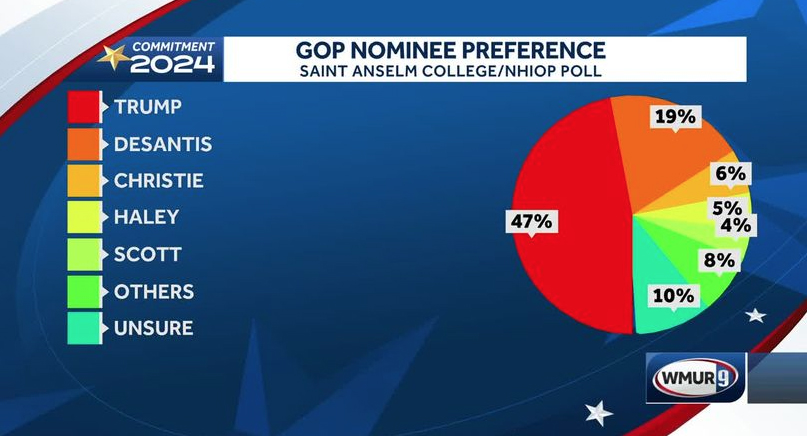
New Hampshire Poll: St. Anselm College Releases Regular Poll — The New Hampshire Institute of Politics of St. Anselm College published their latest regular survey of Granite State voters (June 21-23; 1,065 registered New Hampshire voters; live interview) and sees former President Donald Trump gaining strength in the Republican primary while principal challenger Gov. Ron DeSantis is losing support. The partisan primary numbers find Trump leading Florida Gov. DeSantis, 47-19 percent with no other candidate exceeding six percent support.

On the Democratic side, President Joe Biden dominates Robert F. Kennedy Jr. and author Marianne Williamson, 69-9-8 percent. These numbers exceed how the president is performing nationally. Since the state is unlikely to agree to moving their primary to comply with the new Democratic National Committee calendar, these numbers suggest that Biden could win a write-in campaign against his two intra-party challengers even if he doesn’t enter the official Democratic primary.

In hypothetical general election pairings, President Biden would lead both former President Trump and Gov. DeSantis with the same 49-40 percent spread. This data suggests there is less chance that New Hampshire will become a major general election Republican conversion target.

Senate

Montana: Retired Navy SEAL Declares Candidacy with NRSC Endorsement — Retired Navy SEAL and aerospace company CEO Tim Sheehy (R) announced his US Senate candidacy Tuesday. Immediately, the National Republican Senatorial Committee, with its chairman being Montana’s junior Sen. Steve Daines, endorsed Sheehy’s candidacy. The Montana Senate race is expected to be one of the hottest campaigns in the country as Republicans attempt to deny incumbent Sen. Jon Tester (D) a fourth term.

Rep. Matt Rosendale (R-Glendive), who is also expected to join the race, responded with a Tweet saying, “congratulations to Mitch McConnell and the party bosses on getting their chosen candidate. Now Washington has two candidates – Tim Sheehy and Jon Tester – who will protect the DC cartel.” Early polling shows Rep. Rosendale beginning the race with a substantial lead, so we can expect both a hot general election campaign, and an equally tough Republican nomination contest next year in Big Sky Country.

House

Alabama: Governor Calls Special Redistricting Session — To comply with the US Supreme Court ruling on the Alabama racial gerrymandering case that went against the state, Gov. Kay Ivey (R) said that she will call a special redistricting session for the purposes of drawing a new map to comply with the decision. The legislature will report on July 17 to begin the process.

Since Alabama is a Super Tuesday state and is holding its regular primary on March 5, time is short to draw a new map and obtain the necessary judicial approvals. The ruling and new map is expected to give the Democrats an extra seat in the Alabama US House delegation that currently stands at 6R-1D.

SCOTUS: North Carolina Case Ruling — In an unsurprising 6-3 ruling, the US Supreme Court ruled against the state of North Carolina on the subject of redistricting. Legal analyst Derek Muller of the Election Law Blog describes the crux of the state’s argument as saying, “the state constitution or state judiciary cannot constrain the state legislature exercising power under the Elections Clause.” Predictably, the justices ruled that the judiciary does have the authority to involve itself in redistricting decisions but underscored that the Supreme Court has the power to restrain lower courts from taking too much power away from the legislative bodies.

Largely because the North Carolina state Supreme Court has already reconsidered its previous partisan gerrymandering decision, the high court confined itself to the judicial power question.

SCOTUS Rules; Calif. Recall Scheduled

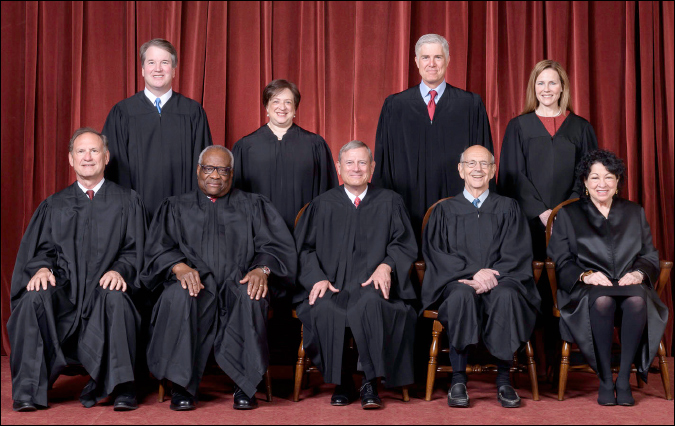
Current US Supreme Court

By Jim Ellis

July 6, 2021 — On their last day of the year’s early session last week, a Thursday, the Supreme Court of the United States issued rulings on the Arizona voting rights case and the California non-profit organization disclosure lawsuit.

In the Democratic National Committee v. Brnovich, the Supreme Court with Justice Samuel Alito writing for the 6-3 majority, ruled that the state of Arizona did not infringe upon minority voting rights or violate Section 2 of the Voting Rights Act in both prohibiting ballot harvesting with certain exceptions, and not counting provisional ballots cast from voters who do not reside in the particular precinct that the polling place covers.

The high court agreed with Arizona Attorney General Mark Brnovich’s (R) arguments that the laws are not racially motivated, nor do they intentionally discriminate against certain segments of the voting population, thus overturning the full 9th Circuit Court of Appeals ruling.

Originally in 2016, Brnovich won at the district court level and on the first appeal to a three-judge panel from the 9th Circuit. The DNC requested an en banc review of the original appellate ruling that agreed with Brnovich, and the entire 9th Circuit membership overturned the decision, siding with the plaintiff. At that point, AG Brnovich petitioned the Supreme Court, which agreed to hear the case. (Hearing cases en banc allows the full circuit court to overturn a decision reached by a three–judge panel. Due to the decreasing probability of U.S. Supreme Court intervention, the circuit court is often the court of last resort in the ordinary life of a case, thereby amplifying the importance of en banc review.)

In his ruling, Justice Alito stated that “every voting rule imposes a burden of some sort,” and that “mere inconvenience cannot be enough to demonstrate a violation of Section 2.” He also cautioned that, “what are at bottom very small differences should not be artificially magnified.”

While agreeing that holding free and open elections is a “valid and important state interest,” he also addressed the voter fraud argument, clearly stating that attempting to prevent such abuses is also a “strong and entirely legitimate state interest.”

In her article discussing these rulings, Supreme Court expert Amy Howe, in her Howe on the Court article that was published on the SCOTUS blog, offered that the Brnovich ruling “will make it more difficult to contest election regulations under the Voting Rights Act,” and thus likely means fewer voting rights cases coming through the courts. She further categorized this decision as a “major ruling.”

Continue reading