Tag Archives: Trafalgar Group

Longshot Candidate Close
In Open Tennessee Senate Race

By Jim Ellis

July 23, 2020 — The open Tennessee Senate race has not gotten much national attention, but we now seem to have a close race brewing in the final days leading up to the state’s Aug. 6 primary. The Volunteer State is the only one to host a Thursday primary.

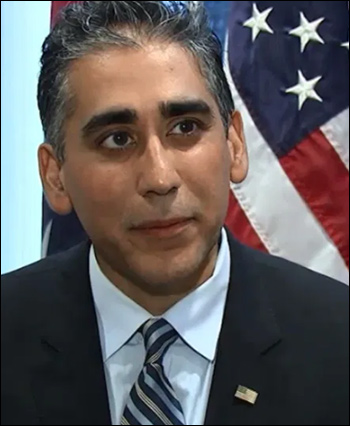
Dr. Manny Sethi, original long-shot candidate and noted Nashville orthopedic surgeon, has become a viable contender in the Tennessee Senate Republican Primary race.

Once most of the state’s well-known politicos took their names out of consideration after three-term incumbent Sen. Lamar Alexander (R) announced his retirement at the end of 2018, former US ambassador to Japan Bill Hagerty looked to be the odds-on favorite to win the Republican nomination. These days in Tennessee, becoming the GOP standard bearer is virtually tantamount to winning a general election.

As the candidates make a dash for the political finish line, original long-shot candidate Manny Sethi, a noted Nashville orthopedic surgeon, has become a viable contender. Three separate polls released last week all found the two candidates within two to four points of each other, with Hagerty, armed with President Trump’s endorsement, clinging to a dwindling lead.

Late Tuesday, JMC Analytics & Polling released their new independent Tennessee survey (July 18-19; 600 likely Tennessee Republican primary voters), which projects Hagerty to be holding a 36-32 percent edge over Dr. Sethi. Last week, both the Trafalgar Group (July 6-8; 1,062 likely Tennessee Republican primary voters) and Victory Phones, the latter for the Sethi campaign (June 30-July 1; 800 likely Tennessee Republican primary voters), released survey results.

Continue reading

Louisiana Elects a Governor;
Bevin Concedes in Kentucky

By Jim Ellis

Louisiana Gov. John Bel Edwards (D), left, and Republican challenger Eddie Rispone (R)

Nov. 18, 2019 — Louisiana Gov. John Bel Edwards (D) defied typical southern electoral history on Saturday as an incumbent winning a run-off election. Usually, when an office holder is forced into a run-off because he or she failed to secure majority support in the primary election, that individual loses the secondary vote. Not so, for Gov. Edwards as he scored a 51.3 – 48.7 percent victory over Baton Rouge developer Eddie Rispone (R).

Late polling suggested a different outcome, as the latest data proposed a trend line where Rispone might have well gone over the top. A new JMC Analytics poll (Nov. 12-13; 600 likely Louisiana voters) showed that Baton Rouge developer Rispone could slip past Gov. Edwards by a 46-45 percent count. The one-point margin was not particularly significant, since the result meant the two candidates were locked in a virtual tie, but the aggregate late-polling trend was more telling.

Since Nov. 1, five studies have been publicly released from five different pollsters and each find the spread ranging from a flat tie to four points. But even the four-point margin, 50-46 percent from Targoz Market Research (Nov. 7-13; 803 likely Louisiana voters) in Edwards’ favor, is inconsistent with the others. Removing this poll, with its strong sample size but long sampling period, means the average percentage difference between the two candidates from the four remaining surveys is only 1.25.

The actual turnout said something different, however, and the first clue came from early voting. According to the latest count on Thursday night, 46 percent of the early votes were coming from Democrats as compared to 38 percent from Republicans. In the jungle primary election, the Democratic early voting advantage was only 44-41 percent, and the GOP candidates secured 52 percent of the vote.

The Daily Kos Elections site authors calculated the percentages that Gov. Edwards would need to attain in key parishes in order to reach 50 percent. We see that the governor reached his projected benchmark in 13 of the 15 representative parishes selected, which accounts for his statewide total.

Over 1.5 million voters participated in the election, meaning a turnout percentage of 50.7 percent of registered voters. This was up 4.8 percent from the recorded primary turnout figure. Four years ago, when Gov. Edwards was first elected in defeating then-US Sen. David Vitter (R), just 40.2 percent of registered Louisiana voters cast their ballots.

Rispone centered his campaign around attacking Edwards over Louisiana ranking near the bottom of state statistics in job creation, and that he was fully in President Trump’s camp. The President came to the state to hold one of his rallies for Rispone, but even this did not help engender a victory.

Edwards’ campaign contended that Louisiana is in the top 10 of fastest growing state economies, that the $2 billion deficit the governor inherited is now a surplus and that was accomplished while increasing teacher pay and expanding Medicare.

Continue reading

First-Term Louisiana Gov. Edwards Forced to Run-Off Against Rispone

Republican challenger Eddie Rispone (R) and Louisiana Gov. John Bel-Edwards (D)

By Jim Ellis

Oct. 15, 2019 — Saturday’s Louisiana statewide open primary election found first-term Gov. John Bel Edwards (D) failing to win re-election outright, meaning he and the second-place finisher, businessman Eddie Rispone (R), will advance to a Nov. 16 secondary vote.

The result suggests Edwards’ bid for re-election is in trouble since no governor in Louisiana history has won a secondary vote when forced into a run-off. The governor received 46.6 percent of the vote in the primary, an election where all candidates are placed on the same ballot irrespective of political party affiliation. If no contender receives majority support, as was the case on Saturday, the top two finishers advance to a second election.

Rispone (pronounced: ris-pony), a Baton Rouge-area developer who reportedly spent more than $11 million of his own money on the gubernatorial campaign, garnered 27.4 percent of the vote, more than 51,000 votes ahead of third place finisher and fellow Republican Ralph Abraham, a northern Louisiana US congressman. The remaining two-plus percentage points were spread among a minor Democrat, Republican, and Independent.

Combined, the Democratic vote, despite featuring the incumbent at the top of the ticket, reached only 47.4 percent, compared to the combined Republican percentage of 51.8. Upon being eliminated, Congressman Abraham, who did not have to risk his federal position to run for governor, immediately endorsed Rispone. The two appeared together at President Trump’s Louisiana rally on Friday night, at which point the president urged the attenders to vote for either GOP candidate.

Polling appeared to correctly predict the race. Going into the final campaign days, nine different pollsters through 11 separate polls surveyed the Louisiana electorate. Nine of the 11 predicted Edwards to finish below 50 percent. Eight of the surveys projected Rispone to finish second with Rep. Abraham close behind. The Trafalgar Group and Data for Progress firms predicted the final result almost exactly.

Continue reading

Breaking Polls

the-primariesBy Jim Ellis

Aug. 20, 2018 — Now with 41 states having officially moved into general election campaign mode and two more, Alaska and Wyoming, voting on Tuesday, new November surveys and a key primary election poll were all just released into the public domain.
Looking at the two Senate special elections, the just-completed Minnesota primary yielded, as expected, appointed Sen. Tina Smith (D) advancing into the general election against Republican state Sen. Karin Housley (R). The Emerson College polling institute went into the field just before the primary vote, and released their data as the voting concluded.

According to the Emerson results (Aug. 8-11; 500 likely Minnesota general election voters conducted electronically), Sen. Smith jumps out to a small 32-28 percent lead over Housley when the two are paired in the now-official general election match-up. While 40 percent are not yet professing a choice, largely because both candidates have low name identification, we can expect this race to become a top-tier Senate campaign as the time progresses towards Election Day.

Continue reading

The Aug. 7 Primaries – Part I

By Jim Ellis

the-primariesAug. 6, 2018 — The Aug. 7 primaries that arrive tomorrow decide important nomination campaigns in Kansas, Michigan, and Washington; the Missouri political card is already virtually set. Today, we look at Kansas and Missouri, followed tomorrow by Michigan and Washington.


KANSAS

The Sunflower State governor’s race is the key feature in the Republican primary, as Gov. Jeff Colyer (R) appears to be struggling to cobble together a victory coalition in tomorrow’s primary election. Colyer ascended to the governorship when incumbent Gov. Sam Brownback (R) accepted a position in the Trump Administration. Colyer is attempting to repel a strong challenge coming from activist conservative Secretary of State Kris Kobach, who is leading in the latest polling.

According to the Trafalgar Group (July 30-Aug. 2; 1,546 likely Kansas Republican primary voters), Gov. Colyer trails Secretary Kobach, 43-36 percent. But the Remington Research Group, polling in the same period (Aug. 2; 859 likely Kansas Republican primary voters), sees a tie between the two men with both attracting 32 percent support. Former state Sen. Jim Barnett and State Insurance Commissioner Ken Selzer are at or below 13 percent preference in both polls.

Democrats also see a multi-candidate campaign, and it appears that state Sen. Laura Kelly (D-Topeka), the party activists’ favorite, is positioned to win the nominating election. She faces former Agriculture Commissioner Josh Svaty, and retired Wichita Mayor Carl Brewer, but Sen. Kelly appears to have constructed the appropriate coalition to achieve victory tomorrow night.

Continue reading

The Georgia Run-off

By Jim Ellis

Georgia-mapJuly 25, 2018 — Peach State voters went to the polls yesterday, in a place where Republicans will choose a gubernatorial nominee while Democrats pick congressional candidates in Atlanta suburban districts 6 and 7.

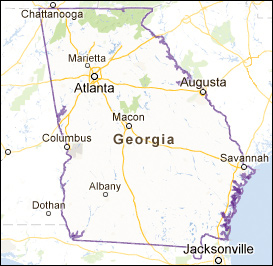
Secretary of State Brian Kemp defeated Lt. Gov. Casey Cagle to win the Republican gubernatorial nomination. His landslide victory produced a more dramatic point spread than even the most optimistic poll for Kemp had predicted. In the May 22 Republican statewide primary, Lt. Gov. Cagle placed first in a field of six candidates with 39 percent of the vote. Placing second in the gubernatorial primary was Secretary of State Kemp with 26 percent of the vote. Under Georgia election law, to win a party nomination, a candidate must receive majority support. Because no one in the Republican primary topped 50 percent, the top two finishers advanced to yesterday’s run-off.

Kemp scored a crushing 69.4 – 30.6 percent win over Cagle, even though the latter began the race as the favorite for the nomination and placed first in the primary election. In that electoral contest, Cagle carried 123 of the state’s 159 counties. To best illustrate how far he dropped during the two-month run-off period, Cagle managed to win only two counties last night, Monroe, just north of Macon, and small Stephens County, a northeast Georgia political entity that hugs the South Carolina border.

Pre-election polls suggested that Kemp would win the run-off last night, as the latest publicly released survey research studies found him leading the lieutenant governor in a range between three and 18 points. The latest poll came Monday from the Trafalgar Group (July 21-22; 1,177 likely Georgia Republican run-off voters) and found Kemp topping Cagle 59-41 percent when leaners were included.
Continue reading

West Viginia Poll: The SCOTUS Effect

By Jim Ellis

July 23, 2018 — The Trafalgar Group surveyed the West Virginia US Senate campaign (July 13-16; 1,158 likely West Virginia general election voters) and tested — for what may be the first time any pollster has done so since President Trump officially nominated Appeals Court Judge Brett Kavanaugh to replace retiring Justice Anthony Kennedy — how the impending Supreme Court confirmation vote will affect a US Senate election.

Trafalgar’s initial ballot test response is consistent with other released polls regarding the race itself. That is, Sen. Joe Manchin (D) leads Attorney General Patrick Morrisey (R) 50-40 percent when the question is first posed. For the past month, all West Virginia surveys have delivered results in a similar range.

Polling chart courtesy Trafalgar Group

Polling chart courtesy Trafalgar Group. Click on the Trafalgar Group link or the graphic above to see more details.

However, the question also was asked of each individual respondent how he or she would would view the Senate race through the prism of whether or not Sen. Manchin would vote for or against confirming Judge Kavanaugh for the US Supreme Court. How much would the answer to that question sway a voter? The answer is: greatly.

At this point, the senator has not yet indicated how he will vote. Immediately after the nomination became public, Sen. Manchin stated that he wanted Judge Kavanaugh to complete the hearing process and publicly answer specific questions (Sen. Manchin is not a member of the Judiciary Committee).

According to Trafalgar, should he vote to confirm Judge Kavanaugh to serve on the Supreme Court, Sen. Manchin’s support within the electorate would substantially grow. However, if he opposes the judge, his campaign against Morrisey falls into the toss-up category.

Continue reading

Alabama: The Last Polls

By Jim Ellis

Dec. 12, 2017 — The latest polls for today’s special Alabama Senate election were released over the weekend, and three of what are likely the final four surveys arrived at virtually the same conclusion.

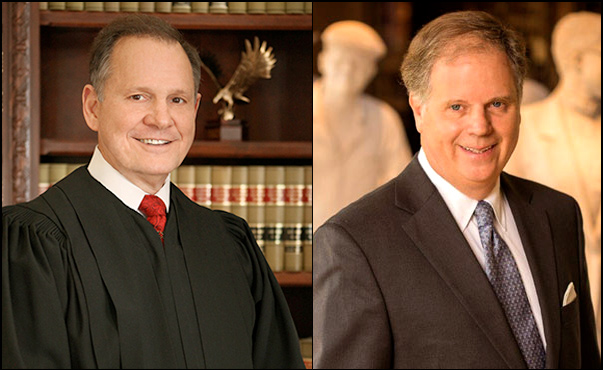
Left: Former state Supreme Court Chief Justice Roy Moore (R) Right: Ex-US Attorney Doug Jones (D)

Left: Former state Supreme Court Chief Justice Roy Moore (R) | Right: Ex-US Attorney Doug Jones (D)

The Survey Monkey (Nov. 30-Dec. 7; 1,559 registered Alabama voters), Change Research (Dec. 5-7; 2,443 registered Alabama voters), Trafalgar Group (Nov. 6-7; 1,419 likely Alabama voters), and Gravis Marketing (Dec. 5-8; 1,254 likely Alabama voters) still see a close contest as the campaign surges to culmination.

CR, Trafalgar and Gravis all post embattled former state Supreme Court Chief Justice Roy Moore (R) to single-digit leads over ex-US Attorney Doug Jones (D). The Change Research ballot test result favors Moore, 51-44 percent; Trafalgar: 51-46 percent; and Gravis: 49-45 percent. On the other hand, Survey Monkey finds Jones holding a 49-47 percent edge.

The Survey Monkey study found Jones’ slight advantage through weighting the responses both from demographic data and 2016 voter performance. Though they forecast a different leader than the other three, their methodology looks to be sound and all four automated polls featured strong sampling universes. Therefore, it is difficult to discount the SM result simply because the end result is slightly different.

Continue reading

A Virtual Tie in Virginia


Lt. Gov. Ralph Northam (D) — latest campaign ad


https://youtu.be/Fg3Gac44cl4
Ed Gillespie (R) – latest campaign ad


By Jim Ellis

Nov. 7, 2017 — On the dawn of today’s Virginia governor’s race, significant movement is apparent in the final pre-election polls.

At the end of last week, we previously reported that Lt. Gov. Ralph Northam (D) had a lead of 3.7 percentage points when mean averaging seven realm polls conducted between Oct. 15-28. The latest six studies, all commissioned during the Oct. 29-Nov. 2 period, show Republican Ed Gillespie closing the gap even further, reducing Northam’s lead to a miniscule 1.0 percent.

At least one of the latest half-dozen comes from a pollster with a poor reliability record. Here, Roanoke University (Oct. 29-Nov. 2; 781 likely Virginia voters) finds the two candidates tied at 47 percent, which actually appears in line with the other published polls. Usually, the Roanoke data proves to be an outlier.

The survey giving Northam his best showing comes from Gravis Marketing (Oct. 30-Nov. 3; 1,143 registered Virginia voters via Interactive Voice Response system) where the lieutenant governor posts a 48-43 percent edge, consistent with results from data released last week. Gravis, not screening for likely voters, however, could explain why their results show a bigger spread than the others. The newest poll, from the New York Times/Siena University (Oct. 29-Nov. 2; 785 likely Virginia voters), finds Northam carrying a three-point edge, 43-40 percent, but with a larger undecided factor than the other studies.

Continue reading

Alabama: Strange vs. Moore

By Jim Ellis

Sept. 27, 2017 — Voters returned to Alabama polling places yesterday, as Republican run-off participants voted to choose a nominee to advance to the Dec. 12 special general election. To re-cap, former state Supreme Court Chief Justice Roy Moore placed first in the Aug. 15 special Republican primary election, taking 40 percent of the vote from the over 423,000 individuals who cast their ballots. Appointed Sen. Luther Strange took second with 32 percent, which allowed both to move into yesterday’s run-off election. That’s almost exactly the way election turned out yesterday. Judge Moore scored a robust victory last night over Sen. Strange in the special Republican Alabama Senate run-off election. Sen. Strange went down to a 55-45% crushing defeat, just as the pre-election polls predicted. Judge Moore now advances to the Dec. 12 special general election against the Democratic nominee, former US Attorney Doug Jones.

Sen. Strange was the choice of the GOP establishment, which, in this case, somewhat surprisingly included President Trump, who usually lines up on the other side. But all the firepower this group brought to bear and Strange’s minimum 3:1 spending advantage was insufficient to overtake and defeat the former state Supreme Court chief, who was twice removed from the bench for disobeying federal court orders that violated his principles.

Since the primary, polls had shown Judge Moore holding the advantage heading into yesterday’s vote. So did the very last published polls released within the past 48 hours preceding election day.

The Trafalgar Group, proving to be the most accurate pollster from the 2016 election through the special elections held earlier this year, went into the field during the Sept. 23-24 period and interviewed 1,073 likely run-off voters. According to their results, Judge Moore’s lead was major: 57-41 percent, far beyond any reasonable margin of error.

Continue reading