Tag Archives: Sen. Cindy Hyde-Smith

Virginia Redistricting: Yes Vote Wins; Mississippi’s Hyde-Smith’s Tight Race

By Jim Ellis — Wednesday, April 22, 2026

Virginia
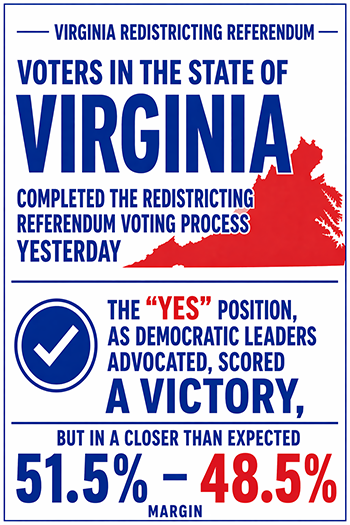
Old Dominion voters completed the redistricting referendum voting process yesterday and the “yes” position, as Democratic leaders advocated, scored a victory, but in a closer than expected 51.5 – 48.5 percent margin.

The outcome must be viewed as a Republican leadership strategic misplay. With Democrats dominating the airwaves and using a partisanship strategy, the early spending showed they had an 11:1 advantage.

Republicans countered to an extent, but their effort proved too little, too late. The closeness of the outcome suggests that a better GOP campaign might have delivered a close win.

The referendum result means the state’s congressional map is expected to shift dramatically from the current 6D–5R alignment to a projected 10D–1R configuration. The new map will take effect unless the Virginia Supreme Court, which allowed the referendum to proceed, upholds the lower court ruling that declared the legislature violated its own rules and state electoral procedure in placing the measure on the ballot. Now that the voters have spoken, it becomes even more unlikely that the high court will overturn the referendum that they allowed.

Therefore, we can expect to see Reps. Rob Wittman (R-Montross), Jen Kiggans (R-Virginia Beach), and John McGuire (R-Manakin-Sabot) all become general election underdogs.

The one remaining Republican seat is in southwestern Virginia. It is possible that Reps. Ben Cline (R-Botetourt) and Morgan Griffith (R-Salem) will be paired in a Republican primary. Rep. Cline could also choose to face a Democrat in an adjoining district where he would also be a general election underdog.

Earlier in the year as a result of placing the referendum on the ballot, the Virginia candidate filing deadline was moved to May 26 and the state primary to Aug. 4. Therefore, it remains to be seen what decisions the affected members make regarding where, or if, they will seek re-election.

Mississippi

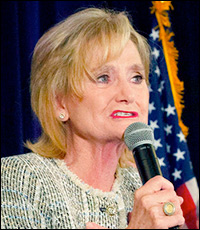
A newly released April survey from Impact Research suggests that Sen. Cindy Hyde-Smith (R) may be heading into a more competitive re-election environment than expected.

The survey, conducted for the Southern Poverty Law Center Action Fund (April 8-12; 500 likely Mississippi general election voters; live interview & text), sees Sen. Hyde-Smith leading Lowndes County District Attorney Scott Colom, who won the Democratic nomination in March, by a narrow 42-39 percent margin.

Perhaps the most concerning data point for the Senator is her favorability rating. While President Trump scores a personal favorability index of 55:43 within this polling universe, Sen. Hyde-Smith scores a poor 35:55, with a “very unfavorable” data point of 42. Gov. Tate Reeves (R) is also in negative territory with a 43:52 index, but his standing is obviously not as challenging as those reported for the Senator.

The result is surprising since the Senator fared well in the March Republican primary, scoring 81 percent of the GOP vote and obviously winning the nomination outright. In her two general election victories, one a special vote conducted after she was appointed to replace resigned Sen. Thad Cochran (R) in 2018, she averaged a 53.8 victory percentage.

For Democrats to put the Senate majority in play this cycle, they must broaden the competitive map. Should polling like this continue, national Democratic leaders and outside groups who support liberal candidates may begin directing significant resources toward Mississippi.

According to the Q1 Federal Election Commission campaign financial disclosure reports, Colom only has raised $1.6 million and held just under $560,000 in his campaign account, far under the dollar quantity he will need to run an effective statewide campaign.

Conversely, Sen. Hyde-Smith posted just over $5 million raised with a cash-on-hand figure of $2.46 million. Expect these financial numbers for both candidates to grow exponentially.

It is likely that a Republican-aligned poll will soon be released presenting more favorable numbers for Sen. Hyde-Smith. If such polling does not emerge, it may indicate that her internal data aligns with the Impact Research findings.

There is always an unexpected Senate race that comes to the forefront in the general election. We will soon see if Mississippi hosts the 2026 surprise campaign.
Mississippi’s Sen. Hyde-Smith Favored for Re-Election; DSSC & Primaries; Fine Likely to Replace Waltz in Fla.; A GA-9 Challenge; Conn., NM Governor News

By Jim Ellis — Monday, Feb. 3, 2025

Senate

Mississippi Sen. Cindy Hyde-Smith (R)

Mississippi — Ty Pinkins, the 2024 Senate nominee against Sen. Roger Wicker (R) who received 37.2 percent of the vote, says he will challenge Sen. Cindy Hyde-Smith (R) in 2026. Sen. Hyde-Smith was appointed to the chamber when Sen. Thad Cochran (R) resigned due to health issues. She then defeated former US Agriculture Secretary and ex-Congressman Mike Espy (D) in the 2018 special election, and won a full term, again against Espy, in 2020 with a 54-44 percent vote spread. The Senator has announced for a second full term next year and will be the favorite to win re-election.

DSCC — At a fundraising event late this week, new Democratic Senatorial Campaign Committee chair Kirsten Gillibrand (D-NY) broadly hinted that the organization would not back away from getting involved in primaries. She made specific references to targeted contests in Maine, Michigan, and North Carolina. Democrats expect to mount strong challenges against Sens. Susan Collins (R-ME) and Thom Tillis (R-NC), in addition to campaigning to hold their newly open Michigan seat.

House

Florida State Sen. Randy Fine (R-Melbourne)

FL-6 — Though not residing in Florida’s vacant 6th District, state Sen. Randy Fine (R-Melbourne) topped two GOP opponents with 83 percent support to win the special Republican primary to replace resigned Rep. Mike Waltz (R-St. Augustine Beach). Waltz left the House to become President Trump’s National Security Advisor.

Sen. Fine, like Jimmy Patronis in the open 1st District, had the support of President Trump and Sen. Rick Scott. The FiveThirtyEight data organization rates the 6th District as R+28, so Sen. Fine becomes a definitive favorite to claim the seat in the April 1 special general election.

CO-8 — Freshman Rep. Gabe Evans (R-Ft. Lupton/Westminster) has already drawn a Democratic opponent in what will be another very competitive congressional race in northern Colorado’s 8th District. The Colorado Independent Redistricting Commission members drew this CD to be contested in every election, and so far it has performed as designed. Democrat Yadira Caraveo represented the seat in its initial term, only to fall to Evans in the 2024 election.

State Rep. Manny Rutinel (D-Commerce City) announced this week that he will enter the 2026 congressional race thus attempting to limit Rep. Evans to a one-term career. This contest will be a top target 2026 campaign.

GA-9 — Three-term US Rep. Andrew Clyde (R-Athens) has drawn a significant primary challenger. Gainesville Mayor Sam Couvillion announced that he will challenge Rep. Clyde in the 2026 Republican primary.

Clyde, a Freedom Caucus member and one of the more conservative Representatives, has fared well in nomination contests. In his first run back in 2020, Clyde won a GOP runoff with 56 percent of the vote. He defeated four Republicans in 2022 with just over 74 percent and was unopposed for renomination in 2024. The Congressman will remain a heavy favorite for renomination in 2026.

Governor

Connecticut — New Britain Mayor Erin Stewart (R) has filed a 2026 gubernatorial campaign committee. She promises to make a formal announcement by the end of this month, but it is a virtual certainty that she will run. Gov. Ned Lamont (D), who is eligible to run for a third term, says he will make a decision about 2026 after the legislative session ends in June.

New Mexico — Sen. Martin Heinrich (D), just re-elected in November, says he will not run for Governor in 2026. The Heinrich decision makes former Interior Secretary and ex-Rep. Deb Haaland the undisputed front-runner for the Democratic gubernatorial nomination. Haaland is making moves toward entering the race but has not yet officially announced her candidacy.

Virginia: The co/efficient data group released their latest Virginia poll (Jan. 18-20; 867 likely 2025 Virginia general election voters; live interview & text) and again finds a toss-up open 2025 gubernatorial race between Democratic former Congresswoman Abigail Spanberger and Republican Lt. Gov. Winsome Earle-Sears. Both appear to be presumptive nominees of their party at this early point in the election cycle. According to the co/efficient data, Spanberger and Earle-Sears would each command 40 percent support.

Candidate Filings: Eye on
Mississippi and Kentucky

By Jim Ellis

Look for a rematch between Mississippi Sen. Cindy Hyde-Smith (R), left, and former congressman, Mike Espy (D)

Jan. 17, 2020 — Two more states closed their candidate filing periods as primary slates in both Mississippi and Kentucky have now been determined.

Mississippi voters will cast ballots on March 10 with a run-off election on March 31 if no candidate receives 50 percent support in a partisan primary.

Sen. Cindy Hyde-Smith (R) stands for election to a full term this year after winning the 2018 special election. While it looked like the senator would receive a Republican primary challenge this year, the battle did not materialize, and she is unopposed as the GOP standard bearer. Josh Randle, the former president of the Miss America Organization, had filed an exploratory committee for a senatorial run, but apparently the research done as part of that process did not yield him a reasonable victory path. Therefore, Randle chose to take a pass on the challenge.

This means we will see a re-match between Sen. Hyde-Smith and former US Agriculture secretary and ex-Mississippi congressman, Mike Espy (D). The two battled in the special election, and Hyde-Smith scored a 54-46 percent victory in a race that appeared more competitive than the final result. Espy has two Democratic challengers, but it is doubtful that either can mount a serious offensive against the former federal official and Clinton Administration cabinet member.

All four Mississippi US House members are heavy favorites for re-election. Only Rep. Trent Kelly (R-Saltillo/Tupelo) is unopposed in his primary. Both Reps. Bennie Thompson (D-Bolton/Mississippi Delta) and freshman Michael Guest (R-Brandon/ Jackson) have weak primary opponents and each have a safe seat for the general election.

Continue reading

2020 Senate Review – Part II

By Jim Ellis

March 26, 2019 — The second of our three-part Senate review covers the races alphabetically from Louisiana through New Mexico:

  • Louisiana – Sen. Bill Cassidy (R) – Sen. Cassidy will seek a second term next year but, as in Kentucky, no real action will occur in the federal campaigns until the 2019 governor’s race is decided. Currently, Sen. Cassidy faces no serious opposition. Likely Republican

  • Maine – Sen. Susan Collins (R) – Sen. Collins appears near the top of the 2020 Democratic target list, but she may not be as vulnerable as it might appear on paper. The four-term senator is a good fit for her constituency; she racked up win percentages of 67 and 61 in her past two elections (2014; 2008) and, unless Rep. Chellie Pingree (D-North Haven/ Portland) runs, the Dems don’t appear to have a top tier candidate.
    Neither newly elected Democratic Gov. Janet Mills nor Rep. Jared Golden (D-Lewiston) appear to be looking at a Senate run. Currently, Lean Republican and closer to Likely Republican than Toss-up

  • Massachusetts – Sen. Ed Markey (D) – Sen. Markey’s only concern is a potential Democratic primary challenger and, with Rep. Seth Moulten (D-Salem) looking more toward the presidential contest than the Senate, the veteran incumbent should be secure for a second full term. Adding his long tenure in the House, Sen. Markey will be in Congress 44 consecutive years at the end of the current session. Safe Democratic

  • Michigan – Sen. Gary Peters (D) – Republican manufacturing company owner and retired Army Ranger John James’ better-than-expected performance against Sen. Debbie Stabenow (D) last year, and first-term Sen. Peters’ below-average polling numbers are moving Michigan fast up the Republican target list. Assuming James runs, the Michigan Senate race could become quite interesting. Lean Democratic

  • Continue reading

Senate 2020: The Second Tier – Part I

By Jim Ellis

Dec. 14, 2018 — Looking ahead to the 2020 US Senate cycle, eight states are clearly in the first tier, but there is budding action occurring in a secondary set of places, also. Today, we look at the first group of prospects.

With Republicans having to defend 22 of the 34 in-cycle seats, six are at the top of their protect list: (in alphabetical order) Arizona special, Colorado (Sen. Cory Gardner), Georgia (Sen. David Purdue), Iowa (Sen. Joni Ernst), Maine (Sen. Susan Collins), and North Carolina (Sen. Thom Tillis).

Democrats look to be defending two top targets: Alabama (Sen. Doug Jones) and New Hampshire (Sen. Jeanne Shaheen).

But developments are occurring, or could occur, in a series of other states, some of which could become highly competitive under the right circumstances.

• KANSAS: Sen. Pat Roberts (R) faced strong competition six years ago, and whether or not he decides to seek a fifth term is unclear at this point. With Democrats just winning the governor’s campaign here, it is possible there could soon be renewed interest in challenging for what is traditionally a safe Republican seat.

• KENTUCKY: Senate Majority Leader Mitch McConnell is on the ballot again in 2020. He won his last two competitive campaigns with 56 and 53 percent of the vote in 2014 and 2008, respectively. Potential candidates likely won’t come forward until the 2019 statewide campaigns, including the governor’s race, are completed.

Continue reading

Hyde-Smith Wins in Mississippi

By Jim Ellis

Mississippi Sen. Cindy Hyde-Smith (R)

Nov. 28, 2018 — The 2018 election cycle ended in Mississippi last night as appointed Sen. Cindy Hyde-Smith (R), overcoming several campaign gaffes and misstatements, defeated former US Agriculture Secretary and ex-Mississippi congressman, Mike Espy (D), by a 54-46 percent margin from a robust turnout of what will exceed 880,000 voters.

In comparison, back on Nov. 6, Sen. Roger Wicker (R) was re-elected from a turnout of just over 936,000 individuals. Wicker’s vote total of 547,540 is roughly 73,000 tallies more than Hyde-Smith’s 474,471 unofficial total, but she outpaced Espy by more than 69,000 votes.

In what was predicted to be a relatively small special election turnout, the actual participation number, and a figure that will likely grow once remaining provisional and absentee ballots are fully counted, rather surprisingly exceeds 93 percent of the number participating in the general election just past.

Sen. Hyde-Smith carried 51 of the state’s 82 counties. Aside from the Columbus area in eastern Mississippi, Hyde-Smith swept most of the northern counties, ran very strong in the northeast counties, particularly in and around the city of Tupelo, as well as taking 14 counties from the southeastern group, including the six that directly border the Gulf of Mexico.

Espy virtually swept the western counties, those that largely comprise the 2nd Congressional District. This is the seat that he initially won in 1986, and which Rep. Bennie Thompson (D-Bolton) currently holds.

Continue reading

Yet Another Election

By Jim Ellis

Appointed Mississippi Sen. Cindy Hyde-Smith (R), left, and Democrat challenger Mike Espy

Nov. 27, 2018 — The 2018 election cycle’s final contest comes today in Mississippi. The special run-off campaign between appointed Sen. Cindy Hyde-Smith (R) and former US Agriculture Secretary and ex-Mississippi congressman, Mike Espy (D), will decide if the 116th Congress will feature a Senate that brandishes a 53-47 Republican majority or a lesser 52-48.

The run-off occurs because no candidate received an absolute majority in the Nov. 6 special jungle primary. The special election is necessary because Sen. Thad Cochran (R) resigned for health reasons in the middle of his final term in office, thus necessitating an appointed replacement and this confirming electoral vote for the winner to serve the balance of the term. Whether Sen. Hyde-Smith or Espy wins today, there will be another election in the regular 2020 cycle for the full six-year term.

In the first vote, Sen. Hyde-Smith placed first, but barely, with a 41.5 percent plurality compared to Espy’s 40.6 percent, a difference of 8,284 votes from more than 883,600 ballots cast. The third-place finisher, Tea Party activist state Sen. Chris McDaniel (R-Ellisville), captured the remaining 16.4 percent with Independent Tobey Bartee picking up the final 1.4 percent. Once the run-off began, Sen. McDaniel announced his support of Sen. Hyde-Smith, which should go a long way toward unifying her Republican base.

Controversy in this run-off campaign arose when Hyde-Smith made several unforced errors. Making statements about wanting to be present at a lynching, visiting a Confederate Museum where she donned a uniform, and now under attack for attending what was commonly referred to as a “segregation academy” for high school has put the appointed senator clearly on the defensive.

Continue reading

Florida Ends; Others Called

By Jim Ellis

Nov. 20, 2018 — In a final result where the candidates were divided by less than two votes per precinct statewide, Gov. Rick Scott (R) defeated Sen. Bill Nelson (D) in the hotly contested Florida Senate race that proved a Herculean battle both before and after the election.

With the original vote falling within a half-percent margin, a mandatory machine recount commenced. Since it produced a separation of less than one-quarter percent between the two candidates, a mandatory hand recount began of the “under and “over votes”, i.e., those ballots where a voter either didn’t make their selection clear or appears to have marked more than one contender in the same contest.

Yesterday, when the afternoon hand count deadline produced a 10,033 vote margin for Gov. Scott, Sen. Nelson conceded the race and ended the seven lawsuits that had been filed by various parties contesting pools of votes and the post-election counting process.

The senator now completes a political career in which he served in elective office for 42 of the past 46 years as a state representative, US congressman, state insurance commissioner, and US senator. Counting his combined time in the House and Senate, Nelson will have served 30 years as a federal lawmaker when he leaves office in January.

Continue reading

The (Mostly) Final Election Results

By Jim Ellis

Nov. 7, 2018
— The long 2018 midterm election cycle drew to a close last night and, as predicted, split government will return to Capitol Hill. Republicans held the Senate and saw their majority grow as Democratic Sens. Heidi Heitkamp (ND), Joe Donnelly (IN), and Claire McCaskill (MO) 2018-mid-term-election-results-graphicfell to Republican challengers. Florida Gov. Rick Scott (R) likely will be forced into a recount to see if his just-under 40,000 vote advantage will be enough to unseat Sen. Bill Nelson (D).

The Montana race is undecided as Sen. Jon Tester (D) is on the precipice of losing but the outstanding vote suggests he could survive by a very small margin. The razor-thin Arizona race is a must-hold for the GOP. Democrat Jacky Rosen defeated Nevada Republican Sen. Dean Heller, and West Virginia’s Joe Manchin (D) fought back a tough challenge from Attorney General Patrick Morrisey (R).

If all of these follow their current trends, Republicans will gain a net of four seats and increase their majority margin to 55-45. If Montana and Arizona go Democratic, the division would slip to 53R-47D. In any event, it appears likely that the Republicans will gain two to four seats.

The new Senate will maintain their new majority split once the Nov. 27 run-off election is held and decided in Mississippi. In that new secondary election, appointed Sen. Cindy Hyde-Smith (R) will face former US Agriculture Secretary and ex-Mississippi congressman, Mike Espy (D). Sen. Hyde-Smith placed first in the Nov. 6 preliminary vote and ended with 41.5 percent of the vote, not close to secure the majority support that would have elected her outright and just ahead of Espy’s 40.6 percent. State Sen. Chris McDaniel (R-Ellisville) was third with 16.4 percent, likely denying Hyde-Smith the opportunity to win in the first round. He is eliminated from further competition.

As predicted, the House did flip to the Democrats and leadership elections will soon be held to determine who will replace retiring House Speaker Paul Ryan (R-WI). It is perceived that California’s Nancy Pelosi will again become the speaker after serving from 2007-11 and losing the post when the Republicans secured the majority in the 2010 election.

Continue reading

Breaking Polls

the-primariesBy Jim Ellis

Aug. 20, 2018 — Now with 41 states having officially moved into general election campaign mode and two more, Alaska and Wyoming, voting on Tuesday, new November surveys and a key primary election poll were all just released into the public domain.
Looking at the two Senate special elections, the just-completed Minnesota primary yielded, as expected, appointed Sen. Tina Smith (D) advancing into the general election against Republican state Sen. Karin Housley (R). The Emerson College polling institute went into the field just before the primary vote, and released their data as the voting concluded.

According to the Emerson results (Aug. 8-11; 500 likely Minnesota general election voters conducted electronically), Sen. Smith jumps out to a small 32-28 percent lead over Housley when the two are paired in the now-official general election match-up. While 40 percent are not yet professing a choice, largely because both candidates have low name identification, we can expect this race to become a top-tier Senate campaign as the time progresses towards Election Day.

Continue reading