Tag Archives: North Carolina

Schiff Explores Senate Race; Valadao Re-Elected; House Candidate Filings

By Jim Ellis — Nov. 23, 2022

Senate

California Rep. Adam Schiff (D-Burbank)

California: Rep. Schiff Exploring Senate Race — With most people believing that Sen. Dianne Feinstein (D) will not seek re-election in 2024 when she will be 91 years of age, Southern California Rep. Adam Schiff (D-Burbank) said that he is considering launching a US Senate exploratory committee. Schiff is already in a battle to keep his seat on the Intelligence Committee after Rep. Kevin McCarthy (R-CA) — should he be elected Speaker — said that Schiff and Rep. Eric Swalwell (D-CA) would be removed from the panel.

Should Sen. Feinstein retire, we will see a strong Democratic battle to replace her. In California’s jungle primary system, it is likely that two Democrats would advance into the general election. One thing is certain: Rep. Schiff would be able to raise the money to compete. In his bid for re-election to the House in the current cycle, he raised more than $22 million.

House

CA-22: Rep. David Valadao Wins Re-election — The Associated Press, late Monday afternoon Pacific time, projected that Rep. David Valadao (R-Hanford) had defeated state Assemblyman Rudy Salas (D-Bakersfield) in their hard-fought congressional race. This, despite Rep. Valadao finishing a distant second on the jungle primary back in June when he received only 26 percent of the vote versus Salas’ 45 percent in a field of four candidates in the most Democratic congressional district in the country that elects a Republican to the House.

According to the California Secretary of State’s official count, Valadao held a 3,381 vote lead with just over 100,000 votes counted. Based upon the number of outstanding ballots and where they are from, the AP made the unofficial projection. The Valadao victory gives the Republicans 220 members in the new Congress as compared to 212 Democrats. Three races, two in California and one in Alaska, remain uncalled. Republicans lead in both Golden State races, Democrats in the Last Frontier.

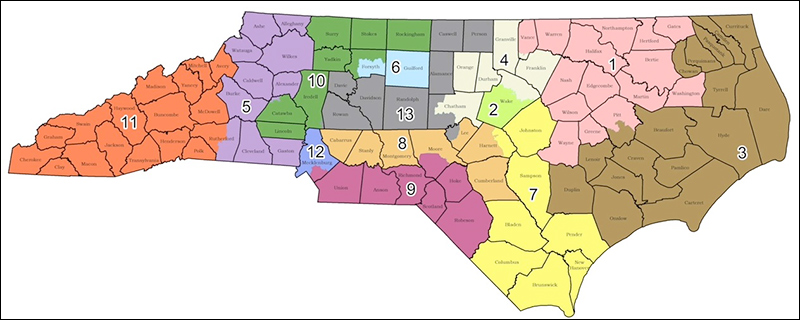
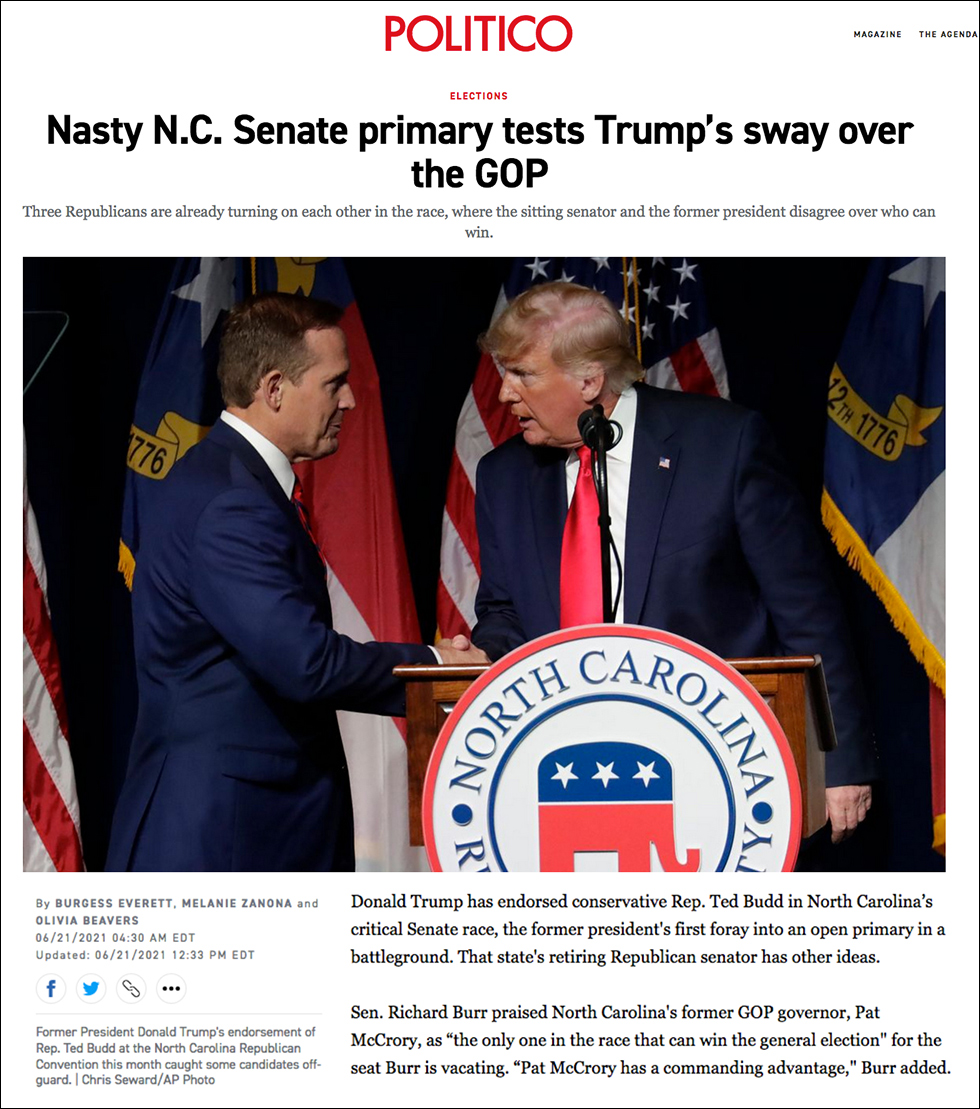
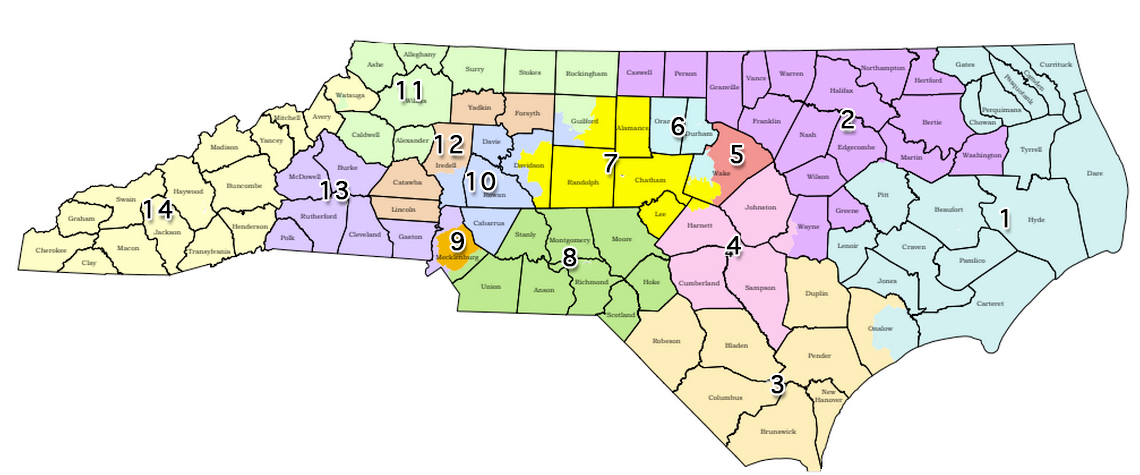
NC-13: Hines Files 2024 Committee — The court-drawn North Carolina congressional map featured a new 13th District that contained the southern Raleigh suburbs, the city of Fayetteville, and Republican Johnston County, which made the CD a toss-up seat. Democratic state Sen. Wiley Nickel carried the district with a 52-48 percent margin, defeating Republican Bo Hines, who received the Trump endorsement in the GOP primary.

Hines, 27, was a former football player for North Carolina State University, but had no other particular ties to the region and actually planned to run in another district before this open seat was drawn. He filed a new 2024 committee on Monday, presumably sending signals that he intends to run again.

Hines did not receive particularly favorable marks as a candidate, and there is a good chance we will see a new North Carolina map drawn after the Supreme Court rules on the state’s partisan gerrymandering case before them. Even if Hines decides to run, he can expect heavy competition in the Republican primary before getting another opportunity of opposing Rep-Elect Nickel.

WV-2: State Treasurer Announces for House — Rep. Alex Mooney (R-Charles Town) already announcing that he will challenge Sen. Joe Manchin (D) in the next election year has ignited the first of what promises to be political musical chairs for what will be an open 2nd Congressional District. State Treasurer Riley Moore (R) announced his congressional candidacy Monday and is the first major candidate to enter the 2024 race. Rep. Mooney’s successor will likely be decided in the Republican primary in a seat that the FiveThirtyEight data organization rates as R+34.

NY Overreach = GOP Majority

CNN’s New York state redistricting map (more coverage on CNN)

By Jim Ellis — Nov. 22, 2022

House

New York State: Redistricting — There is an argument to be made that the New York Democratic redistricting brain trust helped create the new Republican US House majority. With their over-reach on the original map that the legislature and governor enacted, the end result became so egregious that even the Democratic lower and upper courts rejected the congressional map as a pure partisan gerrymander.

The original enacted plan would have yielded a 22D-4R partisan split in the NY congressional delegation of 26 members, thus costing the Republicans four of the eight Empire State seats they control in the current Congress.

Once the votes were cast on Nov. 8 in the districts that the judges’ special master drew to replace the legislature’s plan, the end result saw Republicans not losing four seats but rather gaining three in relation to the current map and seven when compared to the Democrats’ original draw.

Therefore, instead of the intended 22D-4R plan, the New York delegation now headed to Washington is comprised of 15 Democrats and 11 Republicans. With a small Republican majority of what ultimately may be 220-222 seats once the outstanding California and Alaska races are finally projected, the NY swing is arguably the difference in determining which party controls the House.

The Democrats’ map would have reduced the Republicans to just one seat on Long Island, taken the lone district they have in New York City, turned the GOP’s Syracuse seat strongly Democratic, and collapsed the southwestern Upstate seat of resigned Rep. Tom Reed (R) as the lost district in national reapportionment.

You will remember that New York lost a congressional seat by just 89 people when the Census Bureau announced each state’s congressional district compilation under the national reapportionment formula.

After striking down the legislature’s map and replacing it with their own special master’s plan, the court in effect restored much of New York to its historic congressional district pattern.

Under the legislature’s plan, Long Island’s 1st District (Rep. Lee Zeldin) was drawn from the far eastern part of Suffolk County all the way into Queens. This led to stashing a preponderance of the region’s Republican voters in Rep. Andrew Garbarino’s (R-Sayville) South Shore 2nd District. The concept then allowed the map architects to make Districts 3 and 4, both open in 2022 with Reps. Tom Suozzi (D-Glen Cove) running unsuccessfully for governor and Kathleen Rice (D-Garden City) retiring, safely Democratic. The court undid this design.

Now, the 1st District returns to a Suffolk County anchored seat, a CD that Republican Nick LaLota, a former local official and Navy veteran, won to succeed Rep. Zeldin. Rep. Garbarino is back but with a less Republican South Shore seat, which then created a marginal North Shore District 3 seat that Republican George Santos won 54-46 percent in a domain that the FiveThirtyEight data organization rates D+4.

The biggest surprise in New York, and perhaps the country, came in Rep. Rice’s open 4th CD, where Republican Anthony D’Esposito defeated heavily favored Democrat Laura Gillen, 52-48 percent, in a district that actually became more Democratic under the court map at D+10.

The other Republican gains came in the Hudson Valley, where state Assemblyman Mike Lawler (R-South Salem) upset Democratic Congressional Campaign Committee (DCCC) chairman Sean Patrick Maloney (D-Cold Spring) in a D+7 District 17, and Dutchess County Executive Marc Molinaro (R) rebounded from a special congressional election loss in August to claim a 51-49 percent win in a new 19th District rated as R+1.

In the 18th District, state Assemblyman Colin Schmitt (R) came within a percentage point of sweeping the Hudson Valley seats for the GOP, but Rep. Pat Ryan (D-Gardiner) held onto the 18th CD seat after he had won the 19th District special election three months earlier.

The Republican victory string ended with tech executive Brandon Williams (R) defeating former intelligence officer Francis Conole (D) by a percentage point to hold the open Syracuse seat, and former New York Republican Party Nick Langworthy easily won the new 23rd District from which Rep. Reed resigned and Rep. Joe Sempolinski (R-Canisteo) is serving as a caretaker.

The New York 2022 election cycle illustrates just how important map drawing and judicial decisions are in determining US House elections. The New York courts, for example, created a much more competitive political playing field, which certainly led to different results than we would have seen under the legislature’s partisan draw.

Considering that the US Supreme Court is likely to make landmark Voting Rights Act rulings on the Alabama and North Carolina cases before June ends next year, we will likely see new redistricting maps being drawn in several states, and New York could be one of those places. Any newly constructed map would take effect in the 2024 election. A major Supreme Court decision will add yet another dimension to what already promises to be another hot House campaign cycle coming in the new term.

Race Roundup: Closing Trends — Volatile and/or Interesting Races to Watch on Election Day

By Jim Ellis — Tuesday, Nov. 8, 2020

With Election Day upon us, we have come to the end of the 2022 cycle; while strategists from both parties are either confidently or reluctantly predicting a Republican victory, not all of the numbers suggest a Red Wave outcome.

Polling generally suggests a good trend for Republicans, but the margin spread is certainly not overwhelming, and under what should be present if this were to become a wave election.

The Biden favorability index is an upside-down 44:53 percent favorable to unfavorable, which is commensurate with Donald Trump’s numbers prior to the 2018 midterm election.

Overall, it does appear that Republicans are well positioned to claim the House majority. The professional and media pollster range is wide and runs from a Republican +14 to +48 seats, but even the low-end prediction would deliver the majority. It is reasonable to believe that the Republican gain factor will be under 30, but this lower number range would still project a comfortable House majority in the new Congress.

The Senate is a flat toss-up with so many races, Arizona, Georgia, Nevada, New Hampshire, Ohio, Pennsylvania, and Wisconsin all polling within a small single-digit margin. Therefore, predicting the eventual outcome has a high difficulty factor. One point that is predictable, though: count on many of these races going into political overtime. This means it could take days if not more than a week to report a final tally on an inordinate number of close races.

With that said, let’s look at the competitive/volatile/interesting races to watch this Election Day:

Senate

Georgia — The Peach State features one of the top US Senate races, and one of only four Republican major conversion targets. Sen. Raphael Warnock (D), who won the special election runoff in 2021, is now running for a full six-year term. His opponent is former University of Georgia and professional football star Herschel Walker (R), and the two will continue to battle until the last vote is counted. Georgia has a majority vote rule, so if neither Sen. Warnock nor Walker reaches 50 percent, the two will advance to a post-election runoff on Dec. 6.

Ohio — The Senate race dominates the Buckeye State political landscape as US Rep. Tim Ryan (D-Warren/Youngstown) and author J.D. Vance (R) battle to the last day of this election cycle. Vance has led in most polls, 15 of the last 19 with two ties, but the Democrats appear to be performing slightly better in early voting. Vance has to be rated at least a soft favorite to win today. Ohio is a must-win for the GOP.

Helping Vance is a strong Gov. Mike DeWine (R) at the top of the ticket who is poised to win a landslide victory. Keeping the DeWine coalition consistent for Vance will be a boost that could well propel him to the victory.

Pennsylvania — Possibly the most publicized Senate race in the country, the open contest between Democratic Lt. Gov. John Fetterman and television’s Dr. Mehmet Oz (R), could well decide the Senate majority. Many believe that the party carrying Pennsylvania punches their majority ticket. Dr. Oz now leads in most polls after the two met in a highly publicized debate on Oct. 25. Early voting patterns, however, appear to favor the Democrats. Remembering that the Republican primary took about a month to decide because the result was so close, it wouldn’t be surprising to see something similar occur for the general election.

Arizona — The Grand Canyon State is one of the hottest political domains in the country. A now toss-up Senate race featuring Sen. Mark Kelly (D) and venture capitalist Blake Masters (R) suggests that this contest will end with a very tight result. Sen. Kelly has a slight lead in polling, but Republicans have the edge in early voting. The governor’s race is also close, but late polls suggest that Republican Kari Lake has late momentum in her race opposite Democratic Secretary of State Katie Hobbs.

Utah — The US Senate race is dominating the Utah political talk as Sen. Mike Lee (R) is on the ballot for a third term, but this time he faces a strong Independent opponent in former presidential candidate (2016) Evan McMullin. Democrats decided not to file their own candidate so they could coalesce behind McMullin and give Sen. Lee a serious challenge. The strategy has worked, as polling shows this race falling into the single-digits. Chances are still good that Sen. Lee pulls away, but this contest has evolved into much more of a serious battle than once believed. Look for a close result.

Nevada — Tough races from the top of the ballot to the bottom face Silver State voters, and the Senate race may yield the Republicans their top conversion opportunity. Polling between former Attorney General Adam Laxalt (R) and Sen. Catherine Cortez Masto (D) has been nip and tuck. With an improved standing among Hispanics, who now are 31 percent of the state’s population, an upset here is possible. Additionally, Democratic Gov. Steve Sisolak is in a toss-up race with Clark County Sheriff Joe Lombardo (R), and this seat could flip, too. Also, in the House races, the new redistricting plan drew three lean Democratic seats in Las Vegas. To gain the majority, Republicans will need to score at least one win here.

Washington — Republicans recruited a strong candidate in former nurse and veterans’ activist Tiffany Smiley. She has become a very good fundraiser and has polled close to veteran Sen. Patty Murray (D). Though Smiley has put forth a strong effort, it will likely not be enough in a strongly Democratic state like Washington. Though she may do well, a close loss is likely on the political horizon for Smiley as opposed to losing big.

Iowa — Sen. Chuck Grassley (R) leads a very busy Iowa ballot. The senator, seeking an eighth term at the age of 89, is in a closer battle than he usually finds, this time against retired Navy Adm. Michael Franken (D). Late polling suggests that Sen. Grassley will still win a comfortable, but not overwhelming victory, meaning he is likely to win in the 50s instead of his customary 60s. Conversely, Gov. Kim Reynolds (R) looks to be cruising to re-election and is expected to easily win a second full term.

North Carolina — The Senate race tops the Tar Heel State ballot this year, and we see another typically tight North Carolina race concluding. US Rep. Ted Budd (R-Advance) looks to have a slight edge over former state Supreme Court Chief Justice Cheri Beasley (D). Early voting is about even between the two parties in terms of past performance, so this is another race that comes down to the wire.

New Hampshire — In what is arguably the most prevalent swing state in the country, the Granite State ballot is filled with competitive races. Gov. Chris Sununu (R) looks set to win a fourth two-year term, but the state’s US Senate race is one of the country’s hottest. Though retired Gen. Don Bolduc (R) was virtually left for politically dead after winning the Sept. 13 primary by a percentage point, he has battled back into competitive status against one-term incumbent and former governor, Sen. Maggie Hassan (D). This race is now in upset alert status.

House

Alaska — The Last Frontier was the host of an interesting special at-large US House election that saw the new Ranked Choice Voting (RCV) system produce state Rep. Mary Peltola (D-Bethel) as the replacement for the late Rep. Don Young (R), even though Republican candidates received an aggregate 60 percent of the vote.

Now, however, it appears Rep. Peltola will win a full term regardless of whether she faces former Gov. Sarah Palin or businessman Nick Begich III, whose late grandfather and uncle served in the House and Senate, respectively, as Democrats. It is further possible that Peltola will win without even being forced into an RCV round because she may garner majority support on the initial vote.

Conversely, Sen. Lisa Murkowski could be forced into a RCV runoff with former State Administration Director Kelly Tshibaka in what would be a double-Republican race. This is a competitive contest, though the Republicans will retain the seat regardless of the outcome.

Iowa — In the state’s four congressional districts, three are highly competitive. In new District 1, freshman Rep. Ashley Hinson (R-Marion/Cedar Rapids) is favored for a second term against state Sen. Liz Mathis (D-Hiawatha). Rep. Mariannette Miller-Meeks (R-Ottumwa), who was a six-vote winner in 2020, looks to be favored over state Rep. Christina Bohannan (D-Iowa City) by more than her previous victory margin, but this contest will still be close in a historically competitive southeastern Iowa district.

The 3rd District battle may be the most competitive within this trio of races. Rep. Cindy Axne (D-Des Moines) is running for a third term having never achieved majority support. State Sen. Zach Nunn (R-Bondurant) is one of the Republicans’ better challenge candidates, and certainly has a strong chance of unseating the congresswoman. This race will draw national attention on election night.

Ohio — In the House races, veteran Cincinnati Rep. Steve Chabot (R) has a much more difficult district (D+3 according to the FiveThirtyEight data organization) than his previous seat. Cincinnati City Councilman Greg Landsman (D) is the Democratic nominee. Rep. Chabot will need a strong turnout model to record another victory in his long 26-year congressional career.

Though veteran Rep. Marcy Kaptur (D-Toledo), the dean of the Democratic conference with 40 years of congressional service, fared poorly in redistricting as her seat went from D+16 to R+6, the Republicans nominating January 6th participant J.D. Majewski has helped paved the path for the congresswoman’s re-election.

The new 13th District, located southeast of Cleveland and anchored in Akron, features a tight contest between Republican attorney Madison Gesiotto Gilbert and Democratic state Rep. Emilia Sykes (D-Akron). In a seat rated R+2, this contest is anybody’s game.

Arizona — Four competitive seats are on tap in the House delegation. Rep. David Schweikert (R-Fountain Hills) face a tough first-time candidate in businessman Jevin Hodge (D) from a new 1st District that is much less Republican than his current 6th CD, a place in which his 2020 re-election percentage did not exceed 52.

Republican Eli Crane, in a new district that is heavily Republican, is favored to unseat Rep. Tom O’Halleran (D-Sedona). Restauranteur Kelly Cooper (R) is challenging Rep. Greg Stanton (D-Phoenix) in a new 4th CD that is now only slightly Democratic. While the congressman is favored, Cooper is a formidable challenger. Rep. Ann Kirkpatrick (D-Tucson) retiring leaves the new 6th CD as a toss-up battleground between former Hispanic Chamber of Commerce executive Juan Ciscomani (R) and ex-state Senator Kirsten Engel (D).

Oregon — Reapportionment delivered a new seat to Oregon, which was placed in the area between Salem and Portland. The primary saw Democratic Rep. Kurt Schrader (D-Canby) lose to newcomer Jamie McLeod-Skinner, who is a former local official in Santa Clara County, Calif. Polling suggests that businesswoman and former local mayor, Lori Chavez-DeRemer (R), has a chance to score an upset win. Competition is also strong in the new 6th District and in the adjacent seat from which veteran Rep. Peter DeFazio (D-Springfield) is retiring.

New Hampshire — The Granite State’s two congressional districts are also highly competitive. Two-term Rep. Chris Pappas’ (D-Manchester) 1st District has defeated more incumbents since 2004 than any seat in the country. Polling has generally posted him ahead of former Trump White House aide Karoline Leavitt (R), but nothing is ever certain in such a volatile political domain.

Rep. Annie Kuster’s (D-Hopkinton/Concord) western state 2nd District is more Democratic than the eastern 1st, but this seat too can record close elections. If what some predict is a coming red wave truly develops, both Democratic incumbents could be unseated.

Governor

Georgia — The governor’s race is also intense, which features a re-match between now-Gov. Brian Kemp (R) and former state House Minority Leader Stacey Abrams (D). Polling suggests that Gov. Kemp will win re-election with a larger vote than the small margin he garnered in 2018, which resulted in his claiming the governorship through a one-point plus win. Though polling is generally looking good for the Republicans here, Democrats are so far exceeding their 2020 early vote performance.

Florida — Florida voters are navigating through a very busy ballot that the governor’s race headlines. Incumbent Gov. Ron DeSantis (R) appears likely to earn a comfortable, low double-digit victory over former governor and resigned congressman, Charlie Crist (D). The late-cycle polling, early voting matrix, and turnout model looks to favor Republicans, which will allow Sen. Marco Rubio (R) to turn back a strong challenge from US Rep. Val Demings (D-Orlando).

Michigan — Inconsistent polling suggests at least a semi-competitive governor’s race featuring incumbent Gretchen Whitmer (D) and challenger Tudor Dixon (R), an online radio personality. Early voting reports are heavily Democratic, which could be an indication of an impending Whitmer victory.

Oregon — The Beaver State is one of the 2022 political hotbeds. With an open governor’s race where a strong independent might flip the race to the Republican nominee in a plurality finish, Oregon is certainly a state to watch from the Pacific zone. Sen. Ron Wyden (D) faces only perennial opposition as he is on the ballot for a fifth full term.

New York — This is a close race, and incumbent Gov. Kathy Hochul (D), who ascended to the office when then-Gov. Andrew Cuomo (D) was forced to resign, finds herself in a much more difficult campaign against GOP US Rep. Lee Zeldin (R-Shirley/East Long Island) than she originally anticipated. Polling is now showing that the governor’s race is a potential toss-up. Still, the overwhelming Democratic margin in New York City should be enough to deliver Hochul a close victory at the very least.

Texas — Polling suggests a relatively close race between Gov. Greg Abbott (R) and former congressman and 2020 presidential candidate Beto O’Rourke (D). Texas Republicans typically are under-counted in polling, so it is likely that Gov. Abbott will score a stronger victory than currently projected.

Wisconsin — The Badger State is a major political battleground as close races for Gov. Tony Evers (D) and Republican Sen. Ron Johnson, are nip and tuck. Both are considered toss-ups, though polling now slightly favors Sen. Johnson in his re-election contest.

Nevada Electorate Trending to Laxalt, GOP in General; Budd Edging Beasley in NC; CO-8 Race Tight; Oregon’s Gubernatorial Race Leaning Towards Drazan

By Jim Ellis — Monday, Oct. 24, 2022

Senate

Former Nevada Attorney General and current Senate candidate, Adam Laxalt (R)

Nevada: Trending Laxalt — The latest CBS News/YouGov poll (Oct. 14-19; 1,057 likely Nevada general election voters; online panels) finds former Nevada Attorney General Adam Laxalt (R) regaining a one point lead, 49-48 percent, over Sen. Catherine Cortez Masto (D) in the race now featured as the most likely Democratic seat that potentially flips to the GOP. The CBS/YouGov poll marks the eighth of the most recent nine polls projecting Laxalt to a small lead. Considering there is likely a Republican undercount, chances are good that Laxalt’s edge is slightly larger.

The YouGov pollsters also tested the state’s tight governor’s race. There, Gov. Steve Sisolak (D) and Clark County Sheriff Joe Lombardo (R) are tied at 48 percent. Nevada becomes a critical state in determining the Senate majority along with deciding a key governor’s race. The state also features three lean Democratic seats in Las Vegas, all of which are competitive and each has some chance of flipping to the GOP, as well.

North Carolina: Budd’s Breathing Room — The new Trafalgar Group poll is following the East Carolina University survey that projected breathing room for US Rep. Ted Budd (R-Advance) in his open-seat Senate race against former state Supreme Court Chief Justice Cheri Beasley (D). The Trafalgar data (Oct. 16-19; 1,081 likely North Carolina general election voters; multiple sampling techniques) gives Budd a 48-44 percent lead over Beasley. A few days earlier, the ECU data projected a 50-44 percent Budd margin.

Until these pollsters detected a swing toward Budd, the two candidates had been tied or separated by one percentage point in the last six consecutive polls from six unique pollsters. Though the race is still rated a toss-up, a break toward Budd could be forming.

House

CO-8: As Tight as Predicted — Colorado’s new 8th Congressional District that stretches from the Denver suburbs north to the city of Greeley was drawn to be a hotly contested CD. A new Global Strategy Group survey for the Yadira Caraveo (D) campaign (Oct. 11-16; 600 likely CO-8 general election voters; live interview) finds Republican state Sen. Barbara Kirkmeyer (R-Weld County) claiming a two-point, 46-44 percent, edge over Caraveo a Democratic state representative from Adams County.

The race margin hasn’t changed since Global Strategy Group’s released August poll that also found Kirkmeyer holding a two point advantage. Expect this contest to go down to the wire.

Governor

Oregon: Drazan Still Holding Top Spot — The three-way Oregon gubernatorial campaign, featuring strong Independent candidate Betsy Johnson, who served as a Democrat in the state legislature for 20 years, is one of the nation’s most interesting campaigns. More race data is now available as a Hoffman Research Group survey (Oct. 17-18; 684 likely Oregon general election voters; live interview) produces a result that continues to post Republican Christine Drazan, the former state House Minority Leader, to a two-point, 37-35 percent lead over ex-state House Speaker Tina Kotek (D) with Independent Johnson dropping to 17 percent support.

The negative campaign ads have taken their toll on all of the candidates. Drazan fares best of the three contenders with a favorability index of just 35:32 percent favorable to unfavorable. Kotek is upside-down at 31:43 percent, while Johnson posts a 23:32 percent ratio. If successful in the three-way race that features no runoff election, Drazan would become the state’s first Republican governor since Victor Atiyeh left office in January of 1987.

Movement in NC; Oklahoma Senate Races Headed Toward GOP, But Republican Gov. Stitt Trailing; Grassley Trouble in the Polls Deepens

By Jim Ellis — Wednesday, Oct. 19, 2022

Senate

Former North Carolina state Supreme Court Chief Justice Cheri Beasley (left) and Rep. Ted Budd (R-Advance)

North Carolina: Finally, Some Movement — The open North Carolina Senate race has been languishing as a dead heat — a virtual tie between US Rep. Ted Budd (R-Advance) and former state Supreme Court Chief Justice Cheri Beasley (D) for months. On Monday, East Carolina University released a survey (Oct. 10-13; 902 likely North Carolina voters; text & online) that finds Rep. Budd pulling away to a 50-44 percent advantage.

According to the poll analysis, the change is coming from the female sector. In the university’s September poll, Beasley led among women with a substantial 52-41 percent margin. The current respondent sample sees her lead among the female respondents dropping to 48-46 percent. Among men, Budd leads 54-39 percent.

Oklahoma: Both Senate Races Headed Toward GOP — While two polls find the Democratic candidate trending ahead in the Oklahoma gubernatorial race, the same polls, Amber Integrated study (Oct. 13-15; 500 likely Oklahoma general election voters) and Ascend Action, polling for Fox News Oklahoma TV stations (Oct. 10-12; 638 likely Oklahoma general election voters; live interview), projects the Republican candidates in both the regular and special US Senate elections to be in strong position.

Amber Integrated’s regular election poll shows Sen. James Lankford (R) holding a 52-36 percent margin over Democrat Madison Horn. In the special, Rep. Markwayne Mullin (R-Westville) leads former US Rep. Kendra Horn (D) by a similar 52-39 percent count. Ascend Action sees Sen. Lankford leading 51-37 percent, and Rep. Mullin posting a 50-39 percent spread.

House

GA-2: Rep. Bishop Up Only Four — A recent Trafalgar Group survey of the southwest Georgia electorate (Oct. 14-16; 515 likely GA-2 Democratic primary voters; multiple sampling techniques) projects Rep. Sanford Bishop (D-Albany) holding only a 50-46 percent advantage over GOP attorney Chris West, suggesting yet another close congressional race.

This one, unlike several others we’ve covered in the past two weeks, is not a particular surprise. Post-redistricting, the FiveThirtyEight data organization rated the new GA-2 seat as a D+4. Therefore, the Trafalgar poll is indicating the district is performing exactly as the voting history yields. Before the 2021 redistricting map was passed, the district was rated D+6. While Rep. Bishop remains the favorite for re-election, this is another pending Nov. 8 electoral contest that merits watching.

Governor

Oklahoma: Gov. Stitt Trailing in Two Surveys — We are now continuing to see data suggesting that Gov. Kevin Stitt (R) is in serious trouble against Superintendent of Public Instruction Joy Hofmeister (D). Two surveys find Hofmeister claiming a polling lead against the governor. The Amber Integrated research study (Oct. 13-15; 500 likely Oklahoma general election voters) gives Hofmeister a slight 46-45 percent edge.

Ascend Action, polling for Fox News Oklahoma TV stations (Oct. 10-12; 638 likely Oklahoma general election voters; live interview), sees a much larger Hofmeister lead. The latter poll projects a ballot test of 49-42 percent. Last week, the small-sample Sooner Poll (Oct. 3-6; 301 likely Oklahoma voters) was the first to detect a Hofmeister lead. The news organization found a 47-43 percent spread. A Democratic upset here would be surprising, but the data is suggesting that such an outcome is a clear possibility.

Iowa: Selzer & Company’s Different Result — Yesterday, we reported on a Selzer & Company poll for the Des Moines Register newspaper that sounded warning bells for Sen. Chuck Grassley (R). According to the Senate ballot test, the veteran incumbent led retired US Navy Admiral Mike Franken (D) by a scant 46-43 percent margin.

Now, Selzer is releasing its gubernatorial results culled from the same data (Oct. 9-12; 620 likely Iowa general election voters), and it should give the Grassley campaign even more cause for concern. The polling sample gives Gov. Kim Reynolds (R) a 52-35 percent margin against Democratic marketing consultant Diedre DeJear, a strong margin for a Republican candidate in what is typically a swing state.

House Updates – Including Gerrymandering: AL, CO, NM, NJ & NY

By Jim Ellis — Thursday, Oct. 6, 2022

House

Alabama redistricting map

Redistricting: Supreme Court Hears Alabama Case — In one of the first cases on the US Supreme Court’s new term docket, oral arguments were heard for the Alabama racial gerrymandering redistricting case, which could result in a landmark ruling relating to future interpretation of the Voting Rights Act.

The state of Alabama is arguing its reasons for keeping the state’s congressional map, which features one strong majority minority district. The US government is arguing that a second minority seat can be drawn. The presentations consumed more time than usual for Supreme Court oral arguments, and now it is up to the nine justices to craft a definitive ruling, which will be released sometime before June next year.

In November, the high court will hear oral arguments on the North Carolina redistricting case, which will lead to a definitive ruling pertaining to judicial power over the constitutional authority of state legislatures.

CO-3: Rep. Boebert’s Slight Lead — Despite representing a relatively safely Republican western slope 3rd Congressional District, Colorado Rep. Lauren Boebert (R-Silt) looks to have a competitive race on her hands as we begin the campaign cycle’s final weeks. Colorado-based Keating Research conducted a poll for the Adam Frisch (D) campaign (Sept. 28-Oct. 2; 500 likely CO-3 voters; live interview & text). The ballot test results found Rep. Boebert’s lead shrinking to 47-45 percent, down from Keating’s 49-42 percent spread detected in its July survey.

Expect to see countering numbers from either the Boebert campaign or the National Republican Congressional Committee to soon be released.

NM-2: Gerrymandered District Yields Dem a Slight Edge — The Global Strategy Group, polling for the Gabe Vasquez (D) campaign, tested the NM-2 electorate to determine the state of the race featuring freshman Rep. Yvette Herrell (R-Alamogordo) and Vasquez, a Las Cruces City councilman. The GSG survey (Sept. 20-26; 500 likely NM-2 voters; live interview) sees Vasquez pulling ahead of Rep. Herrell, 45-43 percent.

The result is not particularly surprising in that the Democratic legislature and governor crafted the new 2nd CD to flip. Before redistricting, the FiveThirtyEight data organization rated the seat, R+14. Post-redistricting, we see a D+4 categorization. This district will still yield a close finish, and voter turnout will tell the ultimate tale.

NJ-7: Rep. Malinowski Internal Poll Shows Dead Heat — The Greenberg Quinlan Rosner Research organization conducted a congressional poll for two-term Rep. Tom Malinowski (D-Rocky Hill), who is again in a tight battle with former state Senate Minority Leader Tom Kean Jr. (R). In 2020, Kean held Rep. Malinowski to a 51-49 percent re-election win in a district that was more Democratic than the new 7th. The GQR survey (Sept. 20-26; 500 likely NJ-7 general election voters) sees both candidates now attracting 48 percent of the vote. The Democratic pollster, however, also detects a partisan generic party label split of 50-45 percent favoring the Republicans. NJ-7 is a key Republican conversion opportunity seat.

NY-22: Republican Breaks Ahead — The Syracuse-anchored 22nd District is open in the 2022 election cycle because Rep. John Katko (R-Syracuse), one of the 10 House Republicans who voted to impeach former President Trump, is not seeking a fifth term. Ironically, the court-drawn map actually makes this district two points more Republican than the seat the Rep. Katko consistently won.

Siena College conducted an independent poll for the Spectrum News Service (Sept. 25-28; 453 likely NY-22 general election voters) and sees Republican technology company executive Brandon Williams jumping out to a five point, 45-40 percent, advantage over former intelligence agency analyst Francis Conole (D).

With the respondents believing the country is on the wrong track by a 25:63 percent margin, it is not particularly surprising to also see Gov. Kathy Hochul (D) falling behind Rep. Lee Zeldin (R-Shirley/East Long Island) in this Upstate District. NY-22 is a must-win for the GOP in November.

Hassan Leads Beyond Error Margin in NH Senate Race; Three-Way Tie in NC; Dr. Oz Moving up in PA

By Jim Ellis — Monday, Oct. 3, 2022

Senate

New Hampshire Sen. Maggie Hassan (D)

New Hampshire: Again, Beyond Error Margin — Though the new Suffolk University survey for the Boston Globe newspaper (Sept. 23-26; 500 likely New Hampshire general election voters) shows Sen. Maggie Hassan (D) holding a lead well beyond the polling margin of error over retired Army Gen. Don Bolduc (R) as do three other post-primary pollsters, their 50-41 percent margin is a touch closer than some of the other results.

While Republican national political organizations continuing to spend heavily will likely draw Gen. Bolduc closer to Sen. Hassan, it is unlikely that her ballot test advantage can be overcome before Election Day. Therefore, the analysis that the GOP strategists will pull their media buy from the New Hampshire race and transfer it to other more winnable contests remains valid.

North Carolina: The “Three-Way” Tie — The North Carolina Senate race has been tight for weeks, but now we see three separate pollsters all finding the race status languishing in a flat tie. The Cygnal polling organization (Sept. 24-26; 650 likely North Carolina voters), Meredith College (Sept. 20-23; 731 likely North Carolina voters), and the Global Strategy Group (Sept. 12-20; 800 likely North Carolina voters) all project tied results. Cygnal sees Rep. Ted Budd (R-Advance) and former state Supreme Court Chief Justice Cheri Beasley (D) each attracting 44 percent of the vote. Meredith College finds both with 41 percent, while GSG’s total is 46 percent apiece.

Obviously, the North Carolina Senate race is one of the closest in the nation with just over a month remaining and early voting on the cusp of beginning.

Pennsylvania: Dr. Oz Moving Closer — A trio of new surveys find Dr. Mehmet Oz (R) coming within close range of Lt. Gov. John Fetterman (D) in their expensive battle over what is one of the most important Senate contests in the nation.

Fox News (Sept. 22-26; 827 likely Pennsylvania general election voters) finds Dr. Oz pulling to within four points of Fetterman, 48-44 percent. Franklin & Marshall College (Sept. 19-25; 517 likely Pennsylvania general election voters) and Insider Advantage (Sept. 23-24; 550 likely Pennsylvania general election voters) also see similar margins. The latter two arrive at identical ballot test results: Fetterman leading 45-42 percent. With early voting just days away from beginning since the ballots have already been mailed to the registered voters, Dr. Oz may be making his move at precisely the right time.

Governor

Wisconsin: Six Polls, Six Tight Results — The Wisconsin governor’s race between incumbent Gov. Tony Evers (D) and businessman and former statewide nominee Tim Michels (R) is clearly a dead heat. Six polling firms were in the field during the Sept. 14-27 period surveying between 574 and 1,399 likely or registered voters and each sees an extremely close race.

Emerson College and Public Policy Polling find Gov. Evers leading by two percentage points. Big Data Poll and Fox News saw the race as a dead heat tie. The Trafalgar Group and Fabrizio Ward (R)/Impact Research (D), polling for AARP, project Michels as holding a tight lead. In five of the six results, both candidates drew support within the 40s. Only the AARP survey found a contender, Michels, reaching the 50 percent mark.