Tag Archives: North Carolina

New Seat Location in North Carolina

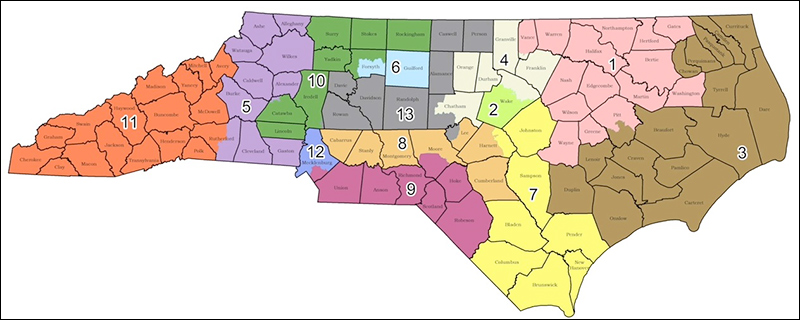
North Carolina’s 12 Congressional Districts

By Jim Ellis

May 21, 2021 — With the new reapportionment map public and the states gaining congressional districts now certain, we can begin to speculate where the new CDs might land. Today, we look at North Carolina, which continues to be one of the most important states from a national redistricting perspective.

The Census Bureau’s apportionment report, released on April 26, almost five months after their Jan. 1 deadline, contained the smallest transfer of congressional seats since the World War II era.

Just seven seats are moving from one state to another. As mentioned above, one of the recipients is North Carolina, the state that came the closest to gaining in the last census, missing by just a few thousand people. Today, we speculate as to how a new North Carolina congressional map might unfold.

The 2020 individual state population data has not yet been distributed and is not expected until October, apparently at the earliest. Once the specific state data is made public, the redistricting process can begin, but for now we can only use the latest available data (July 2019) for estimation purposes.

In examining the population numbers for each of the 13 current North Carolina congressional districts, we see that all must shed population to reach the state’s Census Bureau target number of 746,711 individuals, hence, the reason for the Tar Heel State gaining a new district.

In North Carolina, the state legislature has sole jurisdiction over redistricting. The governor, in this case Democrat Roy Cooper, has no veto power over the maps both houses jointly produce. This means the Republicans will control the process since they hold majorities in both the state House and Senate.

No matter what map is drawn, we can count on seeing post-redistricting litigation. In the previous decade, the courts twice altered the original map because of various lawsuits. The final iteration broke 8-5 in favor of the Republicans after the state Supreme Court redrew sections of the state and in effect awarded two previously Republican seats in Raleigh and Greensboro, respectively, to the Democrats.

Continue reading

Rep. Murphy to Challenge Sen. Rubio

By Jim Ellis

Florida Rep. Stephanie Murphy (D-Winter Park)

May 14, 2021 — According to the Axios news site, insiders close to Florida Rep. Stephanie Murphy (D-Winter Park) say that she has made the decision to challenge Sen. Marco Rubio (R) next year and will formally announce her campaign next month. The move had been expected for some time.

Rep. Murphy, a native of the country of Vietnam, was first elected to the House in 2016, defeating veteran Republican incumbent John Mica after the state Supreme Court had re-drawn the Florida congressional districts and made the 7th CD more Democratic. She unseated Rep. Mica 51-49 percent, and then scored re-election victories of 58 and 55 percent in 2018 and 2020, respectively.

A strong fundraiser, Rep. Murphy obtained over $3 million for both of her incumbent re-election campaigns. She ended the 1st quarter 2021 with a cash-on-hand figure of $1.43 million. Sen. Rubio posted $3.9 million in his campaign account during the same reporting period.

Assuming Murphy does enter the race next month, Democrats will have a credible challenger to Sen. Rubio, but one who still must be considered a decided underdog. In 2010, Sen. Rubio, then a state representative, defeated then-governor Charlie Crist, who was running as an Independent, and Democratic Congressman Kendrick Meek by a 49-30-20 percent margin. He was re-elected in 2016 with a 52-44 percent vote spread over then-congressman Patrick Murphy (D).

Florida races, as we know, are always competitive and usually very close, though the state has been trending more Republican over the past several elections. A Rubio-Stephanie Murphy race promises to become a national campaign.

With the Democrats apparently attracting a strong candidate in Florida, it is a good time to review the other key races.

In Pennsylvania, both parties are headed for very crowded primaries as each works to nominate a candidate to hopefully succeed retiring Sen. Pat Toomey (R). Afghan War veteran Sean Parnell entered the Republican primary earlier this week, but his only venture into elective politics was recording a two-point loss to Rep. Conor Lamb (D-Pittsburgh) last November in an Allegheny County suburban district.

Rep. Lamb, himself, may join the Democratic Senate campaign, meaning both parties are going to host political dogfights for the party nomination. In any event, however, the Pennsylvania race will be a top-tier national campaign.

Continue reading

Senate Action

Ohio Rep. Tim Ryan (D-Warren/Youngstown)

By Jim Ellis

April 29, 2021 — While most of the political world was focused on the census’s national apportionment announcement, several Senate moves of merit were also made this week.

In Ohio, US Rep. Tim Ryan (D-Warren/Youngstown) finally made his fledgling US Senate campaign official. Originally saying he would announce sometime in March only to postpone formal entry to an undetermined time, Ryan finally made his declaration on Monday. Once former Ohio Health Director Amy Acton — who was running slightly ahead of Rep. Ryan in early Democratic primary polling — said that she was not going to run, that paved the way for the 10-term congressman to open with an apparently clear path to the Democratic nomination.

Simultaneously, in Georgia, another announcement was made but one that contained a surprising message. Former Rep. Doug Collins (R), who placed third in the 2020 US Senate jungle primary, also declared his political intentions for 2022 on Monday. While observers were expecting the former four-term congressman to enter the current Senate race, he instead said he will not run for any office next year but didn’t close the door on returning to elective politics in another election cycle.

Yesterday, in another largely expected move, former North Carolina state Supreme Court Chief Justice Cheri Beasley (D), who lost her position in November by a scant 401 votes statewide, announced via video that she will enter the open Tar Heel State Senate race.

The three moves help further set the stage for a trio of critical Senate contests that will each contribute mightily toward determining which party breaks the 50-50 tie and assumes control of the body after the next election.

Despite Rep. Ryan looking as the candidate to beat for the Ohio Democratic nomination, the general election won’t be easy. Additionally, this political cycle could be different in terms of political options for Ryan. He has several times dipped his toe in the statewide or national waters only to return to the safety of his House district. With it now a certainty that Ohio will lose another congressional seat, and with at least one scenario suggesting that the eliminated seat could become Rep. Ryan’s 13th District, his usual fail-safe move might not again be available.

Continue reading

Apportionment Surprises


By Jim Ellis

April 28, 2021 — In virtually every 10-year apportionment announcement at least one surprise occurs, but the census unveiling Monday contained multiple blockbusters.

For example, two states had their final number of congressional districts determined by less than 90 people. Reportedly, if New York had just had 89 more people, that would have saved an Empire State congressional seat. Minnesota becomes the beneficiary allowing the state to barely hold its eighth district.

Instead of 10 seats changing states as had been forecast, only seven, affecting 13 domains, switched. Perhaps the main reason for the lower number is the decade population growth rate. According to yesterday’s final report, the nation grew at only a 7.4 percent rate, the lowest since the 1930 census’s 7.3 percent. By contrast, the population increase from the 2010 total was 9.7 percent.

Pre-census projections, for better than a year, had been predicting that Texas would gain three seats, Florida two, and Arizona one. The analysts also estimated seat losses for Alabama, Minnesota, and Rhode Island. None of these projections proved accurate.

On the other hand, prognostications for the balance of the map were accurate. Texas, and Florida did gain, but two and one, respectively, instead of three and two seats. Colorado, Montana, North Carolina, and Oregon each added one district apiece as expected. The one-seat losers were California, for the first time in history, Illinois, Michigan, New York, Ohio, Pennsylvania, and West Virginia.

It’s a bit too soon to determine which party will benefit the most from these numbers at the congressional level, though Republicans should be up slightly in the Electoral College for the next presidential campaign. Once we see how the population is distributed within the states will better tell us whether Democrats or Republicans will take the most advantage of the apportionment. This will depend upon how the population spreads through the cities, suburbs, and rural regions.

Continue reading

Major Senate Moves

By Jim Ellis

April 14, 2021 — With the Senate tied 50D-50R, and every 2022 campaign potentially meaning a change in majority status, we already see serious political moves being made or at least considered. This week began as being particularly active.

In the Last Frontier State of Alaska, 2020 Independent/Democratic nominee Al Gross, who opposed Sen. Dan Sullivan (R), confirms that he is considering challenging Sen. Lisa Murkowski (R) next year. The state’s new top four jungle primary system would virtually guarantee that both Sen. Murkowski and Dr. Gross would advance into the general election should both decide to run. For her part, Sen. Murkowski has not yet formally declared her 2022 political intentions, but she is expected to seek re-election.

Dr. Gross lost to Sen. Sullivan, 54-41 percent, despite exceeding the incumbent’s fundraising totals by almost a 2:1 margin. The Independent/Democrat spent over $19.5 million as compared to Sen. Sullivan’s expenditure total of $10.1 million. A total exceeding $27.2 million was expended from outside organizations, over $18 million of which aided Dr. Gross’ campaign.

Already announced is Republican former State Administrative Director Kelly Tshibaka; a Cygnal research firm survey of 500 Alaska registered voters taken in late March actually found her leading both Sen. Murkowski and Dr. Gross. The ballot test broke 34-19-18 percent in favor of Tshibaka with Sen. Murkowski and Dr. Gross significantly trailing. Under the new primary system, however, all three of these contenders, and a fourth candidate, would advance into the general election.

Former Kentucky state Rep. Charles Booker, who lost the 2020 US Senate Democratic primary to party nominee Amy McGrath in a close 44-42 percent result, has filed an exploratory committee for purposes of assessing his chances against Sen. Rand Paul (R) in a 2022 campaign.

Booker was literally outspent 10:1 in the Democratic primary, as McGrath hauled in more than $20 million even before advancing into the general election. She never figured on having to spend so much to defeat her intra-party opponent, however. Booker was able to maximize his political base in Louisville and with the African American community statewide to pull within 15,149 votes of McGrath with more than 544,000 people casting ballots in the primary election.

Sen. Paul won his 2014 re-election campaign with a 57-43 percent margin over Lexington-Fayette Urban County Mayor Jim Gray (D), which is the second largest municipality in Kentucky. National Democrats were high on the Gray campaign at its outset, but the race never materialized in what became a landslide Republican election year.

Reports emanating from North Carolina suggest that former Gov. Pat McCrory (R) could declare his Senate candidacy as early as today. McCrory was elected governor in 2012 with a 55-43 percent margin but would lose his attempt at re-election by just 10,263 votes from more than 4.7 million ballots cast, or less than a quarter of a percent.

Largely entangled with the infamous North Carolina bathroom bill that became a national story, the governor could not steer himself clear of the controversy and fell to then-Attorney General Roy Cooper (D). McCrory had previously run for governor in 2008, losing to incumbent Bev Perdue (D) by just three percentage points. Prior to running statewide, McCrory served 14 years as Charlotte’s mayor.

Continue reading

More Redistricting Delays – Part I

By Jim Ellis

Feb. 17, 2021 — The Census Bureau announced just before the Presidents’ Day holiday break that there will be yet another long delay in transmitting the census data to the states. Without the new numbers, redistricting becomes unachievable.

The new target date is Sept. 30, postponed from their first postponement date of July 30. At this point, the postponed apportionment release date remains April 30, long after the statutory deadline of Jan. 1. Apportionment is the first critical step in the redistricting process since this informs the states how many congressional seats they will be awarded for the current decade.

The late September target (and there’s no guarantee even this date will be met) will make it difficult for many states to finish their redistricting on time, and could force the process into the courts if state legislatures are unable to convene or meet a legislative calendar in terms of allowing public input. Even now, at least several states will have to enact emergency legislation to change deadlines to avoid violating pre-existing legal redistricting deadlines.

The delays have already changed the political situation in New Jersey and Virginia. With both states having odd-numbered year state legislative elections, the two are always the first to receive their new census data. In both states, legislative elections will now proceed under the 2011 maps with previously enacted amendments. When the lines are eventually completed, it is possible that new elections, possibly for 2022, will be ordered in Virginia. New Jersey voters passed a referendum in November that allows redistricting to occur before the 2023 state legislative elections.

Another problem could be lawsuits filed against the eventual apportionment. Apparently, the principal problem for the delays is exactly which people to count and where they are placed. College students, for example, are typically counted at the university campus on which they reside. Now, however, so many are not attending in-person classes. Therefore, arguments are ongoing as to where this group should be counted, either at school or back at their primary residence.

Additionally, one of President Biden’s new executive orders reversed Trump Administration policies about whether or not to count non-citizens. This change of direction has also created further delays.

Based upon these controversies, and others, it is probable that at least one potential losing state – apparently Alabama is on the cusp of losing a seat but may not depending upon the counting criteria – could sue over the apportionment conclusion meaning even further delays as various potential lawsuits wind their way through the judicial process toward final determination. All of this could conceivably mean redistricting is postponed until the 2024 election cycle.

Continue reading

More Redistricting Delays

By Jim Ellis

Jan. 29, 2021 — The Census Bureau announced at mid-week yet another postponement in releasing the national apportionment figures, this time until April 30. Reapportionment should have been completed by Dec. 31, but the Bureau previously announced that March 6 would be the new release date due to COVID-related problems. Now, we see further delays.

Reapportionment is the process of creating a new census data algorithm in order to project the number of congressional seats each state will be awarded for the coming decade. It appears that 10-12 seats could change states, with the northeast and Midwest typically losing districts to southern and western states. This time, however, California, for the first time in history, is reversing their trend and appears headed for the losing list.

Once the apportionment numbers are known and the individual data dispersed, the states can begin the redistricting process. The Census Bureau further stated that individual states won’t be receiving their particular data necessary for redistricting until at least July 30. This will clearly set the redistricting cycle back significantly, which could cause major problems for the coming election cycle.

In the past, the Census Bureau has prioritized the states with early primaries to be first to receive their data. This meant that New Jersey and Virginia initially received their new population numbers ahead of the others because they have odd-numbered year state legislative elections. Texas and Illinois were next to receive since they traditionally schedule their regular primaries in March of the election year.

Knowing that the numbers would not be available for them in 2021, New Jersey and Virginia took preparatory action. Garden State officials placed a referendum on the November ballot asking voters for approval to postpone legislative redistricting until 2023. The measure passed.

The Old Dominion leaders decided they would run their 2021 state Delegate elections on the amended 2011 map but could conceivably call elections again for next year once they receive their updated data and can draw district boundaries. Virginia state senators do not stand for election until 2023, so it is unlikely the redistricting delay will affect those campaigns.

The data distribution and processing delay could place most legislatures in a conundrum. Most will be adjourned when the data is received, so special sessions will have to be called in most cases to complete the process prior to the 2022 candidate filing deadlines. This suggests that the states having redistricting commissions might prove to be in better position to complete the task because they won’t have to deal with legislative politics, priorities, or calendars, all of which result in a lengthy process.

Additionally, since almost every map is challenged in court, we could well see a plethora of lawsuits being filed late in the year that keep the redistricting process tied in figurative knots for months.

The states in the most difficult situations will be those gaining and losing congressional representation. Because the number of districts these particular states will have differ from their current allotments, they do not have the option of reverting to the current map once 2021 apportionment becomes final.

In the case of gainers and losers not having completed maps, we may see at-large races for the House. This would be particularly difficult for the losing states because we may see all members in the affected places having to run at-large for seats in their House delegations.

Unofficially, the gaining states appear to be Texas (3 seats), Florida (2), Arizona, Colorado, Montana, North Carolina, and Oregon. The losers may be New York (possibly 2 seats), Alabama, California, Illinois, Michigan, Minnesota, Ohio, Pennsylvania, Rhode Island, and West Virginia. Reports suggest that the closest developing situation concerns whether Alabama loses a seat or New York drops two.

President Biden’s executive order that mandates non-citizens be counted in the census will certainly affect the final data projections and may be another reason for this latest delay.

The only certainty about 2021 reapportionment and redistricting is the many moving parts in these various states will likely produce surprising political results.


Ohio Sen. Portman to Retire

By Jim Ellis

Ohio Sen. Rob Portman (R) surprisingly announced his retirement Monday.

Jan. 27, 2021 — Ohio Sen. Rob Portman (R) surprisingly announced Monday that he will not seek a third term next year, opening the third Senate seat for the 2022 election cycle.

Addressing reporters at a news conference in Cincinnati yesterday, Sen. Portman said, “Our country’s polarized right now. It’s kind of shirts and skins. That makes it more difficult to find that common ground. Elected officials aren’t rewarded for that. What they’re rewarded for is throwing red meat to the talk show.”

The two-term senator indicated that the “partisan gridlock” is one of the reasons for his retirement. He further said in explaining his retirement decision, “we just keep pushing out to the right and to the left, there’s not going to be much left in the middle to solve the real problems we face.”

For the Republicans, they now have three big state open seats to defend as Sen. Portman joins Pennsylvania GOP Sen. Pat Toomey and North Carolina’s Richard Burr as incumbents who have already made their 2022 retirement plans public. Several others could be on the horizon.

Senators Richard Shelby (R-AL) and Chuck Grassley (R-IA) will be 88 and 89 years of age, respectively, at the time of the next election, and Wisconsin Sen. Ron Johnson (R) originally took a two-term pledge when he was first elected in 2010. None of these three lawmakers have made their future political plans public to date, however.

Ohio, once a bedrock Republican state, developed a swing image beginning in 1992 when the state deserted GOP President George H.W. Bush and backed Democrat Bill Clinton. They did so again in 1996. In 2000 and 2004, Ohio returned to the Republican column awarding George W. Bush with its electoral votes. In 2008 and 2012, the Buckeye State ventured back to the Democratic side of the political ledger, supporting Barack Obama in both of his national elections.

Therefore, rather than being cast as a swing state during this 20 year period, Ohio may actually have been a microcosm of the national electorate since the state’s voters chose the winning candidate in each of the presidential elections during that time span, and had done likewise for the three previous decades.

Continue reading

Early House Outlook – Part IV

By Jim Ellis

Jan. 24, 2021 — Concluding our electoral US House preview, today we look at the final dozen states in the country’s southern region.


• Alabama – 7 Seats (1D6R)

Alabama is on the cusp of losing one of its seven seats in reapportionment. Sources suggest the final numbers are very close and the state may sue over how the figures are tabulated should apportionment take away one of the Republican seats. The Democrats have only one CD in the state, which is a majority minority seat (Rep. Terri Sewell-D) that is a certainty to remain as part of the delegation.

Should Alabama lose a seat in reapportionment, the state’s southeastern region, most particularly the Montgomery anchored 2nd District, would probably the most affected since this is the least populated area of the seven CDs.


• Delaware – 1 Seat (1D)

The home of new President Joe Biden was once a relatively conservative state, but no longer. Delaware is growing but won’t come anywhere near gaining a second seat. Therefore, three-term Rep. Lisa Blunt Rochester (D-Wilmington) will have an easy electoral ride for the foreseeable future.


• Florida – 27 Seats (11D16R)

The Sunshine State is one of two entities perched to gain multiple new districts. Florida is projected to add two seats, which should give the GOP map drawers the opportunity of protecting the newly won South Florida District 26 (Rep. Carlos Gimenez) and 27 (Rep. Maria Elvira Salazar) while maximizing the Republican compilation of Florida seats. Winning the aforementioned Miami-anchored CDs might result in conceding one of the new seats to the Democrats, however, in order to off-load a significant portion of their left-of-center voters, which would make both seats more Republican.

Holding the governor’s office, both houses of the legislature, and now a majority on the state Supreme Court will allow the GOP to become the big winner in redistricting. The fact that 25 of the 27 districts are over the estimated per district population projection of approximately 740,000 residents provides statistical evidence for expanding the delegation.

Rep. Darren Soto’s (D-Kissimmee) 9th District is the most over-populated seat with more than 931,000 people. Only Reps. Neal Dunn’s (R-Panama City) and Charlie Crist’s (D-St. Petersburg) seats are slightly below the projected population target. Twelve of the current 27 districts now hold more than 800,000 constituents. Expect the new seats to be added in South Florida, most likely toward the Gulf Coast side of the peninsula, and in the Orlando area.


• Georgia – 14 Seats (6D8R)

Though Republicans will control the redistricting pen as a result of holding both the legislature and governor’s office, the party map drawers will be hard-pressed to construct a map that allows their members to dominate the delegation as they did 10 years ago. Gaining a seat in 2010 reapportionment, the GOP began the decade with a 10-4 advantage in the House delegation only to see two Atlanta suburban seats slip away as a result of demographic and political changes in the metropolitan area.

Georgia is expected to remain constant in this reapportionment with their 14 seats. The GOP will attempt to make at least one of the seats they lost, District 6 (Rep. Lucy McBath) or District 7 (Rep. Carolyn Bourdeaux) more Republican and thus give themselves a chance to re-claim a seat for the coming decade.

Expect a move to make one of these two seats, probably District 6, more Democratic in order to make District 7 more Republican especially since the latter CD is the most over-populated seat in the state with more than 844,000 residents and will have to shed close to 90,000 individuals to other districts.
Continue reading

Early Senate 2022 Previews:
Florida & North Carolina

By Jim Ellis

Jan. 14, 2021 — Regardless of how many in-cycle Senate seats – there are 34 in the 2022 election cycle – come into political play, we can count on seeing Florida and North Carolina once again hosting crucial battleground campaigns.

Florida is always consistent in their close vote totals, particularly when remembering the 2000 presidential campaign — and pollsters, while typically forecasting tight finishes, have often missed the outcomes. In fact, the cumulative polling community has predicted close Democratic victories in the last four key statewide elections: two presidential (2016 & 2020), one senatorial (2018), one gubernatorial (2018), and been wrong on each occasion.

Since 2016, inclusive, Florida has hosted eight statewide races with Republicans winning seven. Yet, their average cumulative vote percentage for these eight victorious campaigns was just 50.7 percent, with the high point being 52.0 percent (Sen. Marco Rubio-R, 2016). Democrats recorded the low winning total: 50.04 percent — 6,753 votes from 8,059,155 votes cast; agriculture commissioner, 2018; winner Nikki Fried (D) vs. Matt Caldwell (R). The aggregate average among the statewide contests in these three most recent election years is 50.7 – 47.9 percent in the GOP’s favor.

With this background, Sen. Rubio will presumably seek a third term next year against what will surely be a highly competitive Democratic opponent. At this point, most of the speculation surrounds two Democratic House members, neither of whom has closed the door on either running for the Senate or challenging Gov. Ron DeSantis (R) as he seeks a second term.

Reps. Stephanie Murphy (D-Winter Park) and Val Demings (D-Orlando) are the two most prominently mentioned prospective contenders, and it wouldn’t be surprising to see one run for Senate and the other for governor. It is less likely that we would see a primary developing between the pair in one of the races.

Other names being floated are Rep. Charlie Crist (D-St. Petersburg), who is always mentioned as a potential statewide candidate because he previously served both as attorney general and governor and lost two other statewide campaigns. Other potential contenders are Rep. Ted Deutch (D-Boca Raton) and former Rep. Debbie Mucarsel-Powell (D-Miami). The state’s lone Democratic office holder, Agriculture Commissioner Nikki Fried, is more often associated with running for governor as opposed to the Senate contest.

Continue reading