Tag Archives: Nevada

Senate Primaries Forming – Part II

By Jim Ellis — Monday, Aug. 14, 2023

Senate

Sen. Pete Ricketts (R) / Photo by Gage Skidmore

Senate Races: Balance of Power — We conclude our look into the critical Senate primary campaigns by previewing the states alphabetically from Nebraska to Wisconsin. (See Friday’s post:
Senate Primaries Forming — Part 1.)

• Nebraska: Sen. Ben Sasse’s (R) resignation earlier this year led to former Gov. Pete Ricketts (R) being appointed to the seat. The new senator must now run in a special election to fill the balance of the term, and then again in 2026 for a full six-year stint. Sen. Ricketts has already announced that he will run in both elections.

Republicans are safe here in the general election; thus, the primary could become the competitive race. So far, no major challenger has come forward, though rancher Chuck Herbster, who placed only second in the 2022 governor’s primary despite having a Donald Trump endorsement, remains a potential candidate.

Sen. Deb Fischer (R), on the ballot for the regular term, has no opposition to date in either the primary or general elections. Nebraskans will choose their nominees on May 14, 2024.

• Nevada: Sen. Jacky Rosen (D) is on the ballot for a second term, and the Republican primary is now becoming crowded. Sam Brown, a disabled Afghan War veteran, is the National Republican Senatorial Committee’s choice and should be viewed as the leading candidate.

Earlier this week, former ambassador to Iceland Jeff Gunter and retired Air Force officer and director of the Reno Air Aces, Tony Grady, entered the race and could make the Republican primary interesting. The Nevada general election contest could well become a top-tier challenge race. The Silver State primary is scheduled for June 11, 2024.

• Ohio: One of the top three Republican conversion opportunities is the Ohio race featuring Sen. Sherrod Brown’s (D) run for a fourth term. Republicans have three major contenders: Secretary of State Frank LaRose, state senator and 2022 US Senate candidate Matt Dolan, and businessman Bernie Moreno.

Early polling gives LaRose, who has won a statewide campaign, the advantage. Sen. Dolan, in his 2022 race, came on strong at the end and finished within one percentage point of second place. Moreno, who was also in the 2022 Senate race but withdrew before voting began, has earned Ohio junior Sen. J.D. Vance’s (R) endorsement.

Regardless of who wins the Republican primary, the Buckeye State Senate campaign will remain a top-tier challenge race. The Ohio primary will occur on March 19, 2024.

• Pennsylvania: Little is occurring in the GOP nomination race as Sen. Bob Casey, Jr. (D) rallies his supporters in a quest for a fourth term.

Republicans are confident that 2022 Senate candidate David McCormick (R) will enter the race, and the primary appears his for the taking. McCormick lost the 2022 Republican campaign to Dr. Mehmet Oz by just 950 votes statewide. Assuming he returns, McCormick will begin the general election contest as a decided underdog to Sen. Casey. The Pennsylvania primary will be conducted on April 23, 2024.

• Texas: The Lone Star State Senate contest appears to be the Democrats only shot at developing a competitive challenge race. Sen. Ted Cruz (R) is on the ballot for a third term and must be considered a clear favorite in a state where Democrats still have not won a major statewide campaign in decades. In a presidential year, their task becomes even harder.

The Democratic leadership is backing US Rep. Colin Allred (D-Dallas), but he faces a serious challenge from state Sen. Roland Gutierrez (D-San Antonio). The senator is the top gun control advocate in the legislature and much closer to the party’s progressive left base than is Rep. Allred.

Additionally, Texas state Senate seats are bigger than congressional districts, so Gutierrez actually represents 150,000 more people than does Rep. Allred.

Allred has raised more than $6 million since his announcement, but now must spend that and more just to win the party nomination. Sen. Cruz will use the primary to force both men further to the left on energy issues, which are so critical to the Texas economy. The Lone Star primary will be held on Super Tuesday, March 5, 2024.

• Utah: The big question lingering in the Beehive State is whether Sen. Mitt Romney (R) will run for a second term. The senator says he will make a decision in the fall. If he does run, Romney faces a competitive Republican primary challenge, likely from state House Speaker Brad Wilson (R-Kaysville).

Sen. Romney has little chance of winning the state nominating convention, so to qualify for the ballot he will need to recruit 28,000 valid petition signatures from around the state. This process would allow him to bypass the party structure and go directly to the primary ballot.

Republicans will hold the seat in the general election, but the political drama comes in the Republican primary where it is not inconceivable that Sen. Romney could lose. The nomination will be decided on June 25, 2024.

• West Virginia: Sen. Joe Manchin (D) continues to waver about seeking re-election. He is again making statements that he could become an Independent or run for president as a minor party nominee. Regardless of his decision, the West Virginia race is the Republicans’ best conversion opportunity. Gov. Jim Justice (R) is an announced candidate in the Republican primary and faces US Rep. Alex Mooney (R-Charles Town).

The winner, likely Gov. Justice, will be considered the favorite for the general election in what has been former President Donald Trump’s second-best state in the nation during both his 2016 and 2020 election campaigns. With the Club for Growth willing to spend millions to help Mooney from the outside, the Republican primary will be more competitive than one might believe at first glance. The victory odds, however, still favor Gov. Justice. The Republican nomination will be settled on May 14, 2024.

• Wisconsin: The Badger State race is the Republicans’ biggest disappointment to date in terms of candidate recruitment. No one has yet come forward to challenge two-term Sen. Tammy Baldwin (D), and it’s possible that she could run without a serious challenge in what is typically a close state.

Should the congressional districts be redrawn, it is possible that Rep. Bryan Steil (R-Janesville) will find that entering the Senate race is his best political option. He would be the Republicans’ strongest contender. The Wisconsin primary is not until Aug. 6, 2024, so time remains for Republicans to right their political ship.

No Labels Party:
Qualifies in Two More States

No Labels Party website image

By Jim Ellis — Wednesday, Aug. 9, 2023

President

No Labels: Making Inroads — The No Labels Party, which is attempting to bring ideological moderates from the two major parties and the self-identified independent voter under one entity, has qualified for the ballot in two more states.

Nevada and South Dakota will now feature a No Labels Party ballot line, joining Alaska, Arizona, Colorado, and Oregon. While the number of qualified states is small in relation to the whole country, three of these six states are key swing entities that could well affect the outcome of next year’s presidential campaign.

Let’s look at one particular poll that exemplifies how a minor candidate can influence a hotly contested election. A new Emerson College poll of the Michigan electorate (Aug. 1-2), for example, finds President Joe Biden leading former President Donald Trump by less than a percentage point. When Green Party candidate Cornel West’s name is added to the questionnaire, Trump takes a two point lead over Biden because West draws four percent support.

The Michigan example will be similar in the states where the presidential election is extremely close. In this case, Dr. West’s presence draws enough left-of-center Michigan voters away from President Biden that would allow former President Trump to take the lead. We would likely see a reversed outcome if the minor party candidate were prone to attract suburban Republican votes.

The No Labels Party is different than others we have seen over the years in that they are well financed and have a national organization. Therefore, the ability to qualify for the ballot in a maximum number of states is greater than any other minor party — including the Green Party — of which Dr. West will be the likely nominee.

Looking at the composition of the No Labels Republican leadership — should they file a presidential candidate (the leaders have not yet committed to doing so) it will be someone more likely to take votes away from Trump rather than Biden. Therefore, when the party leaders and activists from around the country meet in Dallas on April 14-15, it is probable they will choose a disaffected Republican for the presidential slot and a disaffected Democrat as the running mate … if they even decide to file a national candidate slate.

The organization’s co-chairmen, former US senator and 2000 Democratic vice presidential nominee Joe Lieberman and ex-Maryland Gov. Larry Hogan (R), have said on multiple occasions that they want a ticket comprised of a member from each major party, but again without firmly committing to fielding a presidential ticket.

Turning to the No Labels qualified states, Arizona and Nevada are two of the five entities where flipping from Biden in 2020 to the Republican nominee in 2024 could change the national outcome.

A surprising state that could be in play next year is Alaska. The Last Frontier state changed its election system in the last election and added a Ranked Choice Voting system should no candidate secure majority support.

The addition of a No Labels candidate could make the above scenario real. In the 2020 Alaska special congressional election, Republican candidates cumulatively drew 60 percent of the vote; yet, when RCV went into effect because no one reached 50 percent, a Democratic candidate won the election. Therefore, Alaska should be added to the watch list of swing states that could move toward the Democrats.

Pennsylvania and North Carolina are two of the larger states in the swing category. Pennsylvania went Democratic in 2020, while North Carolina backed the Republican nominee. Both states require a defined number of valid registered voter petition signatures for a candidate under a different party banner to earn a ballot position.

Wisconsin, another state that swung the Democrats’ way but which could certainly rebound in 2024, employs the same requirements for minor party candidates as they do for Republicans and Democrats. Therefore, No Labels would have a strong chance of qualifying in this important swing domain as well.

Should key minor party candidates qualify in each of these aforementioned states – how each break will be critical in determining the 2024 presidential winner – the number of votes they attract, and from which candidate they draw, will be a major factor in how the election turns not only in these particular states but in the nation as a whole.

Senate: Status Check

By Jim Ellis — Tuesday, Aug. 1, 2023

Senate

Senate Election Cycle: A Review — The 2024 US Senate cycle is a critical one, especially for Republicans since the political map favors them for the first time in three election cycles. Democrats must defend 23 of the 34 Senate races next year, and there are signs of competition in only one of the 11 GOP defense seats.

Therefore, Republicans must maximize their present opportunity because they face minority status for several more election cycles if they fail to claim the majority next year.

With that, let’s review where the key races stand:


FIRST TIER (alphabetically by state)

Sen. Jon Tester (D), Montana

• Montana: Sen. Jon Tester (D) stands for a fourth term from a state that has moved considerably to the right since he was last on the ballot in 2018. The presidential turnout for 2024 is another obstacle that he must overcome.

The Club for Growth leadership several months ago said they would back US Rep. Matt Rosendale (R-Glendive) to the tune of $10 million if he decided to challenge Sen. Tester, as he did five years ago. In the 2018 election, Rosendale, then the state auditor, lost to Sen. Tester, 50-47 percent.

Now, CfG president David McIntosh, himself a former Republican congressman, is hedging on such a support level, saying that retired Navy SEAL and aerospace company CEO Tim Sheehy is an impressive candidate and Rep. Rosendale is needed in the House. Rosendale has long been a presumed Senate candidate but has yet to come forward and formally announce his political plans. Former Navy SEAL and aerospace company Sheehy, with the Republican leadership’s endorsement, has officially entered the race.

• Nevada: The close results seen in the state both in 2022 and 2020, along with more GOP candidate development, moves Nevada into the top tier. Afghan War veteran and 2022 Senate candidate Sam Brown enters the race with endorsements from the Senate leadership and key support groups.

Former Ambassador to Iceland Jeffrey Ross Gunter, one of former President Donald Trump’s appointees, is close to becoming a Senate candidate. Also in the race is former state Assemblyman Jim Marchant who was defeated in previous gubernatorial and secretary of state races.

The eventual Republican nominee, particularly if Brown wins, will be in a toss-up race with first-term Sen. Jacky Rosen (D).

• Ohio: Republicans have a three-way primary featuring Secretary of State Frank LaRose, state Sen. Matt Dolan, and businessman Bernie Moreno. Polling shows all three would run within the polling margin of error opposite Sen. Sherrod Brown (D) while keeping him under the 50 percent support plateau.

Republicans have done well in Ohio since Sen. Brown was re-elected in 2018. This will likely be the incumbent’s most difficult re-election race. Ohio becomes a must-win for the Republicans if they are to wrest the Senate majority away from the Democrats.

• West Virginia: Polling finds Gov. Jim Justice (R) holding comfortable leads over Sen. Joe Manchin (D) in the general election and Rep. Alex Mooney (R-Charles Town) in the Republican primary. Sen. Manchin has still not committed to seeking re-election. West Virginia is the Republicans best conversion opportunity. If the GOP fails to win this seat it will be a precursor to a very bad election night.


SECOND TIER (alphabetically by state)

• Arizona: This race will be the wild card of the 2024 election cycle. The three-way race featuring Independent incumbent Kyrsten Sinema means that she, a Democrat, likely Rep. Ruben Gallego (D-Phoenix), and an eventual Republican nominee, possibly 2022 gubernatorial candidate Kari Lake, could all win this seat with a plurality figure of less than 40 percent.

Considering that Lake received 49.6 percent of the vote in the governor’s race, her chances in the Senate race should not be overlooked. She still, however, must be viewed as an underdog since the other two candidates’ chances appear better at present.

• Michigan: Mitchell Research conducted a new poll of the Michigan electorate (July 11-13; 639 likely Michigan voters; SMS text) and finds Rep. Elissa Slotkin (D-Lansing) recording a 44-38 percent lead over former Rep. Mike Rogers (R) and an even larger 41-28 percent advantage over ex-US Rep. Peter Meijer (R). Both are potential Senate candidates.

Additionally, two-term US Rep. Lisa McClain (R-Bruce), who represents the region commonly referred to as “the thumb” since the state’s Lower Peninsula configuration resembles a human hand, said that she will not enter the open Senate race next year. The move presumes that she will seek re-election to the House in 2024.

Michigan is trending more Democratic than it had in the previous elections before 2020, so the party remains the favorite to hold this open seat due to incumbent Sen. Debbie Stabenow’s (D) retirement.

• Pennsylvania: Sen. Bob Casey, Jr. (D) is on the ballot for a fourth term next year and is the clear favorite for re-election. Republicans do not yet have an official candidate, but it is believed that 2022 Senate candidate David McCormick will at some point announce his entry into the race. He lost the Republican nomination in the last election to Dr. Mehmet Oz by 950 votes statewide.

Even with McCormick in the race, Sen. Casey will hold the inside track to re-election. For this seat to fall to the Republicans, a national Red Wave will have to form.

• Texas: The Lone Star State is the only place at present where a Republican incumbent is being seriously challenged. The entrance of state Sen. Roland Gutierrez (D-San Antonio), however, actually helps Sen. Cruz. With Gutierrez being identified with the progressive left, Sen. Cruz will be able to use the Democratic primary to help drive Rep. Colin Allred (D-Dallas) further to the left, thus setting both up favorably for the general election regardless of which man becomes the Democratic nominee.

This will be an expensive race, but Sen. Cruz is well positioned to again prevail.

• Wisconsin: Sen. Tammy Baldwin (D) stands for a third term. Wisconsin turns in close races, but early polling suggests the Democrats have a clear advantage heading into this cycle. Republicans have yet to recruit a candidate. Some of the GOP possibilities are individuals who have lost previous statewide races.

Should a redistricting case come before the state Supreme Court, there is a possibility that the Wisconsin congressional map may be redrawn. If so, then both Reps. Bryan Steil (R-Janesville) and Derrick Van Order (R-Prairie du Chien) could be endangered. If that happens, we could see Steil move forward to challenge Sen. Baldwin. Should this scenario unfold, the Senate race would become more competitive.

Presidential Trends

By Jim Ellis — Friday, July 28, 2023

President

Are Trump and Biden locks for their respective parties?

Presidential Trends: Biden, Trump Party Nominations Look Inevitable — Heading toward August of the off-year, we are seeing clear presidential trends already developing.

President Joe Biden will be renominated. Despite Robert F. Kennedy Jr. being in the primary race and attracting some media attention, the Democratic process will almost assuredly be a non-event.

Trends are also clear for former President Donald Trump. He continues to lead in all polling and has actually gotten stronger within the party base after the series of indictments were leveled against him.

The Morning Consult data and research firm released a graph of the candidates’ progress from December of 2022 through the present. The latest result from their daily online track finds Trump now approaching 60 percent support nationally. In December, he was right at 50 support, but then generally dropped into the 40s through February but has continued to gain strength ever since.

The perennial second-place candidate, Florida Gov. Ron DeSantis, is now trending in the opposite direction. Beginning with 30 support national support in late December, Gov. DeSantis now finds himself languishing in the teens according to most GOP surveys.

The trajectory for most of the second-tier candidates has also been upward. Aside from Gov. DeSantis, who has fallen, and former Vice President Mike Pence and ex-UN Ambassador Nikki Haley, who have remained virtually stagnant, businessman Vivek Ramaswamy, Sen. Tim Scott (R-SC), and North Dakota Gov. Doug Burgum have all improved their standing. Ex-New Jersey Gov. Chris Christie has bolted onto the scene but appears to be running to deny Trump, and while he is moving into the middle of the pack, it is difficult to see how his support grows from the Republican Party’s relatively small “Never Trump” faction.

As we know, national polls do not deliver any delegate votes to the candidates. Those, of course, are won at the state level through public voting, so it is important to follow the state data to get a true indication of the nomination contest’s ebbs and flows.

Continue reading

Brown Becoming Leading Senate GOP Candidate in Nevada; Redistricting Activist Challenges in Michigan; Kuster Stands Pat; Competition in NY-16; NC Gubernatorial Race Update

By Jim Ellis — Monday, July 24, 2023

Senate

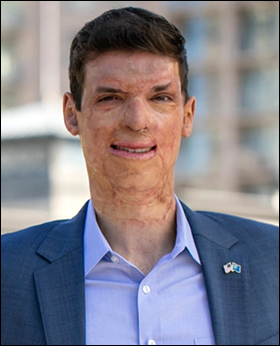
Afghan War veteran Sam Brown (R)

Nevada: Brown Becoming GOP Candidate of Choice — Afghan War veteran Sam Brown (R), disfigured through his war injuries, is becoming the leading Nevada Republican US Senate candidate just since his official announcement on July 10.

According to published reports, he is already the leading fundraiser in the Republican field and has the endorsement of National Republican Senatorial Committee chairman Steve Daines (R-MT), the Americans for Prosperity organization, and individual senators such as Marsha Blackburn (R-TN). The eventual Republican nominee will oppose first-term Sen. Jacky Rosen (D) in the general election. For Republicans to gain the Senate majority, the Nevada seat must become a prime target.

House

MI-4: Redistricting Activist to Challenge Rep. Huizenga — Attorney Jessica Swartz (D), who was one of the prime movers behind the successful ballot initiative to convert the Michigan redistricting system to a citizens’ commission, announced that she will challenge US Rep. Bill Huizenga (R-Holland) next year.

Originally, Rep. Huizenga appeared to be the odd man out as national reapportionment cost Michigan a congressional seat. The map led to he and veteran Rep. Fred Upton (R) being paired in the new southwestern Michigan’s 4th CD. However, with Rep. Upton opting for retirement after serving 36 years in the House, that ultimately left the seat to Huizenga, who was re-elected with a 54-42 percent victory percentage last November even though he had not previously represented 75 percent of the new constituency. Expect this race to draw some national attention in 2024.

NH-2: Rep. Kuster Staying Put — Saying that Democrats already have “two great candidates,” US Rep. Annie Kuster (D-Hopkinton) said late last week that she would not enter the open governor’s race now that four-term incumbent Chris Sununu (R) has announced his retirement. It is presumed that Rep. Kuster will seek re-election to a seventh term in the House.

In her comments, Rep. Kuster was referring to Manchester Mayor Joyce Craig and Executive Councilor Cinde Warmington who are declared Democratic gubernatorial candidates. Republican former state Senate President Chuck Morse immediately announced his candidacy when Gov. Sununu made his retirement plans public. Ex-US Sen. Kelly Ayotte may also soon join the open Republican primary.

NY-16: Potential Tougher Challenger for Rep. Bowman — Last year, New York Rep. Jamaal Bowman (D-Yonkers) turned back two Democratic primary challengers by a 54-25-19 percent margin in what proved to be a moderately competitive campaign. This cycle, his competition may be more formidable.

Westchester County Executive George Latimer (D), who defeated a Republican incumbent in 2017 and then won a 62-38 percent re-election campaign, confirms that he is considering challenging Rep. Bowman. Prior to his election to local office, Latimer served in both the New York Assembly and state Senate. Westchester County, the population of which is just short of 1 million residents, dominates the 16th CD. A total of 91 percent of the district lies in this one county, with the remaining territory crossing into the Bronx borough.

Governor

North Carolina: New Candidate Emerges — Former state Sen. Andy Wells announced late last week that he will enter the Republican gubernatorial primary. This sets up a re-match of sorts with Lt. Gov. Mark Robinson. The two ran against each other in the 2020 lieutenant governor’s primary, a political battle that Robinson won by almost a 2:1 ratio. Also in the race is former Congressman Mark Walker. Democratic Attorney General Josh Shapiro at this point is unopposed but may have opposition from former state Supreme Court justice Mike Morgan. The 2024 governor’s race is open because incumbent Roy Cooper (D) is ineligible to seek a third term.

Can DeSantis Overtake Trump?

By Jim Ellis — Tuesday, July 18, 2023

President

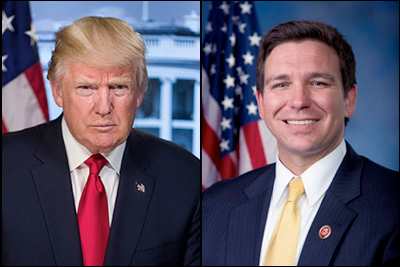
Former President Donald Trump; Florida Gov. Ron
Desantis (R)

Polling: DeSantis vs. Trump — A series of flash polls taken in June and early July within 13 states provides us a glimpse into the path Florida Gov. Ron DeSantis has ahead of him if he is to wrest the Republican presidential nomination away from former President Donald Trump. In summary, the deficit may be too large to overcome.

National polls have for weeks shown Trump holding huge leads over his GOP opponents, but these national surveys are virtually meaningless since the race will be determined in the state-by-state count. The winner must secure 1,234 pledged delegate votes from the 56 voting entities to clinch the party nomination.

The recent polling from the 13 states yields a combined 944 delegates, or 38.3 percent of the total Republican universe. The tallies come from 11 different pollsters during the period beginning June 5 and ending July 6.

Cumulatively, Trump would command a combined 47.4 percent support from these places, slightly less than he is showing nationally. Gov. DeSantis is so far recording 21.2 percent, and no other candidate even reaches five percent support. Therefore, the Florida governor must more than double his support base if he is to surpass Trump’s advantage.

Included in these 13 states are eight places where voters will cast their ballots on Super Tuesday, March 5, or before. The eight states are, in voting order: Iowa, New Hampshire, Nevada, South Carolina, California, North Carolina, Tennessee, and Texas. Of the pre-Super Tuesday states, only Michigan is not included.

In the early states, Trump’s margin, according to the latest available polling data, is actually an even larger 55-22 percent over Gov. DeSantis, with 23 percent choosing one of the seven minor candidates. Therefore, the Trump lead in the critical momentum building early states is larger than in the at-large universe, thus making DeSantis’s task even more difficult.

In addition to the eight early states mentioned above, the remaining tested domains, again in voting order, are Florida, Ohio, Wisconsin, Pennsylvania, and Montana. Of the 13, DeSantis’ strongest state is Wisconsin, where the Marquette University Law School survey, a frequent Badger State pollster, finds the Florida governor trailing Trump by just one percentage point.

The state will the largest chasm between the two men is Tennessee, where the Targoz Market Research survey finds a Trump margin of 61-12 percent. Perhaps most troubling to Gov. DeSantis is his most recent showing in his own home state of Florida. The latest Florida Atlantic University study that concluded on July 1 reveals a 50-30 percent margin in Trump’s favor.

This poll, however, may be an anomaly because no other data has shown such a large disparity. Since the beginning of May, one other research study finds Trump ahead by eight percentage points, while two more see a virtually even split between Trump and DeSantis. Still, for Trump to be doing this well in Gov. DeSantis’ home state is telling as to the strength of the former President’s national advantage.

While serious campaigning is just now getting underway, much can change between the present circumstances and the eventual outcome. With Iowa now moving their precinct caucuses from an original date of Feb. 5 to Jan. 15, the nomination campaign season grows even shorter.

For Gov. DeSantis, or any of the minor candidates to make a serious run at former President Trump, the activity pace will have to significantly quicken, and their momentum will need an abrupt about face.

Hill Harper Announces for Senate; Nevada’s Brown Will Run for Senate; Sen. Ted Cruz Picks Up Challenger; Jockeying in Alaska for House Seat

By Jim Ellis — Thursday, July 13, 2023

Senate

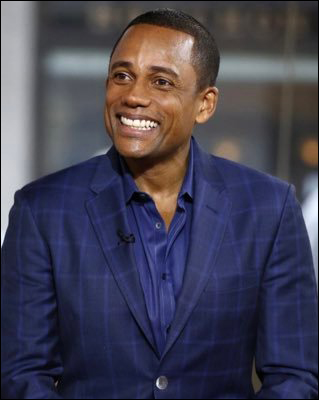
Frank Eugene “Hill” Harper (D), one of the stars of the “CSI: NY” and “The Good Doctor” programs

Michigan: Actor Announces for Senate — As expected, actor Frank Eugene “Hill” Harper (D), one of the stars of the “CSI: NY” and “The Good Doctor” programs, announced that he will compete in the open Michigan US Senate primary. He becomes the fourth major candidate, and third African American, in the Democratic primary. He joins US Rep. Elissa Slotkin (D-Lansing), Michigan State Board of Education president Pamela Pugh, and former state Rep. Leslie Love.

The crowded field likely plays well for the perceived leader, Rep. Slotkin. This primary will take a long while to unfold, however. The Michigan primary won’t occur until Aug. 6, 2024, and its competitiveness could tamp down the Democrats’ advantage in the general election. Though the party primary may well be more eventful considering Harper’s entry, Rep. Slotkin must still be rated as the favorite for the party nomination and to win the seat in the November election. Sen. Debbie Stabenow (D) is retiring after serving what will be four full terms.

Nevada: Republicans Score Candidate Prospect — In another move that has been expected for several months, disabled Afghan War veteran and 2022 Senate candidate Sam Brown (R) announced he will return to again compete in a Nevada US Senate race. This time, he hopes to capture the Republican nomination and challenge first-term Democratic Sen. Jacky Rosen.

In ’22, Brown lost the party primary to former Attorney General Adam Laxalt, 56-34 percent, but raised an impressive $4 million-plus for his effort. Laxalt would then lose the general election to Sen. Catherine Cortez Masto (D) by fewer than 18,000 votes from more than 1 million ballots cast. Now, it appears that Brown has the inside track for the party nomination and would be an interesting candidate in the general election. A strong Brown candidacy could elevate Nevada into top-tier campaign status.

Texas: State Senator Enters Battle to Challenge Sen. Cruz — San Antonio area state Sen. Roland Gutierrez (D) announced Tuesday that he will enter the Texas Democratic primary, which will likely ignite a difficult nomination battle against US Rep. Colin Allred (D-Dallas) who announced his candidacy in early May. The eventual party nominee will then challenge two-term Sen. Ted Cruz (R) in the general election.

Sen. Gutierrez, who represents a legislative domain similar to that of US Rep. Tony Gonzales’ (R-San Antonio) congressional district in that it begins in the metro area and then stretches through most of west Texas toward El Paso, is a strong gun control advocate. Prior to defeating a Republican incumbent to win a Senate seat in 2020, Gutierrez had served six terms in the state House of Representatives.

Rep. Allred is reporting raising more than $6.2 million for his Senate effort after announcing his candidacy, but now will have to spend heavily just to win the party nomination in March. It is likely the beneficiary of what will be a hotly contested race between Allred and Gutierrez is Sen. Cruz. The Texas primary is scheduled for Super Tuesday, March 5, 2024.

House

AK-AL: Nick Begich (R) Considering Another House Bid — Businessman Nick Begich III, whose grandfather was a Democratic congressman and uncle, Mark Begich, served as a Democratic US senator before losing to current Republican Sen. Dan Sullivan, is again reportedly contemplating a run for the state’s at-large US House seat. He participated in the 2022 special and regular elections as a Republican, qualifying for the secondary election both times, but failing in Ranked Choice Voting.

Many observers believed he would be the strongest candidate against Rep. Mary Peltola (D-Bethel) who won both of those elections by outdueling Sarah Palin in the Ranked Choice rounds. Should Begich run in 2024, it is probable he would have a strong chance to end in the final round with Rep. Peltola. The at-large Alaska seat is now the most Republican congressional district in the country to send a Democrat to the US House.

New California Senate Entry; Montana’s Sheehy Gets Major Endorsement; Former Nevada Senate Candidate Ready to Announce; Louisiana & North Carolina Governor News

By Jim Ellis — Wednesday, July 5, 2023

Senate

Former Google executive Lexi Reese

California: New Senate Entry — Wealthy former Google executive Lexi Reese (D), who says she will spend some of her own fortune on the open statewide US Senate race, announced that she will enter the California March 5 all-party primary for the right to succeed retiring Sen. Dianne Feinstein (D).

While her path to claim one of the two qualifying positions necessary for advancing into the general election is narrow since she faces sitting US Reps. Barbara Lee (D-Oakland), Katie Porter (D-Irvine), and Adam Schiff (D-Burbank), the chances of her taking enough Democratic votes to potentially allow a Republican to sneak past the Democratic field and clinch a general election ballot slot becomes more plausible. The California Senate race will be one of the main attractions on Super Tuesday.

Montana: Another Major Endorsement for Sheehy — On the heels of retired Navy SEAL and aerospace company CEO Tim Sheehy announcing his senatorial campaign and receiving the National Republican Senatorial Committee endorsement, another has come his way. Gov. Greg Gianforte (R) also announced his public support for Sheehy.

It is clear the Republican political establishment is getting solidly behind Sheehy in an attempt to deny Rep. Matt Rosendale (R-Glendive), who soon will announce his own Senate candidacy, the nomination. Rep. Rosendale begins with a large polling lead, so it will be worth watching to see if the Montana Republican establishment has enough pull to thwart a strong Rosendale bid. The eventual party nominee then challenges three-term Sen. Jon Tester (D) in what should be considered a must-win contest for the GOP.

Nevada: Former Candidate Ready to Announce — Disabled Afghan War veteran Sam Brown lost the 2022 Senate Republican primary to former Attorney General Adam Laxalt, but raised more than $4.4 million for his race, which caught the attention of the Nevada Republican leaders. Reports are surfacing that suggest Brown will return for the 2024 campaign and will announce his intentions this month. Should he enter the Republican primary, he will face former state assemblyman and ex-Secretary of State nominee Jim Marchant.

The eventual Republican nominee will then challenge first-term Sen. Jacky Rosen (D) in what has the potential of becoming a top-tier 2024 Senate race.

Governor

Louisiana: Dueling Polls — Two all-party jungle gubernatorial primary polls have been released brandishing very different conclusions. The Remington Research Group (June 22-25; 896 likely Louisiana voters) released a survey this week that projected a close open contest. They found the lone Democratic candidate, former Transportation Secretary Shawn Wilson, who is now the officially endorsed party candidate, usurping all Republicans to capture the lead with 27 percent, two points ahead of Attorney General Jeff Landry. Former Louisiana Chamber of Commerce CEO and ex-gubernatorial chief of staff Stephen Waguespack placed a relatively close third with 16 percent.

WPA Intelligence released their earlier poll to counter the Remington data. In their survey (June 15-17; 500 registered Louisiana voters; live interview & text) WPAi sees Landry (R) leading the candidate field with a 35 percent preference figure. Former Secretary Wilson secures the second general election runoff slot with 17 percent. In this poll, Waguespack (R) is a distant third with six percent support.

The Louisiana open governor’s primary is scheduled for Oct. 14. Since it is likely that no candidate will receive majority support, the top two finishers, regardless of political party affiliation, will advance into the general election runoff, which is on the calendar for Nov. 18. Incumbent Gov. John Bel Edwards (D), who has already endorsed Wilson, is ineligible to seek a third term.

North Carolina: Budding Dem Primary on the Horizon — It has been presumed that Attorney General Josh Stein (D) would see little in the way of Democratic primary opposition in his bid to succeed term-limited Gov. Roy Cooper (D), but such may not ultimately be the case. Democratic state Supreme Court Justice Michael Morgan made a public comment late last week that clearly suggests he is seriously considering becoming a gubernatorial candidate.

Understanding that Stein was only re-elected attorney general with just 50.1 percent of the vote in 2020, many in the Democratic Party may believe the party would fare better with a fresh face come the 2024 general election. Lt. Gov. Mark Robinson and former Congressman Mark Walker are the leading Republican candidates. This is a developing story.

Hispanics: A New Political Wild Card

By Jim Ellis — Thursday, June 29, 2023

Electorate

Mayra Flores

Hispanics: Swing Demographic — A new nationwide poll suggests the Hispanic community is now becoming much more of a swing demographic than its previous status as a homogenic Democratic voting bloc. While the Democrats still maintain majority support within Latino communities throughout the country, their margins are beginning to wane.

The Ipsos polling firm partnering with the Axios news service and Noticias Telemundo conducted an online nationwide poll of 1,116 Latino adults and registered voters over the June 2-9 period. Possibly the most surprising response is that a respondent plurality of 32 percent believes that neither party cares about them. A total of 30 percent say the Democrats care more about them, 11 percent believe Republicans do, another 11 percent say both do, and 15 percent did not respond for various reasons.

The Ipsos/Telemundo polling analysis further says that the Hispanic numbers are down considerably for Democrats when compared to historical trends. The study compares the 60 percent of the vote Latinos delivered for Democrats in 2022 to Presidents John F. Kennedy receiving 90 percent of the Latino vote in 1960, and Jimmy Carter attracting 82 percent Hispanic support in 1976. In 2022, Republicans garnered 39 percent of the Hispanic vote, which is a significant increase. Any time the Republicans reach 36 percent in this demographic category they are exceeding their national vote goal.

The analysis also points out that non-partisan Hispanic voters are outpacing those who choose a political party affiliation in Arizona, Florida, and Nevada. They are not alone, however, as the population at-large appears to be moving more toward Independent or non-affiliated political party status in most places but particularly the aforementioned.

The analysis also illustrates the fact that Hispanics are the fastest growing demographic group in the country, making them even more valuable as a voting center. The analysts quote US Census figures indicating that the entire US Latino population now exceeds 62 million, which is a whopping 23 percent growth factor in the decade ending in April of 2020.

The analysis also says that while Hispanics are gravitating more toward Republicans in Florida, they are still strongly Democratic in California and holding their own for Democrats in Texas. The analysts suggest, however, that Republicans under-performed among Hispanics in Texas, saying Democrats were able to hold “statewide and district” victories in critical places because of Hispanic loyalty.

The Texas analysis is flawed, however. There were 12 statewide races in the Lone Star on the 2022 ballot, including contests for state Supreme Court and the Court of Criminal Appeals. Republicans won all 12 with a very consistent voting pattern. GOP victories in the statewide contests ranged from just beyond 53 percent to just over 57 percent, while the Democrats consistently fell between 41 and 44 percent. These are typical Texas electoral results.

The one race they claim flipped to the Democrats in Hispanic South Texas was GOP Rep. Mayra Flores’ loss. The analysts did not complete their research. The contest Flores won in a 2022 special election was in a different district than her regular 2022 election campaign because of redistricting.

In the original 34th District, the FiveThirtyEight data organization found a partisan swing of D+5. In the new 34th, where she was paired with Democratic incumbent Vicente Gonzalez of McAllen, the Democrats gained 12 points on the same partisan lean scale to arrive at a D+17 figure. The final vote tally in favor of Rep. Gonzalez was 53-44 percent, which is in line with the traditional partisan voting pattern for such a district.

The Hispanic Republican swing in South Texas, however, is quite real. Of the five congressional districts that touch the Mexican border, Republicans now control two, and the third Democratic seat, the 28th District, is Rep. Henry Cuellar’s (D-Laredo) domain. He is generally regarded as the most conservative Democrat remaining in the House.

The overall premise of the Ipsos/Telemundo poll is that a much larger portion of the Hispanic vote is now more open to both parties. This development is an opportunity for Republicans, but it remains to be seen if the party can craft a series of messages that will convince a larger number of Hispanics to vote their way.

Together with the Asian population, Hispanics represent a Republican opportunity group that the party needs to offset its poor standing among suburban women and college educated voters, a latter trend that only seems to widen. If the GOP is successful in attracting more Latinos and Asians, 2024 could prove to be a watershed political realignment year.

Blunt Rochester Announces in Delaware; Montana’s Rosendale Way Up; An NV-1 Rematch Shaping Up;
OR-5 Democratic Primary Forming

By Jim Ellis — Friday, June 23, 2023

Senate

Rep. Lisa Blunt Rochester (D-Wilmington)

Delaware: Rep. Blunt Rochester Announces — As expected, Delaware at-large US Rep. Lisa Blunt Rochester (D-Wilmington) officially declared her US Senate candidacy. The move became obvious when Sen. Tom Carper (D) announced his retirement in May, and as part of his address encouraged the congresswoman, a former aide and appointee when Carper was governor, to run for the seat.

Rep. Blunt Rochester, first elected in 2016, is expected to have little opposition both in the Democratic primary and general election. The Senate seat will remain in the Democratic column. There could be developing competition brewing for Blunt Rochester’s open House seat, however.

Montana: Rep. Rosendale Way Up in GOP Primary Poll — Public Policy Polling tested the Montana Republican Senate primary (June 19-20; 51 likely Montana Republican primary voters; live interview & text) and sees US Rep. Matt Rosendale (R-Glendive) as the big early leader. According to the ballot test, Rep. Rosendale posts ahead of retired Navy SEAL Tim Sheehy, 64-10 percent. The congressman faced seven different Montana electorates in the past seven elections and won five times.

The National Republican Senatorial Committee leadership would prefer a different candidate since Rep. Rosendale is viewed as part of the far right flank of the Republican Conference and lost to Sen. Jon Tester (D) in the 2018 campaign, but the statewide GOP polling sample propelled him to a huge lead for a potential 2024 Senate race. Thus, whether the national Republican leadership likes it or not, Rep. Rosendale, when he announces for the Senate, must be viewed as the clear favorite to win the Republican nomination. He would then advance into the general election for a re-match with Sen. Tester, the lone Democratic statewide office holder in Montana. This is one of top three Republican conversion opportunities in the nation.

House

NV-1: Re-Match Possibility — In November, financial planner Mark Robertson (R) held Nevada Rep. Dina Titus (D-Las Vegas) to a 52-46 percent re-election victory in a district that had been drastically changed through redistricting. Many, however, viewed the result as a Republican under-performance in a district that the FiveThirtyEight data organization rates as D+4.

Whether Robertson gets another chance to oppose Rep. Titus remains a question. He has Republican primary opposition from business consultant Ron Quince and restaurant chain owner Flemming Larsen.

All three Las Vegas Democratic seats have competitive potential. With such a slim House majority and the Alabama racial gerrymandering ruling from the Supreme Court favoring the Democratic position, the Republicans will pursue as many offensive opportunities as possible. Therefore, expect Nevada to become another hotbed of political activity in 2024.

OR-5: Democratic Primary Forming — Two weeks ago, Oregon Metro President Lynn Peterson (D) announced her entry into the Congressional District 5 Democratic primary; Wednesday, state Rep. Janelle Bynum (D-Happy Valley) filed a committee with the Federal Election Commission to join her as the perceived two top candidates. The winner will advance to challenge freshman Rep. Lori Chavez DeRemer (R-Happy Valley).

The 5th District race will be hotly contested. Chavez-DeRemer defeated Democrat Jamie McLeod-Skinner by a 51-49 percent margin in November. McLeod-Skinner, a first-time candidate in Oregon but former local office holder in California, had already defeated incumbent Rep. Kurt Schrader in the Democratic primary. She is also a potential 2024 candidate. The district carries a D+3 rating from the FiveThirtyEight data organization and is categorized as a swing district. This will be a top Democratic conversion opportunity seat and will attract national political attention.