
By Jim Ellis — Wednesday, April 29, 2026
Redistricting
As the election cycle progresses and a new round of candidate filing deadlines are fast approaching, redistricting action is coming quickly.
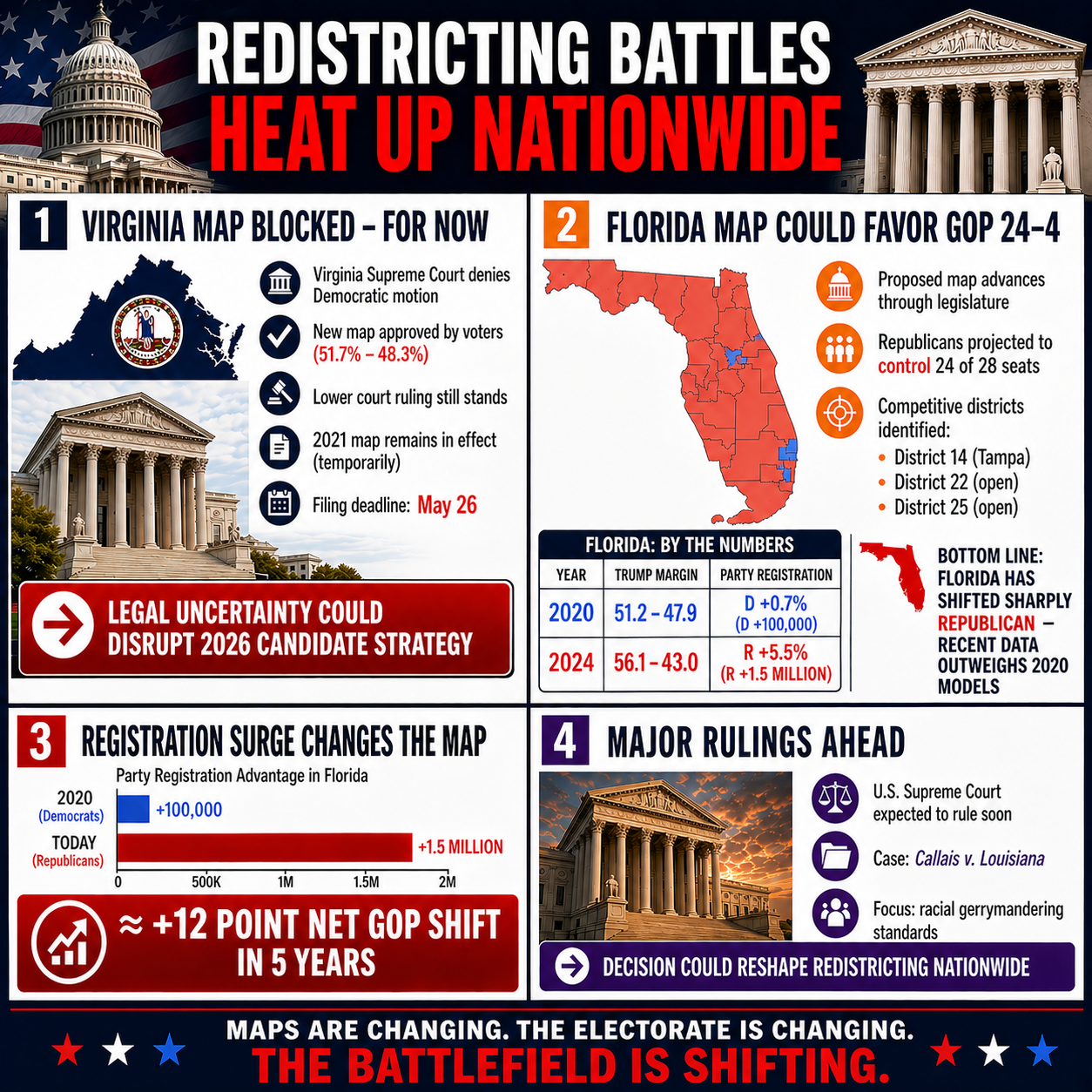
Yesterday, the Virginia Supreme Court heard arguments on the Democratic Party’s motion to lift the lower court’s stay that had invalidated the new map. The original ruling, issued before the statewide referendum election, stemmed from the judge’s finding that the legislature violated its own rules by rushing the measure onto the ballot.
After the circuit judge’s ruling, the Democrats appealed to the state Supreme Court. The justices have not yet heard the appeal but allowed the referendum to proceed. On April 21, voters approved the new congressional map by a narrower than expected 51.7 to 48.3 percent margin. With the candidate‑filing deadline approaching on May 26, the Democratic Party moved to ensure that the 2026 elections can proceed under the newly adopted map.
In a rather surprising ruling, the state Supreme Court yesterday denied the motion. As a result, the 2021 congressional map remains in effect until the justices hear the Democratic Party’s appeal of the lower court ruling and issue a final decision.
More details are emerging about the newly proposed Florida congressional map, which is expected to come before the state House of Representatives this week. If approved, the plan would then advance to the state Senate.
The new plan is being characterized as one that would deliver 24 of Florida’s 28 congressional districts to Republicans.
Researchers at the University of Virginia’s Center for Politics have conducted a preliminary review of the proposed districts and suggest that several of the new seats may be more competitive than Republicans are indicating.
The Center’s report specifically identifies new Districts 14 (Rep. Kathy Castor-D; Tampa), 22 (likely a new open seat), and 25 (also likely an open seat) as competitive contests that could present opportunities for Democratic holds.
While the weakest of these districts is the new 25th, which would have given President Trump a 54-45 percent victory in 2024, the Center compares the totals to the 2020 election when President Trump faced Joe Biden. In that scenario, the Center’s analysis shows new District 14 narrowing to a two‑point Trump advantage, while Biden would have carried District 22 by 2.9 points and District 25 by a wider 5.1‑point margin.
While competitive races in these districts are certainly possible, particularly in the 14th, which features a long‑serving incumbent (Rep. Castor was first elected in 2006), the two presidential elections are not equally comparable in terms of political significance.
Florida has undergone drastic political change since 2020, largely to the benefit of Republicans. In 2020, Democrats held a 36.5 to 35.8 percent advantage in party registration, amounting to just under 100,000 more registered Democrats than Republicans.
Today, Republicans hold a 41.3 to 35.8 percent advantage, giving the party a registration lead of roughly 1.5 million voters. Measured as a percentage shift over the past five years, this represents a net Republican gain of nearly 12 points.
In 2020, President Trump carried Florida with just a 51.2 – 47.9 percent victory margin. In 2024, his margin increased to 56.1 to 43.0 percent. When these statewide shifts are considered alongside the substantial changes in voter registration and the per‑district analysis, the 2024 projections are likely a more accurate reflection of the current electorate than the numbers derived from the 2020 results.
Expect additional redistricting developments soon, particularly the US Supreme Court’s decision in Callais v. Louisiana, which many observers anticipate will be a significant ruling on racial gerrymandering.