Tag Archives: Gov. Ron DeSantis

DeSantis Suspends Campaign; Louisiana Map Passes Legislature, State Changes Primary System;
NY-3 Poll Shows Tightening Race;

By Jim Ellis — Monday, Jan. 22, 2024

President

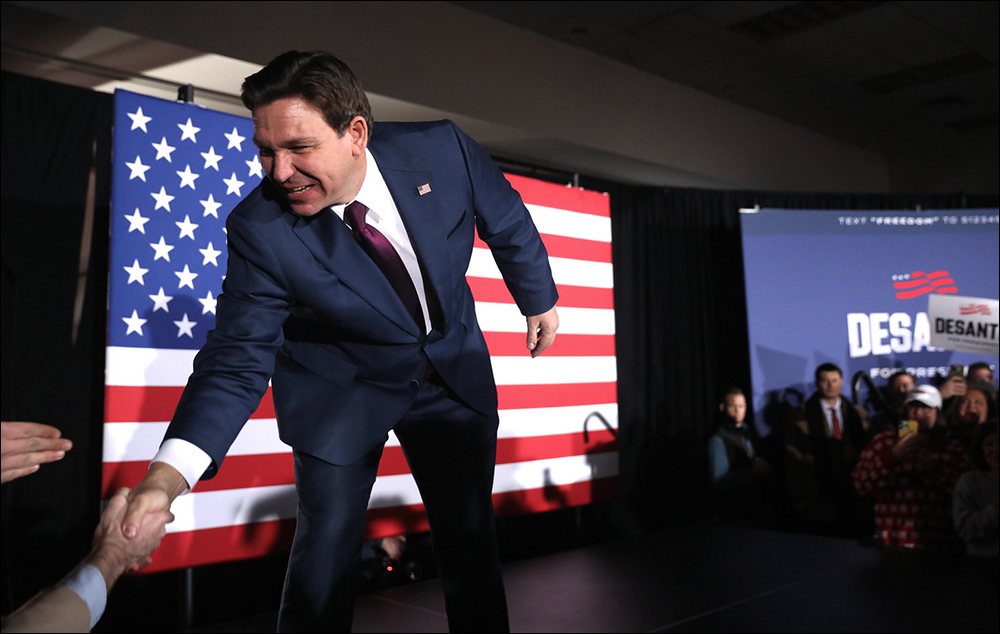
Florida Gov. Ron DeSantis (R) / Photo by Gage Skidmore

Ron DeSantis: Suspends Campaign: Two days before Tuesday’s New Hampshire primary, Florida Gov. Ron DeSantis, once thought to be former President Donald Trump’s principal Republican challenger, announced that he is suspending his national campaign and endorsed the former president.

While DeSantis suspended his campaign, he didn’t soften his attacks on both President Joe Biden and fellow GOP challenger Nikki Haley. “I look forward to working together with him [Trump] to beat Joe Biden, who is the worst and most corrupt president in the history of our country,” DeSantis said.

Referring to Haley, Gov. DeSantis was quoted as saying, “I signed a pledge to support the nominee, and I will honor that pledge. He [Mr. Trump] has my endorsement because we can’t go back to the old Republican guard of yesteryear, a repackaged form of warmed over corporatism that Nikki Haley represents.”

The GOP presidential fight now winnows to two major contenders, former President Trump, and ex-UN Ambassador Haley. Tomorrow’s New Hampshire primary may be close; Trump, however, will easily win in Nevada on Feb. 6, after which the campaign heads to Haley’s home state of South Carolina on Feb. 24 where polling finds Trump holding a 2:1 lead. If such margin holds, the Republican nomination will effectively be clinched before Super Tuesday on March 5.

House

Louisiana: Congressional Map Passes Legislature — The Louisiana state legislature agreed upon legislation to create a new congressional map as part of their special session to satisfy a court order. The bill now goes to Gov. Jeff Landry (R) for his signature. The agreed upon plan creates a new 6th District anchored in Baton Rouge, which then stretches through Speaker Mike Johnson’s (R-Benton), virtually cutting it in half, to reach Shreveport. This satisfies the court order to create a second majority minority seat in the state (54 percent black). According to the Dave’s Redistricting App statisticians, President Biden would have carried the new 6th by a 59-39 percent majority.

The big loser on this map is five-term Rep. Garret Graves (R-Baton Rouge). He is now paired with Rep. Julia Letlow (R-Start) in a new 5th District seat that stretches along the Mississippi border on the south and east and going all the way to the Arkansas border on the north. The new 5th contains at least two-thirds of Rep. Letlow’s current constituency.

The partisan division will now award another seat to the Democrats, making the future Louisiana delegation 5R-2D. Under the plan, Speaker Johnson, Majority Leader Steve Scalise, and Reps. Troy Carter (D-New Orleans), and Clay Higgins (R-Lafayette) all get safe seats from a partisan perspective.

NY-3: New Poll Shows Tight Special Election Race — A newly released Emerson College survey (Jan. 13-15; 975 registered NY-3 voters; 819 likely voters; multiple sampling techniques) sees a close special election race developing between former US Rep. Tom Suozzi (D) and Nassau County Legislator Mazi Melesa Pilip (R). The ballot test shows a 45-43 percent split in favor of Suozzi.

The best news for the former Democratic congressman is that the most likely voters within the sample break for him on a 51-37 percent split. While the majority white vote (58 percent of the district population) favors Pilip 49-40 percent, the largest minority group, Asians (24 percent of the district population), overwhelmingly favor Suozzi (60-25 percent). Hispanics (13 percent of the population) are moving toward Pilip in a 44-33 percent clip.

Possibly the most troubling news for Suozzi are President Biden’s and Gov. Kathy Hochul’s (D) poor job approval ratings. Only one-third of voters, 33 percent, approve of President Biden’s performance in office (59 percent disapprove). Gov. Hochul’s numbers are even worse. Her approval index is 25:66 percent favorable to unfavorable. The special election is scheduled for Feb. 13.

States

Louisiana: Changing to Party Primary System — As part of the special Louisiana state legislative session, the House and Senate are sending a bill to Gov. Jeff Landry (R), one that he initiated, to change Louisiana’s primary voting system from a top-two jungle system to a partisan primary. The changes would take effect for the 2026 election and would institute a modified system where registered members of the political party must vote in their own primary while non-affiliated voters would have their choice of where to cast their ballot.

The change would mean, as in most other states, that only the political party nominees and qualified Independents would advance to the general election. The legislation would affect all federal races along with the state Supreme Court, the state school board, and the Public Service Commission. All other offices would continue with the current system of sending the top two finishers regardless of political party affiliation to the general election.

Surprising New Hampshire Numbers

By Jim Ellis — Thursday, Jan. 18, 2024

President

New Hampshire citizens at a town hall meeting at Hillside Middle School in Manchester. / Photo by Gage Skidmore

New Hampshire Polling Snapshot: Two Candidates Tied — The American Research Group has released companion New Hampshire primary polls the results of which are a bit surprising for both parties.

The ARG survey (Jan. 12-15; 600 likely New Hampshire Republican primary voters; 406 Republican voters; 194 Independent voters; live interview) sees former President Donald Trump and ex-UN Ambassador Nikki Haley now tied as the candidates turn the corner toward the Granite State primary on Jan. 23. Both candidates were drawing 40 percent support. Florida Gov. Ron DeSantis and now-ex presidential contender Vivek Ramaswamy were attracting only four percent apiece.

New Hampshire has been Trump’s weakest polling state among the pre-Super Tuesday primary and caucus entities. In the ARG polling series, Haley’s support has grown from 29 percent in their Dec. 20 survey to 33 percent in the Jan. 3 version, and now 40 percent. Trump, however, has also gained growing support indicated by his polling progression from 33, to 37, to now 40 percent.

ARG is the only pollster to show the race this close. The recent St. Anselm College, Emerson College, CNN/University of New Hampshire, and the Suffolk University/USA Today surveys project Trump with leads of 14, 16, 7, and 20 points, respectively.

The Democrats — The survey research firm also tested the Democratic presidential primary in a series of four polls beginning with their release on Dec. 20. The current study (Jan. 12-15; 600 likely New Hampshire Democratic primary voters; 452 Democratic voters; 148 Independent voters; live interview), finds US Rep. Dean Phillips (D-MN) posting his best standing against President Joe Biden. According to the results, Biden, clearly identified as a write-in candidate on the questionnaire, would lead Rep. Phillips 58-28 percent, with author Marianne Williamson drawing three percent.

Based upon ARG’s four-poll series, Phillips has consistently increased his support from 17 percent on Dec. 20 to 21, 26, and now 28 percent in the Jan. 15 poll. The congressman has been advertising heavily in New Hampshire. In those same polls, President Biden increased his share from 51 to 58 percent, but has remained stagnant in the two most recent surveys.

Other pollsters don’t see Rep. Phillips as strong. In data released Jan. 9 and 11, Suffolk University/USA Today projects the president holding a whopping 64-6 percent lead over Phillips. The CNN/University of New Hampshire ballot test results agree. They record a 69-7 percent Biden advantage. Within this group only the latest Emerson College poll finds Rep. Phillips breaking into double digits. EC calculates a 49-16 percent spread in the president’s favor.

Similar to Haley on the Republican side, Rep. Phillips actually leads Biden among the Independent voters who plan to participate in the Democratic primary according to ARG. The Independent/Democrats break 46-32 percent for Phillips. The registered Democrats support President Biden, 67-22 percent.

With the Jan. 23 New Hampshire primary looming, we shortly will see the impact of Biden choosing to bypass the state because the Granite State did not agree to the proposed Democratic National Committee primary calendar changes. Because of that decision, voters wanting to support the president must now write in his name on the ballot.

The question remains as to whether Haley and Phillips getting close to Trump and Biden in their respective primary races in New Hampshire would have much of an effect upon the national nomination campaign. Could the state be the starting point for new trends, or will more favorable challenger results only prove a blip on the path to convincing national primary victories for both President Biden and former President Trump?

Chances are good that the latter scenario will occur. New Hampshire results don’t tend to be particularly reliable national predictors. For the Republicans since 1976, the non-incumbent winner of the Granite State primary has gone on to win the GOP nomination just four times. For the Democrats, they too see only four of the New Hampshire winners carrying through to become the party’s national standard bearer.

At this point, particularly when looking at other state polls around the country, it appears that the New Hampshire results are more likely an outlier than a new trend setter. Even so, we may be primed to see some interesting results come Tuesday.

GOP Presidential Field Narrows to Three; Second Redistricting Map Released in Louisiana; MD-2 Primary Opponent Challenges Incumbent

Former UN Ambassador Nikki Haley speaks with supporters at a “Countdown to Caucus” campaign rally at the Country Lane Lodge in Adel, Iowa. / Photo by Gage Skidmore

By Jim Ellis — Wednesday, Jan. 17, 2024

President

Candidates: And Then There Were Three — After former President Donald Trump’s victory in the Iowa Caucuses on Monday, two more presidential candidates, businessman Vivek Ramaswamy and former Arkansas Gov. Asa Hutchinson, suspended their campaigns.

Prominent candidates who previously dropped their bids are former Vice President Mike Pence, ex-New Jersey Gov. Chris Christie, Sen. Tim Scott (R-SC), and North Dakota Gov. Doug Burgum. The moves essentially leave the presidential field to Mr. Trump, Florida Gov. Ron DeSantis, and ex-UN Ambassador Nikki Haley. Of the exiting candidates, Ramaswamy and Burgum both have endorsed Trump. No other former candidate to date has issued an endorsement.

New Hampshire: ARG Sees Trump & Haley Tied — A third installment of the American Research Group survey series (Jan. 12-15; 600 likely New Hampshire Republican primary voters; 406 Republican voters; 194 Independent voters; live interview) sees Trump and Haley now tied as the candidates turn the corner toward the New Hampshire primary on Jan. 23. Both candidates were drawing 40 percent support. DeSantis and now-ex presidential candidate Ramaswamy fell well back to four percent apiece. Clearly New Hampshire is the only pre-Super Tuesday state where Trump fails to dominate.

New Hampshire: A Biden Warning Sign — The American Research Group also ran a companion poll for the Democratic presidential primary as it was surveying the Republican side. This study (Jan. 12-15; 600 likely New Hampshire Democratic primary voters; 452 Democratic voters; 148 Independent voters; live interview) finds US Rep. Dean Phillips (D-MN) posting his best standing against President Joe Biden of any poll. According to these results, Biden, clearly identified as a write-in candidate on the questionnaire, would lead Rep. Phillips 58-28 percent, with author Marianne Williamson drawing three percent.

The New Hampshire primary is Jan. 23, but Biden chose to bypass the state because New Hampshire did not agree to the proposed Democratic National Committee primary calendar changes. Therefore, voters wanting to support the current president will have to write in his name.

House

Louisiana: Second Redistricting Map Released — On the first day of the special legislative session for congressional redistricting and other issues, state Rep. Mike Echols (R-Monroe) released a map that was seen as potentially the basis for an eventual final draw. Under the introduced plan, Rep. Garret Graves (R-Baton Rouge) would likely find himself as the odd man out as a new Baton Rouge-anchored 6th District that would be designed to elect an African American representative. The original map was sent back to the legislature for the purpose of increasing minority representation.

The Dave’s Redistricting App statisticians have already released their calculations of all six districts in the proposed plan. Instead of the current 5R-1D plan, we would see a 4R-2D map, with the 6th District going from a partisan lean of 66.0R – 31.9D to one that favors the Democrats to the degree of 56.3D – 41.8R. Rep. Graves would be placed in the 5th District with fellow Republican incumbent Rep. Julia Letlow (R-Start). In this map version, Letlow’s current constituency would comprise two-thirds of the new district, thus giving her a major advantage if the two ultimately face each other.

Now, a second plan has been submitted but two points are clear when comparing the two versions.

First, the legislature is clearly complying with the court order to draw a second majority minority seat within the six-member congressional delegation, and second, the targeted GOP House member likely to lose his seat is to make room for the new district is Rep. Graves. Once completed and passed into law, the new court-ordered map will almost assuredly mean a net gain of one seat for the Democrats in the 2024 election.

MD-2: Primary Opponent Emerges for Rep. Ruppersberger — Two-term state Delegate Harry Bhandari (D-Nottingham) announced that he will challenge 11-term US Rep. Dutch Ruppersberger (D-Cockeysville) for the Democratic nomination in the May 14 Maryland primary election. Bhandari does not have to risk his seat in the legislature because Maryland awards its state Delegates with four-year terms, and he was re-elected in 2022. Rep. Ruppersberger has yet to announce that he will run for re-election. The Maryland candidate filing deadline is Feb. 9.

MD-2 is a safe Democratic seat. The FiveThirtyEight data organization rates the district as D+11. The Daily Kos Elections statisticians rank the seat as the 62nd most vulnerable in the House Democratic Conference.

Iowa Republican Presidential Caucus Winners, Losers & Runners-Up; California Senate Polling Update; NY-26 Special Election Nominee

Gov. Ron DeSantis celebrates with supporters at a caucus night watch party at the Sheraton West Des Moines Hotel in Iowa. / Photo by Gage Skidmore

By Jim Ellis — Tuesday, Jan. 16, 2024

President

Iowa Republican Presidential Caucus: Winners, Losers & Runners-Up — The first votes of the presidential campaign have been cast, and former President Donald Trump met expectations last night in the Iowa Caucuses as he became the first non-incumbent candidate to secure a majority of the vote in the state’s history. The Democrats first voted in Iowa back in 1972, with Republicans following in 1976.

It appears he will place first in 98 of the state’s 99 counties, losing apparently by just one vote in Johnson County, home to the University of Iowa. He also won closely, and below 50 percent in Story County, the home of Iowa State University, and in the state’s most populous county, Polk, the home to the capital city of Des Moines. He recorded plurality victories in eight other counties.

At this writing, and mostly in the rural regions, Trump exceeded 60 percent of the vote in 41 counties, and topped 70 percent in eight. His best showing appears to be in Keokuk County, where he recorded 74 percent. There is likely to be some change in these numbers once all of the votes are counted and canvassed.

The battle for second in Iowa is close, as predicted, though it appears that Florida Gov. Ron DeSantis, and not the candidate the media proclaimed had the most momentum, former UN Ambassador Nikki Haley, finishes second. DeSantis was hovering around the 21 percent mark, some 30 points behind Trump. Haley was further back approaching 19 percent of the caucus votes. Businessman Vivek Ramaswamy, as polling also predicted, was well back with just under eight percent support. After considering his fourth-place finish, Ramaswamy announced that he was dropping out of the presidential race.

“There is no path for me to be the next president, absent things that we don’t want to see happen in this country,” he said at his Iowa watch party at the Surety Hotel in downtown Des Moines.

“I am so proud of every one of you who have lifted us up,” he said to the crowd. He then announced that he would give his “full endorsement” to Trump. Ramaswamy said he had called Trump to tell him that he was suspending his campaign and would endorse the former president.

Senate

California: Schiff and Porter Lead New Poll — The University of California at Berkeley’s Institute for Government Studies, a regular California political pollster, released their latest US Senate survey result. This poll, for the Los Angeles Times (Jan. 4-8; 8,199 registered California voters; 4,470 weighted sub-sample; online), again finds Rep. Adam Schiff (D-Burbank) leading the crowded field, but with a smaller margin than found in other recent polls.

Baseball great Steve Garvey (R), who had placed second in two December polls, is third here, but still gained support when compared to the previous Berkeley IGS survey (10 percent in October poll; 13 percent in current edition). Rep. Katie Porter (D-Irvine), second in their previous polls, is also second now, but remains stagnant at 17 percent support when compared to the two previous Berkeley IGS studies. Rep. Barbara Lee (D-Oakland) remains languishing with single digit support with nine percent preference.

The California jungle primary is scheduled for Super Tuesday, March 5. The top two finishers regardless of percentage attained or political party affiliation will advance into the November general election.

House

NY-26: Democrats Choose Special Election Nominee — The local Erie and Niagara County Democratic Party chairmen announced that they have chosen state Sen. Tim Kennedy (D-Buffalo) as their special election congressional nominee once Rep. Brian Higgins (D-Buffalo) resigns in early February. Once the seat officially becomes vacant, Gov. Kathy Hochul (D) will call a special election to fill the seat for the balance of the current term. The Republican chairmen will announce their pick at a later date.

Under New York election procedure, a district’s county chairmen have the power to nominate a special election candidate in lieu of holding a party primary or special district convention.

Nate McMurray, a former western New York local official who ran two close campaigns in the former 27th District that was collapsed in 2021 reapportionment, declared after the announcement naming Sen. Kennedy as the special election Democratic nominee that he will launch a regular Democratic primary challenge against him for the full term.

Trump Over 50 Percent in Iowa;
Dead Heats in Arizona & Michigan; Casey Expands Lead in Pennsylvania

By Jim Ellis — Monday, Jan. 15, 2024

President

Former President Donald Trump

Iowa Caucus Polls: Trump Over 50 Percent; Haley in Second Place — The first votes of the presidential campaign are to be cast tonight. In frigid temperatures, Iowa Republicans will attend their individual precinct caucus meetings to cast the first votes of the 2024 presidential election beginning at 7 p.m. Central time. Because of a schedule change on the Democratic side, only the Republicans are voting tonight. No non-incumbent has ever topped the 50 percent plateau, but polling shows that Trump may well exceed that number in these caucus votes.

Suffolk University released a new Iowa Caucus survey in preparation for today’s vote. This survey (Jan. 6-10; 500 likely Iowa Republican Caucus attenders), as every other Iowa poll has projected, sees former President Donald Trump attracting majority support (54 percent). Former UN Ambassador Nikki Haley, according to the Suffolk data, has surpassed Florida Gov. Ron DeSantis for second place with 20 percent as compared to DeSantis’ 13 percent.

In terms of interesting side questions, the sampling universe broke virtually evenly regarding the traits of the candidate they want to support. Three responses dominated the answers. The one most often articulated is the respondent’s desire to support a candidate who can defeat President Joe Biden (27.2 percent). Next, is an individual having strong moral character (25.8 percent), and a close third is a person who “has the right experience” (25.0 percent).

Asked of people who said that Donald Trump was neither their first nor second choice, 45 percent said they would support the former president if he became the party nominee, 16.5 percent said they would vote for Independent Robert F. Kennedy Jr., and 15.3 percent said they would support Biden.

No fewer than five polls have been released since Wednesday, including the survey that is typically regarded as the state’s most accurate — the Selzer & Company poll, routinely conducted for the Des Moines Register newspaper.

The Selzer poll, released late on Saturday night (Jan. 7-12; 705 likely Iowa caucus attenders; live interview) and conducted for the Des Moines Register and NBC News, found Trump below 50 percent but holding at 48 percent support, ahead of Haley, in second place again with 20 percent, and DeSantis in third, posting 18 percent preference. Businessman Vivek Ramaswamy trailed in single digits with eight percent. Of the five polls conducted during the final week of campaigning, this is the only one that projects Trump with under 50 percent support.

Senate

Arizona: New Poll Shows Virtual Dead Heat — Public Policy Polling, surveying for the Replace Sinema PAC (Jan. 5-6; 590 registered Arizona voters; multiple sampling techniques) sees a dead heat developing between Rep. Ruben Gallego (D-Phoenix) and former news anchor and 2022 Republican gubernatorial nominee Kari Lake. Incumbent Sen. Kyrsten Sinema, running on an Independent ballot line, significantly trails.

According to the ballot test data, Rep. Gallego would record a 36-35 percent edge over Lake with Sen. Sinema well behind with a 17 percent support figure. Among the key non-affiliated voting sector, Lake takes the largest share with 31 percent. Sen. Sinema posted 27 percent from this category, while Rep. Gallego trailed with 24 percent. If the race were a two-way contest between Gallego and Lake, the Republican would hold a 46-45 percent edge. This poll again shows that the Arizona Senate race continues as a true wild card campaign.

Michigan: Virtual Ties All Around — The Glengariff Group, a Michigan-based pollster who frequently conducts political surveys for media organizations, tested the Wolverine State electorate for the Detroit News and WDIV-TV Channel 4 (Jan. 2-6; 600 likely Michigan voters) though the partisan division within the polling sample looks to have comparable numbers of Democrats and Republicans. Michigan does not register voters by political party, but it is clear through voter history statistics that the state houses at least a slightly higher number of Democrats than Republicans. Therefore, these results, though weighted to decrease a bias factor, are likely skewed somewhat toward Republicans.

The ballot test results find Rep. Elissa Slotkin (D-Lansing) and three potential Republican opponents all locked into virtual ties. Retired Detroit Police Chief James Craig matches up most favorably with Rep. Slotkin, leading her 38-36 percent. Former Rep. Peter Meijer is tied with Slotkin at 36-36 percent, while former US Rep. Mike Rogers trails her by just one percentage point.

It is likely that the Michigan race will become a top-tier general election Senate campaign irrespective of which Republican candidate claims the party nomination in August.

Pennsylvania: Sen. Casey Expands Lead — The new Quinnipiac University Pennsylvania poll (Jan. 4-8; 1,680 self-identified registered Pennsylvania voters; 746 Democrats; 651 Republicans; live interview) finds three-term Sen. Bob Casey Jr. (D) expanding his lead over Republican challenger David McCormick (R) to a full 10-point advantage, 54-43 percent, an improvement of a net four percentage points when compared to the October Q-Poll. Within this survey sample, the split between Democrats and Republicans is almost spot on, with Republicans under-counted by approximately just one percentage point.

The Casey lead is strong in comparison to how President Biden fares. Biden posts a job approval rating of only 40:58 percent as compared to Sen. Casey’s 51:31 percent. The president, however, still leads former President Trump, 49-46 percent in a general election ballot test. The Pennsylvania office holder with the best job approval ratio is Gov. Josh Shapiro (D) who records a 59:23 percent favorability index.

Trouble for Biden in Swing States; Incumbents Reign in 2023 Elections; Former Michigan Rep. Announces for Senate; What the Amo RI-1 Win Means

By Jim Ellis — Thursday, Nov. 9, 2023

President

President Joe Biden is in trouble in swing states. / Photo by Gage Skidmore

Siena College/NYT Poll: Trouble for Biden in Swing States — Siena College and the New York Times teamed up on recent polls in six key swing states all conducted during the Oct. 22 to Nov. 3 period. The six states are: Arizona, Georgia, Michigan, Nevada, Pennsylvania, and Wisconsin. The tested Republicans against President Joe Biden were former President Donald Trump, Florida Gov. Ron DeSantis, and ex-UN Ambassador Nikki Haley. In all instances, with the exception of Trump in Wisconsin, the named Republican would poll ahead of President Biden, thus unseating him if the election were today.

Of the three Republicans, Haley performs the strongest against the Biden. Her best number, +14, comes among Wisconsin likely voters. Trump’s best state is Nevada (+11); DeSantis tops President Biden by five percentage points among Arizona registered voters; Biden’s best showing comes against Trump in Wisconsin (+2).

The Democrats certainly have time to right their political ship, and if Trump is convicted in any of his criminal cases, that might get adjudicated before the election, and the tables could quickly turn. This campaign will prove the most unique of presidential elections.

Election 2023

Déjà Vu: Incumbents Reign — The 2023 odd-numbered year elections are now in the books, and, as we saw on Election Night, the results are very similar to what occurred a year earlier in the 2022 midterm elections.

Most of the political pundits are calling this election year a victory for Democrats despite having an unpopular president in office, while others cite the abortion issue as a continuing turnout driver, which also benefits Democrats. Both statements are true, but perhaps the more definitive underlying pattern is that the incumbents, just as they did in 2022, again reign supreme.

In 2022, 55 of the 56 US senators and governors who ran for re-election won. In the US House elections, 98.1 percent of incumbents who ran for re-election were successful. On Election Night, we saw two more incumbent governors win again.

Governors Andy Beshear (D) and Tate Reeves (R) in Kentucky and Mississippi, respectively, were re-elected with similar five percentage point margins. Polling in the two states suggested a closer result for both incumbents, but each was favored to win.

The Virginia situation is a bit different. Largely due to new court-imposed redistricting maps that radically changed the complexion of most districts, voters elected Democratic majorities in both houses of the legislature. It is inconsistent to rate the Virginia results as incumbent-oriented because we saw roughly one-third of all districts run without incumbents, and most of those office holders who did seek re-election found themselves in new districts vastly different from the one in which they were originally elected.

Democrats will now have at least 21 of 40 seats in the Virginia state Senate and 52 of 100 in the House of Delegates. The party division margin differences yield no change in the Senate, while Democrats converted at least four seats in the House.

While it’s difficult to overlay an incumbent victory matrix across the Old Dominion legislative elections, it is not unusual to see a state that has become reliably Democratic over the past two decades to again vote for that party’s candidates in the 2023 elections. Therefore, the fact that the state’s favored party over the course of time again performed better is consistent with the incumbent voting pattern seen elsewhere.

The abnormal facet of the incumbent-oriented elections we have witnessed in 2022 and now 2023 is that the issue polls consistently show voters certainly believing the country is headed down the wrong track, with similar feelings regarding most states. The state right direction/wrong track questions, however, are not as intensely negative as at the national level.

Yet, despite the recorded discontent, voters return to their respective polling places and almost unanimously re-elect the incumbents. This again suggests that the Republican campaign message machine needs an overhaul. It is clear that their campaign themes and approaches are not driving enough voters to support the GOP candidates in the most hotly contested races.

Once numbers become finalized, we can better understand the results. Because the 2023 vote tabulations verified the pattern set in 2022, it is likely this precursor favors incumbents at large, and more specifically the Democrats, to have another positive election year in 2024 despite what today’s issue polls may currently be projecting.

Senate

Michigan: Ex-Rep. Meijer Announces — Former one-term Congressman Peter Meijer (R), who was defeated for renomination in 2022, announced Monday that he will join the open Michigan US Senate field. The move had been expected for weeks, but is a curious one, nonetheless. It is hard to see a victory path for Rep. Meijer since he couldn’t get enough conservative support to defeat his ’22 GOP challenger, John Gibbs. Gibbs would then go onto lose the general election to now freshman Rep. Hillary Scholten (D-Grand Rapids).

The top Republican contenders for the party’s Senate nomination are former US Rep. Mike Rogers and retired Detroit Police Chief James Craig. It is possible that Meijer’s entry could actually help Rogers, since Craig and Meijer will likely both appeal to the more centrist element of the Republican voter base. If so, this will help Rogers unite the conservatives behind his candidacy and propel him to the nomination. Whoever wins the Republican primary will almost assuredly face Rep. Elissa Slotkin (D-Lansing) in the general election.

The open Michigan race is likely to be close, but Democrats will have at least a slight edge in the general election. Sen. Debbie Stabenow (D) is retiring after serving what will be four full terms once the current congressional session concludes at the beginning of 2025.

House

RI-1: Gabe Amo (D) Wins Special Election — Former Biden and Obama White House aide Gabe Amo virtually assured himself of succeeding resigned Rep. David Cicilline (D-Providence) when he won the Sept. 5 special Democratic primary. Amo easily defeated Republican Gerry Leonard Tuesday in the special general election. Upon winning the seat, Amo now will be sworn in to the House and serve the balance of the current term.

Rhode Island’s 1st Congressional District is solidly Democratic. The FiveThirtyEight data organization rates the seat as D+32. Dave’s Redistricting App calculates the partisan lean at 64.9D – 33.1R. President Biden carried the seat with a 64-35 percent victory margin in 2020. The Daily Kos Elections site ranks the seat as the 99th most vulnerable seat in the Democratic Conference — pretty secure. Therefore, there was little doubt as to which candidate would win the special election.

The Amo victory will bring the Democrats back to their full 213-member compliment in the House. The next special election, in UT-2, will be held on Nov. 21. Republican Celeste Maloy is favored to hold resigned Rep. Chris Stewart’s (R-Farmington) seat. Should she win, the House will be restored to its post-regular election division of 222R-213D.

Trump Well Below 50 Percent in Iowa; Primary Pairing Develops in AL-1; Missouri Candidate Leaves Senate Race to Run for House; West Virginia Governor Candidate Emerges

By Jim Ellis — Wednesday, Nov. 1, 2023

President

Former President Donald Trump speaks in Las Vegas Saturday. / Photo by Gage Skidmore

Iowa: Trump Well Below 50 Percent, Again — According to the new Selzer & Company poll for the Des Moines Register newspaper (Oct. 22-26; 404 likely Iowa Republican Caucus attenders; live interview), former President Donald Trump is still enjoying a healthy lead over the Republican field, but his support level continues to become stagnant. According to this survey, he has 43 percent of the impending Iowa Caucus vote, scheduled for Jan. 15, 2024. This is a one-point increase from Selzer’s August survey. Tied for second place are Florida Gov. Ron DeSantis and ex-UN Ambassador and South Carolina Gov. Nikki Haley. Both record 16 percent support.

The allegiance percentage is an increase of 10 points since the August survey for Haley but a three-point drop for Gov. DeSantis. Sen. Tim Scott (R-SC), who has now moved his whole campaign focus to Iowa, draws a seven percent preference. Former New Jersey Gov. Chris Christie and businessman Vivek Ramaswamy are tied in this poll with four percent apiece.

House

AL-1: GOP Primary Pairing Develops — The recently completed court-driven Alabama congressional map creates a new majority minority district anchored in the capital city of Montgomery, but then stretches southwest to encompass downtown Mobile. Now we see that the draw results in a pairing of two Republican congressmen. Two-term Rep. Barry Moore (R-Enterprise) announced Monday that he will challenge Rep. Jerry Carl (R-Mobile), also serving his second term, in the state’s new 1st District. The seat now spans the entire width of southern Alabama from the Mississippi border all the way to Georgia.

This will be a short-term paired campaign in that the Alabama state primary is held concurrently with the Super Tuesday presidential vote on March 5. Should no one receive majority support, the top two finishers will advance to an April 2 runoff election.

This version of AL-1 favors Rep. Carl in that he already represents 59 percent of the new territory as compared to 41 percent for Rep. Moore. The former also leads in fundraising and cash-on-hand. According to the Sept. 30 Federal Election Commission disclosure filing. Rep. Carl reported raising $1.3 million for the campaign-to-date; $257,000 in the 3rd Quarter just completed and holds $869,000 in his account.

By contrast, Rep. Moore has raised just $309,000 during the cycle-to-date, $109,000 for the Q3 period, and shows $647,000 cash-on-hand. Rep. Moore, a member of the Freedom Caucus, may be viewed as the more conservative of the two, which often proves to be the defining factor in a safe district Republican primary.

MO-1: Democratic Prosecutor Exits Senate Race to Run for House — St. Louis County Prosecuting Attorney Wesley Bell (D) who was challenging for the Democratic US Senate nomination, announced Monday that he is ending his statewide bid and will instead run a primary challenge against Democratic Socialist Congresswoman Cori Bush (D-St. Louis).

Four Democrats opposed Rep. Bush in the 2022 election, two years after she upset veteran Rep. Lacy Clay (D), but she was easily renominated with 69.5 percent of the primary vote.

Bell will be a credible challenger, but Rep. Bush must be viewed as the favorite for renomination and then an easy re-election in a 1st District that the FiveThirtyEight data organization rates as D+52.

Governor

West Virginia: First Credible Dem Candidate Announces — Though Democrats are viewed as a clear underdog to convert the open West Virginia governor’s mansion next year, the party now has a candidate capable of running a credible general election campaign. Huntington Mayor Steve Williams (D) announced his candidacy late last week. He is a former state Delegate and ex-Huntington City Manager.

Republicans are headed for a competitive gubernatorial primary among Attorney General Patrick Morrisey, state Delegate Moore Capito (R-Charleston), Secretary of State Mac Warner, and businessman Chris Miller. Capito is the son of US Sen. Shelley Moore Capito (R-WV), and Mr. Miller is US Rep. Carol Miller’s (R-Huntington) son.

Haley Gaining in Poll Test; McCarthy Out as House Speaker; Ex-North Las Vegas Mayor Announces for House Race; Majewski Returns

By Jim Ellis — Thursday, Oct. 5, 2023

President

Insider Advantage Poll: Haley Gaining — The Insider Advantage polling organization (Sept. 29-30; 850 likely US voters) finds former UN Ambassador and ex-South Carolina Gov. Nikki Haley getting a bounce from the second Republican primary debate. According to the IA ballot test, former President Donald Trump continues to dominate the field with 50 percent support. Florida Gov. Ron DeSantis is second with 15 percent, just ahead of Haley’s 14 percent score.

Haley gained three percentage points since the firm’s late August poll, while Gov. DeSantis’ support fell by the same margin. No other candidate reached double digits. The candidate falling furthest from August, businessman Vivek Ramaswamy, dropped from seven to three percent support.

House

Former Speaker of the House, Kevin McCarthy / Photo by Gage Skidmore

Speaker Vote: Eight Rs Against McCarthy; Three Not Voting — The House Speaker saga continues with Kevin McCarthy (R-CA) being removed from the post on a 216-210 vote. McCarthy likely has at least two more votes from those Republicans not voting yesterday. Texas US Reps. John Carter (R-Round Rock) and Lance Gooden (R-Terrell) were loyal McCarthy supporters in the original 15 votes. The other non-voting Republican was Rep. Anna Paulina Luna (R-FL), who typically votes with the Freedom Caucus.

With the two vacancies – the RI-1 and UT-2 special elections are scheduled for Nov. 7 and Nov. 21, respectively – the House stands at 433 members. Therefore, the winning speaker candidate must obtain 217 votes instead of the typical 218. Assuming at least two more votes from yesterday’s non-voters, McCarthy would need to convince five of the nine Republicans who either voted against him or did not vote (Luna).

The eight Republicans against are: Reps. Eli Crane (R-AZ-2), Andy Biggs (R-AZ-5), Ken Buck (R-CO-4), Matt Gaetz (R-FL-1), Matt Rosendale (R-MT-2), Nancy Mace (R-SC-1), Tim Burchett (R-TN-2), and Bob Good (R-VA-5). Six of these members consistently opposed McCarthy in January. Reps. Buck and Mace are the newcomers to this group.

Reps. Paul Gosar (R-AZ-9), Lauren Boebert (R-CO-3), Dan Bishop (R-NC-8), Byron Donalds (R-FL-19), Victoria Spartz (R-IN-5), Andy Ogles (R-TN-5), and Chip Roy (R-TX-21), who had either opposed McCarthy in January or voted “present,” all supported him in this vote. Filling that now vacant seat is a fluid and ever-evolving situation.

NV-4: Ex-Mayor Announces — John Lee (R), the former North Las Vegas mayor and ex-state legislator, announced that he will enter the competitive 4th District congressional race next year. Assuming Lee wins the Republican primary, he will face four-term US Rep. Steven Horsford (D-Las Vegas). Lee entered the 2022 gubernatorial race but did not fare well in the Republican primary. He placed fourth, only attracting eight percent of the vote.

In the congressional race, with his North Las Vegas base included within this district, he will be a formidable general election candidate in a district that the FiveThirtyEight data organization rates as D+5. The Daily Kos Elections site ranking the district as the 34th most vulnerable seat in the 213-member Democratic Conference.

OH-9: Majewski Returns — J.R. Majewski, the 2022 Republican nominee who lost to veteran Rep. Marcy Kaptur (D-Toledo) on a substantial 57-43 percent vote largely due to his January 6 history, was originally in the 2024 race, then out, and has now injected himself back into the race. Majewski was able to win a contested primary in 2022 with just a base conservative vote of 36 percent, since the remaining votes were split among three others.

His main opponent in the 2024 primary election, former state Rep. Craig Riedel, was one of the multi-candidates in the last GOP nomination contest. It appears Riedel has more unified support this time around and will likely be favored over the returning Majewski.

With the FiveThirtyEight data organization rating OH-9 as R+6, and the Daily Kos Elections site ranking the district as the fifth most vulnerable seat in the Democratic Conference, expect this race to draw a great deal of national political attention from beginning to end.

GOP Presidential Debate Qualifiers; Menendez & Son’s Challenges; Montana Libertarians Change Bylaws

Seven Republican candidates qualified for the second presidential debate. (Fox News graphic)

By Jim Ellis — Wednesday, Sept. 27, 2023

President

Presidential Debate: Seven Qualify — The second Republican presidential debate is scheduled for tonight, and Fox News announced the seven candidates who will participate. With more stringent debate requirements, it was believed that North Dakota Gov. Doug Burgum and ex-Gov. Asa Hutchinson (R-AR), who both appeared in the first debate, would be disqualified leaving six participants. Former President Donald Trump also qualifies but is again declining to appear. A last minute move from Gov. Burgum, however, allowed him to earn a debate podium spot; Hutchinson failed to do so.

The seven who will be present are: Gov. Ron DeSantis (R-FL), Sen. Tim Scott (R-SC), ex-Vice President Mike Pence, former UN Ambassador Nikki Haley, ex-New Jersey Gov. Chris Christie, businessman Vivek Ramaswamy, and Gov. Burgum. Aside from Hutchinson, national commentator Larry Elder and former US Rep. Will Hurd (R-TX) will also not meet the final requirements.

Debate: DeSantis-Newsom Forum Set — Continuing their ongoing public political feud, Florida Gov. DeSantis and California Gov. Gavin Newsom (D) have agreed to a date and state for their mutual debate challenge. The event is scheduled for Nov. 30 at a site to be determined in Georgia. Fox News will air the forum that network headliner Sean Hannity will moderate.

Senate

New Jersey: Sen. Menendez Addresses Media; Rep. Kim to Run: — Sen. Bob Menendez (D-NJ) held an indictment response news conference Monday. His statements left little doubt that he intends to fight the charges levied against him and has no intention of resigning his seat.

Some pre-news conference reports were predicting that the senator would announce his campaign for re-election. He did not specifically address his election status, only to say that he intends to remain New Jersey’s senior senator after he is cleared. He asked the Garden State voters to reserve judgment until “all the facts are known.” But Rep. Andy Kim (D-Moorestown) isn’t waiting. Kim announced that he will file a Democratic primary challenge against Sen. Menendez.

House

NJ-8: Mayor May Challenge Rep. Menendez — While Sen. Bob Menendez (D) is publicly defending himself over a new indictment brought against he, his wife, and three other associates, freshman Rep. Rob Menendez (D-Jersey City), the senator’s son who has defended his father, may be looking at a serious primary challenge.

New Jersey’s 8th Congressional District is solidly Democratic. The FiveThirtyEight data organization rates it as D+47. The Daily Kos Elections site ranks NJ-8 as the 167th safest seat of the 212-member House Democratic Conference. Therefore, Rep. Menendez’s more significant re-election obstacle is renomination.

Hoboken Mayor Ravi Bhalla (D) confirmed that he is considering launching such a primary challenge. Hoboken, with a population just over 53,000 residents, represents about seven percent of the 8th District’s population but is a considerably larger share of a Democratic primary vote.

States

Montana: Libertarians Change Bylaws — The Montana Libertarian Party has made a significant change to their party bylaws. Beginning immediately, the MLP may now officially endorse a member of another party even if a Libertarian is in the same race. This is significant because the single-digit Libertarian vote has been a thorn in the Republicans’ side since their candidates tend to draw from GOP candidates. This causes certain close races, such as in Sen. Jon Tester’s (D) past campaigns, to allow a Democrat to win with a plurality or small majority support.

Should the Montana Libertarian Party decide to endorse the Republican candidate in the upcoming Senate race and not file their own contender, it would be a plus for the eventual GOP nominee.

Five Republicans Lead Biden; Pelosi to Return; Hudson Announces in MI-3; Cox Draws GOP Challenge in Utah

By Jim Ellis — Tuesday, Sept. 12, 2023

President

Republican presidential candidate Nikki Haley / Photo by Gage Skidmore

CNN Poll: Five Republicans Lead Biden — The new CNN national poll (conducted by the SSRS research company, CNN’s regular polling firm; Aug. 25-31; 1,503 US adults; live interview & text) found no fewer than five of the announced Republican presidential candidates holding small leads over President Joe Biden in general election ballot tests.

Former UN Ambassador Nikki Haley fared best, scoring a six-point advantage over the president. Two-point leaders included former Vice President Mike Pence, Sen. Tim Scott (R-SC), and ex-New Jersey Gov. Chris Christie. Former President Donald Trump held a one-point edge, while Florida Gov. Ron DeSantis tied Biden. The only Republican contender to fall behind Biden, and by only one point, is businessman Vivek Ramaswamy.

This poll, consistent with many other findings, again sees the Republicans doing better in a sample comprised of adults as opposed to registered or likely voters. This suggests the GOP is doing better than Democrats with non-voters, meaning the party will have to find a way to identify, register, and turn these habitual non-voters into participants.

House

CA-11: Rep. Pelosi to Return — Though many expected 83-year-old former House Speaker Nancy Pelosi (D-San Francisco) to retire, she instead announced a re-election bid for a 20th term in Congress late last week. In her statement, Rep. Pelosi said, “our country needs America to show the world that our flag is still there, with liberty and justice for ALL. That is why I am running for reelection — and respectfully ask for your vote.” She will easily be renominated and re-elected next year.

MI-3: Ex-Judicial Candidate Announces for Congress — Attorney and Michigan Supreme Court judicial candidate Paul Hudson (R), who finished fourth in a field of five 2022 candidates, announced for Congress at the end of last week. He hopes to oppose freshman Rep. Hillary Scholten (D-Grand Rapids) in a district the FiveThirtyEight data organization rates as D+3.

Last November, Scholten defeated Republican John Gibbs, 55-42 percent, after he upset one-term Rep. Peter Meijer (R) in the GOP primary. The Michigan Independent Citizens Redistricting Commission transformed what was a safe Republican 3rd District that originally elected Meijer to one that favors the Democrats.

Hudson is the third announced Republican candidate but is clearly the most credible. Should he prevail in the Aug. 6, 2024, GOP primary, assessments will be made as to whether he will become a top-tier challenger candidate. MI-3, however, is the type of politically marginal district that the GOP must win in 2024 in order to protect and enhance the party’s slim majority.

Governor

Utah: Gov. Cox Draws GOP Challenge — State Rep. Phil Lyman (R-Blanding), who hails from San Juan County in the far southeastern corner of the Beehive State, which includes the “Four Corners” where Utah, Arizona, Colorado, and New Mexico meet, announced he will challenge Republican Gov. Spencer Cox in next year’s Republican convention and potentially the state primary.

Lyman, a land rights radical, received a pardon from former President Trump after the government arrested him for his protest activities. Gov. Cox may not be particularly popular with the Republican base, so Lyman may have a chance to assemble a significant support coalition at the state convention.