Tag Archives: incumbents

An Anti-Incumbency Fervor

By Jim Ellis — Thursday, August 20, 2026

INCUMBENTS

Florida Rep. Cory Mills (R-New Smyrna Beach), who lost his renomination bid on Tuesday, is only one in a long list of incumbents being voted out of office. / Photo by Gage Skidmore, Flickr

Tuesday’s primary produced another House incumbent defeat and saw a sitting Senator finish behind his leading general election opponent. The question now is whether the unusually high number of incumbent setbacks in both parties foreshadows broader political turbulence in November. A deeper look at the margins suggests the warning signs for incumbents are serious.

With Rep. Cory Mills (R‑FL) losing his renomination bid on Tuesday and Sen. Dan Sullivan (R‑AK) placing well behind former Rep. Mary Peltola in Alaska’s top‑four jungle primary, the tally of incumbents denied renomination now stands at 13, plus Sen. Sullivan’s failure to finish first. Eleven of the defeats have occurred in House races – seven Democrats and four Republicans – while two Senate Republicans have been denied renomination.

The near‑parity between the parties indicates that these results are not driven by overt partisanship. Instead, they reflect a broader anti‑incumbent, and likely anti- establishment, mood. Voters in both parties appear frustrated with the current governing system.

Democrats are nominating avowed socialists in several districts, while Republican base voters, particularly in Senate contests, are signaling dissatisfaction with incumbents they believe are not enacting enough of the Trump agenda.

The most telling statistic is not the number of incumbents defeated, but the margins by which they lost. These figures should concern any incumbent facing voters in November.

Among the 11 House defeats, Democratic incumbents averaged just 40.1 percent of the vote, while their challengers averaged a commanding 56.3 percent. Republican House incumbents fared only slightly better, averaging 41.7 percent to their challengers’ 52.8 percent. These are not narrow repudiations; they are decisive rejections.

The largest losses occurred on the Democratic side. In Texas, Rep. Al Green (D‑Houston) lost a redistricting‑induced incumbent pairing to newly elected Christian Menefee (D‑Houston) by a lopsided 69.3 – 30.7 percent.

While some attribute the margin to redistricting, most of the new 18th District came from Green’s long‑held 9th District, meaning he should have had the advantage. His strong opposition to President Trump was not the issue; rather, his age – approaching 80 – and 22‑year tenure likely weighed heavily against him.

The second‑largest defeat came in New York’s 10th District, where two‑term 50-year-old Rep. Dan Goldman lost 65.8 – 34.0 percent to former New York City Comptroller Brad Lander, who ran as a Democratic Socialist. Here, ideology was the driving factor, despite Goldman himself being a staunch liberal even as an heir to the Levi Strauss fortune.

On Aug. 9, another veteran Democrat, Connecticut Rep. John Larson – first elected in 1998 and nearing 80 – managed only 32.9 percent against former Hartford Mayor Luke Bronin and two other challengers.

Republican Senators also lost in landslide proportion. Louisiana Sen. Bill Cassidy failed even to qualify for the runoff, receiving just 24.8 percent of the vote. In Texas, four‑term Sen. John Cornyn mustered only 36.2 percent in a runoff against scandal-tainted Attorney General Ken Paxton. Turning to Alaska, Sen. Sullivan will likely finish with roughly 43 percent against ex-Rep. Peltola, leaving him a great deal of work to do in a short period to change his trajectory for the general election.

While these primary results suggest an ominous environment for incumbents, they do not necessarily point to a partisan wave. Instead, 2026 is producing unusual and potentially revealing electoral outcomes that underscore voter restlessness across the political spectrum.

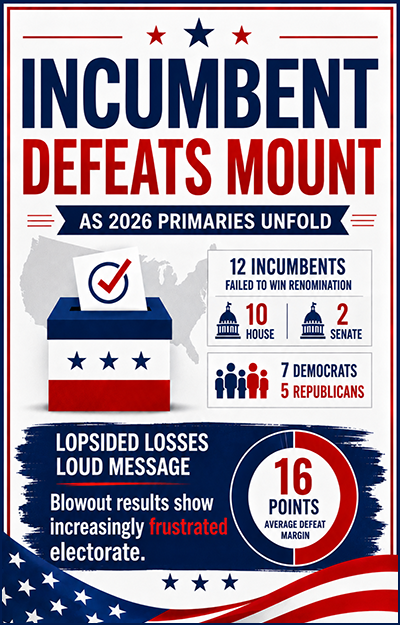
Incumbent Defeats Mount
As 2026 Primaries Unfold

By Jim Ellis — Thursday, August 13, 2026

Primaries

A total of 43 states have now conducted their primary elections, and we have already seen 12 incumbents – 10 in the House and two in the Senate; seven Democrats and five Republicans – fail to win renomination. This is an unusually high number, particularly in the House, but whether it signals a coming major change general election is difficult to determine at this stage. Even so, the pattern offers several notable clues.

One of the most striking findings is the large average defeat margin (16 percentage points) among the 12 incumbents. Such lopsided results suggest an electorate that is, at minimum, frustrated with the current political status quo.

The fact that incumbents in both parties have lost – and that almost all did so by substantial margins – indicates that voters on opposite ideological ends are expressing dissatisfaction, albeit for different reasons. Democratic electorates are clearly gravitating toward more ideologically extreme candidates, while Republican voters appear discontent with what they perceive as slow pace of achievement from the officeholders they have routinely elected.

In the House, seven Democrats and three Republicans have been denied another term. Of the seven Democratic defeats, only Reps. Adriano Espaillat (D‑NY) and Shri Thanedar (D‑MI) lost by margins within four percentage points.

Among the remaining 10 House defeats, the average margin of victory exceeded 17 percentage points. Two races set the high‑water mark: Rep. Al Green (D‑TX) losing to fellow Rep. Christian Menefee (D‑TX) by 38.6 points, and Rep. Dan Goldman (D‑NY) falling to former New York City Comptroller Brad Lander by 31.8 points.

Three defeats occurred within the past two weeks – Reps. Thanedar, Andy Ogles (R‑TN), and John Larson (D‑CT) – demonstrating that the trend is not confined to any single moment in the cycle. Incumbents have now fallen in March, May, June, and August, pointing to a broader and more persistent wave of discontent.

Of the 12 defeats, eight can reasonably be attributed to ideological or partisan motivations. On the Democratic side, incumbents who lost to candidates publicly identifying as Democratic Socialists – Reps. Espaillat, Goldman, and Diana DeGette (D‑CO) – were rejected because they were not far enough to the political left. Though Rep. Thanedar did not lose to a self‑identified Democratic Socialist, state Rep. Donovan McKinney (D‑Detroit) campaigned aggressively on the argument that the incumbent was not sufficiently liberal.

On the Republican side, the dynamic was the reverse: incumbents were deemed as not suitably conservative. This was most evident in Sen. John Cornyn’s (R‑TX) loss to Attorney General Ken Paxton, and retired Navy SEAL Ed Gallrein defeating Rep. Thomas Massie (R‑KY), aided by former President Trump’s very public criticism of Massie’s votes against the MAGA agenda.

Sen. Bill Cassidy (R‑LA) faced similar pressure to that of Rep. Massie, failing even to qualify for the runoff after finishing 20 points behind first‑place finisher Rep. Julia Letlow (R‑Start), who received President Trump’s endorsement. The President became actively involved in the race because he wanted to see Sen. Cassidy, who voted for impeachment in 2021, fail to win renomination.

Though ideology may not have been the principal factor in Rep. Dan Crenshaw’s (R‑TX) 15‑point defeat, challenger Steve Toth (R‑The Woodlands) clearly ran to Crenshaw’s right.

Two incumbents – Reps. Green and Larson – lost primarily due to age‑related concerns, as younger challengers capitalized on generational contrasts. About a dozen elderly Democratic incumbents were challenged by younger opponents who used the generation gap as a principal reason for voters to turn away from the incumbent and a pair of the upstarts were successful.

Two others fell for distinct reasons. Rep. Julie Johnson (D‑TX) lost to former Rep. Colin Allred largely because Allred was better known to Democratic voters and Johnson was forced into unfamiliar territory under the new Texas map. Rep. Ogles lost to former Agriculture Commissioner Charlie Hatcher (R) due to a campaign‑finance scandal and seeing substantially new territory, including the city of Memphis, added to his district under the new Tennessee redistricting map.

While each defeat has its own unique circumstances, the sheer volume and the average double-digit margin across the 12 races are already reverberating through general election campaigns.

It remains to be seen whether any additional incumbents will fall in the remaining seven primaries, and how many more may lose in November. Expect campaigns to begin making strategic adjustments as we move into political prime time after Labor Day.

Trouble for Biden in Swing States; Incumbents Reign in 2023 Elections; Former Michigan Rep. Announces for Senate; What the Amo RI-1 Win Means

By Jim Ellis — Thursday, Nov. 9, 2023

President

President Joe Biden is in trouble in swing states. / Photo by Gage Skidmore

Siena College/NYT Poll: Trouble for Biden in Swing States — Siena College and the New York Times teamed up on recent polls in six key swing states all conducted during the Oct. 22 to Nov. 3 period. The six states are: Arizona, Georgia, Michigan, Nevada, Pennsylvania, and Wisconsin. The tested Republicans against President Joe Biden were former President Donald Trump, Florida Gov. Ron DeSantis, and ex-UN Ambassador Nikki Haley. In all instances, with the exception of Trump in Wisconsin, the named Republican would poll ahead of President Biden, thus unseating him if the election were today.

Of the three Republicans, Haley performs the strongest against the Biden. Her best number, +14, comes among Wisconsin likely voters. Trump’s best state is Nevada (+11); DeSantis tops President Biden by five percentage points among Arizona registered voters; Biden’s best showing comes against Trump in Wisconsin (+2).

The Democrats certainly have time to right their political ship, and if Trump is convicted in any of his criminal cases, that might get adjudicated before the election, and the tables could quickly turn. This campaign will prove the most unique of presidential elections.

Election 2023

Déjà Vu: Incumbents Reign — The 2023 odd-numbered year elections are now in the books, and, as we saw on Election Night, the results are very similar to what occurred a year earlier in the 2022 midterm elections.

Most of the political pundits are calling this election year a victory for Democrats despite having an unpopular president in office, while others cite the abortion issue as a continuing turnout driver, which also benefits Democrats. Both statements are true, but perhaps the more definitive underlying pattern is that the incumbents, just as they did in 2022, again reign supreme.

In 2022, 55 of the 56 US senators and governors who ran for re-election won. In the US House elections, 98.1 percent of incumbents who ran for re-election were successful. On Election Night, we saw two more incumbent governors win again.

Governors Andy Beshear (D) and Tate Reeves (R) in Kentucky and Mississippi, respectively, were re-elected with similar five percentage point margins. Polling in the two states suggested a closer result for both incumbents, but each was favored to win.

The Virginia situation is a bit different. Largely due to new court-imposed redistricting maps that radically changed the complexion of most districts, voters elected Democratic majorities in both houses of the legislature. It is inconsistent to rate the Virginia results as incumbent-oriented because we saw roughly one-third of all districts run without incumbents, and most of those office holders who did seek re-election found themselves in new districts vastly different from the one in which they were originally elected.

Democrats will now have at least 21 of 40 seats in the Virginia state Senate and 52 of 100 in the House of Delegates. The party division margin differences yield no change in the Senate, while Democrats converted at least four seats in the House.

While it’s difficult to overlay an incumbent victory matrix across the Old Dominion legislative elections, it is not unusual to see a state that has become reliably Democratic over the past two decades to again vote for that party’s candidates in the 2023 elections. Therefore, the fact that the state’s favored party over the course of time again performed better is consistent with the incumbent voting pattern seen elsewhere.

The abnormal facet of the incumbent-oriented elections we have witnessed in 2022 and now 2023 is that the issue polls consistently show voters certainly believing the country is headed down the wrong track, with similar feelings regarding most states. The state right direction/wrong track questions, however, are not as intensely negative as at the national level.

Yet, despite the recorded discontent, voters return to their respective polling places and almost unanimously re-elect the incumbents. This again suggests that the Republican campaign message machine needs an overhaul. It is clear that their campaign themes and approaches are not driving enough voters to support the GOP candidates in the most hotly contested races.

Once numbers become finalized, we can better understand the results. Because the 2023 vote tabulations verified the pattern set in 2022, it is likely this precursor favors incumbents at large, and more specifically the Democrats, to have another positive election year in 2024 despite what today’s issue polls may currently be projecting.

Senate

Michigan: Ex-Rep. Meijer Announces — Former one-term Congressman Peter Meijer (R), who was defeated for renomination in 2022, announced Monday that he will join the open Michigan US Senate field. The move had been expected for weeks, but is a curious one, nonetheless. It is hard to see a victory path for Rep. Meijer since he couldn’t get enough conservative support to defeat his ’22 GOP challenger, John Gibbs. Gibbs would then go onto lose the general election to now freshman Rep. Hillary Scholten (D-Grand Rapids).

The top Republican contenders for the party’s Senate nomination are former US Rep. Mike Rogers and retired Detroit Police Chief James Craig. It is possible that Meijer’s entry could actually help Rogers, since Craig and Meijer will likely both appeal to the more centrist element of the Republican voter base. If so, this will help Rogers unite the conservatives behind his candidacy and propel him to the nomination. Whoever wins the Republican primary will almost assuredly face Rep. Elissa Slotkin (D-Lansing) in the general election.

The open Michigan race is likely to be close, but Democrats will have at least a slight edge in the general election. Sen. Debbie Stabenow (D) is retiring after serving what will be four full terms once the current congressional session concludes at the beginning of 2025.

House

RI-1: Gabe Amo (D) Wins Special Election — Former Biden and Obama White House aide Gabe Amo virtually assured himself of succeeding resigned Rep. David Cicilline (D-Providence) when he won the Sept. 5 special Democratic primary. Amo easily defeated Republican Gerry Leonard Tuesday in the special general election. Upon winning the seat, Amo now will be sworn in to the House and serve the balance of the current term.

Rhode Island’s 1st Congressional District is solidly Democratic. The FiveThirtyEight data organization rates the seat as D+32. Dave’s Redistricting App calculates the partisan lean at 64.9D – 33.1R. President Biden carried the seat with a 64-35 percent victory margin in 2020. The Daily Kos Elections site ranks the seat as the 99th most vulnerable seat in the Democratic Conference — pretty secure. Therefore, there was little doubt as to which candidate would win the special election.

The Amo victory will bring the Democrats back to their full 213-member compliment in the House. The next special election, in UT-2, will be held on Nov. 21. Republican Celeste Maloy is favored to hold resigned Rep. Chris Stewart’s (R-Farmington) seat. Should she win, the House will be restored to its post-regular election division of 222R-213D.

Senate Candidate Update

Continuing our periodic reporting about who is currently running for the Senate next year, below is the latest look.

The following 13 senators do not yet have an announced significant opponent:

  1. Jeff Sessions (R-Alabama)
  2. Chris Coons (D-Delaware)
  3. Jim Risch (R-Idaho)
  4. Pat Roberts (R-Kansas)
  5. Susan Collins (R-Maine)
  6. Thad Cochran (R-Mississippi)
  7. Jeff Merkley (D-Oregon)
  8. Jack Reed (D-Rhode Island)
  9. Tim Scott (R-South Carolina – special election)
  10. Lamar Alexander (R-Tennessee)
  11. John Cornyn (R-Texas)
  12. Mark Warner (D-Virginia)
  13. Mike Enzi (R-Wyoming)

And the remaining state match-ups:

Alaska
Incumbent: Sen. Mark Begich (D) – originally elected 2008
Republicans: Lt. Gov. Mead Treadwell
Joe Miller – 2010 nominee who defeated Sen. Lisa Murkowski in the GOP primary
Arkansas
Incumbent: Sen. Mark Pryor (D) – originally elected 2002
Republicans: Lt. Gov. Mark Darr
Rep. Tom Cotton (R-AR-4)
Notes: Rep. Cotton is a possible candidate. Lt. Gov. Darr is highly likely to run for a different office than the one he currently holds. He announced his intention to run for the Senate but there is a good chance, should Mr. Cotton enter the statewide campaign, that he would instead run for the Congressman’s vacated 4th Congressional District.

 Continue reading >

Wrong Track for Incumbents

Incumbents who are accustomed to success at the ballot box are generally nervous and watchful of potential electoral trends by their very nature. They know that this week’s teapot can become next week’s tempest and the spate of recent “change elections” has proven that incumbency is anything but a guarantee of lifetime employment in the U.S. Congress.

While the outcome of individual races can be predicted with a high rate success using modern opinion research tools, it remains a much more daunting task to determine national or even regional trends.

Overall congressional approval ratings and generic ballot test questions become virtually meaningless in the effort to determine trends in congressional races because each race is run locally rather than nationally. The old political saw that says, “The Congress is composed of 434 scoundrels and ‘my guy'” still holds sway more often than not.

However, there is one national indicator to which incumbent politicians should pay close attention, particularly in a presidential election year such as 2012. The well-tested “right track/wrong track indicator” has been a largely reliable indicator of incumbent satisfaction/dissatisfaction and next year is likely to be no exception.

The alarming news for incumbents planning to face the voters again in 2012 is that as of last week, only 16 percent of likely U.S. voters say that the country is heading in the right direction, according to a new Rasmussen Reports national telephone survey taken the week ending Sunday, Oct. 23.

The latest finding is up a point from the previous week, but down a point from a month ago and down a whopping 16 points from this time last year.

Since mid-July, the number of voters who feel the nation is headed in the “right direction” has virtually mirrored the levels measured in the final months of the administration of George W. Bush, with voter confidence bobbing slightly up and down in the narrow range of 14 percent to 19 percent.

Perhaps even more disturbing news for incumbents is the fact that the “wrong track” number in last week’s Rasmussen survey was 77 percent. Since mid-July, the “wrong track” has stayed in the 75- to 80-percent range. When the ratio of likely voters who think that the nation is on the “wrong track” and is not moving in the “right direction” is nearly 5 to 1, that is a reliable sign that voters are planning to make big changes on Election Day.