Tag Archives: President Trump

Rep. Jim Cooper to Retire;
Alabama Map Tossed

By Jim Ellis

Jan. 27, 2022 — The Tennessee state Senate passed the state House version of the new 9-District congressional map on Tuesday, which led to a political move. The redistricting plan now goes to Gov. Bill Lee (R), and he is expected to sign the legislation.

Retiring Tennessee Rep. Jim Cooper (D-Nashville)

Upon passage of the new map that would significantly change the Nashville area, veteran Rep. Jim Cooper (D-Nashville) quickly announced that he will not seek re-election later this year.

The map drawers divided Davidson County, which houses the Democratic city of Nashville, and split it among three districts: Cooper’s 5th, Rep. John Rose’s (R-Cookeville) 6th CD, and Rep. Mark Green’s (R-Clarksville) TN-7.

The effect creates a new 5th District that moves from a victory margin of 60-37 percent for President Biden to a seat that former President Trump would have carried 54-43 percent according to the Daily Kos Elections site statisticians. Both Reps. Rose and Green would continue to have solid Republican seats even with the Davidson County additions to their districts. Under the plan, the Tennessee delegation is expected to move from 7R-2D to 8R-1D.

Cooper is serving his 16th term in the House, winning his first election from the state’s east/southeastern 4th District in 1982, which he represented until he ran unsuccessfully for the US Senate in 1994. He returned to the House from the Nashville district in 2002 when then-Rep. Bob Clement (D-Nashville) left the seat to challenge then-Sen. Fred Thompson (R), the same man who defeated Cooper in his statewide bid.

During his second tour of duty in the House, Rep. Cooper was not seriously challenged for re-election. He is a member of the House Armed Services Committee where he chairs the Strategic Forces Subcommittee. He also is a member of the House Oversight and Reform Committee, and the House Budget panel. It appeared that Cooper was preparing for a Democratic primary challenge this year, but that is moot now that the new 5th District becomes decidedly Republican.

Rep. Cooper is the 29th Democrat not to seek re-election. Counting the Democratic and Republican retirements along with the new and created (through redistricting) open seats, the House will see a minimum of 50 new members coming into office at the beginning of 2023.
Continue reading
The Controversy over Donald Trump’s Endorsement of NC Senate Candidate, Rep. Ted Budd


By Jim Ellis

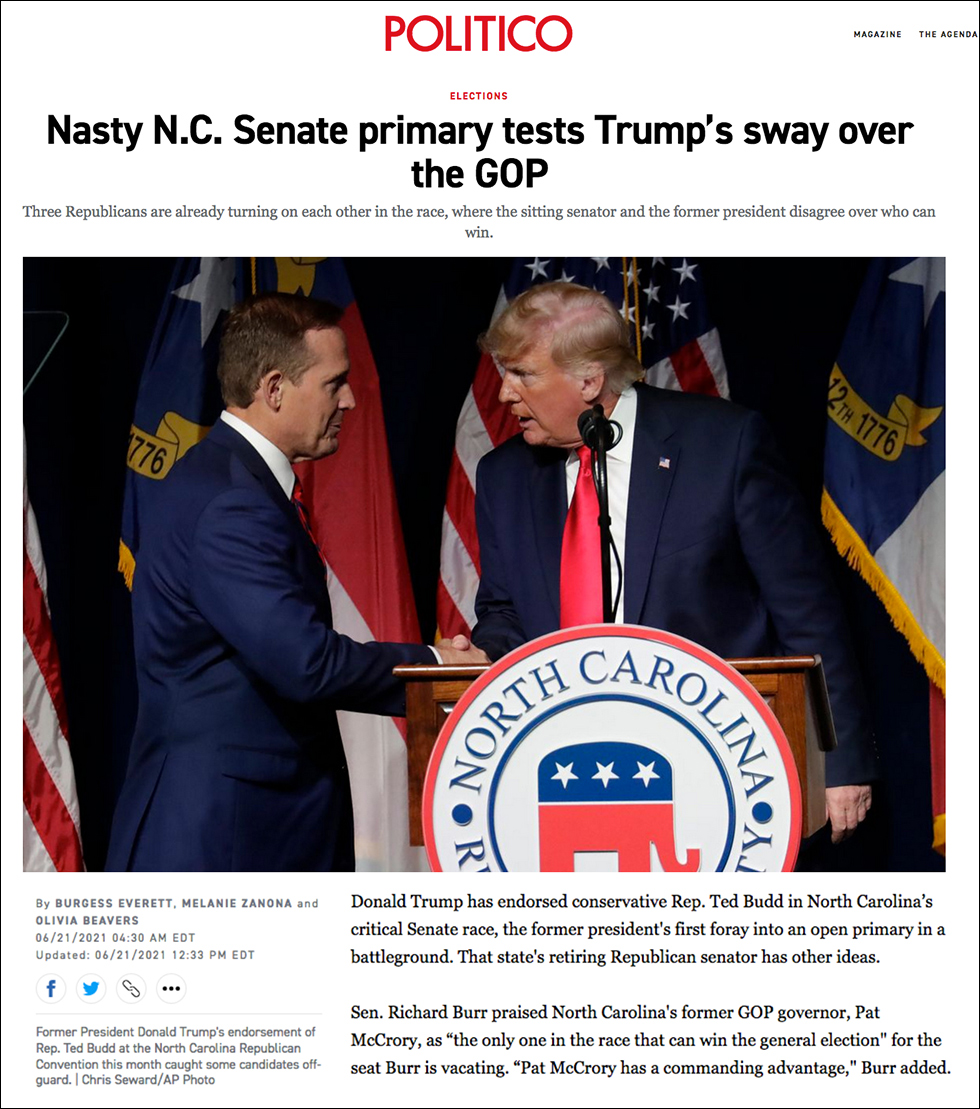
June 23, 2021 — Three Politico publication reporters, Burgess Everett, Melanie Zanona, and Olivia Beavers, combined on an article published yesterday (Nasty N.C. Senate primary tests Trump’s sway over the GOP) that merits refutation.

The piece details former President Trump’s public endorsement of US Senate candidate Ted Budd, the 13th District congressman, at the North Carolina Republican Party convention on June 5, and reactions to the development. Generally, and not surprisingly, it casts the endorsement and Rep. Budd’s statewide chances in a negative light.

Therefore, a number of points require balance.

1. To begin, the story quotes key Republicans, such as retiring North Carolina US Sen. Richard Burr (R) and South Carolina Sen. Lindsey Graham (R), who are downplaying the Trump endorsement’s effectiveness, with Sen. Burr going so far as claiming that ex-governor Pat McCrory is basically the only candidate who could win the upcoming general election. It is important to note here that McCrory failed to win re-election in 2016, the last time he was on a statewide ballot.

2. Secondly, a released Meeting Streets Insight poll conducted for the Budd campaign (June 9-10; 500 likely North Carolina Republican primary voters; live interview) highlights a different perspective.

The MSI survey found McCrory leading the GOP field 45-19-12 percent over Rep. Budd and former US representative, Mark Walker, respectively. When the polling sample is informed of the Trump endorsement – only 20 percent were aware before the pollsters provided the information – the ballot test completely flips to 46-27-8 percent with Rep. Budd leading, followed by ex-governor McCrory and former Rep. Walker. Obviously, this suggests the Trump endorsement still has power within the North Carolina Republican primary voter segment.

Continue reading

It’s Down to a Dozen in SC-7

By Jim Ellis

South Carolina state Rep. William Bailey (R-Myrtle Beach)

June 17, 2021 — South Carolina state Rep. William Bailey (R-Myrtle Beach), who became the first individual to announce a Republican primary challenge to Rep. Tom Rice (R-Myrtle Beach) has become the first candidate to withdraw, with his announcement this past Tuesday. Bailey initially entered the race immediately after the congressman voted to impeach former President Trump in relation to the Jan. 6 assault on the Capitol.

Rep. Bailey indicated that there are ‘enough conservatives in the race to give Mr. Rice a strong challenge,’ and says he is leaving the congressional race to seek re-election to his state House position.

After Bailey’s departure, and including Rep. Rice, there are a dozen announced candidates for the Republican congressional primary in a 7th District that currently occupies South Carolina’s northeastern sector and includes the cities of Myrtle Beach and Conway. In the two Trump presidential elections, the district’s voters strongly supported the former president and with very consistent margins: 58-39 percent in 2016 and 59-40 percent last November.

Normally, a large field of opponents would help an incumbent, but maybe not under the South Carolina election system. The state, like many others in the south, adopts a secondary runoff election process, meaning the winning candidate must secure an absolute majority. If no one can achieve the mark in the primary election, the top two vote-getters advance to a secondary election.

What makes the Palmetto State’s system different is that the runoff cycle lasts only two weeks. Typically, South Carolina holds its primaries in mid-June with the associated runoffs following in the latter part of the month.

Therefore, an incumbent under attack doesn’t have much time to recover before the next election commences. This calendar likely enhances the most common pattern of incumbents generally losing a runoff election if they are forced into a secondary vote.

The large number of contenders notwithstanding, and without Rep. Bailey in the field, the two most prominent challengers appear to be Horry County School Board chairman Ken Richardson and former Myrtle Beach mayor, Mark McBride, though the latter man was defeated in a runoff election for a third term. McBride was also beaten badly in a 2020 special election for the state House of Representatives.

Continue reading

A Special Election Look-In

By Jim Ellis

May 26, 2021 — The Albuquerque, New Mexico vacant US House seat will be filled on June 1, and a new RRH Elections survey finds the Democratic nominee holding a strong advantage. In Texas, There is no mystery as to which party will win the July 27 special runoff election in North Texas to replace the late Rep. Ron Wright (R-Arlington), but which Republican claims the vacant seat is certainly getting more interesting. We take a look at both races.

NM-1

The RRH Elections poll (May 18-21; 555 NM-1 special election voters and those intending to vote, interactive voice response system and online), finds state Rep. Melanie Stansbury (D-Albuquerque) leading state Sen. Mark Moores (R-Albuquerque), 49-33 percent.

The numbers make sense when overlaying the 1st District voting history. Former Rep. Deb Haaland (D-Albuquerque) naturally resigned the seat after being nominated and confirmed as US Interior Secretary in the Biden Administration weeks after winning re-election to a second term. Her victory percentage was 58, after claiming her first term in 2018 with a 59-36 percent margin.

At one time during the century, the 1st was politically competitive – former Rep. Heather Wilson (R-Albuquerque) held the seat for five terms, ending when she ran unsuccessfully for the US Senate in 2008, for example – but a weakened New Mexico Republican Party and a stronger Democratic composition from redistricting has taken the seat off the board.

President Biden carried the district over former President Trump, 60-37 percent, after Hillary Clinton won here in 2016 with a lower but still comparatively strong 52-35 percent spread. Testing President Biden’s current job approval rating, RRH finds him recording a 57:39 percent favorable to unfavorable ratio, which is similar to his 2020 vote performance. This consistency gives the RHH polling data further credibility.

In terms of finances, Stansbury had raised $1.2 million through the May 12 pre-primary reporting period, with $525,000 cash-on-hand as of that date. Sen. Moores, by contrast, had obtained $595,000 with $125,000 in the bank. His receipts total includes a $200,000 personal loan.

Continue reading

Conflicting Electorate Clues

By Jim Ellis

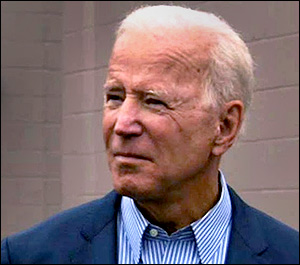
President Joe Biden lingers at the bottom of presidential rankings after his first 100 days.

May 24, 2021 — Data points are routinely being published covering the electorate’s status, leading to various conflicting conclusions. This allows both Democrats and Republicans to promote favorable prediction trends for the 2022 elections.

Presidential job approval is often used as a key prediction benchmark. The Gallup Research organization pioneered presidential job approval tracking, beginning in the 1950s with President Dwight D. Eisenhower, and the tradition continues today.

During that approximate 70-year period, the average performance for a newly elected president in his first 100 days in office is 61 percent favorable. Only those presidents who were elected are included in the Gallup survey. This means that presidents Lyndon B. Johnson, who ascended to the office when John F. Kennedy was assassinated, and Gerald R. Ford, who became president when Richard M. Nixon resigned, are not included.

If you remove, however, the highest rated national leader, President Kennedy (81 percent approval) and the lowest, President Donald J. Trump (41 percent), the adjusted average climbs to 63 percent.

In his first 100 days, Gallup rates President Biden with a 57 percent approval figure, thereby placing him as only the 9th most popular of the 11 newly elected modern era chief executives.

The top three rated presidents in their first 100 days are Kennedy (81 percent), Eisenhower (74 percent), and Ronald Reagan (67 percent). The three lowest are presidents Trump (41 percent), Bill Clinton (55 percent), and Biden (57 percent).

Other surveys rate Biden’s performance somewhat lower, however. In the month of May, eight additional pollsters have tested the president’s job performance and found his favorable score in a tight range, from 51-54 percent with his disapproval percentage spanning from 35 to 48.

The generic polling question is one where a survey respondent is asked whether they would vote for the Republican or Democratic House of Representatives candidate. Right now, we’re seeing the generic numbers span the ideological spectrum, which tells us the great partisan divide is still very much alive. The left-leaning pollsters are seeing big leads for Democrats, while the more conservative-oriented pollsters find the responses very tight.

Continue reading

Disputing the Georgia Poll

By Jim Ellis

Former DeKalb County, Georgia chief executive officer and ex-state representative, Vernon Jones

May 11, 2021 — At the end of last week, the Remington Research Group released a survey of the Georgia 2022 Republican gubernatorial primary for their client, former DeKalb County chief executive officer and ex-state representative Vernon Jones. The results were met with some derision.

The poll (May 1-3; 1,040 likely Republican primary voters, interactive voice response system) finds Gov. Brian Kemp leading Jones only 39-35 percent, and an Atlanta Journal Constitution reporter responded with negative comments about the poll’s credibility and cited unnamed GOP consultants who allegedly agree with this analysis.

Greg Bluestein of the AJC said in response to the poll’s publishing, “suffice it to say we have not found one person with proven knowledge about Georgia politics who believes the poll is credible.” He further stated that, “the last two independent polls I’ve seen show Gov. Kemp leading Jones 74-17 percent and Kemp up 64-14 percent.” There is no evidence that these latter polls have been publicly released, however.

To reject the Remington poll in such a manner should not be considered a legitimate response. The Remington Research Group is a national pollster that specializes in interactive voice response systems and are certainly a well-established survey research firm.

According to the FiveThirtyEight statistical website that ranks polling firms, we find the RRG earning a B grade and placed as the 103rd entity of the 482 polling organizations in the FiveThirtyEight universe. This means the pollster lands in the top 22 percent of all tested survey research firms. Therefore, to reject Remington’s latest Georgia findings as not credible is an analysis and comment trail that should be discounted.

Gov. Kemp’s popularity among Georgia Republicans clearly suffered after the election controversy in his state. At the low point, according to the Morning Consult data intelligence firm, his personal favorability rating stood with a 62:31 percent positive to negative ratio among members of his own party, which is touching the danger zone for any office holder.

Continue reading

The House Opens – Part II

By Jim Ellis

May 10, 2021 — In our second of the two-part series on the House open seats, today we analyze the eight Republican open seats from six states.

Two of the House’s five vacancies are currently Republican held and will be filled in special elections conducted from late June through Nov. 2. The six regular cycle Republican openings result from retirement decisions (2), and members seeking a different office (4).


AL-5 – Rep. Mo Brooks – running for Senate

Rep. Brooks (R-Huntsville), with former President Trump’s endorsement (which has proven extremely strong in other Republican primaries), is running for the Senate. Now that we know Alabama is not losing a seat in reapportionment, the open 5th District will elect a new member, and the 2022 Republican primary becomes the key focus.

Ex-President Trump carried this district in November with a 63-36 percent victory margin. Madison County Commission chairman Dale Strong (R) looks like the strongest candidate making an early announcement. Madison County encompasses half of the 5th District.


GA-10 – Rep. Jody Hice – running for secretary of state

In late March, Rep. Hice (R-Greensboro) announced that he will challenge Secretary of State Brad Raffensperger in the 2022 Republican primary. Raffensperger has come under heavy attack for his handling of the 2020 election, which makes him very vulnerable in a Republican primary.

As with all 14 of Georgia’s congressional districts, the 10th will be re-drawn as part of redistricting, but the GOP is in control of the process so we can count on this seat remaining safely Republican. We can expect a crowded GOP primary followed by a two-person runoff. The eventual Republican nominee then becomes a prohibitive favorite to the hold the seat in the 2022 general election.


NY-1 – Rep. Lee Zeldin – running for governor

With Rep. Zeldin (R-Shirley) in the governor’s race, the open eastern Long Island 1st District will likely host a competitive general election campaign. Already, one of the 2020 Democratic candidates, Suffolk County legislator Bridget Fleming, has announced her candidacy for the open seat. Nancy Goroff, the 2020 Democratic nominee who lost a 56-44 percent race to Rep. Zeldin, confirms that she is considering returning for a second campaign. We can expect NY-1 to be a hotly contested open seat next year and will be at least a moderate Democratic conversion opportunity race.


Continue reading

Julia Letlow Wins LA-5; LA-2 to Runoff

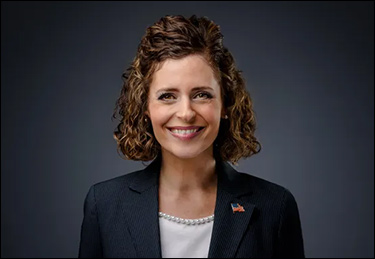
Julia Letlow (R), widow of Rep-Elect Luke Letlow (R) who passed away at the end of last year, easily won Loiusiana’s 5th District special election Saturday.

By Jim Ellis

March 23, 2021 — The two Louisiana special elections turned out as expected on Saturday night but with a slight surprise.

Julia Letlow (R), the widow of Rep-Elect Luke Letlow (R), who passed away at the end of last year, easily won the 5th District special election. Her 65 percent outright win over a field of 11 opponents will allow her to assume the office that her husband won in early December but who died from the effects of COVID and heart disease before the new Congress convened.

In the New Orleans-Baton Rouge 2nd District, vacated when Rep. Cedric Richmond (D-New Orleans) resigned from the House to accept a position in the Biden Administration, two Democrats will advance to an April 24 runoff election. Both outcomes were expected, but the margin for second place in the 2nd District was much closer than anticipated.

Letlow had the support of the entire Republican hierarchy while running in a GOP district, from former President Trump and former Vice President Pence, to Sen. John Kennedy (R-LA), and the Louisiana Republican Party. She also had a huge campaign resource advantage and was expected to exceed the 50 percent mark to win outright. The second-place finisher, Democrat Candy Christophe, fell way back to 27 percent of the vote. No other candidate even exceeded the five percent mark.

Turnout was relatively strong, with 103,609 people voting in the Saturday special election and during early voting. In the pre-election day balloting, Letlow captured 59 percent support, meaning she performed much better in Election Day voting. The total exceeded the Dec. 5 runoff vote that elected Letlow. In that election, 79,306 people voted.

In parish voting, Letlow won 23 of the district’s 24 local parishes, called counties in every other state. The only one she lost, and by just one percentage point, was East Feliciana Parish, but the total vote cast was only from 1,517 individuals. She carried 18 of the 24 parishes with majority support and reached or exceeded the 70 percent threshold in eight localities.

Continue reading

Special Elections Update: LA Votes

https://www.facebook.com/Karen.Carter.Peterson/videos/2521633831472770/Karen Carter Peterson promotional video.


By Jim Ellis

March 22, 2021 — Five special congressional elections are now on the political calendar, and we see current action in all.

Beginning with the two Louisiana seats, voters went to the polls Saturday in the first round of elections in the state’s 2nd and 5th Congressional Districts.

The 2nd, anchored in New Orleans and Baton Rouge, is a Democratic seat left vacant when former Rep. Cedric Richmond (D-New Orleans) was appointed to a White House position in the Biden Administration. The northeastern Louisiana Republican 5th CD became vacant when Rep-Elect Luke Letlow (R), three weeks after winning the seat in a post-general runoff election, passed away from a heart attack and COVID.

The 2nd District sees 15 Democrats, Republicans, minor party, and Independent candidates all on a jungle primary ballot. The political odds favor two Democratic New Orleans state senators, Troy Carter and Karen Carter Peterson, advancing to a general election runoff on April 24. The tone of this week’s candidates’ ads, with Sen. Peterson already being attacked, suggest that the special general between Carter and Peterson is already underway.

Prospects were promising that we would see a winner in Saturday’s 5th District race. Though 12 candidates are on the ballot, just one has strong campaign resources and public backing. Julia Letlow (R), wife of the deceased congressman-elect, looks well positioned to exceed the majority support threshold tomorrow night meaning she would claim the seat outright.

Armed with a 9:1 fundraising lead over her closest competitor at the end of February and holding endorsements from former President Trump, former Vice President Mike Pence, Sen. John Kennedy (R-LA), the Louisiana Republican Party, and the Louisiana Sheriffs of the 5th Congressional District committee, among others, Ms. Letlow appears poised to score a convincing win over a crowded field.

The first poll for the Texas special election was just released. In this 6th District race, vacated because of Rep. Ron Wright’s (R-Arlington) death from cancer and COVID, a whopping 23 candidates are vying to replace the late incumbent. The first election is May 1. If no one receives majority support, which is likely, a runoff will be scheduled after the primary voters officially determine the final results.

Continue reading

Georgia: New Poll, Same Story

By Jim Ellis

Sen. Raphael Warnock will face an interesting challenge depending upon who emerges from the Republican primary.

March 18, 2021 — The Trafalgar Group and the Insider Advantage entity, both Atlanta-based firms, partnered to test the politically beleaguered Georgia electorate about freshman Sen. Raphael Warnock’s (D) standing as he looks to run for a full six-year term in 2022.

Being one of the top battleground states in the 2020 presidential contest and hosting two US Senate campaigns last year, 56 public polls were conducted of this electorate from July of last year through the Jan. 5 runoff election. Almost all of them repeatedly showed results within the margin of error on the presidential and both US Senate races; and, with the final total showing President Biden and former President Trump separated by just 11,779 votes while the Senate races came down to one and two-point finishes, the polling proved correct.

Now we see Trafalgar and IA beginning the 2022 Georgia election cycle polling. The new survey (March 7-9; 1,093 likely Georgia voters, interactive response system and online) again finds very tight hypothetical Senate race results. Because Sen. Warnock won the special election in January, he must stand for election to a full six-year term in 2022.

Trafalgar and IA tested three Republicans against Sen. Warnock: former Sen. Kelly Loeffler, ex-US Rep. Doug Collins, and the past University of Georgia and NFL football star Herschel Walker. None of the three have announced their candidacies but all confirm they are considering the race.

According to the results, Sen. Warnock fares best against the woman he defeated in January, ex-Sen. Loeffler. In this ballot test, he leads 46-41 percent. Both Collins and Walker perform better, especially the latter. The Warnock edge narrows to one point against Collins, 46-45 percent, and the new incumbent actually drops behind Walker, 46-48 percent. Notice that Sen. Warnock records 46 percent against all three potential opponents suggesting that he is vulnerable heading into what promises to be another hard-fought Peach State US Senate battle.

While the pollsters tested the job approval ratings for both President Biden and Gov. Brian Kemp (R), they surprisingly did not include such a question regarding Sen. Warnock.

The approval ratios were poor for both the president and governor. Biden scored a 41:55 percent favorable to unfavorable job approval rating, with 32 percent strongly approving and a large 46 percent strongly disapproving.

Gov. Kemp continues to show weakness as he heads into what will be a difficult run against his former opponent, ex-state House Democratic Leader Stacey Abrams. The governor is again in upside-down territory, recording a 33:53 percent negative approval rating. Only nine percent responded that they strongly approve of the governor’s performance while 26 percent strongly disapproved.

At this point, the pollsters asked Republican primary questions to those most likely to vote in the 2022 GOP nomination election.

If Loeffler, Collins and Walker were all to oppose each other in the Senate primary, we see the latter two men virtually tied at 32 percent apiece. Loeffler trails with 24 percent support.

A Collins-Loeffler match would favor the former, as the ex-north Georgia congressman would record a strong 52-32 percent lead. Walker would lead Collins 50-36 percent in a one-on-one match-up, and the former football player would hold a commanding 62-26 percent advantage over Loeffler.

The Georgia Republican respondent cell is strongly pro-Donald Trump with 70 percent saying they would “absolutely” vote for the former president if he were to run again. Only 14 percent of this sample cell said they would vote for anyone other than Trump. Another eight percent said they would consider voting for the ex-president.

We can expect another very active Georgia election cycle, with the Senate and governor’s race assuredly being covered as if they are national campaigns.