Tag Archives: Oklahoma

Within a Week . . .

By Jim Ellis

Feb. 27, 2020 — Now, just two days away from the South Carolina primary and a mere five from Super Tuesday, it’s time to again determine candidate progress for what is arguably the most important primary election day of this presidential nomination cycle.


Currently, now that the Nevada Democratic Party has ostensibly tabulated the remaining caucus preference sheets from last Saturday’s Nevada vote, the aggregate bound delegate count gives Sen. Bernie Sanders (I-VT) the lead with 45, former South Bend mayor Pete Buttigieg is second at 26, former vice president Joe Biden posts 15, Sen. Elizabeth Warren (D-MA) eight, and Minnesota Sen. Amy Klobuchar holds seven. These numbers will change significantly by this time next week. A total of 1,398 delegate votes will be bound on Super Tuesday evening and 18 states and one territory will have completed their voting process.

We’ve had some polling movement in several of the Super Tuesday states that make a tight race even closer. North Carolina, with 110 first ballot delegates, at least according to one polling firm has lapsed into a three-way tie. Spry Strategies (Feb. 21-23; 561 likely North Carolina Democratic primary voters) finds former VP Biden, ex-New York City mayor Michael Bloomberg, and Sen. Sanders locked into a three-way tie, each with 20 percent support. None of the other candidates appear close to the 15 percent delegate allocation threshold in the Tar Heel State.

The new Public Policy Polling North Carolina survey turns in similar numbers (Feb. 23-24; 852 likely North Carolina Democratic primary voters) with Biden leading Sanders and Bloomberg, 23-20-17 percent, respectively. PPP agrees with Spry in projecting that only these three men will qualify for delegates. Such a split, assuming the congressional delegation allocation yields the same ratio, would find each of the three candidates receiving approximately 35-37 first-ballot votes.

The latest YouGov poll (Feb. 6-18; 1,352 likely Texas Democratic primary voters; online) also finds a tie, but this time in the Lone Star State with again three candidates winning bound delegates. The data finds Biden and Sanders tied with 20 percent, and Sen. Warren getting into delegate contention with 17 percent. If the actual Texas votes break similarly to this ratio, it would mean Bloomberg would fail to qualify for at-large delegates, leading to a fight for delegate allocation within each of the 31 state Senate districts. While other states divide by congressional districts, Texas uses state Senate seats.

Continue reading

The Open Primary Effect

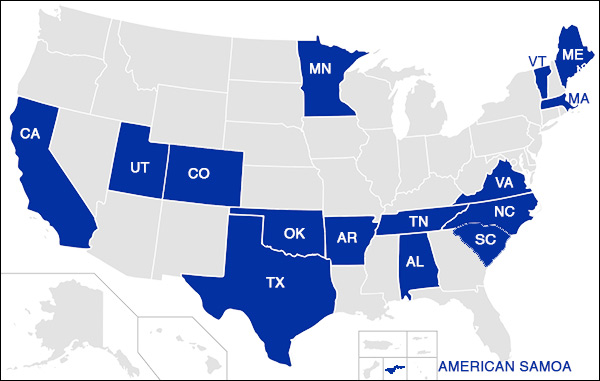
Super Tuesday 2020 States and Territories


By Jim Ellis

Feb. 26, 2020 — One factor for the coming March 3 Super Tuesday primary elections that hasn’t received any discussion is whether or not the open voting system will have a major effect upon the final results. Though only 24 states around the country feature open, or semi-open, primaries, all but two of the 15 Super Tuesday states lie in this category.

For purposes of this column, South Carolina, scheduled for this Saturday and the prelude to the mega-state vote, is added to the Super Tuesday roster because of its close proximity. America Samoa, which also holds its nomination election on March 3, is a caucus.

An open primary is one where any voter may choose to participate in the nomination election of his or her choice. In these states, voters typically are not registered by political party and can select either a Democratic or Republican ballot. A semi-closed primary is one where registered party members must stay in their respective party primary, but the unaffiliated, or Independent, voter may choose the primary in which to participate. A closed primary allows only individuals who are registered in a particular political party to vote in their respective nomination election.

Pertaining to Super Tuesday, Alabama, Arkansas, Colorado, Minnesota, South Carolina, Tennessee, Texas, Vermont, and Virginia are the open primary states. The semi-opens are Massachusetts, North Carolina, Oklahoma, and Utah.

The two closed presidential primaries for the big day are California and Maine. Despite California featuring the ultimate open primary system in their regular elections, where everyone receives the same ballot and the top two finishers advance to the general election regardless of political party affiliation and percentage attained, only registered party members may vote in their respective presidential primary. Therefore, in the national nomination contest, where the top-two system is not recognized for delegate allocation, the Golden State reverts to the closed procedure.

Continue reading

Mid-Year Senate Primaries

By Jim Ellis

Jan. 24, 2020 — The second in our three-part series about the in-cycle Senate races covers the 13 contests with June and early August primary dates:

JUNE 2

Iowa: Sen. Joni Ernst (R) stands for a second term and will likely face Des Moines real estate executive Theresa Greenfield (D) in the general election. Greenfield, who aborted a congressional run in 2018 when her campaign effort didn’t collect the requisite number of legal petition signatures, enjoys at least unofficial backing from the Democratic establishment and party leadership. The leaders’ first choice to run, freshman Rep. Cindy Axne (D-Des Moines), decided to seek her first re-election instead of jumping into a statewide battle.
Sen. Ernst is favored for re-election but some of her approval ratings have been low. Much will depend upon the national political trend, particularly at the presidential level. Iowa is typically a swing state that has been moving right in most recent elections, though the Democrats did gain two congressional seats in the last election.

Montana: Sen. Steve Daines (R) stands for a second term, and with the Democrats unable to convince outgoing governor and former presidential candidate Steve Bullock to run for the Senate, most of the political attention has shifted to the open governor’s race and at-large US House contest. With Rep. Greg Gianforte (R-Bozeman) again running for governor, both the governor’s office and the state’s lone House seat are open for the coming election.
In fact, when looking at the entire statewide ticket, mostly due to term limits and statewide officials running for other offices, five of the seven statewide races are open contests in 2020. Therefore, the lack of attention and concentration on the Senate race certainly helps Sen. Daines. At this point, with the March 9 candidate filing deadline less than a month away, the type of candidate who could give the senator a serious run has not yet emerged.

New Jersey: Sen. Cory Booker (D) backed away from the presidential contest in order to concentrate on his re-election campaign. While state law was changed to allow candidates to run for offices simultaneously, Sen. Booker decided the time to exit the presidential race was upon him before embarrassing losses in Democratic primary states encouraged stronger primary competition for his re-election back home. Now concentrating on New Jersey full-time, Sen. Booker looks safe for re-election.

Continue reading

Biden Showing Up Strong in North Carolina – But Is It Enough?

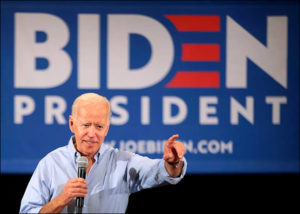
Former vice president and 2020 Democratic presidential candidate, Joe Biden

By Jim Ellis

Oct. 11, 2019 — Raleigh-based Public Policy Polling just released their latest North Carolina survey (Oct. 4-6; 963 likely North Carolina voters, 410 likely North Carolina Democratic primary voters) Wednesday, which projects a two-person race developing in the Tar Heel State as former Vice President Joe Biden leads Sen. Elizabeth Warren (D-MA), 39-22 percent. South Bend Mayor Pete Buttigieg receives nine percent support, while Sen. Bernie Sanders (I-VT) earns only a disappointing six percent. All other candidates fail to break the three percent level.

North Carolina is one of the Super Tuesday states, a state whose electorates will cast ballots on March 3, the largest voting day of the nominating season. On March 3, a total of 14 states and one territory will host primaries or caucuses, seven of which come from the south. It is here where former Biden would have to make his stand, since his southern numbers are the best of any candidate by a wide margin.

The question being posed is whether a sluggish Biden start in the first three voting states, Iowa, New Hampshire, and Nevada, where he could conceivably fail to place first in any, would derail his momentum to the point of lessening his southern advantage.

Making rudimentary delegate calculations from the 19 entities that would vote on or before Super Tuesday, we find that current polling would place the former vice president in the lead on the evening of March 3, but that his delegate edge would certainly not be dominating.

To re-cap, based upon the latest polling from Iowa, New Hampshire, and Nevada, the delegate estimate prior to South Carolina would find the former VP and Sen. Warren tied with 37 delegates apiece, while Sen. Sanders would have 27, meaning a virtual three-way tie despite Biden not winning any of the states outright. If he can stay in the hunt — with neither of his key opponents establishing themselves as a clear leader — the tide turns Biden’s way.

Continue reading

The Early Targets

By Jim Ellis

April 3, 2019 — Continuing our early outlook of the 2020 House situation, we can begin by narrowing the field to those districts where Republicans will be concentrating at least their initial efforts in order to reclaim the majority they lost in November.

After the 2016 election, there were 12 districts that supported President Trump but elected a Democrat to the House. After the 2018 midterm, that number rose to 31. For the Republicans to regain the majority, they will need to convert a net 18 seats back to their column, or 19 if the Democrats score a victory in the NC-9 special election to be held later this year in the Charlotte-Fayetteville metro areas in southern North Carolina.

The other two House special elections, PA-12 (May 21) and NC-3 (Sept. 10), unless huge upsets occur, look to remain within the Republican stable of districts.

Of the 31 Trump/House Democrat seats, 16 of them also voted for Mitt Romney over President Obama in 2012. Furthermore, a dozen within this group elected a Republican Representative until the 2018 election. They are:

  • GA-6 – Rep. Lucy McBath (D) – Defeated Karen Handel (R)
  • IL-14 – Rep. Lauren Underwood (D) – Defeated Randy Hultgren (R)
  • MI-8 – Rep. Elissa Slotkin (D) – Defeated Mike Bishop (R)
  • MI-11 – Rep. Haley Stevens (D) – Replaced David Trott (R)
  • NJ-11 – Rep. Mikie Sherrill (D) – Replaced Rodney Frelinghuysen
  • NM-2 – Rep. Xochitl Torres Small (D) – Replaced Steve Pearce (R)
  • NY-22 – Rep. Anthony Brindisi (D) – Defeated Claudia Tenney (R)
  • OK-5 – Rep. Kendra Horn (D) – Defeated Steve Russell (R)
  • SC-1 – Rep. Joe Cunningham (D) – Replaced Mark Sanford (R)
  • UT-4 – Rep. Ben McAdams (D) – Defeated Mia Love (R)
  • VA-2 – Rep. Elaine Luria (D) – Defeated Scott Taylor (R)
  • VA-7 – Rep. Abigail Spanberger (D) – Defeated Dave Brat (R)

Continue reading

2020 Senate Review – Part III

By Jim Ellis

March 27, 2019
— The third and final segment of our three-part Senate review covers the races alphabetically from North Carolina through Wyoming, with a re-visit to the new open seat in New Mexico:
  • New Mexico – Sen. Tom Udall (D)Open Seat – Since our Senate review began, Sen. Udall, who looked to be a lock for election to a third term, announced he will not run in 2020. Democrats will be favored to hold the seat, but Republicans have won statewide races here as late as 2014, so the potential for a competitive 2020 campaign exists.
    So far, Attorney General Hector Balderas (D) and US Rep. Ben Ray Lujan (D-Nambe/Santa Fe) both confirm they are considering running, as is 2018 Republican nominee Mick Rich. Two individuals have already said they will not enter the Senate race: Gov. Michelle Lujan Grisham (D) and Santa Fe Mayor Alan Webber (D). Many more potential candidacies from both parties are being discussed. Currently, this open seat earns at the very least a Lean Democrat rating but is realistically Likely Democratic.

  • North Carolina – Sen. Thom Tillis (R) – This will be a top-tier race, as are almost all North Carolina Senate races. Sen. Tillis ousted then-Sen. Kay Hagan (D) in 2014 in a state that has re-elected only one senator since the days of Sam Ervin (D) and Jesse Helms (R).
    The Democrats failed to recruit their top target in Attorney General Josh Stein (D), and so far, their field is second tier. Only Mecklenburg County commissioner-at-large Trevor Fuller (D) and state Sen. Erica Smith (D-Gaston) have declared their candidacy.
    Sen. Tillis received pushback for originally opposing President Trump’s emergency border declaration, which has fueled rumors of a potential primary challenge. Therefore, the North Carolina campaign is in a state of flux. Much will change here in the coming year to affect the outcome. Currently, rate this seat as Lean Republican.

  • Oklahoma – Sen. Jim Inhofe (R) – The major discussion surrounds whether 84-year-old veteran Sen. Inhofe will retire. If he runs, the election campaign may be slightly more competitive based upon the 2018 Oklahoma results, in which the Democrats made some significant gains. Even if they continue to build momentum, their chances of winning a statewide election in the Sooner State still remain slim. Likely Republican until it becomes clear whether or not Sen. Inhofe will seek re-election.

  • Continue reading

Kentucky Gubernatorial Race
Challengers Emerging

By Jim Ellis

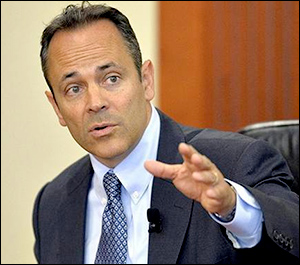
Unpopular Kentucky Gov. Matt Bevin (R)

Jan. 9, 2019 — Blue Grass State politics are beginning to boil, all centered around the 2019 governor’s race. With the candidate filing deadline fast approaching on Jan. 29 for the May 21 statewide primary, several individuals are announcing that they will challenge unpopular Gov. Matt Bevin (R), including a Republican state legislator who is expected to make his formal declaration today.

Though the governor has said he intends to seek a second term, and did so again a week before Christmas, the fact that he has yet to file a 2019 campaign committee has fueled speculation that he may decide to retire. Bevin was elected in 2015 with a relatively substantial 52.5 – 43.8 percent victory over then-Attorney General Jack Conway (D) after upsetting then-agriculture commissioner and now US congressman, James Comer (R-Tompkinsville), by just 83 votes in a May Republican primary that drew almost 215,000 voters.

Bevin’s popularity ratings, however, have largely been upside-down throughout his tenure in office. According to the Morning Consult quarterly national gubernatorial approval rankings that were released just before the November elections in mid-October, Gov. Bevin ranked 46th on the nationwide list, with a 30:55 percent positive to negative ratio.

None of those finishing below the Kentucky governor on that particular scale in October remains in office. The least popular, according to the survey, Oklahoma Gov. Mary Fallin (R), was ineligible to seek a third term last November. Republican Kevin Stitt replaced her. Connecticut Gov. Dan Malloy (D) did not seek a third term and Democrat Ned Lamont held the office. Illinois Gov. Bruce Rauner (R) was defeated for re-election, and Alaska Independent Gov. Bill Walker withdrew before the election because his political situation was hopeless.

Continue reading

National Early Voting Report

By Jim Ellis

i-vote-i-countOct. 31, 2018 — Now more than halfway through the early voting period in the 37 states that offer early voting options for the populace, some places are turning in record participation rates. Each state has various nuances in their early voting procedures, so comparing the early reports to each other is of little value. Going back to contrast the current 2018 reported numbers with how that particular state voted in the last midterm election (2014) does have significance, however.

Already, in the latest available reports according to the United States Election Project administered by the personnel at the University of Florida, seven states are reporting more received early voting ballots than were recorded for the entire 2014 pre-election period. They are:

• Tennessee – 162.3% more ballots (1,029,846 versus 634,364 recorded in 2014)
• Texas – 144.3% increase (2,980,915 versus 2,066,368 recorded in 2014)
• Indiana – 127.9% increase (292,726 versus 228,932 recorded in 2014)
• Nevada – 122.5% increase (372,455 versus 304,005 recorded in 2014)
• Georgia – 111.1% increase (1,188,636 versus 1,069,912 recorded in 2014)
• Minnesota – 106.0% increase (249,909 versus 235,808 recorded in 2014)
• Delaware – 103.2% more ballots (8,550 versus 8,288 recorded in 2014)


An additional seven states have so far recorded better than 85 percent of their early voting total in comparison to their entire 2014 pre-election voting universe:

• North Carolina – 97.1% of previous (1,140,657 versus 1,174,188 recorded in 2014)
• Virginia – 94.2% of previous total (191,755 versus 203,556 recorded in 2014)
Continue reading

The Governors’ Races & Veto Power

By Jim Ellis

2018-elections-open-seats-185Oct. 29, 2018 — The 2018 election cycle features 36 gubernatorial campaigns, 26 of which have federal redistricting ramifications. The ones that don’t are at-large congressional district states (Alaska, South Dakota, Vermont, Wyoming) or will be after the next reapportionment (Rhode Island), those that employ redistricting commissions (Arizona, California, Hawaii, Idaho), or the multi-district state where the governor is only awarded a two-year term (New Hampshire).

Here is a breakdown of where things stand in the upcoming election in the 26 states where the governor will have redistricting veto power:


PURE TOSS UPS

FLORIDA: Mayor Andrew Gillum (D) vs. Ex-US Rep. Ron DeSantis (R)
• Most Recent Polls: Gravis Marketing (Oct. 22-23): Gillum 51 percent, DeSantis 46 percent
   Gray/Strategic Research (Oct. 16-23): DeSantis 48 percent; Gillum 45 percent

GEORGIA: Sec/State Brian Kemp (R) vs. Ex-state Rep. Stacey Abrams (D)
• Most Recent Poll: NBC News/Marist (Oct. 14-18): Kemp 49 percent; Abrams 47 percent

IOWA: Gov. Kim Reynolds (R) vs. Businessman Fred Hubbell (D)
• Most Recent Poll: Selzer & Co (Sept. 17-20): Hubbell 43 percent; Reynolds 41 percent

KANSAS: Sec of State Kris Kobach (R) vs. State Rep. Laura Kelly (D) & Greg Orman (I)
• Recent Poll: Public Policy Polling (Oct. 19-20): Kobach 41 percent; Kelly 41 percent; Orman 10 percent

NEVADA: Attorney Gen Adam Laxalt (R) vs. Commissioner Steve Sisolak (D)
• Most Recent Poll: Emerson College (Oct. 10-12): Laxalt 46 percent; Sisolak 41 percent

Continue reading

The House Results

By Jim Ellis

Aug. 31, 2018 — While we covered the statewide results for the Aug. 28 nomination elections in Arizona, Florida, and Oklahoma earlier in the week, now is a good time to review the many US House campaigns that were decided last Tuesday, and which will become competitive in November.


the-primariesARIZONA

• AZ-1: Freshman Rep. Tom O’Halleran (D-Sedona) stands for his first re-election in an expansive district that encompasses most of eastern Arizona. The Republican winner is retired Air Force officer Wendy Rogers, who has run for several offices in the state but has never been successful. It’s likely that the same pattern will again emerge in November. Rogers defeated state Sen. Steve Smith in the GOP primary, and he was viewed as the party’s strongest general election candidate. Therefore, we can now rate this race as Likely Democratic.

• AZ-2: The pre-race favorites for this Tucson-anchored open seat, vacated because Rep. Martha McSally is running for the Senate, were former US Rep. Ann Kirkpatrick (D) and Tucson Hispanic Chamber of Commerce president Lea Marquez-Peterson (R). While both won their respective nominations, each of their win percentages (41.4 percent and 33.6 percent, respectively) were less that predicted. With neither candidate close to majority support in her own party, the general election will prove interesting. Most believe that Kirkpatrick is the favorite here, but it doesn’t appear her win is yet clinched.

• AZ-9: Rep. Kyrsten Sinema leaves this largely Democratic Phoenix suburban seat to run for the Senate. The heir-apparent is Phoenix former Mayor Greg Stanton (D), and he will face GOP physician Steve Ferrara, a first-time candidate. No question that Stanton is the general election favorite, but Dr. Ferrara is getting high marks as a candidate. Likely Democratic.


FLORIDA

• FL-1: Freshman Rep. Matt Gaetz (R-Ft. Walton Beach) under-performed in his primary, winning with only 65 percent of the vote, but he is still safe in the general election against pediatrician Jennifer Zimmerman (D) in his heavily Republican district.

Continue reading