Tag Archives: Roy Moore

The Senate Picture – Re-cap

34-in-cycle-us-senate-seats

By Jim Ellis

Nov. 28, 2017 — During the Thanksgiving holiday week, we previewed all 34 current Senate races. Today, we wrap-up with the often-described 30,000-foot national overview perspective.

The Alabama special Senate election scheduled for Dec. 12 will tell us a great deal about the coming regular cycle. While the Roy Moore-Doug Jones race is not likely to provide a voting trend preview since the contest has been tainted with scandal, it will signal whether or not the Democrats own a path to the Senate majority.

If Democrat Jones wins the Alabama special, it would give his party 49 seats, thus making their two primary Republican conversion targets in Arizona and Nevada enough to claim majority status, assuming all 25 of their defense seats are held, which, of course, is no easy task. If Republican Moore can hold Alabama, despite being jettisoned by the national GOP leadership, that would secure the Republican majority because such an outcome relegates Democrats’ chances of netting the three GOP seats they need within the regular cycle as highly unlikely.

Continue reading

Turbulent Senate Politics

By Jim Ellis

Sen. Al Franken (D-MN) and Leeann Tweeden

Sen. Al Franken (D-MN) and Leeann Tweeden

Nov. 20, 2017 — Currently, the near-term and long-range Senate outlook seems to fluctuate by the hour. Last week we repeatedly detailed the Republicans’ problem with Alabama Senate nominee Roy Moore and the effect the Dec. 12 special election will have upon the 2018 Senate cycle. But, yesterday became a day for the Democrats’ to receive similar bad news, albeit along with some good news.

While the Republicans languish in Alabama, Democrats were becoming increasingly concerned about Sen. Bob Menendez’s (D-NJ) corruption trial when a verdict appeared imminent, and what might happen should he be convicted. Last week, seeing the trial judge declare a mistrial, may mean that the senator’s legal hurdles have been cleared since it seems unlikely that the government would again pursue the case when prosecutors obviously had too little evidence to completely convince a jury that any crime had been committed.

But the positive Menendez result for the Dems was negated by the unfolding sexual harassment debacle involving Sen. Al Franken. Interestingly, though seemingly unrelated to the Alabama situation, both of these Democratic developments could influence the campaign’s course and help determine whether Judge Moore will be allowed to serve in the Senate if he rebounds to win the special election.

Continue reading

The Roy Moore Polling

By Jim Ellis

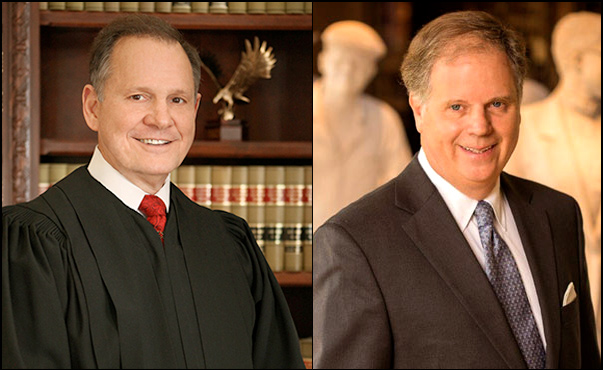
Left: Former state Supreme Court Chief Justice Roy Moore (R) | Right: Ex-US Attorney Doug Jones (D)

Left: Former state Supreme Court Chief Justice Roy Moore (R) | Right: Ex-US Attorney Doug Jones (D)

Nov. 16, 2017 — Last evening’s political news featured heavy coverage of a new National Republican Senatorial Committee poll that produced bad news for Alabama GOP special Senate nominee Roy Moore, but not enough information was released to determine the reliability aspect. In fact, the NRSC didn’t even release the name of the polling company with which they contracted to conduct the survey.

This is significant because their finding that Democrat Doug Jones is leading Judge Moore, 51-39 percent, is clearly out of line with every other poll taken in the corresponding time frame. It is also interesting that they would even release such a poll considering the Republican candidate is doing so badly. It does, however, justify their previous position of cutting the Moore Campaign from additional funding because of the sexual impropriety allegations against the candidate that has dominated recent news coverage.

Below are the post-scandal publicly reported surveys as complied by the Ballotpedia website:

• National Republican Senatorial Committee (Nov. 12-13)
No pollster credited
Jones 51%; Moore 39%
500 Sample

• Fox10 (Mobile) (Nov. 13)
News Strategy Research
Moore 49%; Jones 43%
3,000 Sample (Automated)

• Emerson College Polling Society (Nov. 9-11)
Moore 55%; Jones 45%
600 Polling Sample

• JMC Analytics & Polling (Nov. 9-11)
Jones 46%; Moore 42%
575 Sample

• Decision Desk HQ (Nov. 9)
Moore 46%; Jones 46%
515 Sample

As we can see, the NRSC poll returns the most inconsistent results in comparison to the other available data during the same time frame; the period just after the Moore sexual scandal broke.

Additionally, because the NRSC did not release the name of their pollster or the survey methodology, not enough information exists to determine if their data are skewed in any particular manner.

The lack of available information does not necessarily mean that the Senatorial Committee’s results are inaccurate. It is curious, however, that the other results — and, all have larger sample sizes than the reported NRSC calling universe — finds much different ballot test margins.

Interestingly, the Fox10 poll from a local Mobile television affiliate, which is the latest released survey prior to the NRSC study, and the Emerson College Polling Society find the complete opposite result and their methodologies utilize much larger sample sizes within the studied polling grouping. The Fox10 3,000-person sampling universe clearly suggests that the questionnaire responses were obtained through an automated device, but such does not necessarily mean this poll is less accurate than the live operator polls.

The Alabama race continues to deteriorate, and it is becoming more evident that Jones is now in a strong position to win. But, despite all the negative news coverage, this phantom NRSC poll is the only one that shows him trailing badly.

The other survey to find him dropping behind, from JMC Analytics, featured a sampling universe where 56 percent of the respondents are female, a potential skew in Jones’ favor since this subset broke his way, 46-40 percent. In comparison, men favored the Democrat only 46-45 percent in the JMC crosstabs. Therefore, with a sample where the Democratic-leaning female sector was over-sampled by approximately five percentage points, correcting this skew likely brings the Jones’ 46-42 percent ballot test result back into a tied range.

The NRSC results and partial poll release is intriguing to say the least. Hopefully, we will see more substantiation of their data later today.

The Alabama Debacle

By Jim Ellis

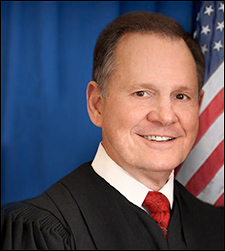
Judge Roy Moore, the Republican nominee in a special Senate election in Alabama.

Judge Roy Moore, the Republican nominee in a special Senate election in Alabama.

Nov. 14, 2017 — Senate Republicans have a major advantage in the current election cycle, but may be on the precipice of giving it away.

Looking at the 2018 Senate map, Republicans have only to defend eight of the 33 in-cycle seats. Considering that six of the eight are the safe Republican states of Mississippi, Nebraska, Tennessee, Texas, Utah, and Wyoming and the Democrats need a net gain of three conversion seats to claim the majority, it appears unattainable even if the latter party converts legitimate targets in politically marginal Nevada and now open Arizona.

But the mathematics change if Democrats score an unlikely upset in the Alabama special election on Dec. 12, and the latest unfolding events there suggest that such an outcome is far more likely to happen.

As we know, Republican Senate nominee Roy Moore, the twice removed former state Supreme Court Chief Justice, has been accused of sexual impropriety with at least one teenage girl when he was 32 years old in 1979. Washington, DC Republicans, who appear to be taking the Washington Post story and the woman’s allegations at face value, are urging Moore to remove himself from the race. Alabama Republicans are still standing firm for Moore, refusing to accept the story without proof. For his part, Judge Moore denies the incident happened.

Three polls have already surfaced telling us that Moore has suffered a major hit. Earlier surveys found him leading in low double-digits, but Opinion Savvy, Gravis Marketing, and JMC Analytics & Polling immediately went into the field to test the Alabama electorate’s reaction.

Opinion Savvy (Nov. 10; 515 likely Alabama special election voters) conducted their survey just hours after the Moore story broke. Their results find that Moore’s lead has evaporated into a 46-46 percent tie with Democratic nominee Doug Jones, a former US Attorney.

Gravis Marketing launched their poll just as quickly (Nov. 10; 478 likely Alabama voters) and finds a similar ballot test tally: 48-46 percent in Moore’s favor.

JMC Analytics (Nov. 9-11; 575 registered Alabama voters) sees Jones pulling into a 46-42 percent lead (48-44 percent when leaners to both candidates are added), but an over-sampling of female voters could account for the Democratic advantage. Fifty-six percent of the survey respondents were female and they break for Jones, 46-40 percent. Men favor the Democrat 46-45 percent.

Considering these polls were taken immediately as the story was breaking and the questionnaires included an explanation of what was being said about him, the results for Moore are not devastating. For the most part, Republican voters are taking Moore’s side while Democrats believe the accuser. The fact that the division is roughly even suggests that Moore has a chance to rebound if he can effectively tell his story.

While Republican leaders may be calling upon Judge Moore to remove himself from the ticket, realistically and legally, he cannot. Under Alabama election law, the ballot cannot be changed within 76 days of the election. That period began Sept. 28. Now comes talk that Gov. Kay Ivey (R) could be approached to postpone the election, or call a special session of the legislature to pass a new emergency election statute. The governor says she is not inclined to even think about such an option.

Additionally, some absentee packets containing Moore’s name have already mailed, thus making it logistically difficult, if not illegal, to inject a new ballot into the campaign. Therefore, the outlook is virtually certain that the election will proceed as scheduled on Dec. 12.

Another idea suggests that the Senate refuse to seat Moore if he wins the election. Should all Democrats vote against Moore, only three Republicans would need to break ranks to keep the seat in abeyance. Presumably, the state could then call a new election, but there would be nothing preventing Moore from running again. Should that be the case, Gov. Ivey then could appoint another interim senator or even keep Sen. Luther Strange (R) in the position. Also, a new election would allow him to run again, too.

For their part, Democrats are remaining publicly quiet. They are likely doing so for two reasons. First, they are adopting the old axiom, “if one’s political opponents are in process of destroying themselves don’t stop them.” Second, they may soon be faced with another vote to eject a senator. Should New Jersey Democratic Sen. Bob Menendez be found guilty in his corruption trial, there will likely be a move to expel him. Democrats would find themselves in a bind if they make a public spectacle of denying entry to Moore, and then quickly pivot to do the opposite in order to save Menendez.

The Roy Moore saga is far from over but at the outset, the situation appears perilous for Republicans. Since losing this seat would endanger their majority standing in 2018, the stakes for how the majority leadership chooses to handle the Alabama situation becomes even more challenging.

Alabama’s Game Within the Game

By Jim Ellis

Aug. 18, 2017 — Tuesday’s special Alabama Senate Republican primary sent former state Supreme Court Chief Justice Roy Moore and appointed Sen. Luther Strange to the September 26th run-off election, but what can we expect from the next round of voting? Will Judge Moore’s momentum continue to thrust him forward despite being badly out-spent, or will the Alabama and national Republican establishment’s strong support for Sen. Strange allow him to overcome his primary election deficit?

On Tuesday, Judge Moore placed first, capturing 39 percent of the Republican primary vote. Just over 423,000 people voted in the election, which will likely be similar to the Sept. 26 projected participation rate. Most of the time fewer people vote in a run-off than a primary, but recent special elections have yielded a slightly different turnout pattern. Sen. Strange garnered 33 percent in the primary and showed strength in the Birmingham area, though he lost substantially in Alabama’s southern region including the metropolitan areas of Montgomery, Mobile, and Dothan.

The run-off wild card may well be Rep. Mo Brooks’ (R-Huntsville) voters. The primary’s third place finisher tallied 20 percent, translating into more than 83,000 individual supporters. Since he placed first in his congressional district (41 percent), and carried his home county of Madison with majority support, northern Alabama will become critical in determining how the run-off concludes. And, considering that Judge Moore received almost the same number of votes as those who cast ballots in the Democratic primary, it is reasonable to presume that the Republican run-off victor will become a heavy favorite to win the Dec. 12 special general election.

Continue reading

AL Run-off; Curtis Wins

By Jim Ellis

Aug. 17, 2017 — The pre-election polling proved accurate Tuesday, as Alabama former state Supreme Court Chief Justice Roy Moore placed first in the special Senate Republican primary, as predicted, and will advance to a Sept. 26 run-off election.

The Trafalgar Group released the last poll for the special primary cycle. The survey (Aug. 12-13; 870 likely GOP primary voters) found Judge Moore holding 38 percent support, followed by appointed Sen. Luther Strange with 24 percent, and Rep. Mo Brooks (R-Huntsville) dropping back to 17.5 percent. The results were almost precise for Moore, understated Sen. Strange’s support, and slightly missed Brooks’ finish.

With just over 417,000 individuals voting in the Republican primary Judge Moore captured 39 percent of the statewide Republican vote, enough to claim the first run-off position but a long way from securing a majority.

Sen. Strange easily took the second run-off slot with 33 percent finishing well ahead of the third place finisher, Congressman Brooks (20 percent).

Continue reading

New Alabama Data; UT-3 Formulating

By Jim Ellis

Aug. 8, 2017 — As we enter the final full week of campaigning before the Aug. 15 vote, a new political poll forecasts a different leader in the Republican special US Senate election primary. The survey reliability factor could be suspect, however.

During the July 31 – Aug. 3 period, RHH Elections conducted a poll of 426 self-identified Alabama GOP registered voters who say they will vote in the special Republican primary. All but 57 responded via the Interactive Voice Response system, and the former provided their responses through an online questionnaire. No live surveyors were part of the interview process, which weakens the reliability substantially.

That being said, the RHH numbers are within the realm of the other published poll results. The new data forecasts former state Supreme Court Chief Justice Roy Moore as capturing the edge with 31 percent over the previous race leader, appointed Sen. Luther Strange, who is just two points behind, meaning the contest is a virtual tie between them with as much as 40 percent of the outstanding preference spread among the remaining seven candidates. The latter group includes US Rep. Mo Brooks (R-Huntsville) with 18 percent, state Sen. Trip Pittman (8 percent), and former Alabama Christian Coalition head Randy Brinson (2 percent). Those not stating a named candidate are categorized as undecided.

Continue reading

Strange vs. Brooks

By Jim Ellis

July 26, 2017 — Though nine Republicans are on the ballot for the Aug. 15 Alabama special Senate GOP primary, the ad war would suggest it’s a contest only between appointed Sen. Luther Strange and US Rep. Mo Brooks (R-Huntsville).

Brooks is advertising heavily and going hard right, a reasonable strategy for an Alabama Republican primary, and his latest ad (above) features his role in helping the shooting victims during the June 14 morning congressional baseball practice at an Alexandria, Virginia park. After Brooks risked his life to help those who had been wounded, a reporter attempted to bring the gun control debate into focus. Brooks’ answer to his question is the ad’s focal point, as well as identifying the shooter as a “Bernie Sanders supporter.”

Sen. Strange, on the other hand, is exclusively targeting Rep. Brooks with hard-hitting negative ads, attacking him for not supporting President Trump during the 2016 national campaign. (See below)

Strange’s tactics tell us that the few published polls suggesting the senator and Rep. Brooks are fighting for the second run-off position are most likely accurate. It also supports the idea that Strange’s own internal polling numbers are giving him similar reports, or he wouldn’t be focusing on just one opponent.

Continue reading

Senate: What the Money Says

By Jim Ellis

July 20, 2017 — Though electronic filing is still not yet required for US Senate candidates, several incumbents and challengers have made their financial numbers available via the public media. Outlets such as the Daily Kos Elections page, The Hill, Politico, National Journal, and local news organizations have allowed us to grasp where some of the key races stand financially.

There has already been a great deal of discussion in recent days about the upcoming Arizona Senate contest, and the dollars raised again reveal a familiar pattern. For the second quarter in a row, Rep. Kyrsten Sinema (D-Phoenix), who says she is not an active Senate candidate but is clearly readying herself in case an opportunity arises, i.e., incumbent Sen. Jeff Flake (R) attracting a strong Republican primary opponent, again raised $600,000 in a quarter, thus putting $3.2 million in her account, about $200,000 more than incumbent Flake.

Finances often give us clues as to impending political moves. California Sen. Dianne Feinstein (D), the body’s oldest member at 84 years of age, raised just $600,000 in the second quarter and has $3.5 million in the bank. This is a low total for a senator from the nation’s largest state. This may be an indication that Feinstein may not seek re-election. In direct comparison, 83-year-old Sen. Orrin Hatch (R-UT), who has been less committal about re-election than Sen. Feinstein and from a state a small fraction of California’s size, raised over $1 million in the quarter and has over $4 million cash-on-hand.

Continue reading

An Alabama Surprise

By Jim Ellis

May 19, 2017 — Filing closed yesterday for the Alabama special Senate election, and events didn’t unfold as expected. Instead of having more candidates opposing appointed Sen. Luther Strange in the special Republican primary, we actually see fewer.

Three individuals expected to file formal candidate declaration statements, including an announced candidate and one who had filed an exploratory committee — and both of those were viewed as active candidates until yesterday — chose not to run.

State Senate President Del Marsh (R-Anniston) was an Alabama politico thought to be a sure US Senate candidate. About 10 days ago he said a decision had been reached about the statewide special election, but wouldn’t be announced until later. As filing closed, Sen. Marsh chose to remain on the political sidelines. He still expresses interest in the governor’s race, but says he would “probably” support Gov. Kay Ivey (R) if she decides to run.

State Rep. Ed Henry (R-Decatur), who led the drive in the state House to impeach resigned Gov. Robert Bentley (R) and was one of the first individuals to announce his Senate candidacy, also decided not to formally file.

Continue reading