Tag Archives: Bernie Sanders

Ohio Specials Prelude

By Jim Ellis

OH-11

July 28, 2021 — Voters in north Texas went to the polls yesterday to decide the double-Republican runoff in their state’s vacant 6th District, but there is unfolding action in the two Ohio special elections right now. The Buckeye State’s vacant CD’s will culminate with partisan primary elections next week, on Aug. 3.

First, the Mellman Group, polling for the Democratic Majority for Israel PAC (July 13-17; 400 OH-11 likely Democratic primary voters, live interview), sees the multi-candidate contest in the Cleveland-Akron seat that has evolved into a race between two candidates getting even closer.

Mellman’s ballot test finds former state senator and ex-Bernie Sanders for president national co-chair Nina Turner leading Cuyahoga County ouncilmember and local Democratic Party chair Shontel Brown by a tightening 41-36 percent spread with the momentum again flowing toward the latter woman. The remaining 11 candidates all split an aggregate five percent, with the remainder categorized as undecided/don’t know/refused to answer.

We can expect a very active final week as the candidates continue attempting to convince their voters to cast early ballots or visit the polls a week from tomorrow. The eventual Democratic nominee will become the prohibitive favorite heading into the Nov. 2 special general election. The winner will replace former Rep. Marcia Fudge (D-Cleveland) who resigned the seat upon her confirmation as Housing & Urban Development Secretary in President Biden’s cabinet.

Mellman’s most recent effort delivered the closest result from a Democratic polling firm. Compared to their June poll, Brown is the beneficiary of a net 19-point swing. In the June poll, Mellman found a 50-26 percent spread in favor of Turner. In early July, Normington Petts, polling for the Brown campaign, also detected movement toward their client. They forecast a 43-36 percent result, certainly in the same realm as the Mellman poll conducted more than a week later. The original Mellman poll came in April and found Turner more than doubling Brown’s support, at 42-19 percent.

The primary campaign is dividing along the past Democratic primary presidential lines. The Bernie Sanders’ group, including the candidate himself, has endorsed Turner, along with the Justice Democrats PAC associated with Rep. Alexandria Ocasio-Cortez (D-NY) and their individual congressional supporters.

Continue reading

More on the Illinois Primary Results

By Jim Ellis

March 22, 2018 — Tuesday night’s big stories in the Illinois primary were Gov. Bruce Rauner (R) having a difficult time in winning a close Republican primary, and Rep. Dan Lipinski (D-Western Springs) just barely surviving his Democratic primary challenge. Venture capitalist J.B. Pritzker successfully captured the Democratic gubernatorial nomination with a margin greater than polling had predicted.

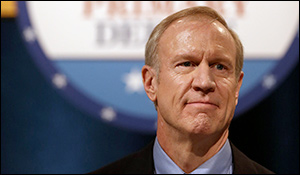
Gov. Bruce Rauner (R) | RGA

Gov. Bruce Rauner (R) | RGA

Gov. Rauner scored only a 51.5 – 48.5 percent win over state Rep. Jeanne Ives (R-Wheaton) in a primary result that finds the state chief executive’s GOP political base eroding. While spending over $60 million in the primary campaign against just $3 million-plus for Ives, the 20:1 resource advantage only proved good for a three percentage point win with still 294 precincts not fully reporting as of this writing. The 351,086 to 330,227 vote totals represent 97 percent of the recorded voting universe. Mathematically, however, there are not enough uncounted votes remaining in Ives’ areas of strength for her to overcome the current statewide deficit.

In the 3rd District House race, seven-term Rep. Lipinski appears to have scored a narrow victory with almost all Cook County precincts reporting. Lipinski carried Cook County with 51.7 percent, a total that will likely rise a bit once all the votes are counted. His opponent, media consultant Marie Newman, won Will County with 58.6 percent of the vote and took the district’s sliver of DuPage County with a mere 55 to 34 vote margin. But, her 1,256 vote lead coming into Cook County was not substantial enough to defeat Lipinski there, which resulted in her district-wide loss.

Lipinski is one of the few remaining Blue Dog Democrats, while Newman enjoyed support from the Bernie Sanders’ wing of the Democratic Party along with major backing from national liberal organizations. The turnout will exceed 90,000 voters once all of the ballots are recorded. When all totals are official, the voter turnout percentage here will hover somewhere in the 45-50 percent range.

In other key congressional races, the Democratic primary in the state’s 6th District has flip-flopped back and forth in a very close contest between financial advisor Kelly Mazeski and clean energy company executive Sean Casten. Mazeski initially was in the lead but in the end, Casten pulled ahead when all 640 precincts were able to report vote totals. Casten captured about 30 percent of the vote (18,863) to Mazeski’s 26.5 percent (16,686). Five other candidates were on the ballot, and cumulatively they garnered 44.2 percent of the vote. Now Casten will challenge veteran Rep. Peter Roskam (R-Wheaton) who was unopposed in his primary.

Continue reading

Senate: What the Money Says

By Jim Ellis

July 20, 2017 — Though electronic filing is still not yet required for US Senate candidates, several incumbents and challengers have made their financial numbers available via the public media. Outlets such as the Daily Kos Elections page, The Hill, Politico, National Journal, and local news organizations have allowed us to grasp where some of the key races stand financially.

There has already been a great deal of discussion in recent days about the upcoming Arizona Senate contest, and the dollars raised again reveal a familiar pattern. For the second quarter in a row, Rep. Kyrsten Sinema (D-Phoenix), who says she is not an active Senate candidate but is clearly readying herself in case an opportunity arises, i.e., incumbent Sen. Jeff Flake (R) attracting a strong Republican primary opponent, again raised $600,000 in a quarter, thus putting $3.2 million in her account, about $200,000 more than incumbent Flake.

Finances often give us clues as to impending political moves. California Sen. Dianne Feinstein (D), the body’s oldest member at 84 years of age, raised just $600,000 in the second quarter and has $3.5 million in the bank. This is a low total for a senator from the nation’s largest state. This may be an indication that Feinstein may not seek re-election. In direct comparison, 83-year-old Sen. Orrin Hatch (R-UT), who has been less committal about re-election than Sen. Feinstein and from a state a small fraction of California’s size, raised over $1 million in the quarter and has over $4 million cash-on-hand.

Continue reading

Gillespie Digging Out

By Jim Ellis

June 19, 2017 — As has been discussed since the Virginia gubernatorial primary votes were counted last Tuesday, the election’s end result was much different for both parties than expected even though the favored candidates won. For Republican nominee Ed Gillespie, the primary vote distribution could have only been worse if he had lost.

At week’s end, GOP second-place finisher Corey Stewart announced that he would not challenge the vote totals –- it is unlikely that a recount would have produced enough to overcome his 4,320 statewide vote deficit -– but he stopped short of formally endorsing the new party nominee; though Stewart did indicate that he would vote for Gillespie.

The breadth of his former opponent’s comments indicates that Gillespie has quite a gap to fill in order to attract the Stewart vote base for the general election. These are people Gillespie must have if he is to seriously compete with Lt. Gov. Ralph Northam, who won the Democratic gubernatorial nomination in surprisingly easy fashion.

“The real question is, will [Gillespie] support my supporters? Unless he stands up and takes clear positions on defending our heritage and our history, supporting the president, cracking down on illegal immigration, those who supported me are not going to go with him. This isn’t old-style politics anymore. I just can’t tell 155,000 folks to go ahead and vote for Ed despite the fact that he’s not a fighter,” Stewart said in a post-election Washington Post interview.

https://youtu.be/PPTL9m33SpA

Gillespie had hoped to be in the opposite position that he now faces. Forecasts suggested he would easily win the party nomination, while it appeared that the Democrats were in the closer contest. Possibly the best case Gillespie scenario was seeing a close Northam win after strongly securing his own nomination. Since the lieutenant governor moved far to the left to counter the Bernie Sanders/Elizabeth Warren-supported Tom Perriello, Gillespie wanted maneuvering room to move closer to the center while Northam was trapped on the far left perch of his party.

Continue reading

Another House Opening;
Puerto Rico Vote

By Jim Ellis

June 13, 2017 — Colorado Rep. Jared Polis (D-Boulder) announced his campaign for governor Sunday, making the open seat Democratic primary even more crowded. Polis’ move sets up a major primary confrontation with fellow Colorado congressional colleague Ed Perlmutter (D-Golden), who announced his own candidacy in early April. Gov. John Hickenlooper (D) is ineligible to seek a third term.

Rep. Polis becomes the ninth Democrat to enter the governor’s race, but clearly he and Perlmutter are the heavyweight candidates. Former state Treasurer Cary Kennedy, ex-state Sen. Mike Johnston (D-Denver), and plastics company CEO Noel Ginsburg are also substantial players. Seven Republicans are in the race, the most prominent of whom is George Brauchler, the Aurora County District Attorney who prosecuted James Holmes, known as the “Joker”, a mass murderer who killed a dozen people and wounded 70 more in a rampage outside a local movie theatre in July of 2012.

The Colorado governor’s race will be one of the most interesting and competitive of the 2018 election cycle. Democrats will be favored to claim the statewide race, but a strong Republican effort could position the GOP candidate for an upset victory, similar to how Sen. Cory Gardner (R) won here in 2014.

The Democratic primary here will likely yield another example of how the party is becoming at odds within itself. Rep. Polis may be in strong position to attract the Bernie Sanders/Elizabeth Warren most liberal faction, while Perlmutter is likely to be the establishment wing’s preferred contender. With at least seven other Democrats vying for the nomination in varying degrees of strength, this June 2018 Dem primary will be among the most hard fought, and potentially divisive in the nation.

Continue reading

Virginia Primary Today

By Jim Ellis

June 13, 2017 — The Virginia governor’s campaign is becoming a national race in relation to prognosticating political trends, and we will be able to glean some partial answers this evening.

Initially, the eventual Virginia general election winner earns the redistricting veto pen for the 2021 redraw, and becomes the first newly elected governor to have such authority. All other states where redistricting is handled through the normal legislative process will elect their commensurate governors in 2018, 2019, and/or 2020.

Second, the Commonwealth’s Democratic primary race has evolved into an early microcosm of what Democrats may be experiencing throughout the country this year and next, and quite possibly beyond.

The split between the party’s more extreme Bernie Sanders/Elizabeth Warren faction and the traditional liberal Hillary Clinton segment is portrayed in the Tom Perriello/Ralph Northam gubernatorial primary. Though former US Rep. Perriello is wrapping himself in the Sanders/Warren mantra, going so far as having them star in his ads along with film clips of President Obama extolling his virtue when he was a member of the House, Perriello’s initiative has driven Lt. Gov. Northam to adopt more leftward ideological positions, as well.

Continue reading

KS-4: Special Election

By Jim Ellis

April 11, 2017 –National Republicans are investing in media and digital ads at the very end of the Kansas special congressional election cycle in order to infuse energy into what has been a lackluster campaign effort from GOP nominee Ron Estes.

The 4th District of Kansas contains 16 south-central Sunflower State counties and a sliver of Pawnee County. Sedgwick County, home to the city of Wichita, is the population anchor (70 percent of the congressional district population resides in this local entity).

Since the 1936 elections, only one Democratic congressional candidate has won here: former Rep. Dan Glickman, first elected in 1976. He would serve nine consecutive terms before falling to defeat in 1994. Republican Todd Tiahrt unseated Rep. Glickman that year, and held the seat for an additional eight terms until departing for an unsuccessful US Senate run. In 2010, businessman Mike Pompeo won a crowded Republican primary to capture the seat. President Trump’s selection of Rep. Pompeo as CIA director opened the district for today’s special election.

Continue reading

Kaine; Wasserman Schultz’s Problems

By Jim Ellis

July 26, 2016 — Hillary Clinton’s choice of Virginia Sen. Tim Kaine as her vice presidential running mate became official over the weekend, and it tells us several things about her campaign.

First, she appears to have taken the politically safe route in tabbing the more centrist Kaine, a senator, former governor, and ex-chairman of the Democratic National Committee. Second, the move suggests that she feels comfortable with her November prospects and base support, since Kaine does not have great appeal to the Bernie Sanders/Elizabeth Warren left. Additionally, his selection doesn’t appear to have direct pull within the minority communities, though Kaine speaking fluent Spanish will undoubtedly be highlighted whether or not it attracts any actual votes.

The real reasons for picking him, however, are that Sen. Kaine is unlikely to make any major mistake on the campaign trail, and he proves an important asset in converting his home swing state, Virginia, to the Democratic column. The Old Dominion (13 Electoral Votes) has been considered battleground territory in the 21st Century’s presidential elections, breaking twice for each party.

Continue reading

A Skeptical Look at Maine’s MPRS Poll Results

The left-wing Maine People’s Resource Center released their new survey (March 31-4/2; 993 registered Maine voters) of the state Senate and House races with results that are, let’s say, susceptible to a reliability scrutiny. Since the newly open Senate contest is of critical importance in determining which party will control the majority in the next Congress, it is this campaign that demands the most analysis.

According to MPRC, Independent former Gov. Angus King is staked to a commanding lead in the hypothetical general election ballot test. In the one intra-party match-up surveyed, King leads Secretary of State Charlie Summers (R) and former Secretary of State Matt Dunlap (D) by a whopping 56-22-12 percent margin, respectively. But, the poll appears to have methodology flaws.

Angus King, after developing some statewide name identification as the Maine PBS spokesman, was elected governor in 1994 as an Independent and easily won re-election four years later. He established himself as a liberal, but also as someone who will take conservative positions under certain circumstances. For example, he endorsed George W. Bush for President in 2000, but backed Democrat Barack Obama in 2008.

King has said several times that if elected to the Senate he may not caucus with either party, but will do what “is in the interest of the people of Maine.” He further said that he will caucus with the Democrats on some issues and the Republicans on others. He will eventually come to the conclusion, as both senators Bernie Sanders (I-VT) and Joe Lieberman (I-CT) have publicly advised him, that he cannot succeed without caucusing with one of the major parties for organizational purposes, including the rendering of committee positions. King will also realize that having such assignments will be “in the interest of the people of Maine,” so expect him to join the Democratic conference.

Returning to the Maine People’s Resource Center poll, the data appear to have two principal problems. First, the sample is tilted in favor of the Democrats, and the methodology description admits the result data is not weighted to reflect an accurate political party dispersion. Of those polled, 39 percent are Democrats, 29 percent Republicans, and 31 percent Independents. Considering that the actual Maine electorate divides into a 32 percent Democratic-28 percent Republican split, with 37 percent Independent (officially labeled as “unenrolled”), the polling sample is unbalanced.

Secondly, the MPRC general election ballot test is only asked with Mr. Dunlap as the hypothetical Democratic nominee. But, even in their own poll of Democratic primary contenders, state Sen. Cynthia Dill outperforms the former secretary of state 20-17 percent. Therefore, to only test the second-place finisher against the top-performing Republican and King unfairly skews the results away from the Democratic Party ballot position even though it is they who have the greater number of respondents.

MPRC also tested the state’s two House races, which are now more conventional campaigns since neither Reps. Chellie Pingree (D-ME-1) nor Mike Michaud (D-ME-2) are seeking their party’s Senatorial nomination. According to the study, Pingree leads state Senate Majority Leader Jon Courtney (R) by a huge 61-28 percent count. This finding, too, is likely skewed in Pingree’s favor especially when contrasting her 2010 re-election result (55-42 percent) in virtually the same district.

The ME-2 campaign is expected to be more seriously contested because the Republicans are fielding state Senate President Kevin Raye as their candidate. Raye ran for the seat when it was last open in 2002 and lost to Michaud 52-48 percent. According to this latest data, the Congressman leads 53-37 percent. Again, considering the sample skew, it is virtually certain that the incumbent has a substantial lead, but it is reasonable to conclude that this poll probably skews it a few points more in his favor than what is the actual margin.

Our 2012 Senate Outlook

With three new Senate vacancies already present in the 2012 election cycle, it’s time to update our election grid. Democrats, including the two Independent senators who caucus with the party, must defend 23 states compared to just 10 for Republicans. The GOP needs a net gain of four seats to claim the outright majority, but 13 to reach 60, the number needed to invoke cloture on any issue.

Democratic Seats – Most Vulnerable

North Dakota – Sen. Kent Conrad’s retirement gives the Republicans their best shot at converting a Democratic state. The GOP political bench here is robust and strong, thus the eventual Republican nominee will enter the general election as the favorite.

Nebraska – Sen. Ben Nelson, a retirement possibility, is politically damaged. He already trails at least two potential GOP candidates in polling, Attorney General Jon Bruning and state Treasurer Don Stenberg. Right now, in this very early going, the Republicans are favored to convert the state.

Lean Democrat

Florida – The politically marginal Sunshine State suggests that Sen. Bill Nelson (D) will face a highly competitive 2012 election challenge. The GOP field is yet to be determined, but Rep. Connie Mack IV (R-FL-14) appears to be the only Congressman positioning himself for a run. Right now, Nelson must be viewed as the favorite, but this will become a serious race.

Michigan – The Republican resurgence here, and the early polling, suggests that Sen. Debbie Stabenow has a difficult road to re-election. GOP candidates have yet to come forward, thus the current Lean D rating is attached. Michigan is certainly a state to watch. The presidential election year turnout model is a plus for Stabenow.

Toss-ups

Missouri – Sen. Claire McCaskill is polling in the dead heat range against former Sen. Jim Talent (R), the man she defeated in 2006. Talent is not a sure candidate, but former state treasurer and gubernatorial candidate Sarah Steelman is. Rep. Sam Graves (R-MO-6) also is reportedly considering entering the contest, particularly if Talent remains on the sidelines. All would be very competitive against McCaskill in a state that is trending a bit more Republican during the past two elections.

Montana – Sen. Jon Tester can also expect a very competitive GOP challenge in what is normally a Republican state in a presidential year. Rep. Denny Rehberg (R-MT-AL) has not yet committed to the Senate race. Former Lt. Governor nominee Steve Daines is an official candidate and actively raising money.

Ohio – Sen. Sherrod Brown faces tough sledding presumably against newly elected Lt. Gov. Mary Taylor (R). Ohio will again assume its normal role as a battleground state for the presidential campaign, which, in 2012, could help Taylor. This may become the most hotly contested Senate race in the country.

Virginia – The actions of former governor and Democratic National Committee chair Tim Kaine and defeated gubernatorial candidate and ex-DNC chair Terry McAuliffe (both saying they won’t run for Senate in 2012 under any circumstances) suggests that Sen. Jim Webb will seek re-election, even though the incumbent has yet to confirm his intentions. Former senator and governor George Allen (R) will soon announce his candidacy, setting up a re-match with Webb. The Democrat won by 7,231 votes of more than 2.3 million cast five years ago. Early polling suggests a dead heat.

Questions

Hawaii – Speculation is prevalent that Sen. Daniel Akaka, who will be 88 at the time of the 2012 election, will retire. If so, the Republicans will be competitive with former Gov. Linda Lingle. If Akaka runs, and early indications suggest he will, the Democratic incumbent should have little trouble winning again.

New Jersey – Sen. Bob Menendez is polling below 50% in early survey trials but comfortably ahead of all potential Republican rivals. Though the senator is the decided favorite today, this race could become one to watch. Republicans may be looking most favorably toward entrepreneur John Crowley, who appears to have the potential of generating measurable political strength.

New Mexico – Sen. Jeff Bingaman (D) is in strong position for re-election and is viewed as a heavy favorite. Republican former Rep. Heather Wilson (R-NM-1), always a good vote-getter, could make challenging Bingaman a competitive race. She is said to be seriously considering launching a bid.

Wisconsin – Though he has been mum on his re-election intentions, Sen. Herb Kohl is another retirement possibility. If he chooses not to run, defeated Sen. Russ Feingold (D) waits in the wings to run again. Should the senator seek re-election, he will likely face only a minor challenge.

Likely Democrat

Connecticut – Sen. Joe Lieberman’s (I) retirement, thereby avoiding an unpredictable three-way race, greatly improves the Democrats’ chances. Rep. Chris Murphy (D-CT-5) and ex-Secretary of State Susan Bysiewicz are announced Democratic candidates. Edward Kennedy Jr., son of the late senator, is rumored as a possibility. The two losing 2010 nominees, Tom Foley in the governor’s race and Linda McMahon for the Senate, are both mentioned as possible candidates; so is former Rep. Rob Simmons (R-CT-2).

Pennsylvania – Until the Republicans field a top-tier candidate, something they have yet to do, Sen. Bob Casey Jr. is a strong favorite for re-election. A serious campaign could develop, but not unless a stronger Republican joins the current field of candidates.

Rhode Island – The Republicans could move this state into the competitive category if former Gov. Don Carcieri (R) decides to run. In a presidential year, it is unlikely he will, so Sen. Sheldon Whitehouse is a solid favorite for re-election. 2010 gubernatorial nominee John Robitaille (R) has already closed the door on a senatorial challenge.

Vermont – Sen. Bernie Sanders (I) is another strong favorite for re-election, but state Auditor Tom Salmon (R) is making noises about challenging the first-term senator. A statewide official would give the Republicans the opportunity of making this a competitive race.

Safe Democrats

California – Dianne Feinstein (D)
Delaware – Tom Carper (D)
Maryland – Ben Cardin (D)
New York – Kirsten Gillibrand (D)
Washington – Maria Cantwell (D)
West Virginia – Joe Manchin (D)

Republican Questions

Arizona – Retirement rumors are swirling around Sen. Jon Kyl. The senator has yet to begin an active re-election effort, thus suggesting he may decide to call it a career. The seat is competitive in an open situation.

Nevada – This is clearly the most vulnerable Republican seat, should scandal-tainted Sen. John Ensign win re-nomination. Rep. Dean Heller (R-NV-2) is considering a Republican primary challenge. Heller would have a good chance of winning the nomination and the seat. Democrats are in strong shape if Ensign qualifies for the general election. Rep. Shelley Berkley (D-NV-1) is a potential Democratic candidate and promises to make her intentions known in mid-February.

Lean Republican

Massachusetts – Sen. Scott Brown (R), elected in an early 2010 special election, must stand for a full term in 2012. Despite Massachusetts being one of the most reliable of Democratic states, Brown’s numbers appear strong and he has a legitimate chance to win again. Once the Democratic field gels, a better assessment can be made.

Likely Republican

Indiana – Sen. Richard Lugar (R), who will be 80 at the time of the 2012 general election, has already announced that he is seeking re-election. A predicted Tea Party primary challenge could be his biggest problem. Lugar looks strong in a general election, but the GOP primary situation could change the outlook.

Maine – Sen. Olympia Snowe (R) has some of the better general election approval ratings of any 2012 in-cycle senator but, she too, has Tea Party problems in the Republican primary. Her situation in that regard has improved of late, however.

Safe Republicans

Mississippi – Roger Wicker (R)
Tennessee – Bob Corker (R)
Texas – Kay Bailey Hutchison (R) – Open Seat
Utah – Orrin Hatch (R) – Potential Tea Party convention challenge
Wyoming – John Barrasso (R)

Analyzing this initial line-up, it appears the Republicans’ chances of gaining an outright majority are good today, though there is no chance the net increase could be so high as to score filibuster-proof control.
__________________________________________________
For further detailed insights, to sign up for my daily email updates, or to sign up to track specific issues or industries, please contact me at PR***@*******************ts.com.