Tag Archives: New York

The Trifecta States

By Jim Ellis

In the trifecta of political parties controlling the House, Senate and Executive branches in a state, how many will actually benefit from that power in the redistricting process?

Oct. 11, 2021 — As the redistricting cycle moves forward, predictions are being made as to which party will benefit most through the decennial district boundary drawing process. Most analyses favor the Republicans as the party best positioned to gain under 2021 redistricting largely because of the number of states they control outright, but this could be an over-statement.

When a state features one party in control of the governor’s mansion, state House, and state Senate, the horse racing term of “trifecta” is used to describe such a political situation. Since Republicans hold 23 trifectas and Democrats just 15, it appears on the surface that the GOP will be the big gainer in redistricting.

Let’s look a bit closer because the aggregate trifecta number doesn’t tell the whole story.

On the Republican side, though they control 23 states, their redistricting position is lessened when examining their ability to extract a net gain of congressional seats.

Of their 23, in one, West Virginia, they are a sure bet to lose a seat. In this case, Republicans hold all three of the state’s CDs, but reapportionment reduces the Mountain State to two districts. Therefore, Republicans will unavoidably absorb the loss.

In two of their states, Arizona and Montana, a non-politician commission will draw the maps. In another dozen (Alabama, Arkansas, Idaho, Indiana, Mississippi, Missouri, Nebraska, North Dakota, South Carolina, South Dakota, Utah, and Wyoming) the GOP is already at the max level of partisan members and can’t stretch the new plan further.

In Iowa and Texas, though Republicans have trifecta control, legislative rules lessen their complete power; hence, the redistricting outcome is affected.

Finally, the GOP only has effective redistricting control in six states, and in two of those, Oklahoma and Tennessee, it could arguably backfire if the party tries to expand their ratio further. Therefore, it is in really just four states, Florida, Georgia, New Hampshire, and Ohio where we could see Republican redistricting gains.

The Democrats find themselves in similar position. From their 15 trifectas, they only have redistricting control in five, possibly, and realistically, three states. In five of their 15 (California, Colorado, New Jersey, Virginia, and Washington) redistricting goes to a citizens’ commission.

Continue reading

The New Mexico Ploy

By Jim Ellis

Sept. 15, 2021 — During the last week reports were surfacing that suggested the New Mexico State Democratic leadership was considering ways to turn the current 2D-1R congressional map into a 3D-0R plan. This might be easier said than done, however.

New Mexico is one of the Democrats’ 15 “trifecta states,” meaning the party controls all three legs of the redistricting stool: the state Senate, state House, and governor’s mansion. Republicans have 23 trifectas. Therefore, if the Democrats are to minimize the redistricting damage, or even possibly come out slightly ahead, they must fully use their political leverage in the states they control.

Of the Democrats’ 15 trifectas, however, five of the states handle redistricting through a commission, and in another five the party already controls all the congressional seats. Therefore, if they are to make a national redistricting play they must take maximum advantage in Illinois, Nevada, New Mexico, New York, and Oregon. The lay of the land, however, makes it very difficult to expand their fortunes in Nevada and possibly Oregon, which is why trying to take an extra seat from New Mexico makes some sense from a national Democratic perspective.

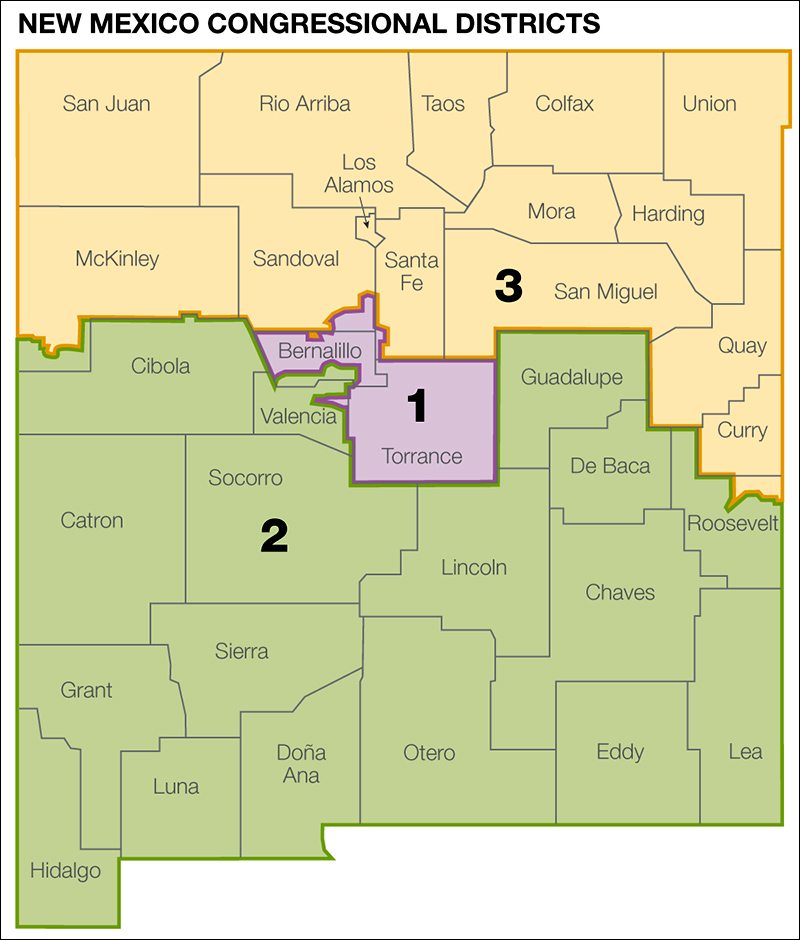
New Mexico has three congressional seats, all of which a freshman represents. The 1st (Rep. Melanie Stansbury; D-Albuquerque) and 3rd Districts (Rep. Teresa Leger Fernandez; D-Santa Fe) in the northern part of the state are safely Democratic.

The southern 2nd District (Rep. Yvette Herrell; R-Alamogordo), which encompasses almost all of the territory south of Albuquerque, has performed as a Republican seat at the congressional level in 19 of the last 21 elections. Democrats picked up the district in their recent wave election years (2006; 2018) with open seat victories, but the voters favored the Republican challenger in both successive elections. This, despite NM-2 being a majority Hispanic district: 53.7 percent of the overall population according to the previous census data.

Additionally, the current seats are not widely out of population balance. The 1st District needs to gain just 11,264 people, while the 2nd must shed 8,181 individuals, and the 3rd must relinquish 3,082 residents. Therefore, a radical re-draw that results in a sweep of the three districts for one party when the population swings are so small would certainly draw a political gerrymandering lawsuit upon adoption of the new map. Whether such a lawsuit would succeed of course is a question that can only be answered when the final map is drawn and enacted.

Likely, the only way to draw a 3D-0R map in New Mexico would be to keep the northern 3rd District Democratic seat virtually intact, and then draw the Republican 2nd into Albuquerque. This would cause the city and Bernalillo County to be split resulting in the 1st and 2nd then appearing as southwestern and southeastern seats that divide Albuquerque, and subsequently stretch all the way to the Mexican border.

Even this draw might make it difficult to create three Democratic seats because the southeastern district would still have the potential of being Republican enough to make the party’s candidate, in this case Rep. Herrell, strong enough to have a chance of winning a general election.

New Mexico is a good example as how a largely internal state exercise can transform itself to help achieve a national partisan goal. It remains to be seen just how bold the New Mexico Democrats will be, as this small and sometimes obscure state steps into the national redistricting limelight.

Gerrymandering Wars Ignited

By Jim Ellis
Aug. 27, 2021 — In the past few days, Democratic leaders and news sources in two states, New York and Illinois, are suggesting that the party redistricting strategists will attempt to maximize Democratic US House gains. Republicans will then counter in similar states that they control.

New York Gov. Kathy Hochul (D), on her first official day in office after replacing resigned Gov. Andrew Cuomo (D), bluntly answered a reporter’s question to the affirmative when asked if she would use her newfound power to maximize Democratic congressional gains through the redistricting process.

Earlier this week, news sources were reporting that Illinois Democratic map drawers, though no preliminary congressional map has yet been released, are attempting to draw a new 14D-3R map that would likely collapse Reps. Adam Kinzinger (R-Channahon) and Rodney Davis (R-Taylorville) into a strong Democratic seat for the former and pairing for the latter with another downstate Republican.

Doing this would put added national pressure on Republicans in states such as Texas, Florida, North Carolina, Ohio, and Georgia – places where the GOP has full control of the redistricting process. Here, the states are either adding seats or in position to carve a sitting Democrat into unfriendly political territory.

With New York losing one seat, the prime district for elimination would appear obvious since Rep. Tom Reed (R-Corning) has already announced his retirement and his 23rd District is the lowest in population among all New York seats. Adjacent Rep. Claudia Tenney’s (R-New Hartford) 22nd CD is second lowest, so combining those two Upstate Republican districts into one appears to be a foregone conclusion. It remains to be seen if the Democratic leaders try to do more. The current delegation breaks 19D-8R but will reduce to 26 seats in the next Congress.

Of Illinois’ current 18 congressional districts, only one, that of Rep. Danny Davis (D-Chicago), is over-populated and only by 10,986 people. While the Kinzinger seat is 61,125 individuals short of the state quota of 753,677 for the new 17-district map, his is not even close to being the most under-populated. He, however, sits between two Democratic seats that the party needs to protect, those of retiring Rep. Cheri Bustos (D-Moline), whose 17th CD is 79,907 residents under quota, and Rep. Lauren Underwood’s (D-Naperville) 14th, where she had a close call in 2020 but is only 482 people short of quota.

While the 14th does not need many more people, it does need significantly more Democrats and they can be found by dividing Kinzinger’s 16th CD into pieces.

Redistricting is always full of surprises, so this analysis is merely educated speculation. If, however, the Democrats come away with gaining a net three or four seats from New York and Illinois combined, then how do the Republicans retaliate?

Continue reading

Census by District

By Jim Ellis

Aug. 17, 2021 — We can now see exactly where each congressional district in the country stands in terms of population. The Census Bureau delivered the state redistricting data last week, and the Daily Kos Elections site data team segmented the numbers into individual congressional districts.

Below is a chart of the 38 states that have more than two districts, isolating the CDs that are the most over and under populated. The “High” column depicts the district that is the most over-populated in the state, while the “Low” is the one requiring the most new residents. The “+/-” column shows how many districts in the particular state are over and under populated.

The most robust district is that of Texas freshman Rep. Troy Nehls (R-Richmond). His southwest Houston seat houses just under one million people, at an exact count of 972,309. The least populated seat is West Virginia’s 3rd District (Rep. Carol Miller-R): 326,267 people under quota. With all of the Mountain State seats seriously down, it is clear as to why West Virginia lost a seat in reapportionment.

There are only two states, Colorado and Oregon, where all of the current districts are over-populated. Both entities gain one seat in reapportionment. On the other end of the spectrum, Michigan and Pennsylvania saw all districts falling below their new population quota, and in Illinois, 17 of their current 18 do as well. All three states are losing a district.

It is not surprising that California lost a seat for the first time in history. A total of 35 of their current 53 seats require more population versus 18 that must shed residents. New York barely lost a seat, by just 89 people statewide, which is surprising when seeing 23 of their current 27 districts requiring additional population.

The states are now converting their new data into their redistricting software systems. After that, most will hold hearings for public input prior to district construction beginning.

STATE DIST INCUMBENT HIGH LOW +/-
Alabama 5 Mo Brooks (R) 43,348 4, 3
7 Terri Swell (D) -53,143
Arizona 5 Andy Biggs (R) 86,414 3, 6
2 Ann Kirkpatrick (D) -50,133
Arkansas 3 Steve Womack (R) 86,266 2, 2
4 Bruce Westerman (R) -66,283
California 45 Katie Porter (D) 53,645 18, 35
-1 40 Lucille Roybal-Allard (D) -70,139
Colorado 4 Ken Buck (R) 148,823 7, 0
+1 3 Lauren Boebert (R) 36,543
Connecticut 4 Jim Himes (D) 25,627 2, 3
2 Joe Courtney (D) -21,288
Florida 9 Darren Soto (D) 186,381 21, 6
+1 13 Charlie Crist (D) -41,756
Georgia 7 Carolyn Bourdeaux (D) 94,304 8, 6
2 Sanford Bishop (D) -92,108
Illinois 7 Danny Davis (D) 10,986 1, 17
-1 17 Cheri Bustos (D) -79,907
Indiana 5 Victoria Spartz (R) 50,921 5, 4
8 Larry Bucshon (R) -38,579
Iowa 3 Cindy Axne (D) 61,382 1, 3
4 Randy Feenstra (R) -31,730
Kansas 3 Sharice Davids (D) 57,816 1, 3
1 Tracey Mann (R) -33,697
Kentucky 6 Andy Barr (R) 33,300 4, 2
5 Hal Rogers (R) -57,592
Louisiana 6 Garret Graves (R) 40,173 3, 3
4 Mike Johnson (R) -47,947
Maryland 4 Anthony Brown (D) 26,772 6, 2
7 Kweisi Mfume (D) -68,401
Massachusetts 7 Ayanna Pressley (D) 18,714 4, 5
1 Richard Neal (D) -50,635
Michigan 11 Haley Stevens (D) -17,368 0, 14
-1 5 Dan Kildee (D) -104,476
Minnesota 3 Dean Phillips (D) 24,586 5, 3
7 Michelle Fischbach (D) -39,978
Mississippi 4 Steven Palazzo (R) 37,196 3, 1
2 Bennie Thompson (D) -65,829
Missouri 3 Blaine Luetkemeyer (R) 35,121 6, 2
1 Cori Bush (D) -54,618
Nebraska 2 Don Bacon (R) 47,170 2, 1
3 Adrian Smith (R) -53,152
Nevada 3 Susie Lee (D) 79,374 2, 2
1 Dina Titus (D) -73,332
New Jerseyy 8 Albio Sires (D) 47,314 5, 7
2 Jeff Van Drew (R) -41,606
New Mexico 2 Yvette Harrell (R) 8,181 2, 1
1 Melanie Stansbury (D) -11,264
New York 12 Carolyn Maloney (D) 34,717 4, 23
-1 23 Tom Reed (R) -83,462
North Carolina 2 Deborah Ross (D) 165,703 12, 1
+1 1 G.K. Butterfield (D) -6,238
Ohio 3 Joyce Beatty (D) 23,119 2, 14
-1 6 Bill Johnson (R) -99,512
Oklahoma 1 Kevin Hern (R) 36,806 3, 2
2 Markwayne Mullin (R) -69,793
Oregon 1 Suzanne Bonamici (D) 157,843 5, 0
+1 4 Peter DeFazio (D) 117,399
Pennsylvania 10 Scott Perry (R) -5,379 0, 18
-1 15 Glenn Thompson (R) -90,540
South Carolina 1 Nancy Mace (R) 87,689 3, 4
6 Jim Clyburn (D) -84,741
Tennessee 4 Scott DesJarlais (R) 62,976 5, 4
9 Steve Cohen (D) -77,122
Texas 22 Troy Nehls (R) 205,322 28, 8
+2 13 Ronny Jackson (R) -59,517
Utah 4 Burgess Owens (R) 65,265 1, 3
3 John Curtis (R) -31,190
Virginia 10 Jennifer Wexton (D) 100,750 6, 5
9 Morgan Griffith (R) -87,917
Washington 7 Pramila Jayapal (D) 28,862 6, 4
6 Derek Kilmer (D) -33,730
West Virginia 2 Alex Mooney (R) -275,777 0, 3
-1 3 Carol Miller (R) -326,627
Wisconsin 2 Mark Pocan (D) 52,678 2, 6
4 Gwen Moore (D) -41,320

Census Delays: Some Ramifications

By Jim Ellis

June 1, 2021 — As we know, the Census Bureau has delayed in meeting its public reporting deadlines, which causes ramifications in the political world. As a result, the state officials responsible for redistricting could well find themselves placed behind the proverbial eight ball as the new year approaches.

Reapportionment is the term used to explain the entire decennial process. Reapportionment, as the US Supreme Court defined it in their 1999 ruling on the US Census Bureau v. House of Representatives case, is basically divided into two parts. The first, which was finally completed and released on April 26, is the allocation of congressional seats to the states. The second is the re-drawing of congressional, state, and local district boundaries most often referred to as redistricting.

To complicate matters even further, the delayed allocation proved much different – affecting six seats to be exact – than predictions. It was believed for at least two years that Texas would gain three seats in the 2020 reapportionment and Florida two, with Arizona, Colorado, Montana, North Carolina, and Oregon adding one seat apiece. The actual numbers found Texas gaining two, Florida one, and Arizona none. The other one-seat gaining states were correctly predicted.

Conversely, Alabama, California, Illinois, Michigan, Minnesota, New York, Ohio, Pennsylvania, Rhode Island, and West Virginia were all expected to lose one seat apiece. The actual report found Alabama, Minnesota, and Rhode Island each retaining the same number of seats they held in the 2010 reapportionment, while the others did lose a single district apiece.

The Census Bureau claims that COVID is largely responsible for their delays, but the state of Alabama, in their pending lawsuit against the federal statistical entity, disagrees. Alabama claims the deadline violations occurred because of the Bureau’s attempt to impose, for the first time in history, differential privacy over the data. This means, under the argument of protecting individual privacy, data would be deliberately scrambled, and certain information not publicly released.

Differential privacy alone would make redistricting extremely difficult for state map drawers because the released census tract numbers, now by definition, wouldn’t equal the state population figures brought forth earlier in the year. The effect would cause political havoc throughout the country. A court ruling on the Alabama case is expected shortly.

Because of a successful legal challenge from Ohio, the Census Bureau has agreed to make the data necessary for redistricting available to the states by Aug. 15 instead of the Oct. 1 date indicated when allocation was announced.

Continue reading

Census Patterns

By Jim Ellis

April 30, 2021 — Monday’s Census Bureau’s congressional apportionment and state population report continues to be digested, and its many surprises will potentially lead to legal action from unanticipated sources.

First, the ongoing Alabama lawsuit against the census counting methodology, among other issues, will likely be drastically altered since the Yellowhammer State did not lose its seventh district. An in-person hearing has been scheduled for Monday, May 3, in the state capital of Montgomery.

Second, New York Gov. Andrew Cuomo (D) is already making noises that his state will sue over the apportionment formula that eliminated one of his state’s congressional districts by just 89 individuals. Others are questioning how the state, where projections forecast a loss of potentially two congressional districts, landed exactly on the national growth average and came within just a few people of not even losing one seat.

The 50-state population segmentation is interesting in that it again provides us clear growth and mobility patterns. Regionally, the immense area starting in the center of the country and moving west to the Pacific Ocean is the big population gainer. The Midwest and Northeast is the major loser, with the South and Southeast producing mixed data.

In the 17 states beginning at the eastern border of North Dakota and moving down all the way to Texas’ eastern border and then back through the entire west but not including Alaska and Hawaii, the regional population growth rate was 10.6 percent, or 3.2 points above the national growth rate of 7.4 percent.

If, however, the five states within this sector that fell below the national growth rate are removed, California (6.1 percent growth rate), Oklahoma (5.5 percent), Kansas (3.0 percent), New Mexico (2.8 percent), and Wyoming (2.3 percent), the regional average for the 12 states that exceeded the national growth rate becomes 13.4 percent, or a full six points above the US benchmark.

Therefore, the fact that this western region gained five of the seven new congressional seats is consistent with the recorded sector growth data.

The South/Southeast segment, which includes 11 states, produced inconsistent regional data. Area-wide, the average growth rate was 6.7 percent, or 0.7 percent below the national average. This is a surprising number considering the region gained two congressional seats in reapportionment.

Continue reading

Apportionment Surprises


By Jim Ellis

April 28, 2021 — In virtually every 10-year apportionment announcement at least one surprise occurs, but the census unveiling Monday contained multiple blockbusters.

For example, two states had their final number of congressional districts determined by less than 90 people. Reportedly, if New York had just had 89 more people, that would have saved an Empire State congressional seat. Minnesota becomes the beneficiary allowing the state to barely hold its eighth district.

Instead of 10 seats changing states as had been forecast, only seven, affecting 13 domains, switched. Perhaps the main reason for the lower number is the decade population growth rate. According to yesterday’s final report, the nation grew at only a 7.4 percent rate, the lowest since the 1930 census’s 7.3 percent. By contrast, the population increase from the 2010 total was 9.7 percent.

Pre-census projections, for better than a year, had been predicting that Texas would gain three seats, Florida two, and Arizona one. The analysts also estimated seat losses for Alabama, Minnesota, and Rhode Island. None of these projections proved accurate.

On the other hand, prognostications for the balance of the map were accurate. Texas, and Florida did gain, but two and one, respectively, instead of three and two seats. Colorado, Montana, North Carolina, and Oregon each added one district apiece as expected. The one-seat losers were California, for the first time in history, Illinois, Michigan, New York, Ohio, Pennsylvania, and West Virginia.

It’s a bit too soon to determine which party will benefit the most from these numbers at the congressional level, though Republicans should be up slightly in the Electoral College for the next presidential campaign. Once we see how the population is distributed within the states will better tell us whether Democrats or Republicans will take the most advantage of the apportionment. This will depend upon how the population spreads through the cities, suburbs, and rural regions.

Continue reading

Rep. Zeldin Declares for Governor

By Jim Ellis

Rep. Lee Zeldin (R-Shirley)

April 12, 2021 — Long Island US Rep. Lee Zeldin (R-Shirley) announced late last week that he will run for governor next year in hopes of facing beleaguered New York Gov. Andrew Cuomo (D). The move appears to be a risky one in that Zeldin would be jettisoning a relatively safe Republican congressional seat that is almost redistricting proof for a statewide race in very unfriendly political territory for his party.

Should Gov. Cuomo survive the impeachment offensive against him and seek and win re-nomination, then Zeldin would be in position to wage a competitive challenge campaign. Against any other Democrat, however, the pendulum undeniably swings back to the left.

Rep. Zeldin’s 1st Congressional District is essentially secure under almost any potential redistricting map because water borders the far eastern Long Island seat on three sides. Therefore, the only way the district can move is west meaning the core constituency remains intact. Of course, a lot depends upon whether New York loses one or two seats in reapportionment.

The only way to fundamentally change the 1st is to cut Districts 1 and 2 (Rep. Andrew Garbarino; R-Sayville/Islip) horizontally but doing so could conceivably make Democratic Reps. Tom Suozzi (D-Glen Cove) and Kathleen Rice’s (D-Garden City) districts more Republican. Irrespective of what occurs with redistricting, Rep. Zeldin is likely risking a relatively secure political future in what possibly becomes a Republican controlled House of Representatives.

The Zeldin announcement, however, doesn’t mean he, or any other potential candidate, couldn’t change their minds. Candidate filing in New York for the 2022 election cycle will be set for April of next year prior to the June primary, and the region’s politics will change a great deal during the time interval between now and then.

At this point, the Cuomo situation seems to have stabilized. No longer are we seeing daily announcements of different women coming forward to accuse the governor of inappropriate sexual oriented behavior. Furthermore, the investigation into the COVID-related nursing home deaths, a more serious situation than the sexual impropriety allegations, will take a long time to unfold.

With the governor steadfastly refusing to resign, the state Assembly has introduced articles of impeachment against him. In the past two weeks, key legislative leaders have said that such a procedure is likely to consume months rather than weeks, so the odds of Cuomo being able to hold on throughout the remainder of the term are increasing.

Continue reading

Cuomo Poll: Retirement Seen As
Preferential Over Resignation

By Jim Ellis

New York Gov. Andrew Cuomo (D)

March 8, 2021 — A new Quinnipiac University poll of the New York electorate (March 2-3; 935 self-identified NY registered voters, live interview) was released late last week after his press conference with mixed results for embattled Gov. Andrew Cuomo (D).

While his numbers are consistently bad with Republicans and Independents, the governor remains strong with his dominant Democratic base. Thus, while a majority of the Q-Poll respondents don’t favor the governor resigning, a large number believes he should not seek re-election in 2022.

To begin, the governor’s favorability ratio is 45:46 percent favorable to unfavorable, which is not particularly bad considering the negative effects of his dual-scandal situation, one involving COVID-related nursing home deaths and the other sexual harassment claims from former staff members.

The positive rating, however, is almost exclusively from Democrats. By a margin of 65:27 percent, self-identified Democrats still view the governor’s job performance positively. Republicans are wholly opposed, 13:82 percent positive to negative, and Cuomo is also decidedly upside-down with Independents, 33:57 percent.

Surprisingly, the polling sample still gives him positive reviews for his handling of the Coronavirus situation (56:41 percent), but, again, most of the favorable ratings come from Democrats, 80:18 percent, while Republicans and Independents both hold strongly negative opinions about how the governor has managed COVID-19: 17:80 percent among tested Republicans; 42:54 percent among Independents.

Once a small number of Democratic officials opened the spigot of dissent toward the governor, many more joined to form a high-flowing chorus. The calls for Cuomo’s resignation aren’t having much effect, however, as a majority, 55:40 percent, do not favor the governor giving up his office before his term ends. As mentioned above, however, the same polling sample does believe he should not seek a fourth term next year, and on this question, even the Democratic response is close.

Overall, 59 percent of the respondents say he should retire at the end of this term, while 36 percent believe he should run again. The Republican pro-retirement ratio registers 90:9 percent. Virtually two-thirds of the Independents (66:28%) say he should retire at the end of next year, while Democrats still barely back him remaining in office after the next election, 50:44 percent.

Continue reading

More Redistricting Delays – Part II

By Jim Ellis

Feb. 20, 2021 — Yesterday, we covered the Census Bureau announcement that delivering new population data to the individual states will again be postponed, and what effect receiving numbers in October, if then, will have on the redistricting process.

Today, after previously analyzing the states that appear poised to gain seats, we look at those that will probably lose districts. At this point, estimates project that 10 seats will be transferred. This, however, is only a projection as the current published numbers do not include the final changes in the previous decade’s last year.

At this point, all of the succeeding states appear positioned to lose one seat. The individual state logistical data comes from a study that the Brennan Center for Justice just released.


Alabama

It appears that Alabama is on the cusp of losing a seat depending upon who is counted and where they reside. This specifically refers to college students and non-citizens. President Biden’s executive order countermanding President Trump’s directive not to count non-citizens may have an effect upon Alabama’s status. Officials there may sue over the apportionment if, in the final count, the state loses one of their seven districts.

It is likely that Alabama redistricting will be pushed into 2022 irrespective of the apportionment decision because the legislature will be out of session when the data is finally delivered. The state’s May 24 primary could conceivably be postponed.


California

For the first time in history, California is likely to lose a seat in apportionment. The 2010 apportionment cycle was the first in which the state did not gain representation. In the 1980 census, for example, California gained seven seats.

The Golden State has a redistricting commission, but the data postponement may force the process into a secondary mode since the redistricting completion deadline is Aug. 15. Unless the deadlines are changed, the state Supreme Court will appoint a special master to draw the map. California’s March 8, 2022 primary may have to be postponed, and almost assuredly their Dec. 10 candidate filing deadline will have to move.


Illinois

The state legislature has the redistricting pen, but Illinois also has a backup commission empowered in case the regular process is not completed. A March 15, 2022 primary and certainly a Nov. 29 candidate filing deadline, however, could and will face postponement.


Michigan

Voters previously adopted the institution of a 13-member commission to draw maps. The commissioners, now appointed, consist of four Democrats, four Republicans, and five unaffiliated voters.

With an April 1, 2022 candidate filing deadline and an Aug. 2 state primary, the Michigan system should have time to complete the redistricting process without changing their election cycle calendar.
Continue reading